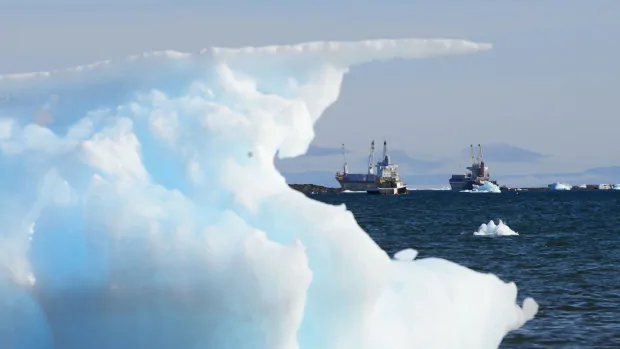
The global body that regulates shipping is moving to eliminate a highly polluting fuel in the Arctic.
But environmental groups say the International Maritime Organization’s proposal is so full of loopholes that heavy fuel oil will go on being burned for another decade.
“That’s an extreme timeline for something that needs to happen immediately,” said Andrew Dumbrille of the World Wildlife Fund.
On Friday, the IMO passed a draft regulation to ban the use of heavy fuel oil in the Arctic by 2024. But Dumbrille said the draft allows Arctic nations to exempt their own ships from following the ban for another five years.
Research by the International Council on Clean Transportation suggests most ships in the Arctic burn the fuel.
It’s considered a major spill risk because it’s so thick that it’s very difficult to clean up. Impacts from a moderate spill in Russia in 2003 were still visible in marine mammals more than a decade later.
The fuel is also a major source of black carbon, a type of soot that settles on sea ice and snow, darkening it and hastening its melt. The same research by the clean transportation council found about two thirds of black carbon emissions attributable to Arctic shipping in 2015 was from burning heavy fuel oil.
The fuel has long been banned in the Antarctic. Canada supported the ban coming into force in 2024.
But Dumbrille, who was at the meetings in London, said the loophole was drafted to get Russia to sign.
“Russia wasn’t going to sign on to the ban until the domestic waiver was put in place,” he said.
Russian carriers used 56 per cent of heavy fuel oil burned in the Arctic in 2015, says the council. Canada comes next, at six per cent.
The ban is supported by Inuit organizations, despite fears that forcing shippers to use cleaner, more expensive fuel could increase costs for northern families by up to $649 a year. Those groups have asked for some kind of compensation to help reduce the expense — a move the federal government has said it will consider.
The IMO will consider final ratification of the ban at a meeting in October.
Public health researchers in the U.K. say that the spread of misinformation during a disease outbreak may make the outbreak more severe, and that reducing the amount of harmful advice circulating by even a little bit could mitigate that effect.
Julii Brainard and Paul R. Hunter at the University of East Anglia reached that conclusion using a simulation to model how the spread of information might affect the spread of three different viral diseases. Their results were first presented at a U.K. public health conference in 2018 but were published again recently in the journal Revue d’Épidémiologie et de Santé Publique (Journal of Epidemiology and Public Health).
The findings could be relevant in light of how far and how fast misinformation has spread around COVID-19 in recent weeks.
The novel coronavirus was first detected in Wuhan, China, in December and since then has killed more than 2,200 people and sickened tens of thousands more, according to figures from the World Health Organization (WHO). The outbreak has led to quarantines, travel restrictions and cancellations of events around the world — prompted in part by an abundance of caution, and in part by misinformation about the virus’s spread.
The WHO was so concerned, it set up a “myth busters” page to debunk claims such as eating garlic or spraying chlorine all over your body can prevent coronavirus infection (they can’t). Members of the International Fact-Checking Network, a group set up by the non-profit journalism organization Poynter, have run over 430 stories debunking claims around coronavirus since January 22.
How the simulation works
Brainard explained that there are many existing models for how disease can spread which factor in the ways people move around and have contact with each other, and how often that can lead to illness.
“What we did differently in this that hadn’t been done before was we had information spread, but the information could be good or bad in terms of affecting behaviour,” she said.
So in the simulation, “people could take both good advice on how to avoid contracting a disease, or they might take bad advice, anything from failing to wash their hands to actively seeking out someone who is ill.”
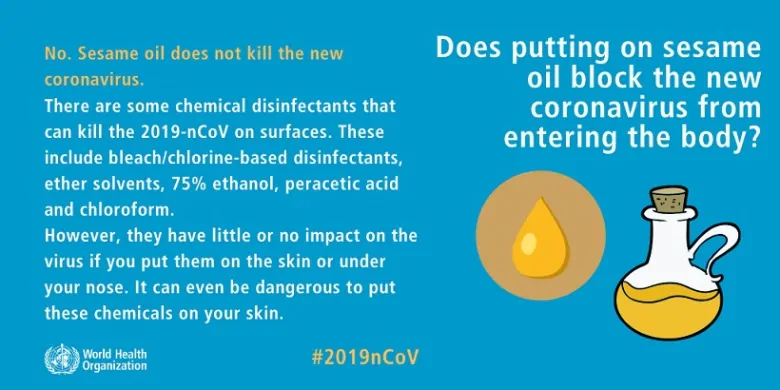
An image from the World Health Organization debunking a myth that applying sesame oil on your skin can protect people from contracting COVID-19. (World Health Organization)
Brainard and Hunter used real-world data for influenza, norovirus and monkeypox, which all have different incubation periods and recovery times. This was intended to show that the findings could be adapted to different diseases and different situations.
Brainard also explained that they considered the spread of bad information cumulative in their model.
“So if you have good information and bad information circulating, and if the bad information is kind of winning out, then over time you’re going to drift into more and more bad habits,” she said.
Misinformation led to more risks
In the first stage of the model, Brainard said, they assumed diseases spread without people changing their behaviour in any way, and then they measured how many people got sick.
In the second stage, half the people in the model were exposed to good information and half exposed to bad. The simulation was set up to replicate information-sharing patterns from a study published in the journal Science in 2018 which examined false news spread on Twitter over an 11-year period. That study found that false news reached more people than truthful information, and it reached them faster.
The result in Brainard and Hunter’s model was that more people got sick because they took more risks with their health due to following bad advice: in the influenza example, 82.7 per cent of the population got sick in the second stage, versus 59.2 per cent in the first stage.
While in real life, fewer people would actually get the flu because they have prior immunity, the researchers assumed no one had prior immunity to the diseases in their model — which is more likely to be the case with a newly identified virus like COVID-19.
The model also found that reducing the amount of harmful advice circulating by just 10 per cent could reduce the effect of bad information on an outbreak.
In the third stage of the model, Brainard said, they assumed that 60 per cent of people received to good information and 40 per cent received bad information — and even that small change resulted in sickness numbers dropping back to levels comparable to the first stage of the model.
The model also took into account that people must be in physical contact to spread the disease, but information about the disease can be passed along through social media and virtual contact.
Brainard said she was surprised that a relatively small reduction of misinformation in the model could change outcomes.
“I thought, you know, maybe we’d need a more dramatic difference,” she said. “But that is basically saying just a small leverage in one direction or the other can actually have a big impact in terms of countering the effects of [misinformation].
Still, Brainard cautions, her work is a model under development and hasn’t been tested in real-world settings, something she would like to see in the future.
“I think it’s just one step towards trying to figure out how … we can influence the narrative and influence what sources of information people are using. It’s only a start,” said Brainard.
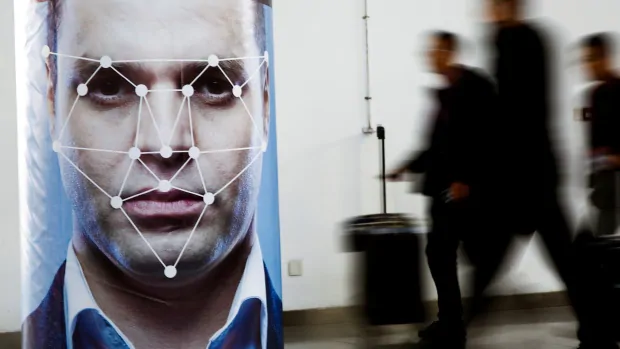
The federal privacy watchdog and three of his provincial counterparts will jointly investigate Canadian use of facial-recognition technology supplied by U.S. firm Clearview AI.
Privacy commissioner Daniel Therrien says he will be joined in the probe by ombudsmen from British Columbia, Alberta and Quebec.
The investigation follows media reports that raised concerns about whether the company is collecting and using personal information without consent.
Clearview AI’s technology allows for the collection of huge numbers of images from various sources that can help police forces and financial institutions identify people.
Therrien’s office says the four privacy regulators will examine whether the organization’s practices comply with Canadian privacy laws.
It also says privacy regulators in every province and territory have agreed to develop guidance for organizations — including law enforcement — on the use of biometric technology, including facial recognition.
Hello, people! This is our weekly newsletter on all things environmental, where we highlight trends and solutions that are moving us to a more sustainable world. (Sign up here to get it in your inbox every Thursday.)
This week:
Zero-waste grocery shopping is tricky but not impossible
Worldwide carbon emissions have levelled off
Climate change could make more of Canada farmable — but is that a good thing?
Zero-waste grocery shopping is tricky but not impossible
But zero-waste living is a growing movement. Thousands of social mediainfluencers are sharing their trashless journeys. Plastic-free shops are popping up and the phrase BYOC — bring your own container — is becoming normalized.
So last week, I tried a new diet. The only rule? Don’t buy anything that comes in disposable packaging. That meant no containers, bags, wrappers or jugs.
I had some prior experience with this. A few years ago, I did Plastic Free July. It was a challenge for me — and food was the main culprit.
Many of us in Canada are used to one-stop grocery shopping. Going plastic-free, however, requires more planning and time.
I’m fortunate to live in Toronto, which has a number of stores that encourage a BYOC mentality, carrying the basics you’d find at a big-box store, minus the plastic. Many more have popped up around Canada, including in Vancouver, Charlottetown and Sudbury.
I had all the supplies I needed: reusable bags, containers and jars of various sizes — things most people have in their homes anyway. And so off I went on my plastic-free odyssey.
Quick win: fruits and veggies
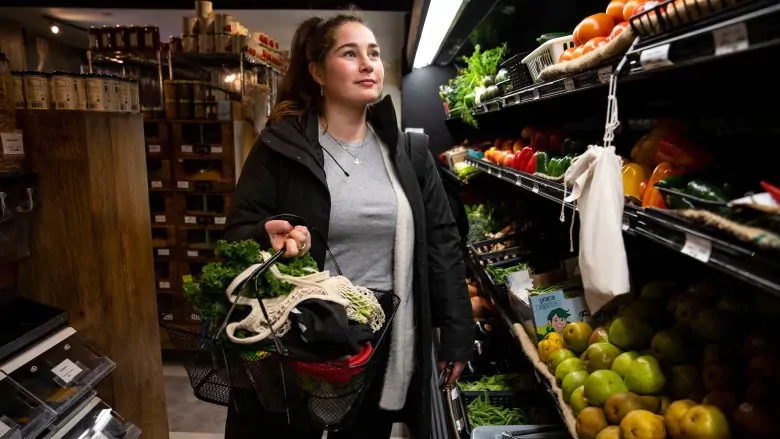
The easiest feats were in the produce aisle, given that most fruits and vegetables have a protective layer. I used some cotton bags I had for smaller items such as brussels sprouts. Otherwise, I left them unpacked until weighed and paid for.
A timeless idea: buying in bulk
Bulk Barn has a reusable container program that allows customers to shop with their own containers — as a result, grains, spices and snacks were no sweat to gather. (Bulk Barn sometimes even offers discounts for BYOC.) Many other stores also have bulk sections, but may not be as accommodating. I found the bulk option was cheaper than buying these items in the grocery aisle, and led to more conscious consumption.
Trickier: Proteins and bread
For meat, bread and cheese, I visited a number of specialty shops as well as a major grocery store. All of the stores I visited accommodated my requests. I used a cloth bag for bread, which had to be bought fresh from a bakery. When buying meat and cheese, the employees weighed my items prior to placing them in my container and then labelled the price.
That said, my items were almost double the cost of the pre-packaged equivalents, though fresher and higher quality in most cases. I also had to be sure to thoroughly clean these containers with soap and hot water after use, especially if I had stored raw meat in them.
Challenge: Oils, condiments, most beverages
I didn’t find any waste-free alternatives to cooking oils or most condiments. Most beverages were off-limits, too, seeing as they come in cans, bottles and cartons.
I spotted only one option for milk — a brand with a glass jug deposit program. But since I stick to plant-based milks as a personal preference, that was out. Making it from scratch using a nut milk bag is one alternative, but it wasn’t a realistic option for me. I caved mid-week and bought a carton of oat milk for my loose-leaf black tea and oatmeal at breakfast.
Another challenge: Anything instant or frozen
Frozen and instant foods are often wrapped in multiple layers of packaging, and that looks unlikely to change.
My takeaway
I concluded that the only solution for the problem items would be to make my own. But I can’t be a one-woman brewmaster, chef, baker, barista, juicer and confectioner.
I can, however, transition away from trash by incorporating new habits over time.
“The material is not the enemy. It’s our addiction to single-use,” said Vancouver-based marine plastic researcher Rhiannon Moore, who runs a blog documenting her low-waste lifestyle. “I want to support farmers and producers that are making things with less waste and travelling a shorter distance to get to me.”
— Isabel Terrell
Have you tried grocery shopping without plastic? Share some of your wins and fails by emailing us at whatonearth@cbc.ca.
Last week, the International Energy Agency shared some news that climate activists received with cautious optimism: after two straight years of increases, carbon emissions worldwide were flat in 2019. At about 33 gigatonnes, the figure was still significantly higher than what it was in 1995 (around 22 gigatonnes), which is why many environmentalists cautioned against complacency. According to the IEA, the biggest reason emissions didn’t rise is that developed countries are becoming less reliant on coal power.
(CBC)
Hot and bothered: Provocative ideas from around the web
Climate change could make more of Canada farmable — but is that a good thing?
(Andrew Vaughan/Canadian Press)
As the world’s temperatures continue to rise, Canada will add a huge share of the land that becomes suitable for growing major crops, a new study suggests.
The study, published in the journal PLOS ONE, predicts about 4.2 million square kilometres of Canada that are currently too cold for farming crops like wheat will be warm enough by 2080 if greenhouse gas emissions continue to climb.
“It may become our bread basket for the future,” said co-author Krishna Bahadur KC, an adjunct professor of geography at the University of Guelph. Currently, only a million square kilometres in Canada are warm enough for growing crops like wheat, corn and potatoes, he said.
The research suggests that even much of the Northwest Territories and Yukon could get warm enough to grow wheat and potatoes, while corn and soy could be grown farther north than they are now.
By combining models that predict the future climate with those that show what temperatures are suitable for growing 12 major crops, the researchers showed that about 15.1 million square kilometres of new land around the world — more than 30 per cent of the land currently being farmed — could become warm enough for farming corn, sugar, oil palm, cassava, peanuts, cotton, millet, sorghum, rice, potato, wheat and soy.
But the study also says farming all of it could have serious environmental impacts:
Huge amounts of greenhouse gas emissions would be released from the soil — about 177 gigatonnes, or 119 times the current annual emissions of the U.S.
It would destroy important biodiversity hotspots and many of the animals and plants that live there.
It would degrade the drinking water quality for millions of people.
“We need to proceed to expand agriculture very cautiously,” KC said, and “also [be] very mindful about possible environmental consequences.”
Experts have long predicted that a warmer climate would make new areas of the world suitable for growing crops. But Lee Hannah and Patrick Roehrdanz of the U.S.-based environmental organization Conservation International wondered what the impact would be on biodiversity and water quality.
And so they approached KC and his colleagues at the University of Guelph, who thought they could use models to answer that question. In the process, they realized the release of carbon from agriculture would be an issue.
In fact, it would be a major consequence of pushing agriculture into Northern Canada, where boreal forests and peatlands store huge amounts of carbon, the study says. Cutting down the trees and disturbing the peat would release a lot of that stored carbon, as would tilling the soil to grow crops, KC said.
“The magnitude of the potential release indicates that policies directed at constraining development of these areas are vitally important,” the study says.
Johanna Wandel, a geography professor at the University of Waterloo who edited a book called Farming in a Changing Climate, doesn’t think the expansion of agriculture into new areas is necessarily the solution to a growing population and increased demand for food in the near future.
She predicts the emphasis will instead be on better technology and productivity on the land we already farm and reducing waste to make harvests go further.
— Emily Chung
Stay in touch!
Are there issues you’d like us to cover? Questions you want answered? Do you just want to share a kind word? We’d love to hear from you. Email us at whatonearth@cbc.ca.
Sign up hereto get What on Earth? in your inbox every Thursday.
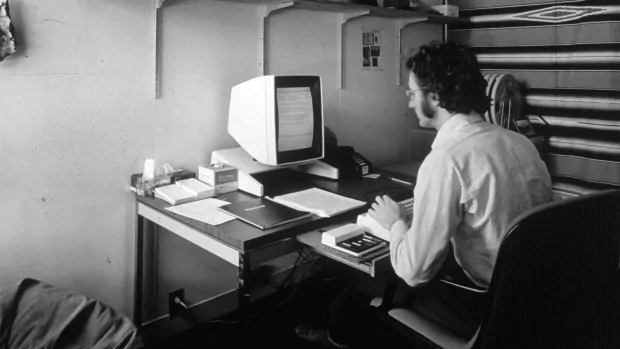
Larry Tesler, the Silicon Valley pioneer who created the now-ubiquitous computer concepts such as “cut,” “copy” and “paste,” has died. He was 74.
He made using computers easier for generations as a proponent and pioneer of what he called “modeless editing.” That meant a user wouldn’t have to use a keyboard to switch between modes to write and edit, for example.
“The inventor of cut/copy & paste, find & replace, and more was former Xerox researcher Larry Tesler. Your workday is easier thanks to his revolutionary ideas,” Xerox said in a tweet Wednesday.
Tesler was born in New York and attended Stanford University, where he received a degree in mathematics in 1965.
In 1973, he joined Xerox Palo Alto Research Center, a division of the copier company that worked on creating computer products. There, he pioneered concepts that helped make computers more user-friendly. That included such concepts as moving text through cut and paste and inserting text by clicking on a section and just typing.
He continued that work when he joined Apple in 1980. At Apple, he worked on a variety of products including the Lisa computer, the Newton personal digital assistant and the Macintosh.
After leaving Apple in 1997 he co-founded an education software company and held executive positions at Amazon, Yahoo and the genetics-testing service 23andMe before turning to independent consulting.
In 2012, Tesler told the BBC that he enjoyed working with younger people.
“There’s a very strong element of excitement, of being able to share what you’ve learned with the next generation,” he said.
A toothbrush. Human hairs caught in the bristles of a hairbrush. A fingerprint preserved in sealing wax.
Underwater archeologists from Parks Canada found these highly personal items as they recovered more than 350 artifacts during their most recent — and they say most successful — season yet at the HMS Erebus wreck site off the coast of Nunavut.
And they are hoping such tantalizing links to individual sailors from the mid-19th century British expedition led by John Franklin will offer clues and help them move closer to understanding what happened on the ill-fated polar mission.
Along with work done at the site of the other Franklin Expedition vessel — HMS Terror — the underwater excavation on Erebus late last summer was in many ways the result of several years of archeological preparation after the wrecks were discovered in 2014 and 2016.
“Through the work we did on Terror and being able to look inside the cabins, and now getting into the artifacts of individuals inside Erebus, this is the beginning — and it’s only the beginning — of really getting into the story in depth,” Marc-André Bernier, manager of Parks Canada’s underwater archeology team, said in an interview.
Some of the artifacts recovered from the wreck lying in the shallow waters of Wilmot and Crampton Bay were unveiled Thursday at Parks Canada’s conservation laboratories in Ottawa.
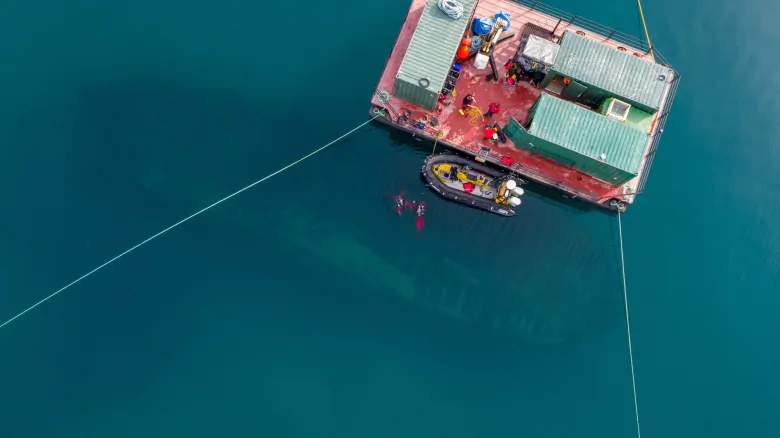
HMS Erebus is visible, lying in about 11 metres of water, as Parks Canada underwater archeologists work from their barge above the wreck. (Underwater archeology team/Parks Canada)
Over a three-week period in late August and September, members of the underwater archeology team made 93 dives and spent about 110 hours underwater at the Erebus site.
“It was by far our most successful season and we’re pretty excited,” said Bernier.
The experience was in marked contrast to their efforts the year before, which were severely hampered by miserable weather.
In 2019, however, the weather was “sublime,” senior underwater archeologist Ryan Harris said in an interview.
“One of our biggest challenges is just … environmental conditions in the central Arctic. We can come up with the most detailed, well-laid plans and they can be frustrated by very unco-operative ice conditions and weather,” he said.
“Finally in 2019 … [it] all came to fruition. It’s extremely gratifying for the entire team.”
HMS Erebus and HMS Terror, shown in the Illustrated London News published on May 24, 1845, left England that year under the command of Sir John Franklin in the search of the Northwest Passage. (Illustrated London News/Getty Images)
Erebus and Terror set sail from Greenhithe, England, in 1845 in an expedition led by Franklin in search of the elusive Northwest Passage.
The ships were beset by ice off King William Island in 1846 and deserted two years later, according to a note left by the crew in a cairn. Franklin and his 128 men all died.
But what really happened on the expedition has been an enduring mystery. The discovery of Erebus in 2014, and Terror two years later, in many ways only raised more questions, particularly regarding how the ships ended up where they did.
This past season marked a major transition in the exploration of the Erebus site, as archeologists moved from assessing and evaluating it to meticulous and systematic excavation inside the wreck.
“We have always said … that the potential to find things is great because of the cold water [preserving artifacts]. But this year, that was confirmed,” said Bernier. “We are finding places that have not been displaced or moved since the ship went down.”
‘It’s quite humbling’
In this instance, archeologists focused efforts on the living quarters of the crew on the lower deck of the ship, diving about eight metres below the surface of the water.
“We’re excavating in the world of somebody that lived 170 years ago in his space, so when you go down it’s quite humbling … but it’s exciting,” said Bernier.
“Every day, every dive is a discovery. You just don’t know what to expect.”
Epaulettes from an officer’s uniform were found on the lower deck of Erebus in September 2019. (Photo: Marni Wilson)
Items recovered included epaulettes from a lieutenant’s uniform and ceramic dishes. The epaulettes, Bernier said, were found in a drawer filled with a lot of sediment but otherwise empty of artifacts, leaving the impression that they were abandoned.
“On the flip side, in the ship’s pantry, there’s barely any sediment, because the density of the objects is so big. You would have plates stacked up 13 high.”
Other items recovered include a leather coat sleeve, textiles, navigational instruments, buttons, an entire table service for the captain’s table and a ceramic jar with “prepared mustard” stamped on it and mustard seeds inside. Quite a few bottles were found — “10 or 12 of the wine bottle type,” Bernier said.
“Some still had contents in it, so we’ll have that analyzed.”
A decanter or eau de toilette bottle was found on the lower deck of Erebus in August 2019. (Underwater archeology team/Parks Canada)
There was even an accordion — after the years underwater, it doesn’t play, but does allude to how the sailors brought along items to entertain themselves.
While human hairs were found on the hairbrush, no human remains have been discovered on Erebus so far.
Numerous writing materials — a wooden pencil case, four kinds of pencils and a quill with a full feather and a pointed end — were also discovered. But no logs or diaries that might contain sought-after accounts of what happened during the expedition have been found.
“That’s the next step, we hope,” said Bernier, who also noted such materials might be more likely found toward the ship’s stern, in officers’ cabins.
A lead stamp marked ‘Ed. Hoar’ was found on Erebus during Parks Canada’s most recent research season at the site of the wreck in Nunavut. (Underwater archeology team/Parks Canada)
In the Erebus pantry, archeologists found a lead stamp with a name on it — that of “Ed. Hoar,” steward for the ship’s captain. Edmund Hoar, from Portsea, Hampshire, was 23 when the expedition set sail in 1845.
Such personal discoveries hold a particular significance for the archeologists.
“Whenever in archeology we come across artifacts that can really be linked to individuals, that’s highly personalized, that’s quite evocative,” said Harris. He also pointed to the sealing wax that has the thumbprint or fingerprint of the sailor who used it to seal a letter or document.
“We talked about trying to identify DNA samples, but to actually have a fingerprint from one of the crew, that’s incredible, something you just don’t come across every day.”
In the case of Hoar, who wasn’t an officer on the ship, the discovery of his name and its association with an artifact offers the opportunity to tell the tale of someone of a more humble origin.
A Parks Canada underwater archeologist works about eight metres below the surface of the water. (Underwater archeology team/Parks Canada)
‘That’s where archeology is in the best position to tell the story of people who don’t have as much of a presence in the historical record,” said Harris.
“The sailors themselves had to fit all of their earthly possessions into one half of a seaman’s chest that would double as a bench at the mess table.
“We’re not just interested in telling the stories of the officers who had an elevated social status, but of the more anonymous people that made up the rest of the ship’s company.”
Harris said they are trying to tell the story of the expedition on many different levels, from the overarching historical narrative right down to the experiences of individual crew members and who was in a particular cabin at a particular time.
“What are the events we don’t know about and what order did things unfold in? Why are the two ships 75 kilometres apart? How did they sink?” Harris said, rhyming off some of the questions that have been at the core of the Franklin mystery.
Sealing wax was among the artifacts recovered last year from the Erebus wreck site. (Underwater archeology team/Parks Canada)
“Who were the final survivors of the expedition? Did discipline break down or was it maintained until the end? Those are the sorts of stories we hope to tell with artifacts that are linked to specific individuals.”
While the archeologists are revelling in last summer’s results, they won’t offer any public assessment of how what has been found might contribute to answering bigger questions hanging over the Franklin Expedition.
Watch: Video footage from the wreck of HMS Terror
Parks Canada video from the underwater wreckage of HMS Terror shows everything from pieces of furniture to bowls and tumblers. 3:15
It’s “all too early to say,” said Harris.
“You definitely run a risk if you try to arrive at conclusions with only a handful of artifacts, but I think what we have at hand now is a confirmation of the density and diversity of artifacts that we stand to find in subsequent field seasons.”
Bernier said it’s “been a long road” to get to this point in trying to tell the story of the Franklin Expedition.
“We hope this is the beginning of a long string of seasons where we actually get into the story.”