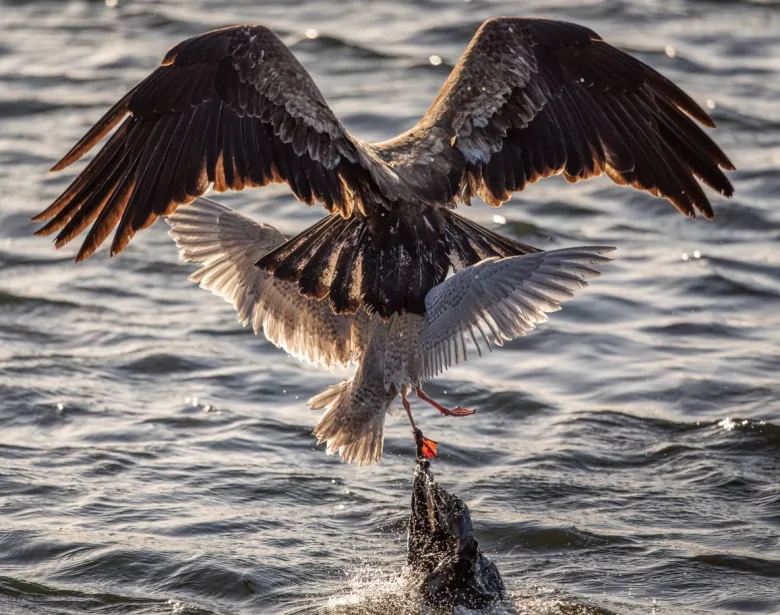
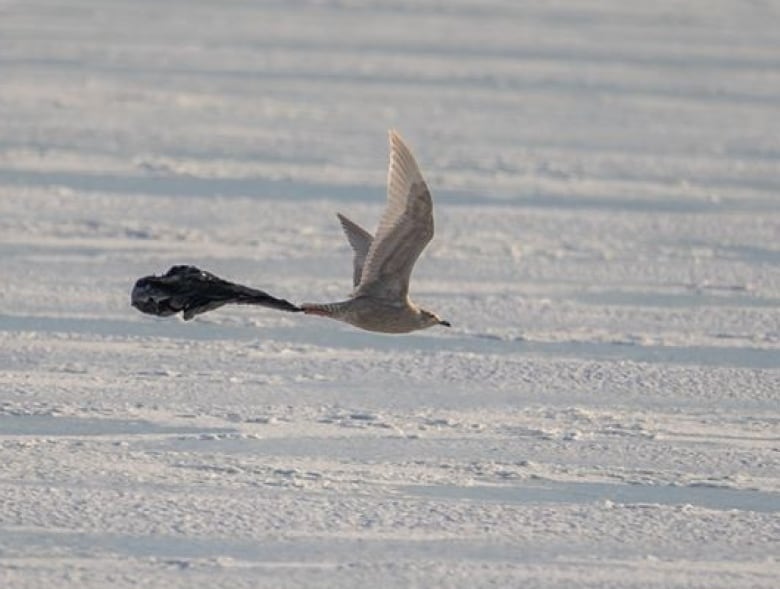
Photographer Michael Winsor captured a seagull fighting off a bald eagle while ensnared in a plastic bag at Quidi Vidi Lake on Monday. (Michael Winsor Fine Art Photography/Facebook)
Photographer Michael Winsor saw first-hand one effect of plastic pollution while taking pictures of birds at Quidi Vidi Lake on Monday.
Winsor, a seasoned wildlife and landscape photographer, has witnessed his share of Newfoundland’s beauty in his travels throughout the island over recent years. But he hadn’t seen anything like what he saw Monday, when he spotted a seagull flying, dragging a plastic bag with it.
“It was flying up across. [The bag] was almost acting like a parachute as he was flying. In the picture you can see the seagull. and the big, black bag was just kind of pulling behind,” Winsor said.
Winsor said he made his way to the opposite side of the lake to try to free the seagull. Its original predicament was caused by people but as Winsor got closer to the gull, he saw survival of the fittest taking over.
Winsor says he initially thought this seagull was a drone before it came close enough for him to realize it was a bird tangled in a plastic bag. (Michael Winsor Fine Art Photography/Facebook)
The seagull was visibly struggling with the bag, which was wrapped tightly around its foot, and Winsor wasn’t the only one who had noticed: a juvenile bald eagle soon swooped in, possibly looking for an easy lunch. Winsor gave chase as the pair of birds fought their way to the lower end of the lake.
“When I got down there I got out of the truck at the right time, I guess, and the bald eagle actually had the talons right into the seagull. I figured it was over at that point,” he said.
“But the ironic thing is when [the gull] hit the water, the bag actually filled up with water. It kind of saved him in the long-run, because the bald eagle couldn’t lift the seagull and the bag full of water.”
Winsor say he often finds trash along hiking trails and woods across the province. (Sherry Vivian/CBC)
The birds struggled for a few moments, until the seagull was able to free itself from both its captors, Winsor said. The bag itself remained floating in the lake, an environmental booby trap for another day.
“It’s going to be there for years, so it’s kind of unfortunate,” Winsor said. “This is the type of stuff that happens that we don’t see.”
This juvenile bald eagle tried to scoop an easy lunch on Monday. (Michael Winsor Fine Art Photography/Facebook)
While he was happy to see the seagull break away for another day, Winsor said he often comes upon trash in the province’s woods and hiking trails.
“It’s unfortunate you always see these little spots where people don’t take their trash,” he said.
The impacts of climate change can be hard to notice on an incremental basis, but when archeologist Peter Dawson stepped off a Twin Otter aircraft onto Yukon’s Herschel Island after a decades-long absence, there was nothing subtle about what he saw.
“I think they’ve lost in some areas … 20 metres of coastline over the last 20 years.”
Dawson said seeing the erosion and other changes drove home the importance of creating digital blueprints of the historic sites at Pauline Cove, part of Herschel Island – Qikiqtaruk Territorial Park.
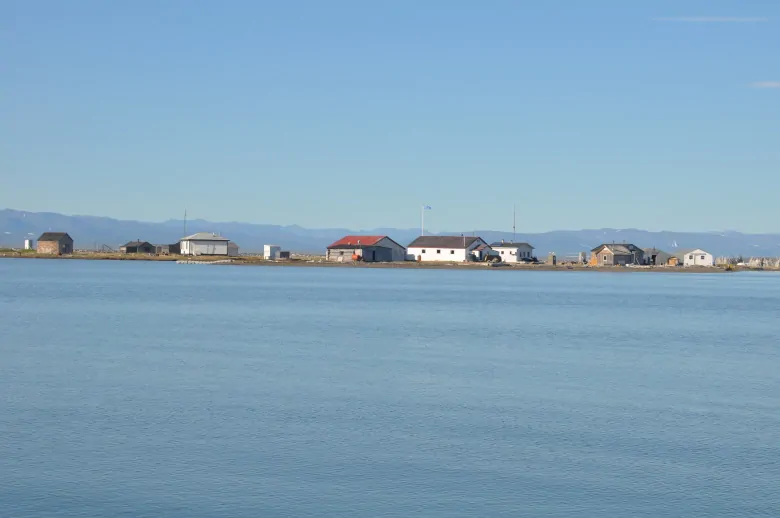
The buildings on Herschel Island, in the Beaufort Sea, are little protected against storm surges and coastal erosion. (Submitted by Yukon Government)
Digital backups
Dawson was first gripped by the history of Herschel Island, located in the Beaufort Sea five kilometres off Yukon’s north coast, when he worked there as a new archeologist in the 90s. The island has been used by Inuvialuit for thousands of years and more recently by American whalers, Anglican missionaries and the Northwest Mounted Police.
“It’s just an incredible, incredible place,” Dawson said.
Now head of the anthropology and archeology departments at the University of Calgary, Dawson specializes in the digital preservation of heritage at risk. Using a drone and a lunchbox-sized device called a terrestrial laser scanner to calculate the exact coordinates of each element of the structure, he created 3D digital replicas of the sites at Pauline Cove.
Dawson said the purpose for the project is twofold: to create an online virtual exhibit for people who can’t visit the 116 square kilometre island, and to have blueprints of all the buildings in the event they need to be reconstructed.
Barbara Hogan, manager of historic sites with Yukon Tourism and Culture, said works crews do restoration and conservation work on the buildings at Pauline Cove every summer, but Dawson’s digital plans provide a safeguard.
“We thought it was a good idea to get a comprehensive record of the site while we could in case the water levels rise and we’re at a point where we can’t capture some of the information,” she said.
“It’s giving us a really, really good record of the outside of the buildings and the inside of the buildings and an overview of the historic settlement area.”
This digital image shows the Bone House building with a section of the roof removed. The interior serves as a storage area and makeshift museum. Inside are the remains of the USS Triton, as well as historic and pre-contact artifacts. (Submitted by Peter Dawson)
Unprecedented erosion and other threats
Researchers have called the erosion on Herschel Island “unprecedented,” but Dawson says that isn’t the only threat to the island’s heritage structures. Animals have destroyed buildings, and he sees another threat on the horizon: polar tourism.
“We’re starting to see more and more cruise ships arriving in the Arctic and of course they want to visit heritage sites like Herschel Island,” explained Dawson. “You can imagine 20 or 30 or 60 disembarking passengers wandering around a site like Pauline Cove. It can cause damage to the buildings it can cause damage to vegetation.”
Dawson says it’s important to come up with new ways to mitigate these threats.
“Digital heritage preservation is, I think, one of the most interesting and potentially one of the most important ways to do this.”
Herschel Island lies five kilometres off the north coast of Yukon in the Beaufort Sea. (CBC)
Virtual learning
Herschel Island is an important site for the Inuvialuit, who continue to use it and Yukon’s north slope for traditional activities, but it still remains a challenge to get to. Summer access is by boat or air charter from communities in the Beaufort Delta region.
Michelle Gruben with the Aklavik Hunters and Trappers Committee said it was exciting for community members to “see” the the sites at Pauline Cove at a presentation Dawson recently gave in the community.
“Not everybody gets to make their way to Herschel Island … and to see this type of new technology that shows people the area, it’s good to see,” Gruben said.
This simplified computer model of an Inuvialuit sod house was constructed using architectural information from archeological excavations in the Mackenzie Delta region and Inuvialut oral history. (Submitted by Peter Dawson)
Dawson said the next stage of the project is to create an online archive of the buildings complete with write ups about their history. He hopes to have that ready for the public in about a month from now. He said people will also be able to print the buildings on a 3D printer to make things like puzzles.
“We’re really interested in exploring how things like 3D printing can be used to again convey the history of Herschel island to a wider audience.”
Flooding has damage buildings and heritage sites on Herschel Island. (Submitted by Yukon Government)
The country’s top aviation officials said Canada will conduct its own flight tests to examine whether the grounded Boeing 737 Max fleet is safe to fly after two deadly crashes.
For decades, countries around the world have relied on the United States to take the lead and certify Boeing aircraft, as they are manufactured there. Other countries then validate that work. But Transport Canada says it is putting in place additional measures to give Canada more independence in scrutinizing the 737 Max fleet.
“We’ve grown the amount of involvement we have,” Nicholas Robinson, Canada’s director general of civil aviation, said on Tuesday to a House of Commons committee that’s studying the issue.
The changes come in the wake of criticism by victims’ family members that Canada’s certification process relies too heavily on the U.S., and amid concerns the U.S. Federal Aviation Administration (FAA) delegates much of the work to manufacturers, such as Boeing. Public hearings in the U.S. revealed Boeing ignored and covered up warnings and issues with the aircraft.
Still, Canadian officials admit Canada will need to largely rely on the information provided by the U.S. because it would take too much time and resources to do all of the work here.
“We don’t have to throw the process out that we have right now,” said David Turnbull, Canada’s director of national aircraft certification. “It is scalable. Think of it like a volume button; when things happen like this we can turn the volume up, we can increase our involvement.”
Transport Canada is currently working with regulators around the world to decide whether or not it will permit the Max to fly again.
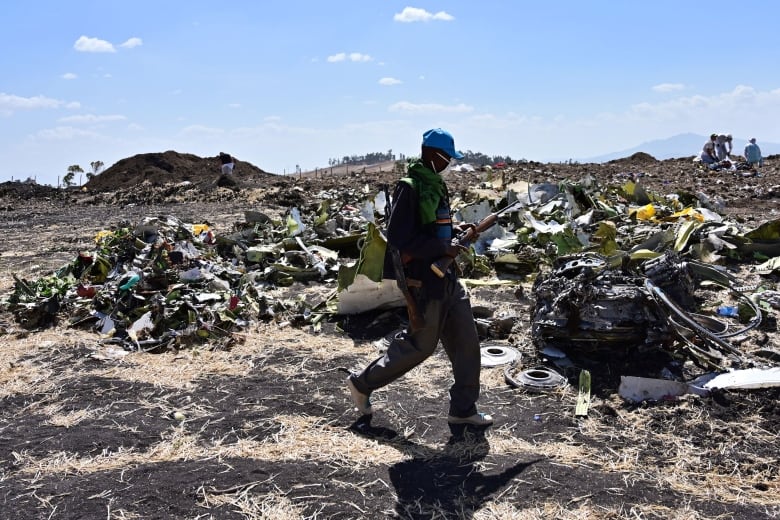
In October 2018, a Lion Air plane plunged into the Java Sea after takeoff in Indonesia, killing all 189 people on board. In March 2019, an Ethiopian Airlines flight nosedived into the ground, killing all 157 people on board, including 18 Canadians and at least three permanent residents of Canada. Satellite data showed both planes experienced significant flight control problems.
Eighteen Canadians died and at least three permanent residents in Canada when an Ethiopian Airlines flight crashed in March 2019. (Tony Karumba/AFP/Getty Images)
Countries around the world swiftly grounded the Max. Canada’s minister of transport came under fire for being one of the last countries to ban the fleet from the sky.
Bloc Québécois MP Xavier Barsalou-Duval told the two government officials yesterday that travellers are afraid of the Max and asked how Canada was going to tighten its surveillance of the recertification process.
Robinson said Transport Canada has already asked for additional information from the FAA.
The federal government is also meeting on a weekly basis with the three Canadian airlines that fly that fleet — Air Canada, WestJet and Sunwing — to let them know about the work it’s doing to recertify the planes, officials said. Airline associations are also being regularly briefed.
Independent tests ‘a start’
When asked why Canada doesn’t independently certify all planes, officials said if each country did that for every aircraft in the system there wouldn’t be enough planes accessible. For example, when Canada certified Bombardier’s Airbus 220 it took years and more than 150,000 hours of work.
Chris Moore’s 24-year-old daughter, Danielle, died in the Ethiopian Airlines crash. He called the move to conduct independent flight tests “a start.”
“They should have done this after the first crash,” said Moore. “It’s too little too late in terms of saving my daughter. It’s cold comfort, but it’s good to know they’re on the right track making sure the skies are safe.”
Another large American bank says it will no longer fund new drilling projects in the Arctic.
In a news release dated Tuesday, JPMorganChase & Co. said it updated its energy policy which will see a ban on financing new oil and gas development projects in the Arctic. It will also restrict new thermal coal mines and coal-fired power projects in the Arctic.
The bank states the changes are part of its advancement of its sustainable development goals, according to the news release. That includes a target of $200 billion in lending and other financial services for green and sustainable companies and projects, up from an earlier target of $175 billion set in 2017, according to a presentation ahead of its annual investor day.
Chase is ranked the largest bank in the United States and the sixth largest bank in the world by S&P Global Inc.
In December, another American bank, Goldman Sachs, made a similar move to end financing for Arctic drilling projects.
We have a lot more work to do.– Bernadette Demientieff, Gwich’in Steering Committee executive director
It’s another win for Indigenous leaders who have been lobbying banks to refuse to fund development in the Arctic National Wildlife Refuge.
“It gives us a lot of hope and we are very grateful to the banks that are listening to the Indigenous voices,” said Bernadette Demientieff, executive director of the Gwich’in Steering Committee which represents Gwich’in communities in Alaska and Canada.
“Although they put a lot of money into the Arctic, it just gave us hope that other banks will follow suit.”
Demientieff said they want other banks and oil companies to know that they will be holding them accountable.
“As Indigenous people of this land, we are caretakers of it and we’re just not going to allow anyone to come in and destroy our homeland — and especially we’re not going to sit idly by while it happens,” she said.
“I do know that we have a lot more work to do. We’re not going to stop now.”
Demientieff said leaders will continue to ask at least a dozen more banks to consider the same, including to Citibank, Bank of America, Wells Fargo and other international banks.
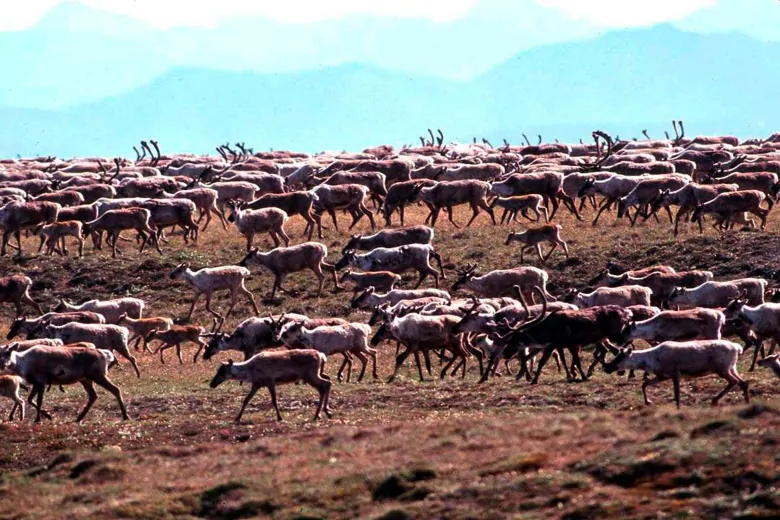
In this undated file photo provided by the U.S. Fish and Wildlife Service, caribou from the Porcupine Caribou Herd migrate onto the coastal plain of the Arctic National Wildlife Refuge in northeast Alaska. (U.S. Fish and Wildlife Service/Associated Press)
CBC contacted JPMorgan Chase for an interview. The bank did not confirm whether cultural ties to the land or financial motivations factored into the decision to end funding for Arctic drilling projects.
Some advocates, like the American environmental group, The Sierra Club, said in a news release Monday that the bank has not gone far enough by not implementing restrictions on other oil and gas development, like fracking or oilsands projects elsewhere.
Other climate-change activists also flocked outside JPMorgan’s New York headquarters on Tuesday, partially blocking some entrances and demanding that the bank get rid of fossil-fuel clients.
Last week, the global body that regulates shipping, the International Maritime Organization, passed a draft regulation to ban the use of heavy fuel oil in the Arctic by 2024.
A vault in the Arctic built to preserve seeds for rice, wheat and other food staples will contain one million varieties with the addition on Tuesday of specimens grown by Cherokee Indians and the estate of Britain’s Prince Charles.
The Svalbard Global Seed Vault, built on an Arctic mountainside in 2008, was designed as a storage facility to protect vital crop seeds against the worst cataclysms of nuclear war or disease and safeguard global food supplies.
Dubbed the “doomsday vault,” the facility lies on the island of Spitsbergen in the Arctic archipelago of Svalbard, halfway between Norway and the North Pole, and is only opened a few times a year in order to preserve the seeds inside.
On Tuesday 30 gene banks will deposit seeds, including from India, Mali, Peru and the Cherokee Nation in the United States, which will bank samples of maize, bean and squash.
The seed vault is the backup in the global system of conservation to secure food security on Earth.– Stefan Schmitz, Crop Trust executive director
The Royal Botanical Gardens at Kew in Britain will bank seeds harvested from the meadows of Prince Charles’ private residence, Highgrove, including from grass species, clovers and broad-leaved flowering herbs.
The vault also serves as a backup for plant breeders to develop new varieties of crops. The world used to cultivate around 7,000 different plants but experts say we now get about 60 per cent of our calories from three main crops — maize, wheat and rice — making food supplies vulnerable if climate change causes harvests to fail.
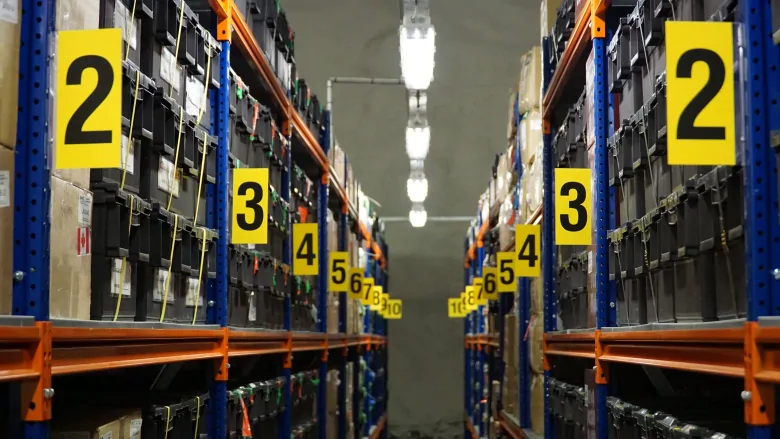
In this photo taken Sunday, Oct.18, 2015, rows of boxes containing seed samples sit inside the Global Seed Vault in Svalbard. The vault was last opened in October. With Tuesday’s deposit, it will contain one million different kinds of seeds, from almost all nations. (David Keyton/AP file)
“The seed vault is the backup in the global system of conservation to secure food security on Earth,” Stefan Schmitz, executive director of the Crop Trust, the Bonn-based organization which manages the vault, told Reuters.
“We need to preserve this biodiversity, this crop diversity, to provide healthy diets and nutritious foods, and for providing farmers, especially smallholders, with sustainable livelihoods so that they can adapt to new conditions.”
Seeds from almost all nations
Already, one in nine people go to bed hungry globally, according to the United Nations’ World Food Programme, and scientists have predicted that erratic weather patterns could reduce both the quality and the quantity of food available.
The vault was last opened in October. With Tuesday’s deposit, it will contain one million different kinds of seeds, from almost all nations.
In 2015, researchers made a first withdrawal from the vault after Syria’s civil war damaged a seed bank near the city of Aleppo. The seeds were grown and re-deposited at the Svalbard vault in 2017.
In October, Norway completed an $11 million, year-long upgrade of the vault, which was built at Svalbard because the Arctic’s cold climate means its contents will stay cool even if the power fails.
But even the doomsday vault has been affected by likely climate change as an unexpected thaw of permafrost when it first opened let in water to the tunnel entrance of the vault building, although no seeds were damaged.
Scientists have spotted in rocks from northern China what may be the oldest fossils of a green plant ever found, tiny seaweed that carpeted areas of the seafloor roughly a billion years ago and were part of a primordial revolution among life on Earth.
Researchers on Monday said the plant, called Proterocladus antiquus, was about the size of a rice grain and boasted numerous thin branches, thriving in shallow water while attached to the seafloor with a root-like structure.
It may seem small, but Proterocladus — a form of green algae — was one of the largest organisms of its time, sharing the seas mainly with bacteria and other microbes. It engaged in photosynthesis, transforming energy from sunlight into chemical energy and producing oxygen.
“Proterocladus antiquus is a close relative of the ancestor of all green plants alive today,” said Qing Tang, a Virginia Tech post-doctoral researcher in paleobiology who detected the fossils in rock dug up in Liaoning Province near the city of Dalian and lead author of the study published in the journal Nature Ecology & Evolution.
Earth’s biosphere depends heavily on plants for food and oxygen. The first land plants, thought to be descendents of green seaweeds, appeared about 450 million years ago.
There was an evolutionary shift on Earth perhaps 2 billion years ago from simple bacteria-like cells to the first members of a group called eukaryotes that spans fungi, plants and animals. The first plants were single-celled organisms. The transition to multicellular plants like Proterocladus was a pivotal development that paved the way for the riot of plants that have inhabited the world, from ferns to sequoias to the Venus flytrap.
Proterocladus is 200 million years older than the previous earliest-known green seaweed. One of its modern relatives is a type of edible seaweed called sea lettuce.
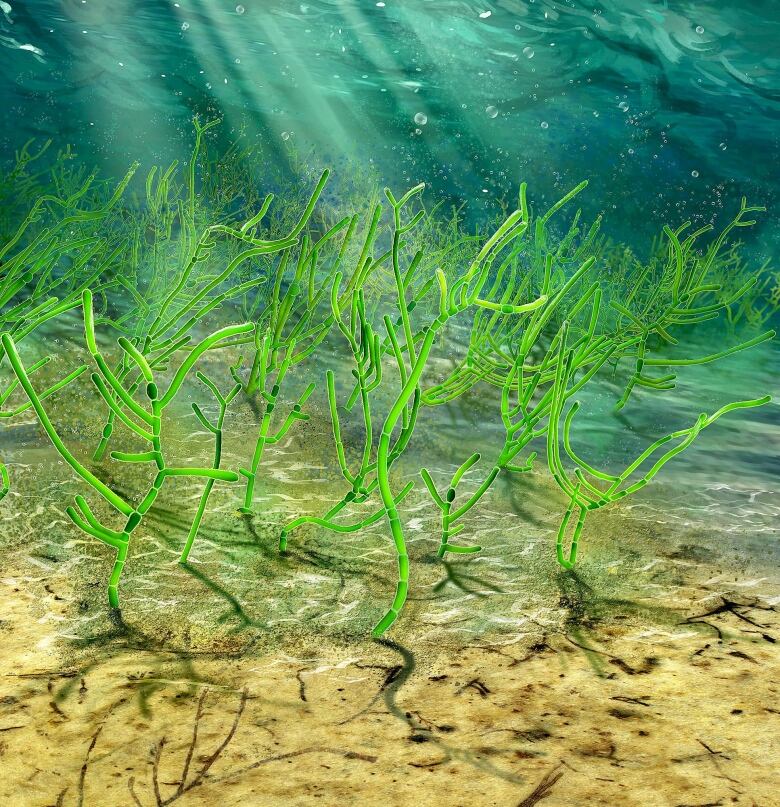
In the background of this digital recreation released by Dinghua Yang February 24, 2020, ancient microscopic green seaweed is seen living in the ocean 1 billion years ago. In the foreground is the same seaweed in the process of being fossilized far later. (Dinghua Yang via Reuters)
Proterocladus represents the oldest unambiguous green plant fossil. Fossils of possible older single-celled green plants are still a matter of debate.
Plants were not the first to practice photosynthesis. They had an ancestor that apparently acquired the photosynthesis cellular apparatus from a type of bacteria called cyanobacteria.
This ancestor of all green plants gave rise to two major branches, one of them includes some aquatic plants and all land plants while the other — the group to which Proterocladus belongs — is made up exclusively of aquatic plants.
“Proterocladus antiquus,” Virginia Tech paleobiologist and study co-author Shuhai Xiao said, “is the sister of the evolutionary great, great grandmother of all green plants alive today.”