Categories
Tech

Fallout from coronavirus outbreak triggers 25% decrease in China's carbon emissions


In the midst of China’s COVID-19 epidemic, the conditions for an unprecedented climate experiment have emerged.

Climate researchers can measure in real time what happens to carbon emissions when one of the world’s largest economies is suddenly stalled, with entire cities locked down, highways emptied, airplanes grounded, factories shuttered and millions of people confined to their homes.

A continent away, from his base in Helsinki, Finland, Lauri Myllyvirta was able to piece together industry and financial data sources and satellite imagery to calculate the epidemic’s impact on emissions: a decrease of about 25% in three weeks.

“In terms of the absolute volume of emissions, this is absolutely unprecedented,” he said.

Lauri Myllyvirta, lead analyst for the Centre for Research on Energy and Clean Air, calculated that China’s carbon emissions have fallen by about 25 per cent in three weeks as that country copes with the COVID-19 epidemic. (Centre for Research on Energy and Clean Air (CREA))


As a climate analyst with the Centre for Research on Energy and Clean Air, Myllyvirta keeps a close eye on China’s economic activity.

His analysis showed how reduced demand for coal from Chinese power plants combined with the slowing of production in oil refineries and steel plants created a decline in the country’s major industrial sectors.

“In terms of global emissions, it’s the biggest story of the year. There’s no question about that,” he said.
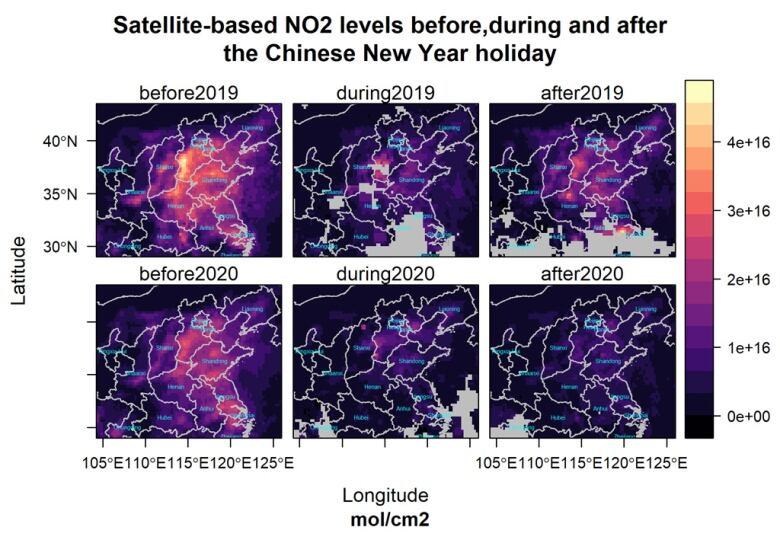
These satellite images show nitrogen dioxide (NO2) levels before, during and after China’s New Year holiday for 2019 and 2020, highlighting the decreased emissions during the weeks of China’s coronavirus lockdowns. (CREA analysis of NASA OMI satellite data)

To support his analysis, he also studied satellite images of China’s nitrogen dioxide (NO2) emissions, a pollutant that is emitted through the burning of fossil fuels. 

“That actually showed an even larger reduction of around 35 per cent in NO2 levels, so it gave us confidence that we’re at least not overestimating when we say 25 per cent or more.”

13,000 fewer flights a day

Another significant contributor to the emissions decrease was the dramatic decline in China’s domestic and international air traffic, which account for about 15 per cent of global air travel emissions.

An analysis by the flight data agency Flightradar24 shows that since late January, 13,000 fewer flights are landing and taking off each day from Chinese airports.

“In general, air traffic originating in China is down 80 per cent since the beginning of the year,” Flightradar24 spokesperson Ian Petchenik said in an email.

Ann Dale is the director of the School of Environment and Sustainability at Royal Roads University in Victoria. She says the COVID-19 epidemic raises some challenging questions for global environmental sustainability. (Paul Couvrette)

The paradox of airline travel is one of the most intriguing aspects of the epidemic for Ann Dale, director of the School of Environment and Sustainability at Royal Roads University in Victoria. 

“We’ve got a virus that is spreading more rapidly because of our advances in airline travel. Ironically, it’s also resulting in a decrease in that airline travel.”

She said it raises questions about how much international travel is sustainable.

“What are the limits and optimal scale of travelling? How many greenhouse gas emissions do you want to consume?

“Maybe it’s time we started addressing questions about limits and scale on human consumption.”

An economic shock that affects carbon emissions this dramatically is rare. Experts point to the 2008 global financial crisis as another moment when an unintended series of circumstances resulted in major reductions in carbon emissions. 

“What it shows is that emissions are closely linked to economic growth,” said Klaus Hubacek, an ecological economist at the University of Groningen, Netherlands. “Once economic activities decline, you have a reduction of associated emissions.”

‘De-coupling’ growth from carbon 

The entanglement of economic activity and carbon emissions is one of the most vexing aspects of climate change mitigation.

For years, experts have debated how to separate growth from carbon emissions, a concept known as de-coupling.

“The economy grows, the emissions grow, unless we have decoupling,” said Hubacek, whose research has shown that reducing carbon emissions in one country often results in a shift of carbon-intensive production to another country.

The task is also complicated by the challenge of lifting much of the world out of poverty while trying to reduce emissions. Hubacek points out that half of the world’s population is still living on $3 a day.

Some academics are also studying the concept of degrowth, a school of thought where economic activity is deliberately reduced to slow climate change. The research is geared toward policies that would gradually scale back economic growth to the point where it’s in sync with global resources. The idea is to use local resources and change the way people work so that less time is spent on economically oriented activity.

“I find it quite sympathetic and interesting but it’s really, within academia, a niche. I don’t think it has any political traction at this point,” said Hubacek.

Klaus Hubacek, an ecological economist at the University of Groningen, Netherlands, says the climate impacts of COVID-19 illustrate the close link between carbon emissions and economic growth. (Ronald Zijlstra)

The various carbon mitigation strategies being considered around the world right now are based on a planned and co-ordinated approach to reducing emissions. So the empty highways and silent streets of Wuhan, China, are not some stark glimpse of a carbon-controlled future.

“Economic activity has to be reduced in some sectors and overall emissions have to decrease, but this is not in any way planned or a healthy way of reducing emissions,” said Hubacek.

Myllyvirta had a similar assessment of what’s happening in China. 

“A plan to bring down emissions, even very rapidly, would not look like this,” he said.

“Millions and millions of people are suffering in different ways because of what’s happening in China. People are unable to access health care, people are unable to work. Many of them are losing income.”

This aerial photo of the Yangtze River Bridge in Wuhan, China, on Jan. 27 shows the city under lockdown to control the spread of COVID-19. (CHINE NOUVELLE/SIPA/Shutterstock)

Having said that, some aspects of China’s response to the coronavirus — such as the construction of Huoshenshan Hospital in Wuhan in just 10 days — could be used as a model if the world decided to move rapidly to a green economy, he said.

“It would look more like that construction site for the hospital, mobilizing a lot of resources to build clean energy on a scale that would enable us to ditch fossil fuels in the span of a decade or two.”

Myllyvirta said his colleagues in China who have been forced to work from home during the epidemic have already adapted.

“I have so many friends and contacts who have logged on to a proper video conferencing system for the first time because of this,” he said. “Will we see more remote working in China going forward? That’s something that has been adopted very rapidly.”

Rapid recovery could increase emissions

The climate implications of COVID-19 are still evolving. More flights are being cancelled as the epidemic spreads to other countries. 

And the outbreak is already being factored into global oil demand projections.

The International Energy Agency’s  oil market report this month stated that “global oil demand has been hit hard” by the virus and China’s economic slowdown. The report predicts demand will fall in “the first quarterly contraction in more than 10 years.”

But those contractions in fossil fuel consumption are viewed as temporary. There are concerns that carbon emissions could rise sharply if China pushes for rapid economic recovery when the epidemic subsides.

Chinese officials could choose to stimulate the economy through large-scale, carbon-intensive construction projects as has happened in the past, said Myllyvirta.

“If [China] actually wants to grow the GDP six per cent after what’s happened during the past few weeks, that would mean an enormous amount of spending on new construction. And that would mean a lot of emissions.”

When the country raced to recover from the previous financial crisis by building infrastructure, the amount of emission-intensive cement used between 2011 and 2014 was staggering. 

“In those three years, they consumed 50 per cent more cement than the U.S. in the whole of the 20th century,” said Hubacek. “It’s just mind-boggling.”


Source link

Categories
Tech

Astronomers have discovered the biggest explosion seen in the universe


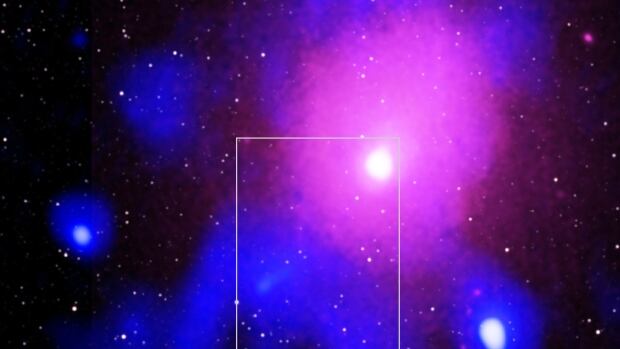
Astronomers have discovered the biggest explosion seen in the universe, originating from a super-massive black hole.

Scientists reported Thursday that the blast came from a black hole in a cluster of galaxies 390 million light-years away.

The explosion was so large it carved out a crater in the hot gas that could hold 15 Milky Ways, said lead author Simona Giacintucci of the Naval Research Laboratory in Washington.

It’s five times bigger than the previous record holder.

Astronomers used NASA’s Chandra X-Ray Observatory to make the discovery, along with a European space observatory and ground telescopes. They believe the explosion came from the heart of the Ophiuchus cluster of thousands of galaxies: a large galaxy at the centre contains a colossal black hole.

First hint of explosion came 4 years ago

Black holes don’t just draw matter in. They also blast out jets of material and energy.

The first hint of this giant explosion actually came in 2016. Chandra images of the Ophiuchus galaxy cluster revealed an unusual curved edge, but scientists ruled out an eruption given the amount of energy that would have been needed to carve out such a large cavity in the gas.

The two space observatories, along with radio data from telescopes in Australia and India, confirmed that the curvature was, indeed, part of a cavity.

“The radio data fit inside the X-rays like a hand in a glove,” co-author Maxim Markevitch, of NASA’s Goddard Space Flight Center in Maryland, said in a statement. “This is the clincher that tells us an eruption of unprecedented size occurred here.”

The blast is believed to be over by now: There are no signs of jets currently shooting from the black hole.

More observations are needed in other wavelengths to better understand what occurred, according to the team.

The findings appeared in the Astrophysical Journal.


Source link

Categories
Tech

Earth has captured a new mini-moon


Earth has a tiny new companion in its journey around the sun — at least for now.

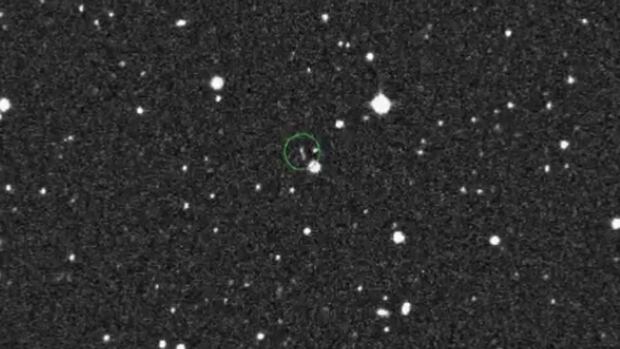
The new “mini-moon” is an asteroid called 2020 CD3. It’s about 1.9 to 3.5 metres in diameter, roughly between the size of a cow and a hippopotamus.

It was confirmed to have been captured and “temporarily bound to Earth” by the International Astronomical Union’s Minor Planet Centre at the Smithsonian Astronomical Observatory on Tuesday. The organization is responsible for the designation of minor bodies in the solar system.

The asteroid was discovered by Kacper Wierzchos and Theodore Prune, astronomers with the Catalina Sky Survey, on Feb. 15, Wierzchos said in a tweet that described it as “big news.”

The Catalina Sky Survey is a NASA-funded project based at the University of Arizona that catalogues potentially hazardous asteroids.

“It’s a big deal as out of ~1 million known asteroids, this is just the second asteroid known to orbit Earth,” Wierzchos said.

The first was 2006 RH120, also found by the Catalina Sky Survey, which most recently orbited Earth between Sept. 2006 and June 2007. It has since resumed orbiting the sun.

The reason mini-moons orbit Earth for such a short time — compared to the moon, which has been orbiting Earth for more than four billion years — is that they’re pulled by the Earth’s, the moon’s and the sun’s gravity at the same time, producing irregular orbits.

At some point, the sun’s gravity will win, and the object will break free from its orbit around Earth.

However, so far, astronomers estimate that 2020 CD3 has already been orbiting the Earth for about three years.

Even though mini-moons are rarely discovered, a University of Hawaii study in 2011 calculated that there should be at least one asteroid with a diameter of at least one metre orbiting Earth at any given time. On average, such a mini-moon would orbit Earth for nine months, but some could orbit for decades, it estimated.


Source link

Categories
Tech

There are 2 different species of red pandas, genetic study shows


Red pandas, the bushy-tailed and russet-furred bamboo munchers that dwell in Asian high forests, are not a single species but rather two distinct ones, according to the most comprehensive genetic study to date on these endangered mammals.

Scientists said on Wednesday they found substantial divergences between the two species — Chinese red pandas and Himalayan red pandas — in three genetic markers in an analysis of DNA from 65 of the animals.

The recognition of the existence of two separate species could help guide conservation efforts for a mammal adored by many people even as its numbers dwindle in the wild, they added.

Chinese red pandas are found in northern Myanmar as well as southeastern Tibet, Sichuan and Yunnan provinces in China, while Himalayan red pandas are native to Nepal, India, Bhutan and southern Tibet in China, the researchers said.

International experts have estimated a total population of roughly 10,000 red pandas in the wild.

“To conserve the genetic uniqueness of the two species, we should avoid their interbreeding in captivity,” said Chinese Academy of Sciences conservation biologist Yibo Hu, who along with colleague Fuwen Wei led the study published in the journal Science Advances. “Interbreeding between species may harm the genetic adaptations already established for their local habitat environment.”

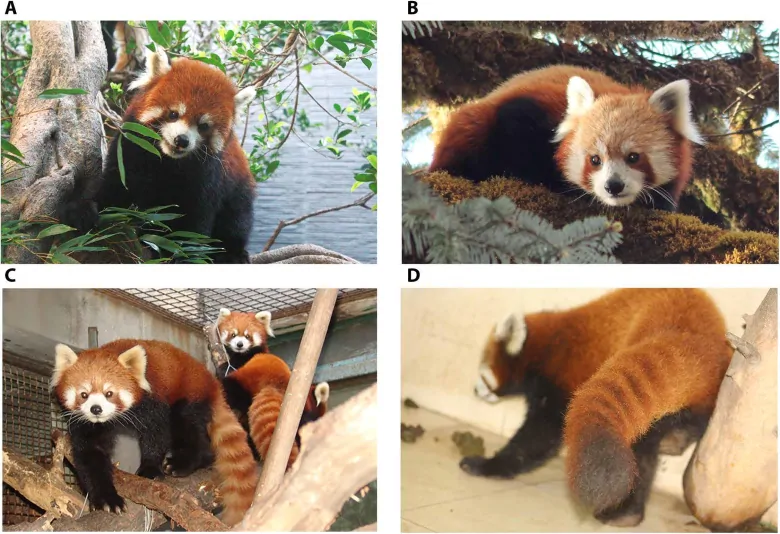
A figure from the paper shows the Chinese red panda ((A and C) has a redder face with less white on it than the Himalayan red panda (B and D). The tail rings of the Chinese red panda are also more distinct than those of the Himalayan red panda. (Yunfang Xiu, Arjun Thapa, Yibo Hu, Chiranjibi Prasad Pokheral via Science Advances)

Scientists previously recognized red pandas as divided into two subspecies. While it had been proposed that these were separate species, the new study was the first to provide the genetic data necessary to allow such a judgment.

The Himalayan red panda is the scarcer of the two and needs urgent protection because of low genetic diversity and small population size, Wu said. The Yalu Zangbu River most likely marks the geographical boundary separating the two species, not the Nujiang River as previously believed, Wu added.

How to tell the difference

The two species also differ in colouration and skull shape.

“The Himalayan red panda has more white on the face, while the face coat colour of the Chinese red panda is redder with less white on it. The tail rings of the Chinese red panda are more distinct than those of the Himalayan red panda, with the dark rings being more dark red and the pale rings being more whitish,” Hu said.

A red panda walks on a snowy branch at Cotswold Wildlife Park in Burford, western England January 6, 2010. Chinese and Himalayan red pandas were previously considered different subspecies, but not separate species. (Eddie Keogh/Reuters)

Slightly bigger than a domestic cat, red pandas have thick fur, a short snout and pointed ears, spending much of their life in trees and dining mostly on bamboo. Major threats to red pandas include deforestation and degradation of their habitat due to human development.

Despite similar names, red pandas and giant pandas are not closely related. Giant pandas are one of the world’s eight bear species.

Red pandas, with no close living relatives, are sometimes called living fossils as the only remaining member of the Ailuridae mammalian family. They are probably most closely related to a group that includes weasels, raccoons and skunks.


Source link

Categories
Tech

Hopes for supernova are dimming as Betelgeuse brightens


It appears that the hopes of people who wanted a nearby star to explode have been dashed. 

After weeks of unprecedented dimming, Betelgeuse — a star in the constellation Orion — is beginning to brighten again.

Both professional and amateur astronomers had been keeping a close eye on the unusual dimming of the red supergiant star, as its brightness decreased to the lowest in recorded observational history. Some had hoped that its fading was indicative of an impending explosion, a supernova.

But the fact that Betelgeuse is brightening is exactly what professional astronomers were expecting.

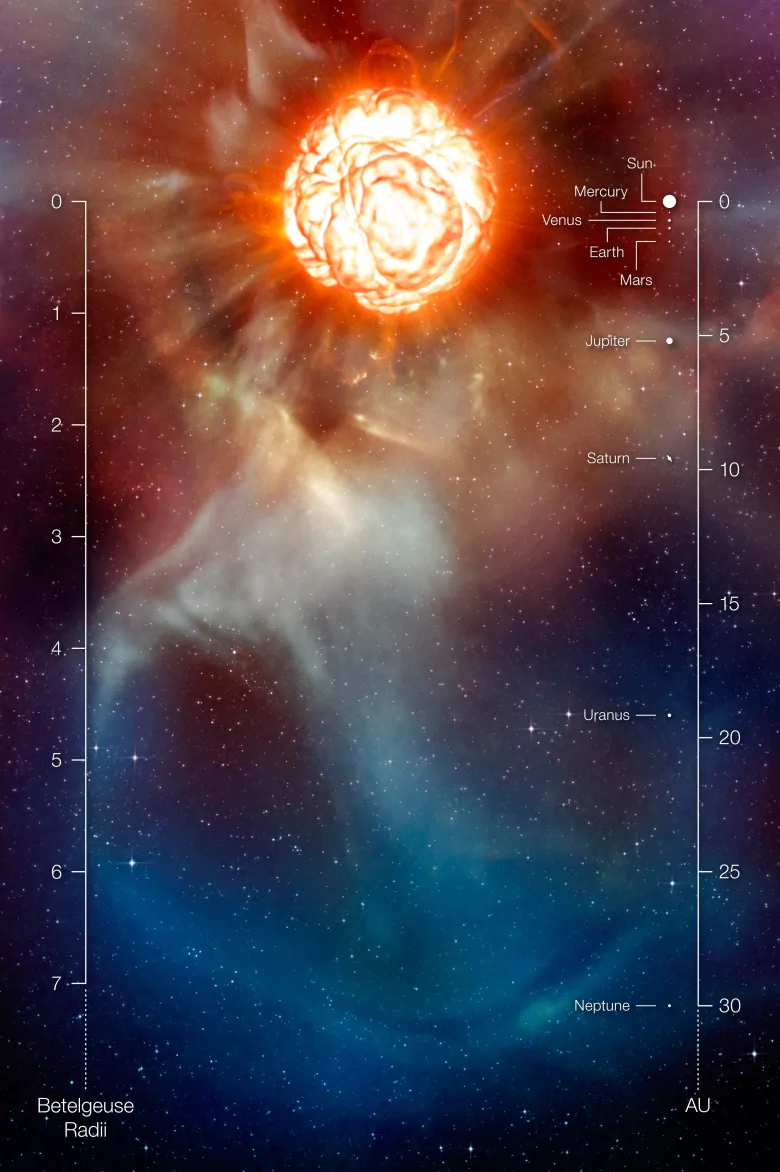
Betelgeuse is a fascinating star to astronomers. The red supergiant is 14,000 times more luminous than our sun and roughly 1,400 times larger. It is surrounded by dust and gas that, if it were at the centre of our solar system, it would stretch all the way to Neptune.

It is also a semi-regular variable, meaning that its brightness waxes and wanes in cycles. 

This artist’s impression shows that Betelgeuse has a vast plume of gas almost as large as our solar system and a gigantic bubble boiling on its surface. (ESO/L. Calçada)

When red supergiants die, they do so in a spectacular fashion, exploding as a supernova. And while Betelgeuse is at the end of its lifespan, astronomers believe that it still has roughly 100,000 years or more to go. But because these types of stars aren’t completely understood, they can’t be certain.

And that’s where the hope lay with Betelgeuse’s dimming.

But astronomers had hypothesized that two of its three cycles — one that is roughly 430 years, one that is roughly six years and one that is roughly between 100 to 180 days — had converged, leading to its extreme dimming. And they believed that somewhere at the end of February, it would begin to recover.

‘Still very cautious’

So Betelgeuse’s brightening is right on schedule, which supports their hypothesis. However, they’re still waiting for more data.

“At this point we’re still very cautious about screaming, ‘Oh, we were right! We know what’s happening!'” said Stella Kafka, chief executive officer of the American Association of Variable Star Observers, an organization that monitors variable stars. “But the data shows us Betelgeuse’s brightness is increasing.”

Though it appears that Betelgeuse won’t go supernova, it’s provided a wealth of information on a class of stars that aren’t well understood. And that, in and of itself, is exciting, Kafka said. 

As well, the strangeness of Betelgeuse has been widely reported, and it’s resulted in non-astronomers looking at the night sky, something that Kafka thinks is remarkable.

“It’s really exciting that we’re all in this together. It’s one of those things that the whole community, the whole world is looking at Betelgeuse trying to figure out what’s going on,” she said. “We’re learning from it.”

Another important takeaway from the recent activity on Betelgeuse is that it serves as a reminder that the sky isn’t as static as we may think; that it can change even in our lifetimes, Kafka said. And studying something relatively nearby that is evolving sheds some light on how our solar system and life on our planet may have begun.

“That’s why astronomy is so interesting to everybody. It satisfies this fundamental question … where do we belong?”


Source link

Categories
Tech

Fossil fuel, climate change research 'being done in secret,' says university prof behind lawsuit


Academic freedom is at the heart of a court case between a University of Regina professor and her employer.

Emily Eaton is an associate professor in the department of geography and environmental studies at the U of R. As part of her research into the effects of the fossil fuel industry on Saskatchewan education, she submitted a freedom of information request to the U of R for the names of the private funders who donated money to research on oil, gas, coal and climate change.

The university refused.

The U of R says disclosing this information would scare off much-needed private donors and that it is defending academic freedom by protecting the ability of its academics to confidentially conduct controversial research.

Eaton is concerned the university is allowing research to be done in secret.

“They’re arguing that because energy research can be controversial, we shouldn’t have to disclose the name of funders in order to shield university researchers from a public controversy,” she said.

“Certainly the university should never fire anybody for pursuing their research whatever that might be. And nobody should be interfering with that research. But it doesn’t mean that research should be shielded from public discussion.”

‘Research being done in secret’

The Local Authority Freedom of Information and Protection of Privacy Act states the University of Saskatchewan, the University of Regina, or hospitals or health centres are allowed to refuse to share details of academic research, though they must share the title of the research and the amount of funding being received.

Eaton has also requested the identity of the funding agency and the funding recipient.

“I would maintain that if they’re not willing to do that … we’re basically green-lighting research being done in secret at academic institutions,” Eaton said. 

“That’s a conversation that we haven’t had nationally about the capacity of private corporations to do research in secret at public institutions.”

A ‘chilling’ effect on research

In its statement of defence, the university said providing the identity of the funding agency and the funding recipient could have a “chilling” effect on research funding.

The U of R said researchers don’t want others to know who their funders are because they’re worried competing researchers will also ask those funders for support, which could reduce future investments.

In cases where research is being undertaken to develop “bleeding edge technology,” the university said a company finding out their competitor is undertaking certain research could be detrimental.

An example the university gives is that “Ford would be very interested to learn that Toyota has given a university $15 million to fund a research project into solar powered vehicles.”

In some cases, the U of R said, the funder is controversial, and disclosing who it is could create safety concerns, “and the possibility of protests or other steps to hinder, interfere with or prevent the progress of the research project,” reads the university’s statement of defence. 

‘Threat to academic freedom’

Eaton said private contracts for research often have restrictive requirements, including being unable to publish the results depending on what you find.

“If they’re attaching strings to your funding, [the corporations] are actually a greater threat to academic freedom than disclosing that they’re funding it, as the university is arguing.”

The university said it will provide her with research files that have been made public and, for all other records, determine whether any exemptions apply. 

Eaton agreed that there is likely research where it is reasonable to withhold this information but said that needs to be decided on a case-by-case basis.

Eaton received $24,000 worth of financial support for the court case, including $12,000 from the Canadian Association of University Teachers and $12,000 she raised privately.

Eaton and the U of R argued their cases Wednesday at the Court of Queen’s Bench. A decision is expected to come this summer.


Source link