Researchers at the University of Guelph have developed a system to help track the spread of infectious diseases using Twitter, a framework they say has the potential to identify outbreaks faster than official monitoring agencies.
The study, which tracked global outbreaks of avian flu, may be the first of its kind to use the social network as an early warning system for tracking diseases.
The team of veterinary and computer science researchers used artificial intelligence and machine learning to analyze over 200,000 tweets for mentions of avian flu, and then sorted that data to help reveal clues about where the disease is spreading.
They say they detected 75 per cent of real-world outbreaks of avian flu in poultry between between July 2017 and November 2018.
“Our web robot monitors the Internet 24/7,” said Shayan Sharif, a professor and associate dean at the Ontario Veterinary College. “We then go back to those tweets, we try to annotate them essentially to identify a background noise from the actual data that can be utilized in order to train the machine.”
Potential use against coronavirus
They’re now turning their attention to COVID-19 as well.
“In the context of coronavirus, people may talk about their signs and symptoms such as fevers, aching all over their body, or having shortness of breath,” he said. “We’d then try and utilize those types of keywords in order to train our machine.”
Sharif said the framework has been able to identify potential avian flu outbreaks before conventional monitoring systems, something he hopes could be of help monitoring COVID-19 and other human pathogens.
He said, the immediacy of Twitter data means monitors can glean information on a potential outbreak without having to wait for results from distant laboratories.
“There’s is a huge gap between the time that a case is detected and the time that the case is confirmed, for example, coronavirus or avian influenza,” he said. “People start talking about their own signs and symptoms well ahead of that.”
The research was published in the journal Nature Scientific Reports in December. The paper’s lead author, computer science professor Rozita Dara, says they hope the system can be used to predict outbreaks earlier “as a supplemental source of surveillance.”
A robotic servicing satellite brought new life to a defunct communication satellite in a major step towards reducing the growing problem of space junk orbiting Earth.
Aerospace giant Northrop Grumman’s Mission Extension Vehicle (MEV-1), which was launched last October, caught up to, then attached itself to INTELSAT 901, in the first ever docking of two commercial spacecraft. The communication satellite had run low on fuel and was taken out of service in December.
Now that they’ve caught the communications satellite, engineers will do some testing of the new twin spacecraft, and soon the MEV-1 vehicle will use its engines to manoeuvre move the INTELSAT back into its operating orbit so it can resume its telecommunications functions. The operators expect to wring another five years life out of INTELSAT 901. After that, MEV-1 will move both satellites into a slightly higher “graveyard” orbit where they will be out of the way of newer satellites that will replace them.
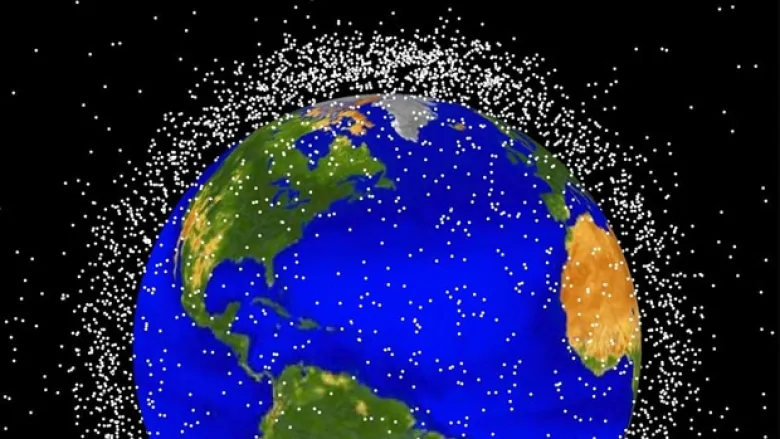
According to the European Space Agency, there are 5,500 satellites in orbit around Earth, with only 2,200 still operating. In addition to all the dead satellites drifting around, there are also many tens of thousands of smaller but substantial objects, such as pieces from rocket boosters and debris from collisions that have already happened, and millions of tiny, but still dangerous, sub-centimetre-sized fragments.
This computer generated graphic from NASA illustrates objects being tracked by NASA. Low Earth orbit, located 2,000 km above the Earth’s surface, has the highest concentration of space debris. (NASA)
That’s a lot of junk circling the planet. Objects in low orbit can be travelling at 30,000 km/h, so collisions with even a small piece of debris can cause a lot of damage. As more and more satellites are launched, especially large constellations of small satellites like the SpaceX Starlink project, the problem of space clutter is growing.
This new strategy allows companies like Northrop Grumman to help with that problem by reducing the number of new satellites they need to send up by extending the lives of the old ones. One of the reasons many satellites reach the end of their lives is because they simply run out of manoeuvreing fuel, so a perfectly good, multi-million dollar instrument becomes useless because it can no longer keep itself in position with the antennae pointed at Earth.
A servicing satellite like an MEV could act as a tow truck providing roadside assistance, such as fuel, diagnostics, and in the future, even robotic repairs. They might also be useful for towing derelict satellites into safe disposal orbits so as to avoid dangerous collisions. And perhaps in the future something like MEV could help multiple satellites — moving from one to another breathing life into ailing instruments.
Satellite servicing is not new. The Hubble Space Telescope was visited five times by space shuttle astronauts who installed corrective optics for a flawed mirror, replaced instruments, solar panels, batteries and not only extended its life, but made it a much better instrument than it was when it was launched.
But those servicing missions were very expensive because they were carried out by people. To do that for all the other satellites in orbit would involve astronomical costs, which is why robotic servicing makes so much more sense.
This Feb. 8, 2019 image from video made available by the RemoveDEBRIS Consortium shows a harpoon striking a square target mounted 1.5 metres from the RemoveDEBRIS spacecraft. The same team used a net to capture a piece of space junk, in a test in September 2018. (RemoveDEBRIS Consortium via AP)
Communication satellites are good targets for refurbishment because they all circle Earth in the same geostationary orbit. This is a ring around the equator 35,785 km high where a satellite takes exactly 24 hours to circle the Earth once, which is the same time it takes Earth to turn in a day. This keeps the satellite over the same spot on the ground, which is why rooftop satellite dishes point to only one spot in the sky.
This arrangement of all the satellites draped around the planet like a string of pearls might make it easier for an MEV to service more than one satellite per flight because they are all lined up in the same orbit. This is quite different from low Earth orbit where satellites are flying around at many different altitudes, speeds and directions, making it difficult to catch more than one at a time.
Other proposals to deal with space junk involve harpoons, nets or even high-powered lasers to drive space junk down into the atmosphere. Servicing satellites like an MEV could be a much more efficient approach in some cases, allowing old satellites to remain functional longer, perhaps reducing the amount of junk that is put up in the first place.
On a cold winter day in Idaho in 2017, a light dusting of snow fell from the sky. For the first time, scientists are able to say with certainty that it fell because humans made it happen.
“We were really, really excited,” atmospheric scientist Katja Friedrich told Quirks & Quarks host Bob McDonald. “We got really hooked on this idea of, OK, we can do it one day, we can do it the next day.”
The team of researchers were testing cloud seeding, a technology designed in 1946 by chemist Vincent Schaefer, which involves infusing clouds with particles to turn lightweight water droplets into heavy droplets of rain or snow. Cloud seeding is used as a part of weather modification programs in countries around the world to attempt to do things like steering precipitation to drought-prone areas, or to enhance snowpack on ski hills. In Canada, it’s often used to try to lessen the impact of hailstorms.
But the problem is that until now, scientists hadn’t come up with a way to prove that cloud seeding actually worked outside of the lab.
“We had difficulties distinguishing what is generated naturally and what is generated by humans,” said Friedrich, an associate professor in the Department of Atmospheric and Oceanic Sciences at the University of Colorado Boulder.
This is the first time that scientists have definitively been able to accurately measure the amount of snow produced through cloud seeding. The researchers published their findings in the journal PNAS.
‘Nature usually does not produce zigzag lines’
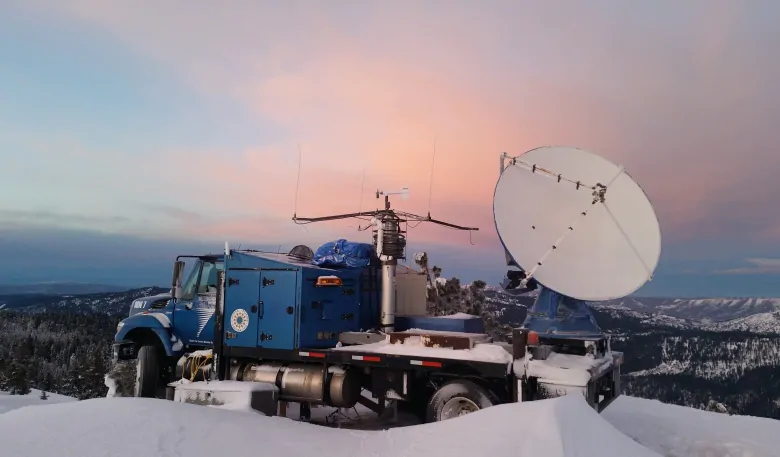
Over three days in January 2017, the team of researchers tracked three separate cloud seeding events from start to finish. They used the “Doppler on Wheels” ground-based radar system, as well as the University of Wyoming’s King Air research plane, which is outfitted with radar and LIDAR systems to peer into atmospheric formations.
The research plane mapped the natural clouds first. Then, another plane flew through those clouds, using a series of flares to inject particles of silver iodide inside.
Researchers used a variety of tools, including this ‘Doppler on Wheels’ radar dish, to track cloud seeding events. (Joshua Aikins)
Immediately the researchers saw something strange in the clouds forming in the sky behind the seeding airplane.
“We suddenly saw these zigzag lines, and we were very puzzled because nature usually does not produce zigzag lines. So in this case we thought, OK these need to be seeding lines,” said Friedrich.
Seeing the same developments the second day confirmed their suspicions.
“The second day, we saw these same seeding lines, and on that day we could even see individual flares … and then we were totally hooked,” she said.
The University of Wyoming’s King Air research aircraft prepares for flight from Boise Airport to participate in the SNOWIE Project. (Jeff French)
The team was able to watch as the liquid water inside the clouds turned into ice, and the snow started to fall. It wasn’t much — about a tenth of a millimetre of snow — but covering an area of 80 by 80 kilometres, that ended up being the water equivalent of 282 Olympic-sized swimming pools.
“At the beginning, we were not quite sure whether that is us and whether this is really from cloud seeding. But then once we could reproduce those results several times, then we actually got more confident,” she said.
“So if we hadn’t seeded the cloud there would not have been any precipitation on the ground.”
Potential Downsides
Cloud seeding is still a controversial technology for some.
“There are some potential downsides that we don’t think about too much,” Robert Jackson, Stanford University’s Earth Sciences Chair said in a 2017 interview on The Current. “One issue is where the rain would have fallen if you hadn’t cloud seeded. Does a cloud seeding event in Alberta keep a farmer in Saskatchewan from getting rain that he or she might have received?”
“So you’re extracting moisture from the atmosphere. That’s absolutely correct. However, these clouds would not precipitate in the area,” said Friedrich. “They can evaporate and maybe they fall down as precipitation over the ocean.”
“On the other hand, the snowpack in the mountains is really important, and millions of people and industries depend on this snowpack.”
She adds that in drought-stricken areas, every drop of water helps, even if that drop is human-made.
“I always say it depends on the cost of water. So if you’re in an area that’s very arid and dry and you’re under drought conditions, then every drop counts. So then why not do cloud seeding?”
University of British Columbia astronomy student Michelle Kunimoto has an out-of-this world job.
Kunimoto scours space for undiscovered planets. And she’s just uncovered 17 new possible ones, including a potentially habitable, Earth-sized world.
“This is a big discovery and definitely one that I’m most excited about,” said Kunimoto.
Her findings are still considered planet candidates, meaning they need to go through additional verification to be considered confirmed planets, which takes more time and research.
Kunimoto, who is working on her PhD in the Department of Physics and Astronomy at UBC, combs through data gathered by NASA’s Kepler mission which surveyed the Milky Way galaxy between 2009 and 2013.
“All the data is publicly available,” Kunimoto said. “I was able to go on to an Internet archive where all the data is available and I just downloaded it all.”
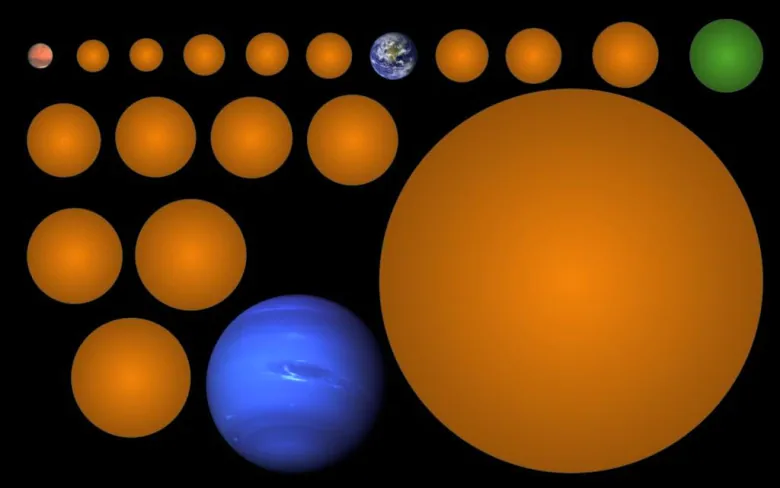
Sizes of the 17 new planet candidates, compared to Mars, Earth, and Neptune. The planet in green is KIC-7340288 b, a rare rocky planet in the Habitable Zone. (Michelle Kunimoto)
The planets she found are thousands of light years away and not visible from earth, even with the most powerful telescopes. Instead, Kunimoto looks for evidence using the “transit method.”
“Essentially, every time a planet passes in front of a star, it blocks a portion of that star’s light,” Kunimoto said. “So, I was looking for signs of these temporary decreases in brightness.”
Of the 17 instances she found that indicate planets, one of them is particularly rare: the KIC-7340288 b planet.
It’s about one and half times the size of Earth — small enough to be rocky, instead of gaseous like larger planets — and at a specific distance from its star that is considered habitable because it could have enough atmospheric pressure to support water.
“Obviously, this has important implications for searching for signs of life,” Kunimoto said.
“If it does get confirmed, it’ll be among the one of the rarest planets that we found so far.”
Kunimoto is no stranger to discovering planets: she previously discovered four during her undergraduate degree at UBC. (Martin Dee)
This is not the first time Kunimoto has discovered new planets, she previously found four during her undergraduate degree at UBC.
Her latest findings, co-authored by her PhD supervisor Jaymie Matthews and UBC alumnus Henry Ngo, were published in The Astronomical Journal last week.
“It’s the product of months and months — years, really — of work to finally reach the point where you can say that you’ve discovered a new planet candidate,” Kunimoto said.
Each year, grey whales travel more than 16,000 kilometres along the Pacific Coast, from Mexico to Alaska and back. But every so often, many of them — sometimes hundreds — become stranded.
It’s not completely clear how grey whales navigate the depths of the ocean during this long journey, but one hypothesis is they use Earth’s magnetic field as a sort of road map.
Now a new study, published in the journal Current Biology, further supports that hypothesis, going so far as to suggest the reason for the mass strandings could be linked to solar storms and how that activity affects Earth’s magnetic field.
The sun and Earth
The sun’s activity doesn’t take place in isolation; Earth — in fact, every planet in the solar system — is affected by it.
One form of solar activity comes in the form of sunspots, the darker, cooler regions that form on the sun’s surface.
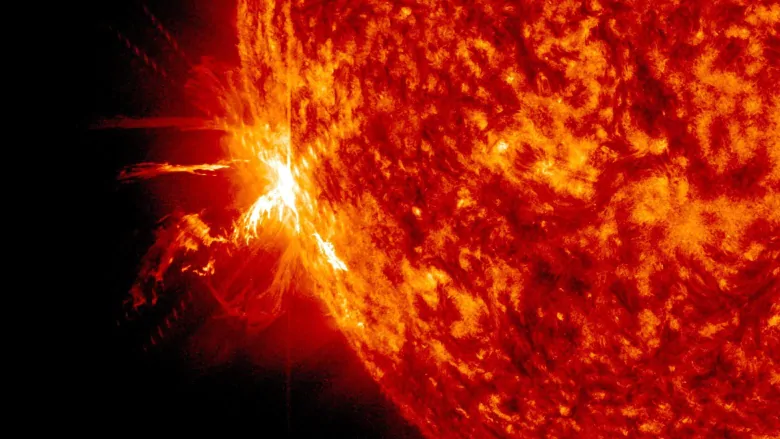
Sunspots have magnetic field lines that can become entangled, like an elastic band, and can snap, releasing a solar flare. These flares produce large eruptions of electromagnetic radiation that can last from minutes to hours.
Travelling at the speed of light, if one of these eruptions reach Earth, it can cause radio blackouts. They also affect animals.
This image provided by NASA’s Goddard Space Flight Center shows a significant solar flare erupting on June 10, 2014. (Goddard Space Flight Center/Associated Press)
Many species, such as lobsters, frogs and snails, use magnetoreception — or a sense that allows them to use the Earth’s magnetic field — for navigation.
There could be two ways in which animals can sense a magnetic field.
One is they have magnetite particles somewhere in their bodies, or even throughout it — something the study’s lead author Jesse Granger refers to as “little iron compass needles.”
Another explanation could be a method known as “radical pair mechanism,” where a magnetically sensitive chemical reaction is triggered depending on which way an animal is facing.
While lots of research supports both hypotheses, there has been no direct evidence recorded.
Whale GPS
Granger — a PhD biology student at Duke University who specializes in sensory migration — wanted to specifically explore how animals used magnetoreception to navigate. She was also intrigued by the idea that grey whales can navigate such vast distances with such precision.
“Meanwhile, I can’t find my way to the grocery store without my GPS,” she joked. “How are they doing this? This is crazy.”
Granger and her co-authors examined 186 live strandings — whales that had “no signs of injury, illness, emaciation, or human interaction” — dating from 1985 to 2018, and found they occurred “significantly” more often on days where the sun had several sunspots, compared to days it didn’t.
On those days, the chances of a stranding more than doubled.
Granger’s first hypothesis was that the sun pushes out high-particle storms, which, in turn, push around Earth’s magnetic field, disorienting the whales.
“The whale thinks it’s on Third Street when it’s actually on Eighth Street,” said Granger. “And it ends up, perhaps, in a pinch point — somewhere it can’t get out of. Or it ends up in a very high riptide, and then gets sucked on the land.
“Perhaps if it had a better idea of where it was located, it wouldn’t have ended up in a bad place.”
A grey whale washed up on Ucluelet Beach on Vancouver Island’s west coast in 2016. The species is not yet considered endangered, but it is listed as a species of special concern. (Les Doiron)
But the findings didn’t support that. So they turned to a variable known as radio frequency noise as something that could potentially affect the whales’ navigation.
“We know that radio frequency noise will prevent an animal from sensing magnetic fields,” said Granger. “It was like a light bulb went off.”
The researchers had a new hypothesis.
“Do we think that perhaps solar storms are turning off [the whales’ ability] to see its magnetic field altogether?” said Granger. “Like they had a GPS and it just turns it off mid-trip?”
Coupled with the sunspot data, they saw a stronger relationship between solar storms and the strandings.
But Granger warns that correlation doesn’t necessarily lead to causation.
“We were really excited,” she said. “But a lot of caution is still needed when you’re talking about these sorts of statistical correlation studies.… This is what we found — and that’s one explanation for why we would see that relationship.”
Klaus Heinrich Vanselow is a marine biology expert at the University of Kiel in Germany who researches sperm whale strandings in the North Sea and has written several papers on with similar findings.
He echoes the idea that the paper is a good start at identifying the potential interactions between radio frequencies and whale strandings, but that more research needs to be done.
“Because they say it’s only a property of the phenomenon — it’s not the real interaction,” he said. “I think in the future, there must be much more research.”
Hello, people! This is our weekly newsletter on all things environmental, where we highlight trends and solutions that are moving us to a more sustainable world. (Sign up here to get it in your inbox every Thursday.)
This week:
Even if geoengineering can help mitigate climate change, is it ethical?
Palm oil production is on the rise
Reader feedback on zero-waste shopping
Even if geoengineering can help mitigate climate change, is it ethical?
(Karl-Josef Hildenbrand/Getty Images)
The Intergovernmental Panel on Climate Change (IPCC) and scientists from around the world have said it time and again: CO2 emissions need to be radically reduced in order to stop the world from warming to a point where it will trigger catastrophic climate change.
But radical reductions aren’t in place right now, which is why some scientists and policymakers are considering a controversial option: geoengineering, or the deliberate manipulation of the environment.
The discussion has recently taken centre stage as the National Oceanic and Atmospheric Administration in the U.S. received $4 million to research geoengineering, with no confirmation as to what that might look like.
One of the more popular methods of geoengineering is solar radiation management (SRM). In this method, particles of sulphur or calcium carbonate are sprayed into the stratosphere, which makes solar radiation “bounce” off clouds back into space, creating a cooling effect. It’s the same process that happens after a large volcanic eruption.
Thus far, geoengineering studies have been done primarily in labs using models. It’s unknown whether it would produce the desired effect on a larger scale or what the consequences might be.
“If you’re talking about justice and equity, then the impacts of changing rainfall patterns are going to fall disproportionately on the poorest around the world,” said Emily Cox, an environmental policy researcher at Cardiff University as well as the Tyndall Centre for Climate Change Research in the U.K.
Cox also noted that there is a philosophical discussion around intentional versus unintentional harm. For example, burning coal and emitting CO2 isn’t limited to borders and is already causing unintended consequences. Similarly, if we employ SRM, we could be causing unintentional harm for other countries.
“Everything we do affects other nations,” she said.
David Keith is a Canadian professor of applied physics at the John A. Paulson School of Engineering and Applied Sciences at Harvard University, which is home to one of the leading geoengineering labs in the world. He disputes the findings that state SRM will increase precipitation.
There is clearly still dispute over the effects of geoengineering, but given the potential differences in outcome, it’s unlikely every country in the world will agree on the specifics of SRM. So what happens when one country says it doesn’t support it? How ethical would it be for another country to simply proceed?
There are “big philosophical questions here,” said Cox. As a result, “there’s a real danger of polarization.”
— Nicole Mortillaro
Reader feedback
Marianne Wyne wrote in to say, “I would love to learn more about all the different renewable energy projects that are either underway or being planned across Canada. All news seems focused on the fossil fuel energy sector and the projects underway or the ones that have been shut down.” As an example of a low-carbon initiative, Wyne cited the Travers project near Vulcan, Alta., which will be Canada’s largest solar farm. “I think Canadians want to hear about all such projects,” she said.
We at What on Earth? agree, and will make more of an effort to highlight some of these emerging projects.
Palm oil has become a ubiquitous substance in modern life, showing up in the ingredient list of everything from candy and chips to infant formula and shampoo. It’s also used as a biofuel. Palm oil is, in fact, the world’s most commonly produced vegetable oil, and much of it comes from Indonesia and Malaysia. Palm oil’s many uses have inevitably led to greater worldwide consumption — and the establishment of ever more palm plantations has led to displacement of Indigenous peoples, loss of biodiversity and deforestation. Here’s a look at how palm oil production has gone up.
(CBC)
Hot and bothered: Provocative ideas from around the web
Car companies are gearing up to offer more electric vehicle options, and our colleague Don Pittis wrote about how this will disrupt the existing “fuel-retail network” — i.e. gas stations.
Readers share their zero-waste shopping tips
(Isabel Terrell/CBC)
Last week, Isabel Terrell wrote about her one-week attempt to buy groceries without packaging. She cited a number of wins, produce being the most obvious. But she also experienced some frustration — for example, in sourcing frozen foods and cooking oil without excessive packaging.
We asked readers to share their own triumphs and setbacks in zero-waste grocery shopping.
Wendy Jeske in Tsawwassen, B.C., had suggestions for protein items: “I have been buying meats from the butcher counter, so that they are wrapped in paper (as my mother used to do!), rather than buying meat that is placed on a plastic tray and wrapped in plastic film.” Jeske also said that she gets her eggs “from a local farm and they want the cardboard cartons only, so I keep returning them to the farm. No styrofoam or plastic cartons! Yay!”
Catherine Irwin-Gibson in Montreal said her fishmonger gives her “a 15 per cent discount for my own container, and just zeroes the scale with my container on it, then prints the label for the cost. Yes, there is a label and that’s the waste, but it’s much lower than the whole packaging and styrofoam and such nonsense like that.”
Irwin-Gibson also had a fix for frozen food. “Buy [produce items] fresh when they’re in season and freeze them yourself. That’s really the only way to avoid packaging.”
“I dusted off my bread machine and I make my own,” said Marcia Parker.
Kiirsti Owen in Truro, N.S., said she brings her own growler (large bottle) to local breweries to get beer and cider. She also put in a plug for the SodaStream home-carbonization system: “I was skeptical at first, but it’s greatly reduced the number of bottles/cans we use.”
Kaitie Hoffmann in Toronto rhymed off a list of things she has “successfully gotten package-free: meats (bacon, chicken breast, ground meat), cheese, milk, yoghurt, sour cream, cream cheese, bacon, breads, fresh and frozen veggies and fruit, oils (olive, etc.), spices, pasta, oatmeal, potato chips, honey, crackers, tortilla chips, peanut butter, chocolate bars, coffee, tea… you name it.” She accomplished this, she said, by bringing her own containers to bulk and grocery stores.
Alex Denicola has “completely eliminated plastic bottled liquid soap for both dishes (hand-washed) and the bathroom sink and shower for over 10 years now. We use both a ‘laundry bar’ soap and a ‘shampoo and conditioner’ bar soap made by a Toronto company, and they awesomely come with zero wrapping. What we do in the kitchen is simply run or pour hot water over the soap bar, and voila, we have a sink or basin of sudsy water.”
Some readers bemoaned the fact that it’s hard to go zero-waste outside of Canada’s urban centres.
Ghita Jones in Calgary talked about her efforts to live zero-waste, and made this point: “I do not live in the downtown core so I have to drive, with my containers, to get them refilled. The question comes up: Is it better to drive (I do not have an electric car, am on maternity leave with two children) and create more emissions and wear and tear on my third-hand vehicle to refill my cleaning products (that are more expensive) rather than buying some while I grocery shop at the local store that is five minutes away from my home?”
Julie Poole in Swan River, Man., wrote, “even though [zero-waste shopping] is possible in big cities like Toronto and Vancouver, it is actually totally impossible in rural Canada.” She said she wrote in “to voice my frustration that I want to do better, but the things I need are not available where I live. No bulk foods and no butcher.”
Kaitie Hoffman offered this parting insight: “I have heard that ‘it’s not about a small group of people doing this perfectly, it’s about a large group of people doing this imperfectly.’ I think that is an amazing message that hopefully will resonate with your readers and beyond. It’s not about going 100 per cent plastic/packaging-free — it’s about avoiding single-use plastics and other packaging where you can.”
Stay in touch!
Are there issues you’d like us to cover? Questions you want answered? Do you just want to share a kind word? We’d love to hear from you. Email us at whatonearth@cbc.ca.
Sign up hereto get What on Earth? in your inbox every Thursday.