Categories
Tech

Next-generation missiles could hold leaders hostage in times of conflict: top general


Advances in missile technology by both the Russians and the Chinese have the potential to paralyze leaders and decision-makers in a crisis, Canada’s top military commander warned in a speech Wednesday.

The remarks by Gen. Jonathan Vance, the chief of the defence staff, are among the most stark and forceful delivered to date about the urgency of re-imagining decades-old continental defence systems and arrangements.

The speech comes as the Liberal government begins to grapple with how to upgrade the aerospace warning systems at North American Aerospace Defence Command (NORAD). It’s an expensive, multi-billion, multi-year proposition that was not funded as part of the country’s defence strategy. 

Both Russia and China have begun to field advanced systems, including manoeuvrable cruise missiles and, more importantly, hypersonic missiles and glide vehicles, which could deliver large conventional warheads anywhere in the world within minutes.

Vance said Russia poses the most serious immediate military threat to the continent.  

Hypersonic missiles can travel at multiple times the speed of sound and there is no technology, currently available, that intercept — or shoot them down.

“We’re facing new, more advanced conventional missiles that can be launched from further away, travel faster and are more manoeuvrable,” Vance told the Ottawa Conference on Security and Defence.

Chief of the Defence Staff Jonathan Vance delivers remarks at the Ottawa Conference on Security and Defence in Ottawa, on Wednesday. (Justin Tang/Canadian Press)

“More importantly, they have the potential to hold North American decision-making hostage in a period of conflict, let alone threaten our force generation capacity and critical infrastructure. Even a modest attack could hamper or cripple Canadian response to crisis — or harm Canadians — or critical infrastructure.”

Addressing these challenges requires improved capabilities for surveillance and command and control, he added.

Last summer, CBC News reported that both Canadian and U.S. military leaders had sketched out and settled on what capabilities a revamped NORAD would need.

Vance said Wednesday there would be more public discussion later this year and that they have begun the work to identify and determine the “scope and cost” of the modernization.

Rob Huebert, a defence expert at the University of Calgary, describes the new generation of missiles as “game changers” and in some respects put military planners and political leaders in the same awkward space they were in when ballistic missiles first appeared over five decades ago.

Not ‘fear mongering’

Back then, there was no defence against the first intercontinental rockets. 

Critics have argued hypersonic missiles are now a reality because successive U.S. administrations have pushed the development of ballistic missile defence systems. 

Vance challenged his audience of defence and foreign policy officials and academics to take up the debate

“I’m not talking about fear mongering. I’m not talking about sensationalism. I’m talking about honest and informed discussions about the world we’re in,” he said.   

The Americans, at the moment, have yet to fully develop their own hypersonic missile capability, but the Pentagon said this week it intends to field the weapons across all branches, including the air force, navy, army and marines.

Gen. Jonathan Vance said Russia poses the most serious immediate military threat to the continent.   (Alexei Druzhinin/Sputnik/Kremlin Pool Photo/AP)

Testifying before the Senate Armed Services Committee in Washington last month, Admiral Charles Richard, the commander of U.S. Strategic Command, tried to reassure lawmakers that the U.S.will have adequate deterrence.  

“I am confident that this nation has the ability to produce the capabilities we have to have,” he said.

The Trump administration, in its 2021 budget, proposed spending $3.2 billion for hypersonic weapons — a 23 per cent increase over 2019. 

Arctic needs attention, says Vance

In his speech Wednesday, Vance argued that the threats to both Canada and the U.S. are more complex than missiles.

“Defending North America isn’t just about having the best point or area air defence.,” he said.

“The Armed Forces must have the capacity to help maintain our resiliency as a nation and the right capabilities to maintain a credible deterrent posture.” 

Vance cited the Arctic as one region that requires special attention.

“I am increasingly concerned about the Arctic as an avenue of approach” to North America, he said.

“This requires strengthening inter-agency and multi-national partnerships, increasing surveillance and military capabilities and improving our ability to base, project and sustain forces in the Arctic.”


Source link

Categories
Tech

Insurers warn federal government Canada can't wait a decade to update flood maps


Canada plans to focus its next budget on tackling climate change and its effects, but the insurance industry, amid skyrocketing costs, is concerned the government will move too slowly on the key first step of mapping flood risks.

Flood mapping is used to underwrite flood insurance, assess bank exposure across mortgage portfolios, inform home buyers, and plan new infrastructure. Prime Minister Justin Trudeau pledged sweeping climate action during his re-election campaign last year, including $150 million  for flood mapping. The federal budget is expected at the end of March.

“Flooding is by far the single greatest peril facing Canadians as a result of climate change,” Craig Stewart, vice president of federal affairs for the Insurance Bureau of Canada, told Reuters.

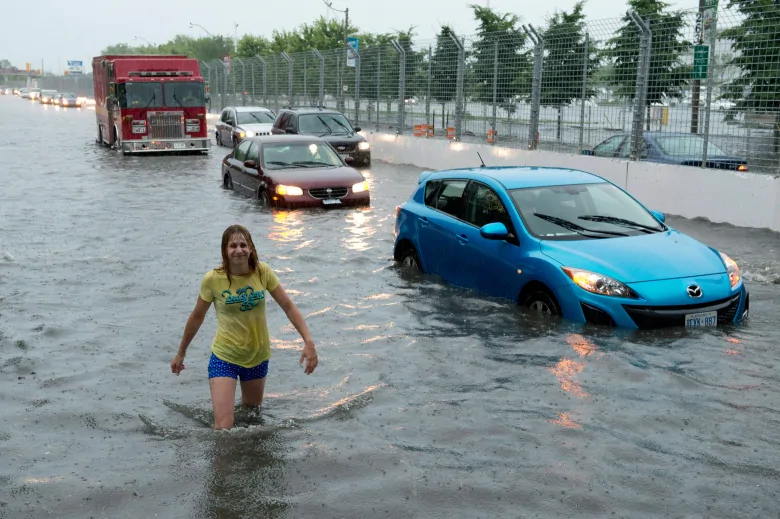
A woman wades through flood water on Lakeshore West during a storm in Toronto on Monday, July 8, 2013. (Frank Gunn/Canadian Press)

Stewart said the natural resources ministry is proposing doing the mapping itself with the focus only on fluvial — river and lake — flooding, in a process that would take 10 years.

The natural resources and finance ministries both declined to say whether such a measure would be in the budget.

“We can’t take a decade to complete flood maps for this country, and we need to make sure we’re mapping urban and coastal flooding as well,” Stewart said. He estimates it could be done within three years if the government collaborates with the private sector.

Out of date

A government source said the approach it will take on mapping has yet to be decided.

Current mapping is on average 20 to 25 years out of date, said Blair Feltmate, head of the University of Waterloo’s Intact Centre on Climate Adaptation Faculty of Environment.

Insurers spent $1.9 billion annually, on average, between 2009 and 2019 on catastrophic flooding claims, compared with an average of $422 million per year in the 1983–2008 period, according to Insurance Bureau data. The four-fold increase was driven mostly by flood loss and the majority of claims were residential.

Last year, a government-commissioned panel on sustainable finance also recommended a public-private partnership for the mapping.

A member of the expert panel, Tiff Macklem, the dean of Toronto’s Rotman School of Management and a former Bank of Canada senior deputy governor, said flood mapping is “an immediate priority.”

“The Expert Panel envisaged a model where the private sector would pay a membership fee,” Macklem said. “This type of model … would be both less expensive and provide higher-quality data.”


Source link

Categories
Tech

Doctors try CRISPR gene editing in a person's body for the 1st time


Scientists say they have used the gene editing tool CRISPR inside someone’s body for the first time, a new frontier for efforts to operate on DNA, the chemical code of life, to treat diseases.

A patient recently had it done at the Casey Eye Institute at Oregon Health & Science University in Portland for an inherited form of blindness, the companies that make the treatment announced Wednesday. They would not give details on the patient or when the surgery occurred.

We literally have the potential to take people who are essentially blind and make them see.– Charles Albright, Editas Medicine

It may take up to a month to see if it worked to restore vision. If the first few attempts seem safe, doctors plan to test it on 18 children and adults.

“We literally have the potential to take people who are essentially blind and make them see,” said Charles Albright, chief scientific officer at Editas Medicine, the Cambridge, Massachusetts-based company developing the treatment with Dublin-based Allergan. “We think it could open up a whole new set of medicines to go in and change your DNA.”

Dr. Jason Comander, an eye surgeon at Massachusetts Eye and Ear in Boston, another hospital that plans to enroll patients in the study, said it marks “a new era in medicine” using a technology that “makes editing DNA much easier and much more effective.”

Doctors first tried in-the-body gene editing in 2017 for a different inherited disease using a tool called zinc fingers. Many scientists believe CRISPR is a much easier tool for locating and cutting DNA at a specific spot, so interest in the new research is very high.

The people in this study have Leber congenital amaurosis, caused by a gene mutation that keeps the body from making a protein needed to convert light into signals to the brain, which enables sight. They’re often born with little vision and can lose even that within a few years.

Standard gene therapy not an option

Scientists can’t treat it with standard gene therapy — supplying a replacement gene — because the one needed is too big to fit inside the disabled viruses that are used to ferry it into cells.

“We literally have the potential to take people who are essentially blind and make them see,” said Charles Albright, executive vice president and chief scientific officer at Editas Medicine. “We think it could open up a whole new set of medicines to go in and change your DNA.” (Rodrique Ngowi/Associated Press)

So they’re aiming to edit, or delete the mutation by making two cuts on either side of it. The hope is that the ends of DNA will reconnect and allow the gene to work as it should.

It’s done in an hour-long surgery under general anesthesia. Through a tube the width of a hair, doctors drip three drops of fluid containing the gene editing machinery just beneath the retina, the lining at the back of the eye that contains the light-sensing cells.

“Once the cell is edited, it’s permanent and that cell will persist hopefully for the life of the patient,” because these cells don’t divide, said one study leader not involved in this first case, Dr. Eric Pierce at Massachusetts Eye and Ear.

Doctors think they need to fix one tenth to one third of the cells to restore vision. In animal tests, scientists were able to correct half of the cells with the treatment, Albright said.

The eye surgery itself poses little risk, doctors say. Infections and bleeding are relatively rare complications.

Unintended changes are the biggest risk

One of the biggest potential risks from gene editing is that CRISPR could make unintended changes in other genes, but the companies have done a lot to minimize that and to ensure that the treatment cuts only where it’s intended to, Pierce said. He has consulted for Editas and helped test a gene therapy, Luxturna, that’s sold for a different type of inherited blindness.

Dr. Jason Comander, inherited retinal disorder specialist at Massachusetts Eye and Ear Infirmary in Boston points to a model of an eye during an interview on Jan. 8, 2020. Comander’s hospital plans to enroll patients in a gene editing treatment for blindness study. (Rodrique Ngowi/Associated Press)

Some independent experts were optimistic about the new study.

“The gene editing approach is really exciting. We need technology that will be able to deal with problems like these large genes,” said Dr. Jean Bennett, a University of Pennsylvania researcher who helped test Luxturna at the Children’s Hospital of Philadelphia.

In one day, she had three calls from families seeking solutions to inherited blindness.

“It’s a terrible disease,” she said. “Right now they have nothing.”

Dr. Kiran Musunuru, another gene editing expert at the University of Pennsylvania, said the treatment seems likely to work, based on tests in human tissue, mice and monkeys.

The gene editing tool stays in the eye and does not travel to other parts of the body, so “if something goes wrong, the chance of harm is very small,” he said. “It makes for a good first step for doing gene editing in the body.”

Although the new study is the first to use CRISPR to edit a gene inside the body, another company, Sangamo Therapeutics, has been testing zinc finger gene editing to treat metabolic diseases.

Other scientists are using CRISPR to edit cells outside the body to try to treat cancer, sickle cell and some other diseases.

All of these studies have been done in the open, with government regulators’ approval, unlike a Chinese scientist’s work that brought international scorn in 2018. He Jiankui used CRISPR to edit embryos at the time of conception to try to make them resistant to infection with the AIDS virus. Changes to embryos’ DNA can pass to future generations, unlike the work being done now in adults to treat diseases.


Source link

Categories
Tech

'That's super exciting': New study finds this 'mini-Neptune' exoplanet could be potentially habitable


New research suggests K2-18b, a “mini-Neptune” that lies roughly 125 light-years from Earth, could be potentially habitable. 

Mini-Neptunes are planets less massive than Neptune, with barely any core or solid surface but with a thick hydrogen-helium atmosphere. However, there has been debate over whether these types of planets could host an environment that could be potentially habitable.

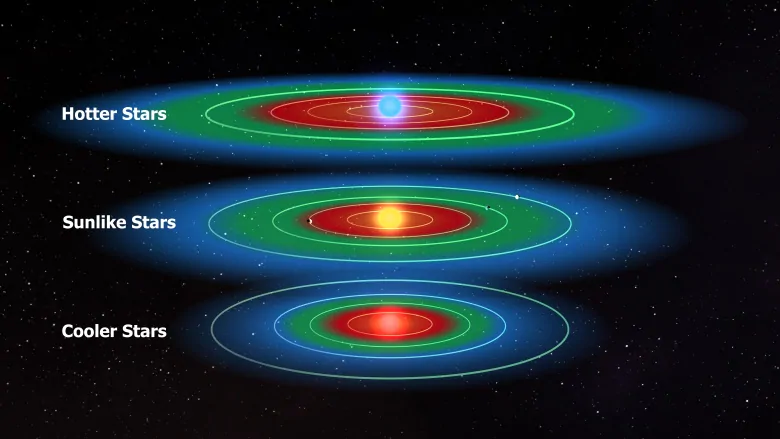
K2-18b, discovered in 2015, is part of a two-planet system, roughly 8.6 times the mass of Earth and 2.6 times the radius. It also lies within the habitable zone around its red dwarf star, a theoretical region where liquid water can exist on the surface of a planet.

The planet has been of particular interest since September 2019 when two independent research teams revealed the detection of water vapour in its atmosphere, marking the first time this had been detected on an exoplanet, a planet orbiting another star.

This diagram shows how the habitable zones of larger stars are wider and farther away the hotter the star is. For a star like K2-18b, it orbits around a cooler star. (NASA/Kepler Mission/Dana Berry.)

Though there was some excitement over the announcement, discussion arose as to whether or not K2-18b was indeed potentially habitable, with some astronomers arguing that conditions on the planet — such as its high pressure and temperature — would make this world unsuitable for life. Just because there was water vapour didn’t mean it was potentially habitable. 

However, the new study published in the Astrophysical Journal Letters, suggests that, under the right conditions, K2-18b could be indeed potentially habitable.

The team of astronomers collected data on the planet’s atmosphere, mass and more using the September 2019 findings as well as earlier studies. They then ran through several different scientific models that could account for their findings.

They finally boiled it down to three: 

  • A rocky world with a core that was 94 per cent iron with little water and a thick atmosphere of hydrogen-helium.
  • A mini-Neptune with an Earth-like core and more than 54 per cent water with a significant hydrogen-helium atmosphere .
  • A water world with a small Earth-like core and almost 90 per cent water with very little helium-hydrogen.

It’s the third scenario that surprised the researchers: it showed such a planet would be potentially habitable.

“Until the very end, even I didn’t know this was possible — that you could have liquid water on this planet. And I do this for a living,” said Nikku Madhusudhan, lead author of the new paper and an astronomer with the University of Cambridge’s Institute of Astronomy in the United Kingdom. “It was quite surprising.… We didn’t believe it for the longest time.”

Because the findings were such a surprise, the team did rigorous followup models.The results also suggested the atmospheric pressure would be amenable to life as would the “room-like temperature,” Madhusudhan said.

“My students joke that we tried for the longest time to make the habitability solutions go away,” he said. “But at the end of the day, we just couldn’t make them go away.”

WATCH | Water vapour found on K2-18b:

[embedded content]

Björn Benneke, an assistant professor at the Université de Montréal, who was the lead author of one of the 2019 papers that found K2-18b’s atmosphere contained water vapour, said the study was “exciting.”

“Among all the planets that we have found around other stars — something like 4,000 planets — 80 per cent … are in this category,” he said, referring to the mini-Neptunes. “It’s very important if you want to understand planets as a whole, if you want to understand why the Earth is like the Earth, if you want to understand why Neptune is like Neptune, that we understand at least the most common type of planet.”

‘Super exciting’

Trying to collect data on atmospheres of planets that are relatively small like Earth is difficult to do, as special telescopes are needed. But it’s easier with larger planets like mini-Neptunes.

And now that the door seems to be opening on finding larger planets that are potentially habitable, there’s the possibility of doing more observations of atmospheres on these mini-Neptunes.

“If there is one big-picture, philosophical conclusion to take away from this, it’s that we’ve shown for the first time planets … as large as this can also have habitable conditions,” Madhusudhan said. “Our search space has increased by a whole lot in the search for habitable planets. To me, that’s super exciting.”

Still, he’s looking forward to followup studies by independent astronomers since they can’t say for certain that K2-18b is habitable, just potentially habitable. But he said, that doesn’t mean astronomers should discount planets of this size in their search for habitable worlds.

“We’ve just opened an entire parameter space in our search for life. So to me, that’s a momentous step forward.”


Source link

Categories
Tech

Chinese social media censored coronavirus terms and criticism early in outbreak, report says


Chinese social media platforms began censoring references to coronavirus and keywords critical of the government’s handling of the infection as early as December, Toronto-based cyber research group Citizen Lab said in a report on Tuesday.
 
Chinese messenger app WeChat, owned by Tencent Holdings Ltd , and JOYY Inc.’s video streaming app YY blocked keyword combinations that included criticisms of President Xi Jinping, local officials and policies linked to the virus, the report found.
 
Citizen Lab said the findings, gathered between December and February, suggest that companies “received official guidance” on how to manage virus content in the early stages of the outbreak, which expanded throughout the testing period.
 
Blocked terms also included non-critical phrases related to public health and local rules, including “travel ban” and 
“people-to-people transmission.”

Tencent and YY did not immediately respond to requests for comment on Tuesday.

Chinese social media companies are subject to strict laws requiring them to censor content that “undermines social 
stability” or is critical of the central government, controls that have tightened under Xi.

The Cyberspace Administration of China, which oversees online content laws, did not respond to a request for comment on Tuesday.

China’s censorship policies have come under scrutiny since the virus outbreak amid allegations from netizens and local 
media that they potentially obscured the seriousness of the outbreak in its early stages.

The report said YY added 45 key phrases to an internal blacklist, including “Wuhan Unknown Pneumonia” and “Wuhan 
Seafood Market” on Dec 31, a day after eight people, including Dr. Li Wenliang, raised an alarm about the virus in a WeChat group and were subsequently punished by police for “spreading rumours.”

Li died of the virus in early February, sparking a wave of public mourning and fierce criticism of local officials online.

The Citizen Lab report said keywords relating to Li were censored after his death in February, including combinations of 
the words “virus,” “Li Wenliang,” “central government,” and “epidemic.”

It said said the group was able to collect a full list of newly added blacklisted words from YY during the period, and a 
sample from WeChat based on attempted keywords and combinations.

Censorship rules are strictly enforced in China, and internet companies have faced service suspensions and fines in 
the past for failure to fully comply with them.


Source link

Categories
Tech

Fossil identified as 'great-grandfather' of wolverines


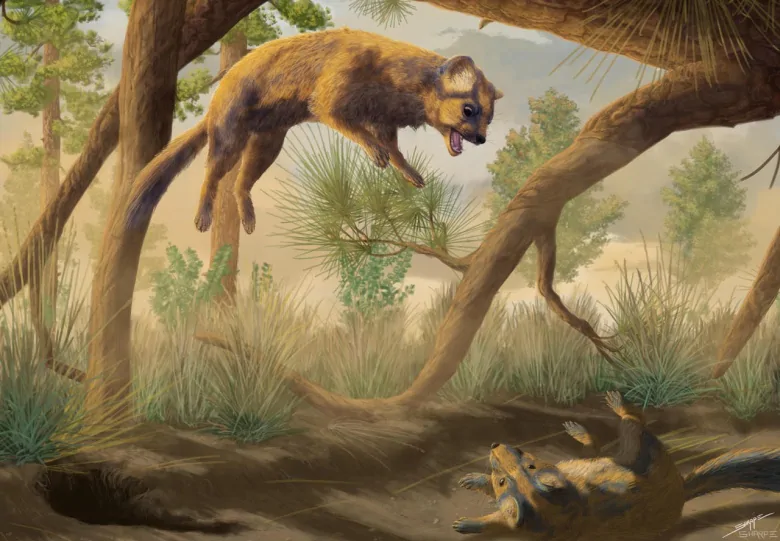
Two ancient weasel ancestors fight in a reconstruction based on a fossil skull and teeth. Corumictis wolsani is the oldest weasel ever found in North America, researchers report. (Henry Sharpe)

A tiny skull once thought to belong to an ancient miniature cat is actually the earliest relative of wolverines, minks, otters and weasels ever found in North America, researchers say.

Corumictis wolsani, would have been tiny enough to sit in your hand, but trying to pick it up would probably not have been a good idea.

“It has these incredibly sharp teeth, sharper than some weasels today,” said Ryan Paterson, who led the research while doing his master’s degree at Carleton University. “It was probably a ferocious little thing, despite being the size of the tiniest weasel on the planet.”

The animal’s beautifully preserved fossil skull was unearthed from the John Day Fossil Beds in Oregon about 15 years ago by Gregory Retallack, a professor at the University of Oregon who studies ancient plants and soils.

It was identified as an ancient feline and put on display at the local museum. There, it caught the eye of Joshua Samuels, who was the museum curator and the chief paelontologist of the John Day Fossil Beds National Monument from 2010 to 2016.

At the time, Paterson was looking for the missing link between seals, sea lions and their land-dwelling ancestors as part of his master’s degree at Carleton and the Canadian Museum of Nature.

Samuels, now a geosciences professor at East Tennessee State University, got in touch, saying he thought the skull might be what Paterson was looking for.

After visiting the museum and having a look, “I thought so too,” Paterson recalled in a recent interview.

The well-preserved skull, about 4 centimetres long, was found in eastern Oregon about 15 years ago. It was thought to be a cat or a relative of ancient seals, but has now been identified as the earliest weasel relative in North America. (Ryan Paterson)

He borrowed the skull, which was just four centimetres long, and brought it back to Canada.

But once he started taking measurements, they weren’t quite right for a seal.

So the researchers CT scanned it, finding some unusual features in its inner ear and the shape of its brain that helped identify it.

“That was when we finally realized it was the earliest ancestor of weasels that was in North America,” Paterson recalled.

‘Eo-wolverine’

That led one of his colleagues to nickname it “eo-wolverine” (“eo” means “early” or “primeval” in Latin) — after the “one creature related to weasels that has kind of captured the public imagination.” 

While the researchers described Corumictis as the “great-grandfather” of wolverines and Paterson says he still thinks of it as “eo-wolverine,” he and his colleagues thought naming it after wolverines specifically would be confusing. After all, it’s just as related to other weasels, such as minks and ferrets.

Instead, the new species was named after the region it was found (Corumictus means “northwest”) and a Polish researcher, Mieczysław Wolsan, who described many weasel-like fossils in Europe.

Corumictis lived between 28.8 and 25.9 million years ago during the Oligocene, a time when camels, three-toed horses and rhinos roamed North America.

That makes it at least a million years older than any other weasel found in North America before and just a couple of million years younger than the oldest weasel found in Europe, the researchers report.

At that time, the area that is now modern-day Oregon was getting cooler and drier, and forests were thinning out into more open grasslands. Burrowing rodents similar to ground squirrels and groundhogs were starting to appear. That’s the kind of prey modern weasels generally prey on.

“We thought there might be a connection between other things popping up that live in these open habitats and our own critter, Corumictus, coming on the scene,” Paterson said.

While modern weasels have long skinny bodies that allow them to squeeze and slither into rodents’ narrow burrows, the researchers have only Corumictis‘s skull and teeth and none of its body. So while they know it was tiny, they don’t yet know if it was long and skinny.

“It could be bulkier, like a wolverine,” Paterson said.

The researchers published their findings in the journal Zoological Journal of the Linnean Society 

The research was funded by the Natural Sciences and Engineering Research Council of Canada.


Source link