Categories
Tech

COVID-19 and social media: Limit the spread of fear by changing online behaviour


Public health authorities worldwide have asked people to change their habits in order to slow the progression of the COVID-19 pandemic. They implore citizens to wash their hands more frequently, to avoid large gatherings and to put themselves in voluntary quarantine if they feel flu-like symptoms.

But as health authorities attempt to calm the public, coronavirus mis- and disinformation is spreading through social media.

Disinformation about the coronavirus not only generates fear and panic, but it can make outbreaks worse by encouraging people to follow bad advice, according to a study by U.K. researchers.

As the crisis unfolds and expands, Décrypteurs, Radio-Canada’s social media fact-checking team, has been monitoring the unprecedented spread of disinformation and fake news. 

Here are a few tips you can follow to avoid infecting your friends’ feeds with disinformation.

Only share trustworthy sources you know well

When using social media, make sure you’ve heard of the social media account before you share any piece of information. (Wilfredo Lee/The Associated Press)

Social media connects the world together. It also exposes us to sources of information from around the world. In normal times, it’s already difficult to tell trustworthy sources from untrustworthy ones. In times of crisis, it’s even harder.

Only share news from local media sources you are familiar with. If you’ve never heard of the media outlet or the social media account that is putting forward a piece of information, don’t share it.

A public health notice published by the U.K. government doesn’t apply in Canada. A news item from the U.S. might not necessarily represent what’s going on here either.

The same thing goes for posts about supposed “cures” or health tips to help with COVID-19: Only trust local public health authorities.

Be wary of videos or pictures that purport to show ‘what’s really going on’

Since the beginning of the crisis, Décrypteurs has received an enormous number of questions related to images or videos circulating on social media. These images often purport to show what’s going in on in this or that country.

Not only is it often impossible to verify these videos, which likely have been filmed by unknown people in undisclosed locations, but it is also much too easy to take videos or pictures out of context and subvert the meaning. For example, Décrypteurs has seen videos from 2018 being applied to the present crisis, presenting a false narrative.

Instead of sharing pictures and videos circulating in Facebook posts and tweets, look for articles that explain the context instead.

Avoid speculation

Before sharing any piece of information, take a deep breath, and if needed, go for a short walk. (Ted S. Warren/The Associated Press)

No one can predict the future, no matter how smart they claim to be.

The present crisis is evolving extremely rapidly. What was true yesterday might not be true today.

Avoid sharing posts which contain speculation about what’s about to unfold. No one really knows what will happen tomorrow. Absorb information one day at a time. Follow trustworthy news sources as the crisis evolves. 

Speculation — often from unqualified or untrustworthy sources — can lead to fear and panic. 

Make less noise

The coronavirus worries everyone. It’s normal to want to give our opinion on social media, to try to join the conversation. On the other hand, social media feeds have a glut of COVID-19 posts from all sorts of sources. That not only causes confusion, but also leads to a type of paralysis as people ask who and what should I believe? What should I think?

Before clicking “publish,” ask yourself a few questions:

  • Is this necessary?
  • Why do I want to share this?
  • Am I propagating fear and confusion?
  • Am I helping to inform my friends?

Take a deep breath

On social media, speed can trip you up.

Before sharing a piece of information, take a deep breath. Calmly evaluate what you’re about to share. Get up and go pour yourself a cup of coffee, or take a short walk. Water your plants. Play with your pet.

Your friends — and society at large — will thank you.


Source link

Categories
Tech

Canada is asking for more time to enact a promised ban on shipping plastic waste


The government of Canada has formally notified the United Nations that Canada’s laws will not be in compliance with a treaty meant to stop rich countries from shipping their hazardous waste to poor countries.

The specific amendments that Canada has asked for extra time to codify are intended to address a problem that is supposed to be a signature issue of the Trudeau government: plastic contamination.

“Before Canada can formally accept the amendments, it needs to complete an internal acceptance procedure. This procedure, led by Global Affairs Canada, is underway,” Gabrielle Lamontagne of Environment Canada told CBC News, adding that Canada hopes to finish that work before the end of the year.

UN documents say the new rules “come into force” on March 24 of this year, but don’t “take effect” until January 1.

Gap between words and actions

Some environmental scientists and anti-plastic waste campaigners say the federal government’s request for a delay is the latest manifestation of a yawning gap between the Trudeau government’s actions and its efforts to present itself as a leader on plastic waste and oceans.

“I think the public just isn’t aware of how much we’re failing to step up and do our bit to stop the pollution of the oceans and land with plastic,” said Kathleen Ruff, founder of the environmental group RightOnCanada. “I don’t think the public is aware that the rest of the world is moving forward, and Canada is dragging its feet, and worse, opposing it.”

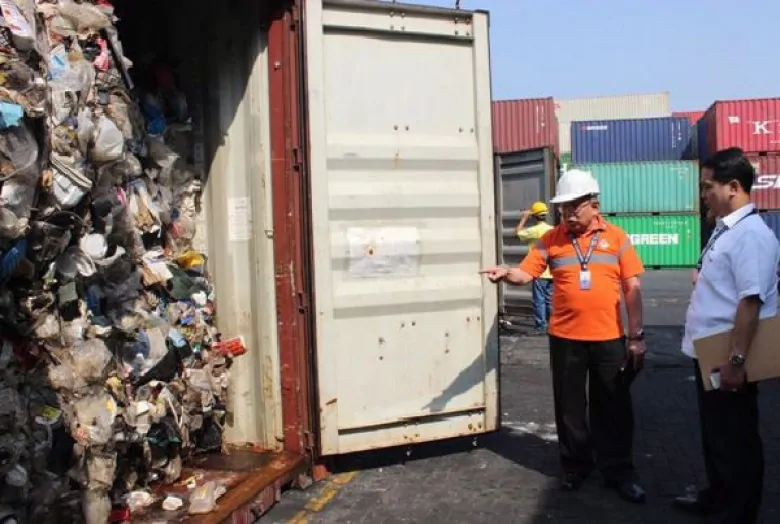
Officials check a shipping container holding Vancouver garbage in Mailia in this undated, handout photo. (Philippines Bureau of Customs)

Ruff said she hopes the Trudeau government makes the next deadline, but “people have the right to be suspicious, and to be disappointed that Canada is not taking strong action to protect the oceans and the land.”

“It’s an embarrassment for us,” said Myra Hird, a professor of environmental studies at Queen’s University and a fellow of the Royal Society of Canada. “Canada is very much behind the curve on this.”

Canada is asking for a special delay in the deadline to align itself with a treaty it helped to craft 30 years ago.

Myra Hird, a professor of environmental studies at Queen’s University, is a fellow of the Royal Society in Canada and director of the research project Canada’s Waste Flow www.wasteflow.ca (Queens University)

‘Intends to comply’

The notice sent to the UN says that Canada “fully supports and intends to comply with the amendments,” but “the said process may not be finalized prior to the entry into force of the above-noted amendments.”

The amendments are intended to stem the flow of microplastics into the world’s oceans.

It’s not the first time the Trudeau government has lagged in an area where it has claimed to be a leader. It used its role as chair of the G7 in 2018 to push for a “Canada-led” Ocean Plastics Charter.

Filipino environmental activists wear a mock container vans filled with garbage to symbolize the 50 containers of waste that were shipped from Canada to the Philippines two years ago, as they hold a protest outside the Canadian embassy at the financial district of Makati, south of Manila, Philippines on Thursday, May 7, 2015. (The Associated Press)

But that same year, at the Commonwealth Summit in London, Prime Minister Trudeau was upstaged by U.K. pime minister Theresa May, who announced a nationwide ban on single-use plastics.

Trudeau waited until 2019 before announcing that Canada would eventually take a similar step “as early as 2021.”

Just two weeks after announcing that future ban, the prime minister tweeted a picture of himself at a meeting in his riding office with pizza and a pile of single-use plastic cutlery on the table in front of him. 

Rather than wait for the Trudeau government, many companies and municipalities have moved ahead with their own measures to reduce plastic waste.

Containers from Manila

The Trudeau government has faced one embarrassing incident over this issue already — when it was forced to repatriate shipping containers loaded with hazardous waste that had been dumped on a dock in the Philippines years before.

Eventually, the Philippines recalled its ambassador from Canada and the Trudeau government shipped the containers back to Canada.

The Philippines, like China and some other countries that used to accept foreign waste, has now banned the practice.

A boy collects plastic materials near a polluted coastline to sell in Manila April 9, 2008. (Cheryl Ravelo/Reuters)

“This is the logical consequence, that at some point these importing countries are going to be saturated and are going to say no,” said Hird. But waste does continue to flow to Asia, exploiting loopholes that allow the import of materials that ostensibly will be recycled.

“My speculation,” said Hird, “would be that [Canada is] asking for more time to comply because they want to maintain those routes of export as long as they possibly can. If there was critical analysis around our dependence on waste export, this horizon would have been seen.”

Trudeau government opposed ban

The claim that Canada “fully supports and intends to comply with the amendments” appears to be at odds with the government’s position during the negotiations on the Basel ban amendments.

In fact, throughout the past year Canada opposed changes that would close the recycling loophole, despite heavy lobbying by environmental groups, including the Basel Action Network.

In July, a coalition of groups wrote then-Environment minister Catherine McKenna asking her government to drop its opposition.

“At the Basel Convention’s 14th Conference of the Parties in Geneva in May this year, delegates approved a decision calling on countries to ratify the Basel Ban Amendment,” says the letter. “Canada stayed silent, but continues to oppose the amendment, saying Canada ‘won’t support a prohibition on the export of recyclables’.

“Shipping our wastes half-way around the world, allegedly for recycling, to countries that are already deluged with wastes, is, as Canada well knows, a practice that is readily abused. It is a practice that is neither environmentally responsible nor just.”

Minister McKenna did not respond to the letter.

‘Canada will have failed again’

Six weeks later, the coalition sent McKenna another letter: “We write once again to urge that, with regard to the issue of managing our country’s wastes, the Canadian government adopt a policy that is evidence-based and environmentally responsible.”

The environmental groups pointed out that Australia, which had been allied with the Trudeau government in resisting tighter regulations, had changed its stance, with PM Scott Morrison declaring “it’s our waste and it’s our responsibility.”

“Australia is not usually seen as a great leader on the environment,” said Ruff, “and yet they are stepping forward and we are not.”

Watch: CBC’s The National looks at the problems with compostable plastics

Many compostable plastics in Canada end up in the landfill because most municipal compost programs can’t process the products. 2:38

The August letter asked Canada to follow Australia’s lead.

“We urge the Trudeau government to be a forward thinking government of the present and of the future,” it reads. “Soon the Ban Amendment will enter into force with or without Canada. Canada will have failed again to step up and lead in a world lacking leadership. This will be long remembered.”

In the end, Canada chose not to formally object to the amendments, which were supported by the EU and other countries. 

Waste problem getting worse

Hird said that the problem has only grown more acute because of the Trudeau government’s reluctance to regulate the waste industry.

“The government has taken a very, very weak stance with regards to waste management and recycling companies. They’ve allowed these companies to control our waste management.”

Hird said Canada has continued to rely on dumping its waste in developing countries rather than developing its own solutions, or trying to reduce the amount of waste generated in the first place.

“This is why various municipalities and industries are having to stockpile, because we don’t have a way to recycle it ourselves, and we are running out of places to send it to.

“They’ve required so little of these companies that produce our goods in terms of taking responsibility for packaging that they’ve really backed themselves into a corner that they should have anticipated.”


Source link

Categories
Tech

Coronavirus work-from-home policies give climate plans a boost


Hello, people! This is our weekly newsletter on all things environmental, where we highlight trends and solutions that are moving us to a more sustainable world. (Sign up here to get it in your inbox every Thursday.)

This week:

  • Coronavirus work-from-home policies give climate plans a boost
  • Planes, trains and automobiles: What mode of transit has the most emissions?
  • Climate change in N.W.T. is endangering cemeteries

Coronavirus work-from-home policies give climate plans a boost

(Shutterstock)

Google has asked all of its North American employees to work from home until at least April 10 to stop the spread of COVID-19. It’s the most drastic in a spate of similar recommendations from Facebook, Twitter, Apple and many other big tech companies.

These companies employ hundreds of thousands of people. Given the scale, it could have a big impact on the climate.

Transportation is a major contributor to greenhouse gas emissions in North America, and a lot of that comes from commuting. 

For example, if the four-million-plus people in Canada whose jobs could be done from home did so twice a week, it could remove the equivalent of 385,231 cars from the road and cut annual greenhouse gas emissions by 1.9 million tonnes, according to a 2011 report from the Telework Research Network commissioned by the City of Calgary.

“There’s no quicker, easier, cheaper way to reduce your carbon footprint than not drive,” said Kate Lister, lead author of that report and president of Global Workplace Analytics, a U.S.-based firm that helps companies plan for the future of work.

In the longer term, emissions savings can be even greater, as telework policies allow companies to reduce the amount of office space they must heat, power and equip. That also saves money.

That’s why many cities, including Calgary, Vancouver, Saskatoon and even smaller communities like Halton Hills, Ont., include telecommuting as one of their plans to reduce climate change.

But the climate benefits go beyond mitigation. Telecommuting infrastructure also instils resilience against the extreme weather that’s increasing with climate change. And it’s part of the climate change adaptation plans for some cities, such as Waterloo, Ont.

A decade ago, the federal government invested $800,000 in WORKshift, a program to support telework throughout the Calgary region. When the city was hit with a massive flood in 2013 that forced a lot of people to work from home, many were already equipped to do so.

“It played a big role in the continuation of government in that flooding situation,” Lister said. “Employers already had the experience, and that’s really key.”

She noted that enabling telework isn’t necessarily simple. It means buying and configuring equipment like laptops, enabling secure file and resource access in the cloud and, importantly, training. “The biggest thing is training managers to manage by results rather than butts in seats,” she said.

She added that the longer employees work from home, the more likely it is that employers start to realize other benefits. That can include cost savings, higher productivity, fewer unscheduled absences, better employee retention and greater flexibility to scale up and scale down, because doing so doesn’t hinge on costs like office space. 

Lister said support for telework often fizzles after events like floods are over. But coronavirus could be different. “It almost feels like this one could be a tipping point,” Lister said, noting that up until now, telework has been growing slowly and steadily at about 10 per cent a year.

She said she’s already hearing hints from companies such as global office real estate giant CBRE that this could “fundamentally change” the nature of workplaces and offices in Asia. And it seems to be spreading to other continents.

 “I do think,” Lister said, “this coronavirus is going to leapfrog the trend.”

Emily Chung


Reader feedback

One theme that has emerged with What on Earth? readers in recent weeks is the unfortunate intersection of sustainable consumption and concern about the coronavirus. 

Nicole Fallon wrote about visiting her local Starbucks in Ajax, Ont., where she was told the store would not fill ceramic mugs. “They informed me that … a new policy had been implemented whereby no reusable cups of any kind, whether the ceramic mugs they have in store or ones customers bring themselves, can be used now…. The barista specifically stated that this policy was a precaution against the spread of the coronavirus. 

“Needless to say I was shocked and dismayed to think that this policy will not only generate a whole lot of extra garbage, but it may also discourage customers from the practice of using reusable vessels in future.”

Jennifer Peach wrote about a similar experience at Bulk Barn. “When I arrived at my local Bulk Barn on the weekend I discovered a sign on their door indicating they’ve temporarily suspended their reusable container program due to an ‘overabundance of caution’ surrounding coronavirus.”

Peach said she was concerned about this change “because it is really difficult for people to change their habits to reduce their production of garbage, [and] it’s really easy to fall back into the habit of single-use plastic bags.”

Old issues of What on Earth? are right here.


The Big Picture: Transportation emissions

Coronavirus fears have dampened the desire of many people to travel this March break (Italy, anyone?), but tourism will surely bounce back, leaving environmentally conscious travellers to contemplate the least polluting way to get to their favoured destination. Here’s a comparative look at the emissions of various modes of transportation, based on the amount of carbon dioxide released per kilometre travelled. (At high altitudes, planes also create other, non-CO2 emissions, such as nitrogen oxides.) The higher the number of people in any given vehicle, the lower the per-person emissions.

(CBC)

Hot and bothered: Provocative ideas from around the web


Climate change in N.W.T. is endangering cemeteries

(Weronika Murray)

People in the Northwest Territories are worried about the impacts of climate change — and that includes the location of their cemeteries.

The issue was raised by multiple representatives at the recent annual general meeting of the NWT Association of Communities, in Inuvik.

“Due to climate change and the melting of the permafrost, our cemetery in Dettah is currently at its end of life,” said Jason Snaggs, chief executive officer for the Yellowknives Dene First Nation. He said most people now prefer to be buried in the nearby Yellowknife cemetery.

Snaggs said the cemetery in Dettah is facing issues with both slumping and overcrowding. He said the community hopes to work with researchers from Wilfrid Laurier University in Waterloo, Ont., and the Aurora Research Institute in Inuvik to identify “the right permafrost” on which they can build a new cemetery. 

“We don’t want to face this issue in the next five to 10 years or 20 years. We want to have a cemetery that can last another 40 years.”

At the meeting, representatives from Tuktoyaktuk, Fort McPherson and Tsiigehtchic said they’re facing similar issues with their cemeteries.

Tuktoyaktuk is already facing worries about houses falling into the ocean because of the eroding shoreline at “the Point,” the most northern area in the hamlet.

Erwin Elias, the mayor of Tuktoyaktuk, said the community is in a state of emergency because of the rapid coastal erosion. Its cemetery is located about 24 metres from the beach.

“Obviously that’s one thing we want to make sure that we never lose to the ocean,” Elias said. “We all understand that we can’t compete with Mother Nature. But we want to preserve [the shoreline] as long as we can.”

Tuktoyaktuk will be opening a new cemetery further inland this year, Elias said. He said they won’t be closing the current cemetery, but noted they risk a situation where they don’t have room for some families.

A representative from the NWT Association of Communities said they’re aware of at least two communities that have received federal climate change adaptation funding to address threats to cemeteries.

Behchoko received $65,000 in 2018-19 to investigate flooding of its cemetery and develop remediation options. Fort McPherson’s Rat River Development Corp. received $4,600 in 2017-18 to work on several initiatives, including work on its cemetery, which is located near the escarpment edge.

Elias said he’s not surprised N.W.T. communities are facing the same problem. He said it’s in the last decade that the effects of climate change have “been starting to show.”

Mackenzie Scott


Stay in touch!

Are there issues you’d like us to cover? Questions you want answered? Do you just want to share a kind word? We’d love to hear from you. Email us at whatonearth@cbc.ca.

Sign up here to get What on Earth? in your inbox every Thursday.

Editor: Andre Mayer | Logo design: Sködt McNalty


Source link
Categories
Tech

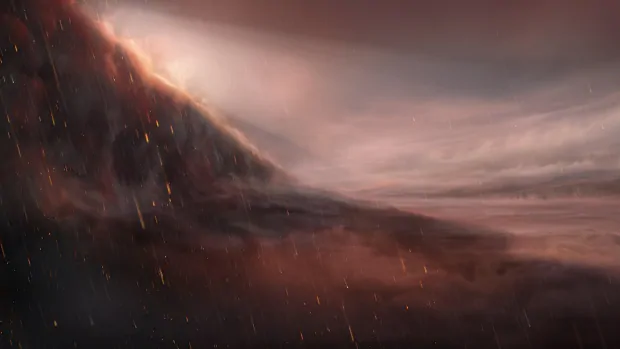
Weather forecast for this exoplanet: iron rain


If you plan on visiting WASP-76b, a planet orbiting another star roughly 600 light-years away, you’d better pack a hardy umbrella.

In a new study published Wednesday in the journal Nature, scientists found that WASP-76b may produce rain. But this is no ordinary rain: it’s iron rain.

The international team of astronomers made the finding using the Echelle SPectrograph for Rocky Exoplanets and Stable Spectroscopic Observations (ESPRESSO) instrument at the Very Large Telescope in Atacama, Chile, which is made up of four individual telescopes.

This type of instrument allows scientists to determine not only the composition of a star — if it’s precise enough, it can detect the atmosphere of a distant exoplanet.

And ESPRESSO did this exceptionally well.

“We were not expecting to find this kind of signature [of iron] with this level of detail,” said David Ehrenreich, lead author of the paper, who is also an astronomer at the Observatoire astronomique de l’Université de Genève in Versoix, Switzerland.

In fact, the original plan was to do a brief analysis of the instrument’s performance and then write a quick paper on the findings. But in doing this, Ehrenreich said he saw “something really intriguing.”

“It really blew my mind, actually.”

[embedded content]

Using ESPRESSO, the researchers measured the atmospheric compositions at two different locations: the region corresponding to morning twilight and the region corresponding to evening twilight.

What they found was on the evening side, where it transitions from day to night, iron vapour is detected. But when gas is circulating from night to day — think of it as the morning — that signature is gone. 

Why it disappeared was puzzling.

Ehrenreich said they concluded that when the wind blows through the night side, it causes the iron vapour to condense, “forming clouds and likely condensing as rain of liquid iron droplets,” Ehrenreich said.

‘Quite crazy’

While iron rain has been hypothesized on other exoplanets, it’s really about how the findings were made.

“The actual observation, the evidence for it, that’s what makes this really unique,” said Eve Lee, an assistant professor in McGill University’s physics department, who studies exoplanets. “Atmospheric analysis of this kind is really difficult and the fact that we have it, it’s really new … It’s really exciting.”

This star system is very different from our own.

At the heart lies a star — WASP-76 — that is similar to our sun in regards to its stellar life stage. But WASP-76 is younger, almost twice as big and hotter than our sun.

As for the planet itself, it’s considered a “hot Jupiter,” a planet roughly twice the size of our solar system’s most massive planet, with a “puffed-up” atmosphere, likely due to the radiation it receives. As opposed to Jupiter, it lies very close to its star — closer than Mercury, the innermost planet in our solar system, is to the sun — completing one orbit every 1.8 days. 

“As a result, the planet is receiving something like 4,000 times the [energy] that the Earth receives from the sun,” Ehrenreich said. “That is quite crazy.”

WASP-76b is also likely tidally locked with its star. That means the same side always faces the star, just as the moon does with Earth. As such, the day side reaches temperatures around 2,400 C. Temperatures along the evening terminator, or the transition from day to night, is closer to 1,500 C. It’s likely this temperature variation is somehow responsible for the condensation of the iron vapour.

As with all scientific findings, Ehrenreich is looking forward to follow-up studies of WASP-76b. And he’s looking forward to a time when this kind of technique will be used to determine the composition of Earth-like planets.

For now, he’s happy this finding tests astronomers’ knowledge about other alien worlds.

“Hot Jupiters are unlike anything in our solar system,” Ehrenreich said. “They are like an extreme laboratory to test the most extreme climates that could happen on an exoplanet.” 


Source link

Categories
Tech

Europe, Russia postpone Mars rover mission amid coronavirus travel restrictions


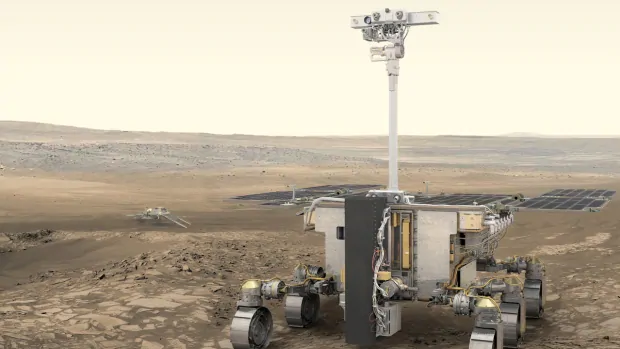
The European Space Agency and Russia’s Roscosmos said Thursday they are postponing a planned joint mission to Mars until 2022, in part due to travel restrictions resulting from the new coronavirus outbreak

The ExoMars mission was due to launch this year but concerns about possible technical problems had already prompted both agencies to discuss the delay.

“It is driven primarily by the need to maximize the robustness of all ExoMars systems as well as force majeure circumstances related to exacerbation of the epidemiological situation in Europe which left our experts practically no possibility to proceed with travels to partner industries,” Roscosmos’ director-general Dmitry Rogozin said in a statement.

The mission’s goal is to put a rover on the red planet to help determine whether there has ever been life on Mars. Scientists hope the rover, packed with high-tech instruments and named after British chemist Rosalind Franklin, will be able to dig for biological signatures of life below the Martian surface and also provide further insights into the planet’s history of water.

It is the latest setback for the ExoMars program, which saw the launch of an orbiter and a test lander in 2016. The Trace Gas Orbiter was successfully deployed but the Schiaparelli lander malfunctioned and crashed on the surface of Mars, highlighting the difficulty of putting a probe on the planet.

“We want to make ourselves 100 per cent sure of a successful mission,” said ESA Director General Jan Woerner. “We cannot allow ourselves any margin of error. More verification activities will ensure a safe trip and the best scientific results on Mars.”


Source link

Categories
Tech

Smallest extinct dinosaur ever found was size of hummingbird


A bird-like dinosaur with a beak full of teeth and claws on its wings is the tiniest extinct dinosaur ever found.

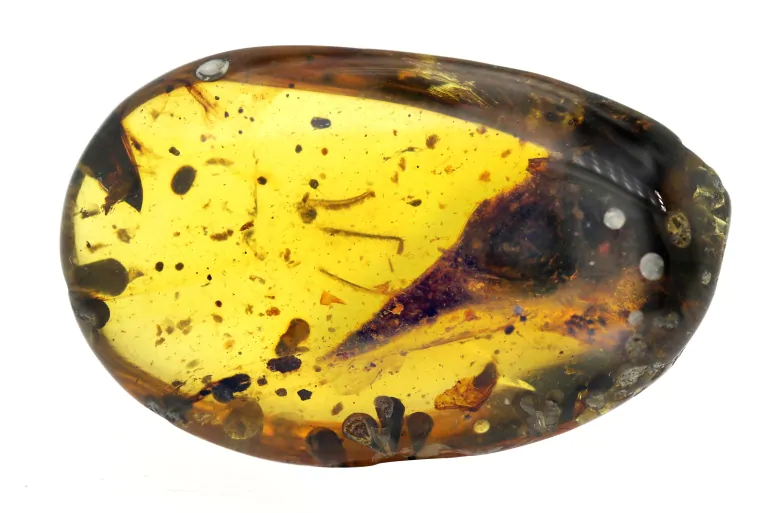
The dinosaur’s beautifully preserved skull — about as long as your thumbnail from the tip of its beak to the back of its head — was found in a hunk of amber from northern Myanmar, researchers report in a new study published Wednesday in Nature.

Its brain is a little smaller than that of the bee hummingbird, the smallest living bird, which is technically a dinosaur itself, said Ryan McKellar, a Canadian paleontologist who co-authored the study with Chinese, Canadian and U.S. researchers. “But once you include the snout, you’re talking about something that’s about the same size.”

Despite being so tiny, the bones in its skull have fused together, indicating that it’s an adult or near adult.

The dinosaur’s skull, just 1.4 centimetres long, was found trapped in amber from Myanmar dating back to 99 million years ago. (Lida Xing)

It lived about 99 million years ago in what was then a tropical mangrove forest teeming with insects, frogs, salamanders, lizards and other bird-like dinosaurs — though they had not yet evolved completely to resemble modern birds.

“They’re sort of our neat little guys that scurried around on tree trunks … that still had claws in their wings and still had teeth in their snout,” said McKellar, curator of paleontology for the Royal Saskatchewan Museum in Regina.

Where its name came from

In fact, this particular animal’s teeth were unusual. Unlike most birds at the time, who had teeth just on the tips of their beaks, it had dozens that extended close the back of its mouth under its eye. For that reason, the new species was named Oculudentavis khaungraae.

The first part of its name means “eye-teeth-bird,” while the second part of its name honours Khuang Ra, the woman who bought the fossil at a market and donated it to the Hupoge Amber Museum in China where it could be studied.

McKellar says this particular bird would have likely have been adapted to eat insects and snails. Its large, lizard-like eyes were adapted to narrowing its pupil in bright light, suggesting it was active during the day. They’re also pointed more sideways than forward compared with modern birds.

“So [it was] maybe even better adapted for escaping as prey as opposed to actually hunting things,” he added.

The study was led by Lida Xing, an associate professor at the China University of Geosciences in Beijing who previously studied and worked in Canada, and Jingmai O’Connor, a paleontologist at the Institute of Vertebrate Paleontology and Paleoanthropology in Beijing.

Most bird-like dinosaurs have teeth just on the tips of their beaks. But Oculudentaris has dozens extending back beneath its eye, as shown in this artist’s impression, giving it its name. (Zhixin Han)

O’Connor said in the email that the discovery shows how small dinosaurs could be, and that even ones this tiny could be predators — something that wasn’t known before.

McKellar got involved in the project a couple of years ago while collaborating with Xing on a different study, and was tasked with figuring out how the animal became encased in amber. It appears the bird was already dead — though freshly so — and rather wet when it became trapped in sticky, syrupy amber oozing down a tree trunk. The types of insects trapped with it suggest the amber never made it to the forest floor before hardening.

Amber’s advantage over fossils

He said the special thing about amber is it provides a snapshot of animals so small that they’re rarely preserved as fossils. Most dinosaur fossils are the size of crows or larger. In this case, Oculudentavis is even smaller than other birds found in Myanmar amber, which are usually about the size of sparrows or robins.

In this case, none of Oculudentavis‘s feathers were preserved, as its skin got separated from its skull during decomposition.

A CT scan of the skull shows details including its eye socket, which was larger and more lizard-like than that of modern birds. (Gang Li)

But McKellar said Myanmar amber is also key to figuring out the origin of feathers trapped in Canadian amber found in Alberta and Saskatchewan.

While about 10 tonnes of amber are mined for jewelry each year in Myanmar, Canada produces only about a kilogram a year “and the pieces are smaller and more fragile,” McKellar said.

By comparing the feathers found in those pieces to larger pieces with more body parts found in Myanmar, scientists are able to learn more about the feathered dinosaurs that lived in Canada.


Source link