Transport Canada is trying a new voluntary speed limit in the Cabot Strait as a part of its plan to protect the endangered North Atlantic right whale.
First announced in February, the voluntary speed limit would see vessels over 13 metres long slow down to 10 knots in a portion of the Cabot Strait between April 28 and June 15, and Oct. 1 and Nov. 15, which are the times of year the right whales are believed to travel through the strait.
There are only about 400 North Atlantic right whales worldwide and there were eight confirmed right whale deaths in Canadian waters during last year’s fishing season.
Michelle Sanders, the director of clean water policy at Transport Canada, said trying voluntary measures will help determine the risks around imposing a speed limit in the Cabot Strait.
“We do know that for some of the smaller communities and for the cruise industry, a mandatory slowdown could have a significant impact on some of their routes,” she said.
Amid the voluntary speed restrictions, the Port of Sydney’s cruise ship schedule remains unchanged. (Holly Conners/CBC)
In 2017, some cruise ship stops in Charlottetown were cancelled, with some trips being diverted to the Port of Sydney in Cape Breton, after mandatory speed reductions were instituted in the Gulf of St. Lawrence.
“We were able to welcome those ships to our port because it just didn’t allow the time to get to some of the other destinations,” said Nicole MacAulay, cruise and administration officer with the Port of Sydney.
“Now it’s a bit of a different scenario now that they’ve expanded the restriction into the Cabot Strait, so a little closer to home.”
So far, both the Port of Sydney and Port of Charlottetown’s cruise ship schedules have not changed.
Unpredictable weather
Sanders said the weather in the Cabot Strait can be severe and sometimes unpredictable, which means slowing down might not always be possible.
“Especially at those times of year at the beginning and the end of the season, the weather can be really challenging,” she said. “We don’t want to put the vessel or the crew at risk.”
Darrell Mercer, communications officer with Marine Atlantic, agrees.
“Our vessels, they have stabilizers that help when the weather gets a little rough,” he said. “Those stabilizers don’t work as effectively at 10 knots as they do at a higher speed.”
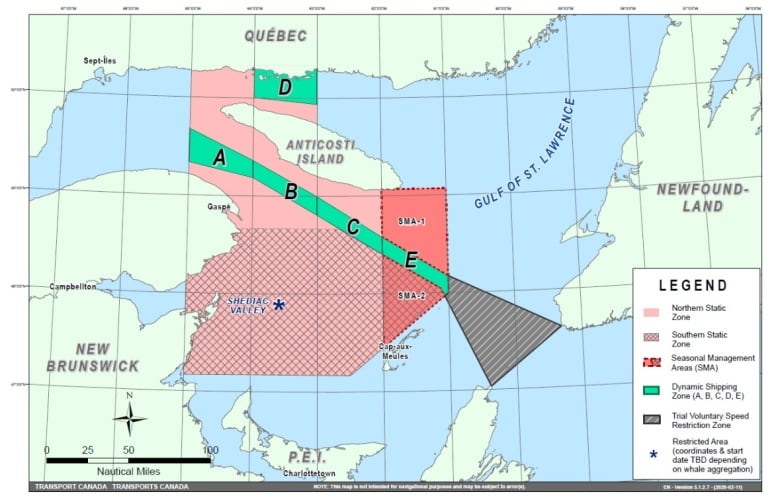
A map showing the various zones facing restrictions by Transport Canada and the Fisheries and Oceans Canada. (Government of Canada)
Sanders said the ferry routes don’t go through the voluntary speed-reduction zone, but the government is in talks with Marine Atlantic on slowing down in the Cabot Strait during the trial period.
The zone starts where the Cabot Strait bottlenecks. It spans roughly from Cape North in Cape Breton to just west of Port aux Basques in Newfoundland and Labrador, and then spans west to meet other restricted zones in the Gulf of St. Lawrence.
This isn’t the first time Transport Canada has tried a voluntary slowdown. In 2019, the federal government announced an expansion of a voluntary speed limit in British Columbia as a measure to protect southern resident killer whales.
Other measures
Another measure impacting the Cabot Strait and Gulf of St. Lawrence is the government’s push to get more marine mammal observers on board vessels throughout the region.
Sanders said Transport Canada and the Department of Fisheries and Oceans are working closely with shipping companies, cruise lines and ferry operators to get trained observers on board. Sanders believes ferry operators in particular can play a key role in collecting data on the whales and having observers on board would also help prevent collisions with the whales.
That’s something Marine Atlantic already started to implement last year. The Crown corporation now has its own marine mammal observer training course as a part of its marine mammal management plan.
Certified compostable plastic cups, cutlery, coffee pods, clamshell containers and other packaging may be touted as greener options at the grocery store, but they’re banned from most residential organics programs in Canada, a recent Marketplace episode showed.
The good news is that while you typically can’t put them in your green bin for curbside pickup, some of these compostable plastic products are being composted in Canada by composting facilities that deal with organic waste from commercial and institutional buildings, and even some condo and apartment buildings.
One example is the National Arts Centre in Ottawa, a venue owned by the federal government that has four halls and can accommodate up to 4,000 people at a time. Last summer, it switched all its dishware and cutlery to compostable options, including paper and sugarcane fibre cups and containers, as well as PLA (polylactic acid) bioplastic drinking cups, coffee cup lids, forks and spoons, and salad bowls and their lids. (PLA is typically made from corn kernels in North America.)
Composting these items has diverted over half a million pieces of waste from the landfill so far, estimates Nelson Borges, the facility’s general manager of food and beverage.
The National Arts Centre also gets back some of the finished compost for its rooftop garden, where it grows saffron and raises bees in two hives.
“We’re using it, turning it back into compost that now fertilizes our plants,” Borges said. “So yeah, there’s a way to do this.”
That said, it wasn’t as easy as it sounds. Here’s how the NAC did it.
Glass and metal weren’t options for safety reasons, since the NAC now allows patrons to drink in its concrete-floored concert halls, including on the balconies. But that has also greatly increased the number of drink cups that customers use.
Borges started looking for compostable alternatives and approached the NAC’s waste hauler and processor, Tomlinson Group, to ask if they would compost it.
“Well, no, you can’t just do that,” was the response he got, he recalled.
The National Arts Centre in Ottawa can hold up to 4,000 people in four different performance halls at a given time. It allows patrons to bring their drinks into the concrete-floored halls, so the glasses can’t be made of glass for safety reasons. (Justin Tang/Canadian Press)
Step 2: Sourcing ‘certified’ compostable products
Borges worked with Tomlinson Group and the Compost Council of Canada to source compostable products certified by the U.S.-based Biodegradable Products Institute (BPI) and designed to be 90 per cent broken down within 84 days under industrial composting conditions without leaving behind any contaminants.
With coffee cups and lids, it was easy, as the coffee vendor in the NAC’s lobby, Equator Coffee, already used certified compostable containers. They just weren’t being composted until then.
With other things, Borges found that the cost of things like wine glasses roughly doubled to 12 cents.
“In a sense, it’s not a lot,” he said, noting that the extra six cents can easily be passed on to the customer if necessary.
The cost of processing wasn’t expected to change — it would just switch from recycling to composting.
Samples of the new cups, glasses and plates are displayed at the media launch of the NAC’s composting program in spring 2019. The items, made of sugarcane fibre and PLA bioplastic, were officially rolled out to customers in August 2019. (Laurie Fagan/CBC)
Step 3: Testing at the right composting facility
Finding certified compostable products was only half the challenge, though.
“Not everything BPI-certified will really break down in every composting process,” explained Lee Timmins, manager of technology and landfill for Tomlinson Group. “Every facility can be a little bit different.”
So, starting February 2019, the company tested the NAC’s products at their composting plant near Kingston, Ont.
During a tour of the facility last week, Timmins showed CBC News what some of the cutlery used by NAC looks like after sitting in huge “windrows” — or mountains of steamy compost — for two weeks. He bent it slightly to show what happens: “It crumbles apart in your hands.”
In contrast, he showed what another brand of fork sold online as biodegradable looks like after three weeks — still easily recognizable as a fork and still flexible: “Not breaking down at all.”
The NAC’s products composted as advertised, completely disappearing into the compost within weeks. But even then, there were more logistics to worry about.
WATCH: Lee Timmins shows how compostable plastic breaks down (or not)
Watch how compostable plastic cutlery breaks down 2:22
Step 4: Training and implementation
The NAC had to change all its waste bins and signage and train its staff to encourage patrons to put compostable products in the right bins.
“The hardest part of this whole thing was to get the people to learn and do this properly,” Borges said.
The arts centre finally announced the switch last spring and officially started offering the compostable products to its customers on Aug. 19.
Nelson Borges shows off some of the composting stations at the National Arts Centre. The NAC had to change all its bins and signage and train staff to encourage the public to put their compostable items in the right bin. (National Arts Centre)
Next: Other facilities, but not necessarily homes
Since then, Borges has been inundated with requests for tours and calls from other businesses and facilities — from malls to municipalities — interested in making the switch to compostable products. He’s been referring some of them to Tomlinson Group, but some are in other parts of Canada.
Meanwhile, Tomlinson is proceeding slowly with the expansion of its composting program. Timmins said the key to the NAC’s success is the fact that it includes only a short list of products that have been tested specifically at Tomlinson’s composting facility. “So there’s really good source control.”
Timmins added that there’s a “great spot” for compostable plastics at places like festivals or restaurants, although each one would have to have their own products tested.
“We’ve tested a lot of different supposedly compostable plastics and very few of them were actually useful.”
But what about residential green bin waste? Tomlinson processes organic waste from homes for the City of Kingston, but for now it doesn’t allow any certified compostable products except plastic bags.
Organic material, including compostable plastics from the National Arts Centre, compost in steamy mountains called windrows at the Tomlinson composting plant near Kingston, Ont. (Alice Hopton/CBC News)
Stephanie Tessier, vice president of business development for Tomlinson Group, said the problem is that it’s really hard for the public to tell which plastics are compostable, given the number of products on the market and the confusing claims on their packaging. (For example, “compostable,” “certified compostable” and “biodegradable” all mean different things, and none of them are necessarily compostable at any given compost facility.) The industry has not stepped up with an easy identification method.
Timmins isn’t sure whether compostable plastics will ever be viable in municipal composting programs: “I think the jury’s still out on that.”
Even with businesses and facilities, Tomlinson may be slowly expanding, but may have to limit composting plastics in the future, as there needs to be a minimum proportion of traditional organic matter such as food waste to compostable plastic in order for it to break down in the composting process.
“We haven’t figured out what that final tipping point is,” Timmins said.
Still, he notes that there’s growing interest from businesses that want to switch to more sustainable packaging. In fact, he recently got a call from a cannabis company asking about testing some of its packaging at Tomlinson’s facility.
Canada’s big phone companies warned MPs on a parliamentary committee Tuesday their networks aren’t yet ready to implement new anti-spoofing technology to guard against fake calls — and many existing landline phones and cellphones will need to be upgraded in order for the technology to be effective.
Representatives from Bell, Rogers and Telus appeared Tuesday before the Industry, Science and Technology House of Commons Committee that’s studying how to prevent the millions of fraudulent phone calls Canadians receive each month.
The telecommunications companies, known collectively as the Big 3, told parliamentarians they are not fully ready to implement technology that alerts customers when a caller is disguising their phone number. Many Canadians have been duped by scammers who use phone call display information to seem like they are calling from a government office or a bank.
The CRTC has given companies until Sept. 30 to adopt technology known as STIR/SHAKEN (Secure Telephone Identity Revisited/Signature-based Handling of Asserted Information Using Tokens). With the help of a checkmark or audible sound chime, for example, STIR/SHAKEN could alert a person if a call is genuinely from a verified number.
Jonathan Daniels, Bell’s vice president of regulatory law, said the company supports the rollout of this new technology. Still, Daniels said unleashing it this early is of little benefit in the fight against fraudulent calls. That’s because Bell’s legacy circuit equipment isn’t ready to utilize STIR/ SHAKEN entirely, and many landlines and smartphones themselves aren’t capable of displaying whether a number is coming from a legitimate source.
“We’re still planning on launching it in September,” Daniels said. “If you turned on STIR/ SHAKEN tomorrow or today on our network, very very few people would actually have phones that can actually benefit from it.”
“It is for this reason that we and most of the telcom operators propose that the CRTC STIR/ SHAKEN mandate be delayed until we get the rules of the regime figured out.”
Daniels said Bell would like to see the deadline pushed to June 2022.
Jérôme Birot, of Telus, told MPs that initially STIR/SHAKEN will only stop fraudulent calls that originate in Canada and the U.S because few other countries have adopted the technology.
“However, many fraudulent calls originate from outside Canada,” Birot, Telus’ vice-president of voice and services development operations, said.
Marketplace was present earlier this week during the arrests of two Canadians linked to the CRA phone scam. 3:13
CRTC open to extending the deadline
CRTC Chairperson Ian Scott told MPs the commission recognizes there have been issues getting the new system up and running in the U.S and Canada and left the door open to extending the deadline.
“We have to be open, and we have to understand that there may be technical challenges,” Scott said. “If there are (the Big 3), they’ll present them to us, and we’ll only, if necessary, add additional time.”
The countdown to adopting STIR/ SHAKEN comes as Canadians increasingly are being bombarded with nuisance and often fraudulent phone calls.
Scott told the committee Tuesday since the CRTC created the Do Not Call List in 2008, 14 million numbers have been added, and in 2019 about 858 numbers were added daily.
Watch the full Marketplace episode on phone scams and spoofing, To Catch a Scammer below:
Exposing the Canadian connections behind a global criminal network involved in cyber-scams 22:31
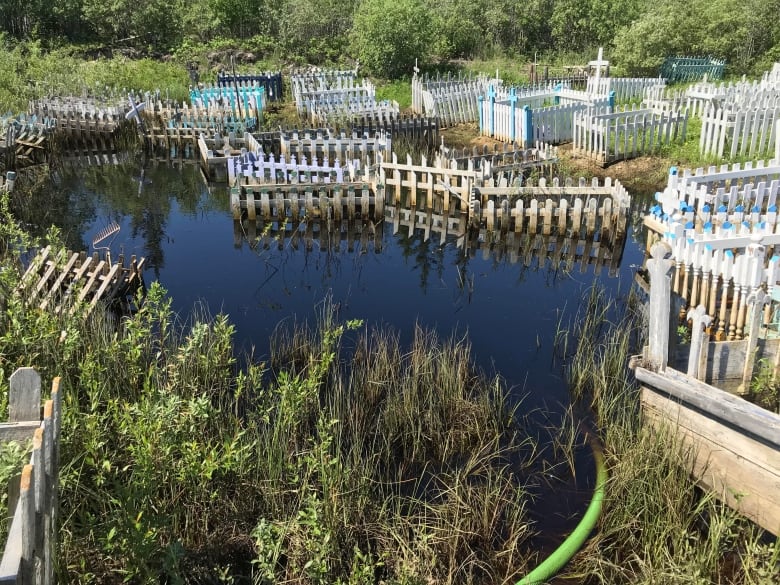
Many communities in the Northwest Territories are worried about the impacts climate change is having on their cemeteries.
The issue was brought up by multiple community representatives at the NWT Association of Communities’s recent annual general meeting in Inuvik.
“Due to climate change and the melting of the permafrost, our cemetery in Dettah is currently at its end of life,” said Jason Snaggs, chief executive officer for the Yellowknives Dene First Nation.
“Most people are now preferring to be buried in the Yellowknife cemetery.”
Dettah’s current cemetery, Snaggs said, is facing issues with both slumping and overcrowding.
Flooding at the cemetery in Behchoko in 2018. (Jamie Malbeuf/CBC)
He said they hope to work with researchers from Wilfred Laurier University in Waterloo, Ont., and the Aurora Research Institute in Inuvik, to identify “the right permafrost” that they can build a new cemetery on.
“As we move forward in the search of a new cemetery we are working with MACA [the N.W.T.’s Department of Municipal and Community Affairs] to see how we can alleviate a crisis, which exists today,” Snaggs said.
He is hopeful using geographic information system data will help.
Most people are now preferring to be buried in the Yellowknife cemetery. – Jason Snaggs, CEO, Yellowknives Dene First Nation
“We don’t want to face this issue in the next five to 10 years or 20 years. We want to have a cemetery that can last another 40 years.”
At the meeting, representatives from Tuktoyaktuk, Fort McPherson and Tsiigehtchic also said they’re facing issues with their cemeteries due to climate change.
Competing with Mother Nature
The Hamlet of Tuktoyaktuk is already facing worries about houses possibly falling into the ocean because of the eroding shoreline at “the Point,” the most northern area in the hamlet.
Erwin Elias, the mayor of Tuktoyaktuk, said the community is in a state of emergency because of the rapid coastal erosion. Its cemetery is located about 24 metres from the beach.
Erwin Elias, mayor of Tuktoyaktuk, N.W.T., says his community is in a state of emergency because of the rapidly eroding shoreline. (Mackenzie Scott/CBC )
“Obviously that’s one thing we want to make sure that we never lose to the ocean,” Elias said.
“We all understand that we can’t compete with Mother Nature, but we want to preserve it as long as we can.”
Elias said a feasibility study has been completed on protecting the shoreline, but now the hamlet will have to complete “detailed shoreline engineering” before it can write a proposal for federal funding.
Tuktoyaktuk will be opening a new cemetery further inland this year, Elias said. He said they won’t be closing the current cemetery but noted they are “running into a situation” in which they don’t have room for some families.
Elias said he’s not surprised other communities are facing the same problem.
2 communities received federal support
“Obviously, climate change is a huge impact on everybody, and more recently in the last 10 years where it’s really recently been starting to show,” he said.
A representative from the NWT Association of Communities said they’re aware of at least two communities that have received federal climate change adaptation funding to address threats to cemeteries.
Bechoko received $65,000 in 2018-19 to investigate flooding of its cemetery and develop remediation options. Fort McPherson’s Rat River Development Corp. received $4,600 in 2017-18 to work on several initiatives, including work on its cemetery, which is located near the escarpment edge.
On the one-year anniversary of an Ethiopian Airlines crash that killed 157 people — including 18 Canadians — MPs are looking to dig deeper into the federal government’s decision to approve the Boeing 737 Max as safe to fly.
The House of Commons transport committee is meeting Tuesday — part of a series of public hearings looking into why Canada cleared the Boeing 737 Max to fly three years ago, before two deadly crashes led to the fleet being grounded worldwide.
MPs on the committee now have two new reports to draw upon that point to serious design flaws with the 737 Max, “grossly insufficient” federal oversight in the U.S. and a “culture of concealment” at Boeing.
On March 10, 2019, Ethiopian Airlines Flight 302 crashed southeast of the capital Addis Ababa minutes after takeoff, killing everyone on board, including 18 Canadians and a family of permanent residents to Canada.
The disaster happened just five months after another 737 Max owned by Lion Air plunged into the Java Sea shortly after takeoff, killing all 189 people onboard. Indonesian investigators concluded the crash was due to a combination of aircraft design flaws, inadequate training and maintenance problems.
Ethiopia blames Boeing
On Monday, Ethiopia’s investigation team released its own interim report. It laid no blame on the airline or the pilot, pointing the finger instead at Boeing and saying flaws in the aircraft’s design caused the crash.
The Ethiopian investigators found that, as in the case of the Lion Air crash, the 737 Max’s automated anti-stall system MCAS pushed the jet’s nose down. Their report concludes the system forced the plane’s nose down four times before it crashed into a farm field, leaving a crater about 10 meters deep.
“Most of the wreckage was found buried in the ground,” said the report.
Rescuers work at the scene of an Ethiopian Airlines flight crash near Bishoftu, Ethiopia, March 11, 2019. (Mulugeta Ayene/Associated Press)
Boeing’s training on the Max was “found to be inadequate,” said the Ethiopian investigators’ report. It recommends training pilots in simulators that can duplicate system failures.
A U.S House of Representatives investigative report released on Friday, meanwhile, paints what it calls a “disturbing picture” of Boeing’s 737 Max production and the Federal Aviation Administration’s (FAA) failure to identify key safety problems. The report concludes that the two flights were “doomed” as a result.
Boeing ‘jeopardized the flying public’: U.S. report
The preliminary findings of the U.S. House Transportation Committee’s investigation said Boeing was under “tremendous financial pressure” to compete with Airbus and in several instances “jeopardized the safety of the flying public” to keep up with production pressures.
The report said the committee found a “culture of concealment” at Boeing that involved hiding flaws with the new MCAS system from 737 MAX pilots.
The company made “faulty assumptions” about MCAS by assuming pilots could overcome malfunctions, and “withheld” from pilots the fact that they would only have 10 seconds or less to diagnose and respond to a system error before risking “catastrophic consequences,” said the report.
Combination of problems ‘doomed’ the flights, says report
The report also found the FAA’s oversight to certify the Boeing 737 Max was “grossly insufficient.”
“The FAA failed in its duty to identify key safety problems and to ensure that they were adequately addressed during the certification process,” said the report. “The combination of these problems doomed the Lion Air and Ethiopian Airlines flights.”
The committee claims the FAA handed over too much power and control to Boeing in several instances, creating a conflict of interest. For example, Boeing employees were granted special permission to act on behalf of the FAA in confirming aircraft systems and designs complied with FAA requirements.
“The fact that multiple technical design missteps or certification blunders were deemed ‘compliant’ by the FAA points to a critical need for legislative and regulatory reforms,” reads the report.
The Commons transport committee is studying how Canada certifies planes like the Boeing 737 Max. Victims’ families have accused the Canadian government of relying too much on the FAA’s evaluations.
A Boeing 737 training simulator shows the cockpit of an earlier 737 model. The cost of training on the new Max 8 was avoided by the inclusion of the MCAS system to control stalls. (CBC)
Appearing before the last committee hearing on Feb. 25, senior Transport Canada officials admitted Canada didn’t do an in-depth inspection the MCAS system before approving the 737 Max.
“We have to choose the areas we will review,” David Turnbull, Transport Canada’s director of national aircraft certification, told the committee. “It so happened that MCAS was not an area that we delved into in any great depth.
“Obviously, the accidents have revealed things about MCAS that we surely wish we had understood, and I believe the FAA would feel the same.”
Officials said that it was up to the U.S. to approve the 737 Max because it’s built in the United States; Canada verifies the information the U.S. provides on American-built aircraft. It takes hundreds of thousands of hours to certify an aircraft and it’s too time-consuming for each country to independently verify every single new model of aircraft, Transport Canada officials said.
‘It’s not a question of negligence’ – Canadian official
“I can assure you if we had had any of that knowledge at the time, we would have been digging a lot further, but with the aviation industry, as with the automobile industry and any other product that’s produced, when things go wrong and things break, those are opportunities where we learn things we previously did not know,” said Turnbull.
“It’s not a question of negligence unless somebody is deliberately hiding information.”
Nicholas Robinson, Transport Canada’s director-general of civil aviation, said Canada wasn’t under any particular pressure to validate the 737 Max.
“We felt that the aircraft was safe to fly in Canada,” he said. “There would have been absolutely no instance where we would have approved that aircraft to fly in Canada if we did not feel that it met and complied with what we expected an aircraft to have.”
Officials with Canada’s Transportation Safety Board are scheduled to testify before the Commons committee Tuesday afternoon.
Boeing and the FAA both expressed their condolences and sympathies to families who lost loved ones in the Ethiopian Airlines Flight. Boeing said it continues to assist in the investigation and the U.S. committee’s work and will be reviewing the reports.
In a statement to CBC news, the FAA said it welcomes the House committee’s scrutiny.
“We are confident that our openness to observations and recommendations will further bolster aviation safety worldwide,” wrote FAA spokesperson Lynn Lunsford.
Last month, Transport Canada officials said Canada would conduct its own flight tests to examine whether the grounded Boeing 737 Max fleet is safe to fly.
The RCMP says it will now use Clearview AI only “in very limited and specific circumstances” as concerns grow about the police force’s use of the controversial facial recognition technology.
“Our review of the continued use of this technology, and particularly Clearview AI, is ongoing,” said RCMP spokesperson Catherine Fortin in an email to CBC News today.
“In the interim, given the sensitivities surrounding facial recognition technology, we will only be using it in very limited and specific circumstances. The RCMP will only use facial recognition technology, including Clearview AI, in exigent circumstances for victim identification in child sexual exploitation investigations, or in circumstances where threat to life or grievous bodily harm may be imminent.”
Concerns about the software intensified earlier this year after a New York Times investigation revealed that the software had extracted more than three billion photos from public websites like Facebook and Instagram, turning them into a database used by more than 600 law enforcement agencies in the U.S., Canada and elsewhere.
Following reports the company’s client list had been hacked, the Mounties issued a statement at the end of last month confirming it had been using the technology for at least the previous four months — weeks after denying it.
The force said its child exploitation unit has used the technology for about four months, resulting in the rescue of two children.
At the time, it also acknowledged “a few units in the RCMP” are using the controversial tech to “enhance criminal investigations.”
On Monday, a spokesperson said six trial licenses were used by RCMP units that “focus on criminal investigations” — which could refer to almost any section of the RCMP.
“These trial licenses were used to assess its potential for use in a criminal investigation, or to help advance a criminal investigation,” said Fortin in an email to CBC News.
Clearview AI’s powerful technology can unearth items of personal information — including a person’s name, phone number, address or occupation — based on nothing more than a photo.
NDP MP Charlie Angus repeated his call on Monday for the Liberal government to issue a moratorium on the commercial, private and public sector use of Clearview AI in public spaces until the privacy commissioner finishes his investigation into the company.
“In the U.S., many municipalities are banning the use of facial recognition software like this. The Liberal government should follow suit, at least until we know for a fact that no laws in Canada have been breached,” said Angus.
“Canadians deserve to have their privacy protected. The Liberals need to stop letting the interests of big tech companies selling shiny new technologies come ahead of the rights and privacy of everyday Canadians.”