Stop and think before you share personal information over the phone or click on COVID-19-related links — that’s the advice coming from the Canadian Anti-Fraud Centre, as reports of coronavirus scams pop up across the country.
“Fraudsters are quick to pick up on world news,” said Jeff Thomson, a senior RCMP analyst with the anti-fraud centre.
“[They’re] really good at creating that situation of urgency or panic when they want people to react and do what they’re saying right away.”
The key, Thomson says, is to know that these scams are happening and to check with friends, family, or official government websites before giving away any of your information.
Here are some of the COVID-19 scams that have been reported:
Text messages offer free face masks
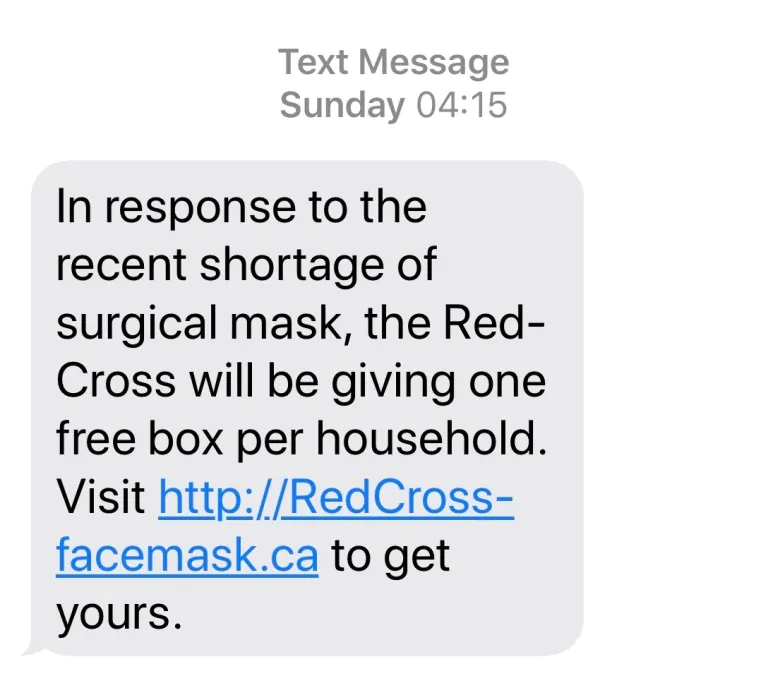
The most prolific scam in Canada so far has been a text message, from a number claiming to be the Red Cross, offering free face masks.
If you receive a text message like this one, the Canadian Red Cross says you should delete it immediately. (Submitted by Michelle Cheung)
The message contains a link to a fake Red Cross website where the person is then asked to either make a payment, either for a donation or to pay for delivery of the mask, according to Thomson.
The Canadian Red Cross has confirmed that it is not sending out any text messages or emails like this and advises anyone who gets one to delete it immediately.
Phishing emails
Fraudsters are sending emails pretending to be from the World Health Organization or the Public Health Agency of Canada with links purporting to provide updates on the organization’s response to the COVID-19 pandemic.
Thomson says not to click on those links, because the website will likely try to trick you into providing personal information. Instead, if you’re looking for information, you should visit the federal government’s official website for updates.
Don’t click on links in phishing emails like this, because the linked website will likely try to get you to disclose personal or financial information. (Submitted)
Test results phone call
Some people report receiving phone calls and voicemails from scammers pretending to be from a public health agency.
In these calls, the fraudster says the person has tested positive for the coronavirus and, to get a prescription, must provide the scammer with their credit card and health card numbers.
Real public health officials will not ask for your credit card information.
There have been some reports of scammers going door to door, either selling fake decontamination services or fake coronavirus testing kits.
Only hospitals and public health agencies are authorized to perform coronavirus tests, and will not charge. No other tests are genuine or guaranteed, according to Thomson.
Thomson also warns that more scams are likely to pop up in the days and weeks ahead.
These could include phone calls to businesses saying they have to update first aid kits, and loan scams exploiting of the financial fallout of the pandemic.
If you’re the target of a COVID-19 scam, Thomson urges you to report it to the Canadian Anti-Fraud Centre or your local police department.
It’s a clash of titans — an epic battle between two famous scientists over the world’s response to the COVID-19 pandemic.
In one corner, influential Stanford University epidemiologist John Ioannidis, who wrote a commentary asking whether taking such drastic action to combat the pandemic without evidence it will work is a “fiasco in the making.”
Across the mat, prominent Harvard epidemiologist Marc Lipsitch punched back with a defiant response titled: “We know enough now to act decisively against COVID-19.”
Watching from the sidelines? Everybody else. The people who worry the world has gone too far too fast.
And those afraid the response hasn’t come fast enough.
The debate comes down to questions about data. What is the true fatality rate of COVID-19? How many people are already infected?
“Better information is needed to guide decisions and actions of monumental significance and to monitor their impact,” Ioannidis wrote. “In the absence of data, prepare-for-the-worst reasoning leads to extreme measures of social distancing and lockdowns. Unfortunately,we do not know if these measures work.”
Ioannidis told CBC News he worries about the consequences of those measures.
“Put a stall to the entire economy. Tell people to stay at their homes, get depressed, commit suicide, domestic violence. Who knows? Child abuse, children losing their education, companies crashing … unemployment, the stock market already dropping 20 per cent.
“Is that the solution?”
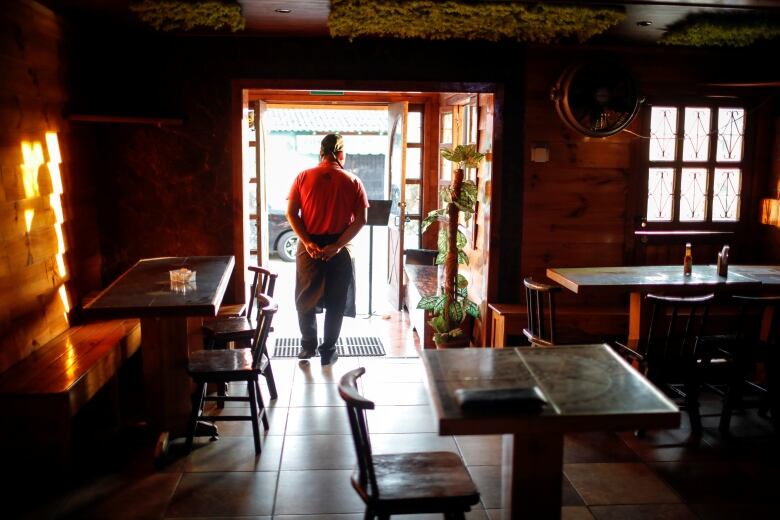
A man waits for takeout orders at the Kua restaurant in Antiguo Cuscatlan after El Salvador’s government announced the closing of restaurants and other measures to try to stop the spread of COVID-19. (Jose Cabezas/Reuters)
The day after Ioannidis’s bombshell commentary appeared on the medical news website STAT, the site published Marc Lipsitch’s response.
Lipsitch said he talked to Ioannidis beforehand and found that they had more in common than it seemed.
“I would say that his article did what contrarian writing should do: started a discussion.”
Lipsitch insists drastic action is required.
“Waiting and hoping for a miracle as health systems are overrun by COVID-19 is not an option,” he wrote. “For the short term, there is no choice but to use the time we are buying with social distancing to mobilize a massive political, economic, and societal effort to find new ways to cope with this virus.”
Social media lit up as other leading scientists joined the fray.
Dr. Gabriel Leung, dean of medicine at the University of Hong Kong, who has seen COVID-19 up close, challenged how Ioannidis compared the illness to the seasonal flu.
Absolutely! Of every 1,000 infecteds who show symptoms, 14 will die. Highly age dependent where the risk of getting infected is 3x and then risk of dying is another 3x in 70+year-olds compared to those in their 30s. <br>This is NOT seasonal flu nor even 2009 pandemic flu! <a href=”https://t.co/q6kWaPnPzE”>https://t.co/q6kWaPnPzE</a>
For his part, Ioannidis is at home in Palo Alto, Calif., obeying an order by county officials in the San Francisco area to “shelter in place.” He’s also weathering another storm — “a pandemic of emails” flooding his inbox as people respond to his commentary.
“The vast majority,” he said, “are congratulations and thinking along the same wavelength.”
He said he doesn’t know what response would be appropriate. And he acknowledges the situation in northern Italy is a disaster.
But he urges scientists and decision-makers to make it a priority to gather the data to find out if the response to the virus might end up being more damaging than the pandemic itself.
A worker crosses Rodriguez de Francia avenue during a curfew put into effect to attempt to slow down the spread of COVID-19 in Asuncion, Paraguay. (Jorge Saenz/The Associated Press)
Prof. Ross Upshur of the University of Toronto is a public health expert, a physician and a scholar of the ethics and history of global health emergencies. He’s also a veteran of the SARS outbreak.
He has corresponded with Ioannidis over the years and respects the Stanford professor’s expertise: “He is one of the most cited, most highly regarded researchers.”
But in this particular case, Upshur said, Ioannidis is making an error in his analysis by failing to view the current response through the lens of public health instead of evidence-based medicine.
“Of course there’s a lack of data,” said Upshur. “It’s all nice to stand on the sidelines and say, ‘Hey, you know we don’t have very good data. These are not evidence-based decisions.’ Well, of course they’re not, because we don’t have the evidence.”
Ioannidis said it’s time to make getting that data a top priority. The capacity to do the necessary research exists, even in the midst of the pandemic response, he said.
“These data may show that lockdown is something that we need to do and then decide for how long,” he said. “They may show that it is a horrible idea. Because we don’t know what harms these interventions will have.”
He said the response so far has been based on modelling, which uses a series of assumptions about important factors including the rate of infection and the case fatality rate.
So far, COVID-19 has killed almost 9,000 people around the world. Doctors working in modern health-care systems in Italy, France and Spain report being on the verge of collapse.
Don’t try to be perfect. Be fast
Dr. Mike Ryan, head of the World Health Organization’s emergencies program and a veteran of the Ebola epidemic, said “speed trumps perfection.”
“Perfection is the enemy of the good when it comes to emergency management,” he said during the WHO’s briefing last Friday. “Everyone is afraid of making a mistake. Everyone is afraid of the consequence of error. But the greatest error is not to move. The greatest error is to be paralyzed by the fear of failure.”
Mike Ryan, head of the World Health Organization’s emergencies program, says ‘speed trumps perfection’ when responding to a crisis. (Denis Balibouse/Reuters)
Still, Ioannidis said he worries about a domino effect with the global response.
“I think there is … the feeling that other leaders have taken measures, and if we don’t act, there is a sense of negligence. Doing that without a plan to realize where we are and where we’re headed is extremely dangerous.”
‘Spring of Fear’
The roadmap for responding to public health emergencies was drawn centuries ago, according to Ross Upshur. There are massive volumes of research, philosophy, court decisions and public inquiries that have upheld the legal and ethical imperative to take dramatic action to protect against a dire threat to public health, he said.
The touchstone is the precautionary principle, clearly articulated in the 2006 investigation into Canada’s response to the SARS epidemic, written by Justice Archie Campbell of the Ontario Superior Court.
“Where there is reasonable evidence of an impending threat to public health, it is inappropriate to require proof of causation beyond a reasonable doubt before taking steps to avert the threat,” Campbell wrote in a chapter called “Spring of Fear,” citing Justice Horace Krever, who presided over Canada’s tainted blood inquiry.
As Upshur put it: “We have put in place public health laws and public health powers for a reason.”
“I know there is going to be a reckoning,” he said. “I know people are going to ask whether this decision was disproportionate or not. But I don’t think people in public health had any other option.”
Ioannidis said that might be true. But there are some key questions that need to be answered in order to make sound decisions going forward, he said.
“We desperately need to know, No. 1, the prevalence of infection, and No. 2, the incidence of new infections,” he said. “If we make decisions with such tremendous uncertainty, we can get tremendous harms.”
The lack of data is one point on which Lipsitch and Ioannidis agree.
“The U.S. has done fewer tests per capita so far than almost any rich country in the world,” Lipsitch wrote. “And many critical details of the epidemiology — including the absolute number of cases, the role of children in transmission, the role of presymptomatic transmission, and the risk of dying from infection with SARS-CoV-2 — remain uncertain.”
The Alberta government is looking to auction off a small patch of native prairie to be plowed under despite recent promises that no Crown land would be put up for sale.
“The province of Alberta sees the unlimited potential in this quarter and has selected it for sale to the public,” says the land description from the auction company.
“Never privately owned and always in pasture, the land offers up unlimited options for added value production to today’s discerning consumers. This quarter will answer the bell for any new owner and produce big yields off the hop.”
The land east of Taber in southern Alberta is to be auctioned off March 31. The starting bid for the 65-hectare plot is $440,000.
Grassland home to 3 sensitive species
Government data says the land is home to at least three sensitive species: Sprague’s pipit, the common nighthawk and the plains spadefoot toad.
Environmental groups are angry that another bit of the remaining grassland that once covered Alberta is to go under the auctioneer’s hammer.
“It’s a bad idea,” said Neil Keown of the conservation group Backcountry Hunters and Anglers.
“It’s setting a precedent, despite the minister proclaiming to the exact opposite just two short weeks ago.”
On March 5, Environment and Parks Minister Jason Nixon told the Calgary Herald: “We are not selling any Crown or public land — period.”
Nixon’s assurance came after the province announced it was closing 20 provincial parks and removing another 164 protected areas from the parks list. The province’s news release mentioned the possibility of sales.
Environment spokeswoman Jess Sinclair said Nixon’s statement to the Herald referred to Crown land that had been used for parks. Crown grazing leases have been sold off before.
The plot being sold has been used for grazing, which doesn’t require the land to be disturbed. Sinclair said proceeds from the sale will go into a fund to support conservation.
Every piece of native prairie that we have left is precious.– Cliff Wallis, Alberta Wilderness Association.
The province should let the public know under what circumstances public lands will be sold off, said Cliff Wallis of the Alberta Wilderness Association.
“Even though the minister has indicated these public lands are not for sale, they clearly are. We would ask the minister to make it very clear what the policies are going forward.”
Kevin Van Tighem, an environmentalist and former superintendent of Banff National Park, said the sale being announced in a real-estate ad raises questions about government openness.
“It’s very frustrating … having a minister who’s responsible for the environment to stand up and say ‘no Crown land sales,’ and then to discover something like this,” Van Tighem said.
“There’s a lot of pretty valuable special places that are potentially at risk if we have the kind of government that can only see the price of land and not its value.”
Keown said one prospective buyer is the same person who attempted to acquire the land in 2011 to convert it to potato fields. That much larger purchase was halted after a public outcry.
Half of grasslands plowed or paved over
Provincial government figures show more than half of Alberta’s original grasslands have been plowed or paved over. Less than two per cent of what is left has been protected, despite three-quarters of the province’s endangered species being native to the prairie.
“Every piece of native prairie that we have left is precious. Temperate grasslands are one of the most rapidly disappearing habitats on the planet,” Wallis said.
He noted there was no consultation about the sale, just as there was none for the parks announcement.
“We have no confidence this government has a conservation agenda. There is no balance in this province.”
In its campaign platform last spring, the United Conservative Party promised to modernize parks and sell off public lands.
When Windsor resident Jo-Ann Robinson received a text message from the Canadian Red Cross claiming to offer free face masks, she immediately knew to be wary.
Rather than clicking on the link included in the message or responding to the message itself, Robinson reached out to her daughter-in-law, who also expressed skepticism about the message.
“I just don’t open them, I just get rid of them,” Robinson said. “If my friends or family are sending me something, then I know it’s legit, but something that I have no idea what it is? I’m not going to open it.”
Robinson’s story is familiar to LaSalle Coun. Mike Akpata.
A former Windsor police officer whose expertise was fraud, Akpata — who’s currently in Florida — said he’s also received a number of fraudulent phone calls to his cellphone related to COVID-19.
Akpata said right now — while concerns about COVID-19 are at their highest — is when fraudsters and scammers are most likely to prey on victims, especially seniors.
A screenshot of the message sent to Jo-Ann Robinson. The link directs to a website that offers a box of face masks for a $5 delivery fee, just as long as users submit their address, email, phone number and credit card information. (Connie Robinson/Facebook)
“They are targeting people who are the most vulnerable or those who are at risk,” he said.
A quick search on social media reveals that a number of Windsor-Essex residents have received some kind of spam message connected to COVID-19, including spam phone calls and spam emails.
According to a Chatham-Kent police media release published on Monday, one Wallaceburg, Ont. resident even received a phone call informing her that someone would soon visit her home to offer in-person coronavirus testing.
In response, Chatham-Kent police issued a media release informing residents that there is no door-to-door COVID-19 testing currently taking place in the community.
In partnership with <a href=”https://twitter.com/CKPublicHealth?ref_src=twsrc%5Etfw”>@CKPublicHealth</a> we would like to remind citizens that there is no door-to-door COVID-19 testing being done in our community. If someone calls you, please do not provide them with any personal or medical info. <a href=”https://t.co/GrTFI8jZBi”>https://t.co/GrTFI8jZBi</a> <a href=”https://t.co/lIgCwbNK5X”>pic.twitter.com/lIgCwbNK5X</a>
And though more and more people are choosing to avoid going outside to avoid the risk of COVID-19, Akpata said that likely won’t stop fraudsters.
“On the internet, they can reach out to anybody and everyone,” he said.
Akpata emphasized all Canadians should remain vigilant when it comes to potential scam communications.
“Simply put, if you didn’t ask for it, right now you’ve got to be very cautious and cognizant that people may be trying to defraud you,” he said.
Some tips to avoid COVID-19 fraud:
Beware of false or misleading information.
Beware of high-priced or low-quality products.
Beware of unsolicited medical advisory emails with links or attachments.
Beware of miracle cures, herbal remedies or other questionable offers, such as vaccines or faster tests.
For their part, the Canadian Red Cross has already issued a statement on scam offers connected to face masks.
“The sender claims to be the Red Cross and is offering to give away or sell face masks during the COVID-19 pandemic,” reads an excerpt from a Canadian Red Cross media release issued on March 15. “This is not a valid offer and the Red Cross advises anyone who receives this message to delete it immediately. Do not click on the link or respond.”
“If you suspect you have been a victim of fraudulent activity, please contact your local police authority.”
A spokesperson for the Canadian Anti-Fraud Centre (CAFC), a federal agency that helps report and respond to fraud, said the organization has also received reports of scams and frauds connected to COVID-19 and is aware of the issue.
The CAFC has made a number of recommendations for how to protect against COVID-19 scams, including being aware of false or misleading information and being aware of miracle cures, herbal remedies and other “questionable offers,” such as vaccines and faster tests.
In the early days of Canada’s COVID-19 outbreak, Elisa Baniassad was able to trace how new cases were spreading and plan her outings accordingly.
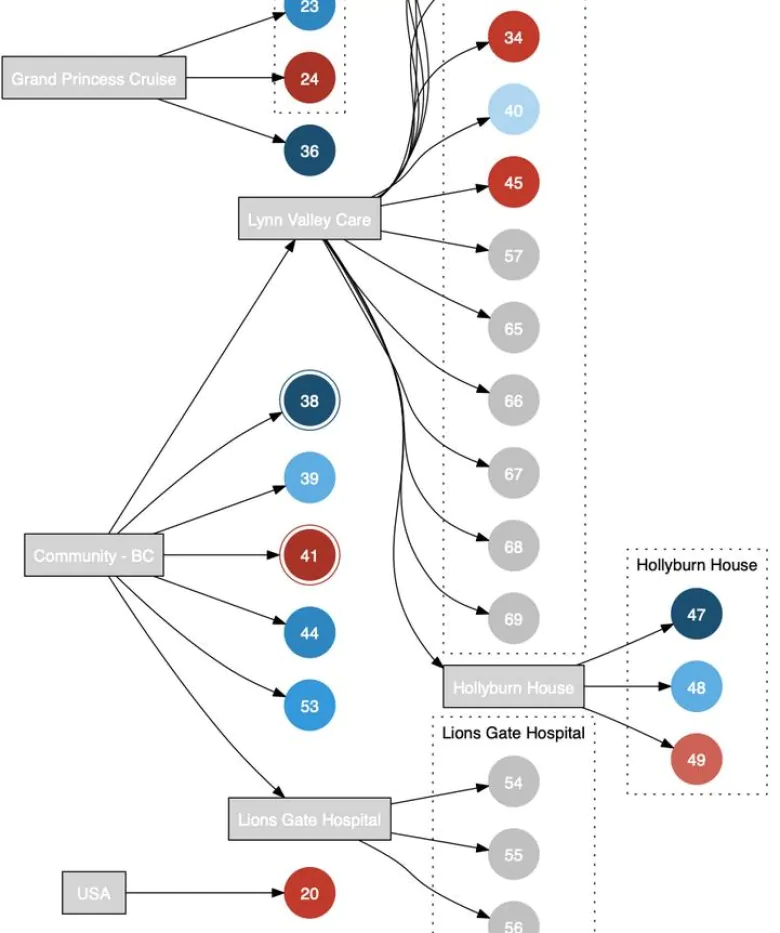
“When I plotted how the virus was being transmitted, I saw that it was from close contact. People weren’t getting it out on the street, they were getting it at home from their family members,” said the computer science instructor at the University of British Columbia.
Baniassad is one of a handful of people making use of the reams of data being collected and published daily around the world to help governments and citizens plan and be informed of the latest situation.
Her diagrams are published on ViriHealth.com, a website started by someone in Toronto to keep track of the information released by the provinces.
Welcome to humanity’s first data-driven pandemic.
When detailed data on each new COVID-19 case was released by the B.C. government, it was possible to trace how the virus was transmitted. (Elisa Baniassad/ViriHealth.com)
“This pandemic is unprecedented, and the amount of data sharing is unprecedented,” said David Buckeridge, a professor of epidemiology at McGill University’s medical school. “I’ve never seen this much activity of people making data so openly available.”
Every day, countries and regional governments are releasing the number of new cases, tests conducted, deaths and recoveries. In some cases, they release how new infections are linked to to others and how the virus is mutating as it hops borders.
This allows researchers to do quick analyses and forecast future infections, along with better advising governments and citizens on how to respond, Buckeridge said.
His team, in fact, received federal funding to measure countries’ responses based on new daily cases.
“We’re been trending towards this over time, being open and releasing data as it’s generated,” said Allison Black, a PhD candidate in epidemiology at the University of Washington in Seattle.
She is one of several people behind NextStrain, a website that traces the genetic mutations of the novel coronavirus and other pathogens for laboratory researchers to use.
“The release of coronavirus data has been incredibly inspiring. The scale that it’s happening at is new,” Black said.
Canada case data hard to compile
In Canada, daily news about new COVID-19 cases comes from provincial health authorities, often in inconsistent ways, and compiling it into a single national dataset is challenging. Still, some have stepped up.
Isha Berry, a PhD student at the University of Toronto’s Dalla Lana school of public health, assembled a team that scans provincial releases each day and standardizes the data in one spreadsheet, which is publicly available.
But a spreadsheet makes it hard to see how the disease is evolving in Canada, so her team made an online dashboard that shows a daily portrait in a visual way.
“It allows people to see summaries at national level, to see what’s happening in a clearer way,” Berry said.
NextStrain.com traces the genetic mutations of pathogens like the coronavirus as it spreads around the globe. (NextStrain)
Another Canadian effort to collate and simplify information is ViriHealth.com, started by a project manager in Toronto. The world’s largest maker of mapping software, Esri, is using the daily data from ViriHealth to power its own Canadian dashboard, released last Friday, which has the most granular geographic breakdown of cases.
Esri has clients in all levels of government, and they’re all asking for help to better plan responses and resources, said Chris North, the company’s director of technology adoption.
“A lot of them don’t have time to react. They are dealing with other aspects of the crisis,” he said.
Esri is also crossing global pandemic data with its own data on socioeconomic measures to see if they can identify areas that could be hit harder by the virus to help their customers prioritize responses.
Data details slim as cases grow
Baniassad is no longer able to trace how the virus is being transmitted in B.C. The data put out by the British Columbia government was detailed in the first few days but as the numbers grow, it’s down to the bare essentials: number of new daily cases, deaths and recoveries.
Other provincial governments seem to be doing the same.
“It’s frustrating because now they’re just giving aggregate numbers for the population,” Baniassad said. It’s no longer possible to see how many new cases are linked, for example, to an initial cluster at the Lynn Valley Care Centre in Vancouver.
As the number of COVID-19 cases mounts in Canada, there are fewer details released about each. This makes it harder for the public to see how the disease is being transmitted. (Esri Canada)
She compares it to Singapore, which continues to release detailed information on each case, including clusters of infection, such as 23 cases linked to a church or 47 cases at a dinner party.
“It’s calming for people to have a sense that they’re being fully informed,” she said. “My mother likes going to church. Having full knowledge where the infection clusters are, we can make more informed decisions.”
Resources to keep up with the COVID-19 pandemic
Canada-specific:
Dashboard from the University of Toronto’s Dalla Lana school of public health
The number of ‘phishing’ attacks meant to steal the online credentials of public servants and corporate sector employees now housebound due to the COVID-19 pandemic is on the rise, one cyber security expert warns.
Many attempts are being made against employees who are working from home on virtual private works (VPNs). Cyber experts are still gathering data to establish a direct correlation between the pandemic crisis and the increase in malicious activity.
But Rafal Rohozinski, chief executive officer of the SecDev Group of Companies, said this pandemic moment — when large numbers of employees are at home and receiving instructions from their workplaces on how to connect to internal networks — offers online thieves a “huge opportunity.”
Federal government and corporate sector systems were never designed to support a sudden, mass migration of employees from offices to their homes, he said.
“The opening that creates for those who want to wreak havoc through ransomware and malware is really, really significant,” said Rohozinski. “And I don’t think we’re anywhere near prepared for that.
“What we’re seeing is an increase in phishing being used as a means to get people’s credentials.”
U.S. Health Department attacked
The U.S. Health and Human Services Department’s website was hit by a cyber attack over several hours on Sunday, an incident which involved overloading its servers with millions of hits.
Officials said the system was not penetrated, although media reports in Washington described it as an attempt to undermine the U.S. government’s response to the coronavirus pandemic — and may have been the work of a foreign actor.
Rohozinski said that while the facts are not all in yet, his “professional guess” is that there’s a link between the attack and the COVID-19 crisis.
Last week, Canada’s top military commander warned that he’d seen recent indications the country’s adversaries intend to exploit the uncertainty, confusion and fear generated by the pandemic.
Gen. Jonathan Vance, chief of the defence staff, was not specific about the potential threats — but experts say they could range from hacking to online disinformation campaigns aimed at discrediting the federal government’s response.
Rohozinski said he’s concerned about the federal government’s technical capacity to support thousands of employees on private networks.
“Everybody’s moving on to VPNs. Everybody,” he said. “This is an enormous pinpoint and an enormous vulnerability.”
Federal Digital Government Minister Joyce Murray’s office was asked for a response Monday, but was unable to provide an immediate comment.
Many of the country’s leading information technology companies are part of the Canadian Cyber Threat Exchange (CCTE), a nonprofit centre where companies can swap information and insights. A CCTE spokeswoman said the corporate sector is better prepared to face the challenges posed by the mass movement of employees to home networks.
Still, there is reason for concern.
“Given we are moving people to work from home now, companies need to ensure that the work from home environment is as safe as the corporate environment and that people are trained to notice these phishing campaigns, just like they were in the corporate environment,” said Mary Jane Couldridge, director of business development at the CCTE.
“It’s a matter of keeping our community aware of what is impacting Canada daily so we know how to react to it and prevent it from spreading — and not chase rainbows.”
Most corporations have plans they’ll activate now to cover the wholesale movement of employees to networks outside of the office, she added.