Categories
Tech

Coronavirus risk to rare mountain gorillas prompts tourist bans


As the coronavirus infects more people around the world, conservationists are warning of the risk to another vulnerable species: Africa’s endangered mountain gorilla.

Congo’s Virunga National Park, home to about a third of the world’s mountain gorillas, is barring visitors until June 1, citing “advice from scientific experts indicating that primates, including mountain gorillas, are likely susceptible to complications arising from the COVID-19 virus.”

Neighbouring Rwanda also is temporarily shutting down tourism and research activities in three national parks that are home to primates such as gorillas and chimpanzees.

Mountain gorillas are prone to some respiratory illnesses that afflict humans. A common cold can kill a gorilla, according to the World Wide Fund for Nature, one reason why tourists tracking gorillas are not normally permitted to get too close.

Around 1,000 mountain gorillas live in protected areas in Congo, Uganda and Rwanda, for whom tourism is an important source of revenue. But COVID-19 has led to restrictive measures.

Virunga National Park’s decision has been welcomed by conservationists in the region.

Paula Kahumbu, chief executive of the Kenya-based conservation group WildlifeDirect, told The Associated Press that “every possible effort must be made” to protect mountain gorillas because so few are left in the wild.

“We know that gorillas are very sensitive to human diseases,” she said. “If anyone has a cold or a flu they are not allowed to go and see the gorillas. With coronavirus having such a long time of no symptoms in some cases, it means that we could actually put those gorillas at risk.”

Protective rules often broken

Even existing measures may not be enough to protect them.

According to Ugandan conservationist Gladys Kalema-Zikusoka with Conservation Through Public Health, a study published this year by her group and Ohio University showed that measures in place to protect gorillas from humans are not effective in practice.

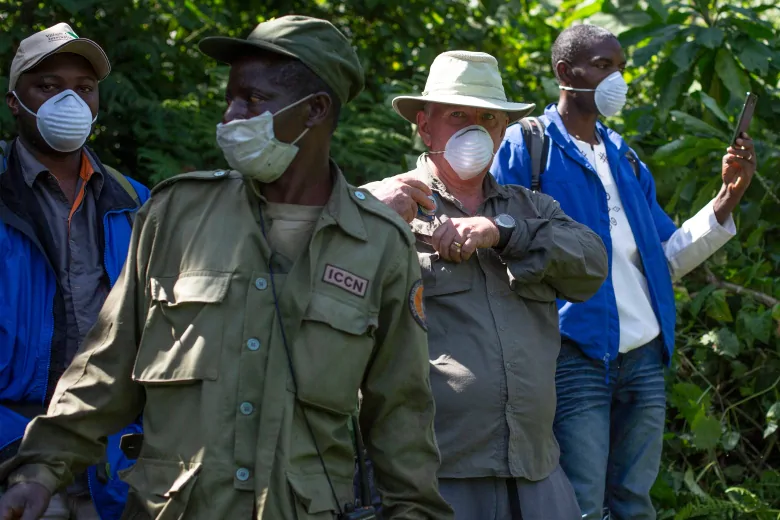
A tourist and park rangers wear protective masks as they visit the Virunga National Park in eastern Congo in 2014. Gorillas are prone to respiratory illnesses and can even be killed by a common cold. (Jerome Delay/The Associated Press)

The rule on keeping a safe distance from the gorillas was broken almost every time a group of tourists visited, she said.

“What the research found is that the seven-metre rule was broken almost all the time — like 98 per cent of the time,” she said. “But what was interesting is that 60 per cent of the time it was tourists that broke it and 40 per cent of the time it was the gorillas who broke it.”

If close interaction cannot be prevented, she said, one measure that could potentially improve safety is requiring tourists to wear masks at all times.

No gorilla tourism shutdown in Uganda

Uganda has not announced a shutdown of gorilla tourism, although tourist traffic from Europe and elsewhere has dwindled.

A spokesperson for the Uganda Wildlife Authority, Bashir Hangi, said the decision on whether to shut down gorilla tourism is now academic as there is almost no business amid the outbreak.

Still, he said, the few tourists who come are screened for fever and other symptoms and must obey rules such as not standing within seven metres of a gorilla family. Visitors from virus-affected countries who have gone through quarantine in Uganda need to produce what he called a certificate of isolation before they are permitted to track the gorillas.

In this Sept. 2, 2019 photo, a silverback mountain gorilla named Segasira sits among plants in the Volcanoes National Park, Rwanda. Rwanda is temporarily shutting down tourism and research activities in three national parks that are home to primates such as gorillas and chimpanzees. (Felipe Dana/The Associated Press)

Amos Wekesa, whose Great Lakes Safaris organizes gorilla tours in Rwanda and Uganda, spoke mournfully of “hardly any business” as tourists postpone visits or seek refunds.

The region’s mountain gorilla population dropped sharply in the past century because of poaching, illness and human encroachment. Mountain gorillas have been listed as critically endangered or endangered since 1996, although their numbers are now said to be growing as a result of conservation efforts.

But there have been painful losses. Some gorillas die of natural causes, falling from trees or being killed in fights between males for territory or dominance. A lightning strike killed four mountain gorillas in February.

In Rwanda, where tourism is the top foreign exchange earner, the government has prioritized the protection of gorillas, even launching a naming ceremony for baby primates.

Tourism revenue is key in protecting mountain gorillas as authorities can use some of the money to help local communities or invest in anti-poaching activities. A gorilla tracking permit costs up to $870 Cdn in Uganda, and thousands of tourists pay each year. A similar permit costs upward of $1,500 Cdn in Rwanda.

Some worry the loss of tourist revenue during the coronavirus pandemic could further expose the primates to poachers. Virunga, established in 1925 as Africa’s first national park and now a UNESCO World Heritage Site, has long been vulnerable in a volatile part of eastern Congo.

“I think this is going to have a huge impact on their sustainability,” Kahumbu, the Kenyan conservationist, said of Virunga. “I call on all donors and governments that support these national parks in Africa to make it easy for the parks that need to shut down to do so and survive.”

Poachers could do even more damage to gorillas if they think the anti-poaching efforts have been reduced, she said.



Source link

Categories
Tech

Canadian publishers turn to e-book discounts to entice readers amid COVID-19


If you’re looking for an escape from the global coronavirus pandemic, some Canadian publishers are offering special deals on e-books in a bid to entertain readers and pay authors. 

Invisible Publishing said all its e-books are set to “pay-what-you-can” during the COVID-19 pandemic. 

“There’s no minimum [price]. There’s also no maximum,” said publisher Leigh Nash. “Everybody should have access to art, particularly in times of trouble.”

Invisible usually splits revenue with authors, but this arrangement will send 100 per cent of the income to the authors.

‘It’s being born in a very changed world’

“We’re in the middle of our spring launch season now and we focus on debut authors,” Nash said. “This is not a good time to be launching your first book.”

Many authors have lost chances to speak publicly, be interviewed or do book signings. People aren’t browsing in bookstores or libraries, meaning new books might never cross their paths.

Nash points to authors like Patty Scott, an Ontario writer whose first novel, The Union of Smokers, is out now. “This is a lifelong dream for him and it’s being born out into a very changed world.”

Invisible started in Halifax in 2007 and now operates in Nova Scotia and Ontario.

Hug a book and feel better

Jay Millar, co-publisher at Toronto-based Book*hug Press, said they’re selling all e-books at a flat $5 rate for the same reasons. All the revenue goes to the authors.

“We’re so hyper-inundated with all the news all the time,” he said. “I think if we can put that aside and disappear into a book, not only will the time pass more pleasantly, but we will also be less anxious.”

Polar Vortex tells the story of a woman who goes offline to escape her past. One day she decides it’s safe to go back online, and trouble follows. (Submitted by Book*hug)

He said their authors with spring launches have seen everything cancelled and their plans left in tatters. Without paid speaking gigs, or helpful promotional events, fewer people will know about their new titles.

“In these unprecedented times, we thought we would do something unprecedented too,” he said.

He said people are buying in big numbers to pass the time and support authors. Gwen Benaway’s poetry collection day/break has been leading the pack, with Shani Mootoo’s novel Polar Vortex following close behind. 

MORE TOP STORIES


Source link

Categories
Tech

Company set to crank out ventilators, awaiting final go-ahead from Ottawa


A Canadian company says it can crank up production within days of potential life-saving ventilators, once it gets final instructions from the federal government.

Countries are scrambling to avoid the nightmarish scenario unfolding in Italy, where doctors are grappling with which patients to save because there aren’t enough breathing machines to serve all the critically ill victims gasping for air.

The Toronto-based medical supplies company has a letter of intent from Ottawa to purchase machines and says it can drastically scale up production once it receives one critical detail:

How many machines does Ottawa want?

Thornhill Medical says its production plans hinge on the answer to that question — such as what kind of manufacturing partner might be required, and how financing might work.

Worker build a temporary hallway to the COVID-19 testing centre at Mt. Sinai Hospital in Toronto on March 19. (Frank Gunn/The Canadian Press)

Once that’s settled, production can immediately start, said company president Lesley Gouldie.

“We would be manufacturing this weekend if we knew what the order was,” said Gouldie, whose company’s MOVES SLC machine is like a portable intensive-care unit with a ventilator.

“We can’t initiate scaling until we know what we have to scale to.”

Those details should be released imminently, one federal official said. The federal government has been consulting with the provinces in assessing requirements.  

Depending on the size of the order, Gouldie said the company can either retain the property rights and sub-contract production to a manufacturer, or transfer the technology in exchange for payments or royalties.

One thing she’s adamant about is the company can meet Ottawa’s demand.

“We’ll do whatever it takes to rapidly scale up,” she said. “Manufacturing capability is not going to be the limiting factor.”

What’s not clear, yet, is how many of these machines actually Canada needs. One study says Ontario risks running out within weeks.  

The federal government estimates there are about 5,000 ventilators in the country; that’s the figure put forward at a news conference Saturday by Canada’s Deputy Chief Public Health Officer Dr. Howard Njoo.

The federal government has expressed an interest in buying these machines, the MOVES SLC, from its Toronto-based manufacturer to use as ventilators during the COVID-19 pandemic. The company says it’s ready to ramp up production, but is awaiting specifics from Ottawa. (Thornhill Medical)


He said that depending on the trajectory of the virus Canada might need anywhere from “1,000, to 3,000, or 5,000.”

For the sake of comparison, in one of the hardest-hit countries so far, on Saturday Italy had 2,857 patients reported in intensive care for COVID-19.

‘This is a war. Treat it like a war’

Closer to home, panic is mounting. In New York State, the governor says his state needs 30,000 ventilators and only has 5,000 to 6,000.

The U.S. Army is discussing plans to turn New York City’s empty hotels into intensive-care facilities as cases skyrocket.

“This is a war. Treat it like a war,” New York Gov. Andrew Cuomo told CNN, urging the U.S. government to use wartime measures under the Defense Production Act.

“Say to the manufacturers in this country, ‘I need you to build these pieces of equipment quickly.’ … This is going to be the matter of life and death for people.” 

It’s happened before.

During the Second World War, car companies stopped building cars. 

Instead they churned out planes, engines, and cannons. Ford had plants in five U.S. states producing military supplies; Chrysler alone had two-dozen factories building everything from tanks and plane engines to anti-aircraft cannons.

In Canada, factories that usually made bicycles and hockey skates churned out gun parts; a soda-fountain company made tank parts.

Amid the current crisis, auto companies in different countries, from Ferrari, to Ford, to Canadian parts makers, are discussing possible roles in producing medical supplies.

Canada’s Deputy Chief Public Health Officer Dr. Howard Njoo says the country probably has 5,000 ventilators and may need anywhere from 1,000 to 5,000 to deal with the COVID-19 crisis. (Sean Kilpatrick/The Canadian Press)

Flavio Volpe, head of Canada’s Automotive Parts Manufacturers’ Association, said he was inundated with calls last week from members keen on getting involved.

He said 16 companies expressed interest early in the week, when auto-production lines were still running; by the end of the week, with most production shuttered by the pandemic, he said he got 50 more inquiries in a single day.

“I wish we could take every call — I can’t,” said Volpe, who said he first discussed the idea in a conversation last weekend with officials in the Ontario and federal governments.

He said that if auto companies get the engineering specifications for a product, and a list of suppliers, they could, within weeks, be churning out gear on a scale unimaginable for medical-supply companies.

“[The medical industry’s] scale is less than one per cent of our scale,” he said, suggesting that companies could, within weeks, be supplying anything from ventilators to protective gear for doctors, like masks. 

The ventilator company, Thornhill, said it’s open to new partnerships: “We’re an innovative company. … We’re more than happy to explore innovative solutions,” Gouldie said.

It’s currently in talks with a manufacturer from another industry — not a car company, but one that has experience producing medical supplies.

She said any manufacturer would need to demonstrate an ability to comply with the strict regulatory requirements of her industry, like ISO 13485.

In Italy, where the health system has been overwhelmed by a surge of COVID-19 cases, a patient in a biocontainment unit is carried on a stretcher from an ambulance arrived at the Columbus Covid 2 Hospital in Rome, Tuesday, March 17. (Alessandra Tarantino/The Associated Press)

Her company isn’t the only one awaiting a purchase order from Ottawa any day now.

A company identified by the federal government as a potential maker of COVID-19 test kits says it hopes to get production rolling within several weeks.

Paul Lem, the founder of Spartan Bioscience in Ottawa, said it would take one week to produce an experimental version, and another week to get the results validated. The company could start mass-production after approval from Health Canada, he added. 

His company makes machines the size of a coffee cup that takes in single-use cartridges for DNA tests.

He said it can be used to test for COVID-19, but needs two things: financing to scale up, and instructions from government.

“[Tell us], ‘How many do you need?'” Lem said. 

“Then we can get going.”


Source link

Categories
Tech

Telecom networks deal with 'unprecedented' pressure as Canadians work from home


Temporarily working from his Toronto home, music composer Igor Correia has run into an unexpected challenge: it takes an awfully long time to upload his work.

“It just chugs and it’s very slow,” he said on FaceTime. The video call repeatedly froze.

Correia, whose music is featured in TV commercials and films, said it took him “a few hours” to send a one-gigabyte file on Wednesday.

He’s among countless Canadians following the advice of public health experts and telecommuting during the COVID-19 crisis. The massive shift is serving as a giant technological experiment, testing bandwidth limits and telephone network capacities as users hold virtual meetings, share files and stream audio and video content.

Correia usually works in a studio, where internet connectivity is seamless. At his normal workplace, “it’s all set up,” he said. “You don’t really think about it.”

Corporate telecommunication technology is typically built with a higher capacity, with greater speeds for more concurrent users than consumer-grade products. 

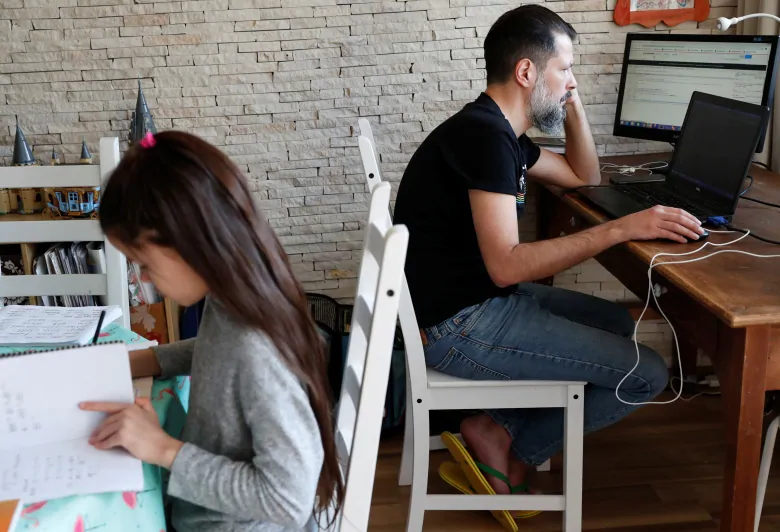
Adults and children at home are both adding traffic to home Wi-Fi networks. (Bernadett Szabo/Reuters)

Bell, Rogers and Telus all acknowledged their networks are experiencing higher-than-normal traffic. And the telecommunications giants pledge their infrastructure can handle the sudden surge.

But lower-tech solutions are facing added pressure as well, with employees dialing into companywide conference calls and Canadians calling government agencies for information on the pandemic.

Telus said in an email that it has an “unprecedented volume of mass-calling events.”

Phone and internet networks under pressure

In some firms, employees shared anecdotes of teleconferences breaking down entirely under the strain of added usage.

Telecom providers said they were working together to ensure connection between networks would be more resilient.

Rogers spokesperson Sarah Schmidt said the provider was “working with other carriers to minimize any intermittent issues.”

Home internet, however, appears to be the service seeing the biggest jump in traffic.

Bell spokesperson Nathan Gibson said home internet usage is up to 60 per cent higher than usual during the day and 20 per cent higher at night.

Widespread outages have not been reported, but University of Toronto computer science professor Yashar Ganjali warned “significant changes in typical traffic might lead to unforeseen situations that might lead to temporary disruptions in some services.”

The three main service providers said they’re all increasing their ability to deal with the traffic as usage grows.

“During these extraordinary times,” Telus spokesperson Brandi Rees said in an email, “our teams are proactively monitoring traffic and performance, optimizing and augmenting capacity as required.”

Several home internet providers have also temporarily removed data overage fees for home internet use.

Not everyone gets broadband

The added reliance on home internet has also highlighted the discrepancy in the availability of high-speed service across Canada.

In rural areas, CRTC data suggests as few as 40.8 per cent of households have access to high-speed broadband.

Netflix announced Thursday it would temporarily reduce bit rates for streaming users in Europe. (Regis Duvignau/Reuters)

It’s taking an added toll on university students who are now expected to attend classes as videoconferences rather than in person.

Because of poor Wi-fF, some students are dealing with connections that keep cutting in and out, making it impossible to take in an entire lecture, said Lydia Angarso, a member of the Arts and Science Students’ Union at the University of Toronto.

She stressed some professors are being especially accommodating, providing lectures as video recordings to allow students to download and watch afterwards.

“It’s a test of what the university is capable of doing … and their ingenuity,” Angarso said.

Netflix lowering bit rates in Europe

With many movie theatres, restaurants and bars closed, streaming services are bound to see an increase in viewership, too.

U.S.-based media research firm Nielsen analyzed the extent of the increase when two weather-related crises forced residents to stay inside: a severe snowstorm in New York in 2016 and Hurricane Harvey in Texas in 2017. Nielsen’s analysis found a 61 per cent increase in streaming via the TV. 

In Europe, Netflix announced it would lower bit rates — which determine the quality and size of its audio and video files — across all its streams for 30 days after a request from the EU. 

“We estimate that this will reduce Netflix traffic on European networks by around 25 per cent, while also ensuring a good quality service for our members,” the company said in a statement.

Netflix did not respond to a request for comment as to whether it would consider a similar move in Canada.

The company says on its website that watching high-definition videos on its platform uses up to three gigabytes of data per hour, while standard definition content requires about one gigabyte per hour. Users can also adjust their own streaming settings.

How to make home internet faster?

Some users may consider temporarily upgrading their home internet plans. The service provider, however, isn’t the only factor to take into account when dealing with slower internet speeds.

The CRTC advises Canadians that several in-home factors may play a role, too, including the age of the modem and the distance between the computer and the wireless router.

The federal regulator also points out it’s important to note the number of devices hogging connectivity on a single network. That’s all the more timely as employees work from home while their children look for pastimes as school is out.

For optimal home Wi-Fi speeds, users are encouraged to move objects away from the modem. (Shutterstock)

For instance, if a smart speaker is streaming music in a bedroom while a tablet downloads a video in the living room and a laptop is used for videoconferencing in the kitchen, the connectivity for all devices may be affected.

If the connection appears slow, it’s best to ensure unused wireless devices are disconnected and not causing unnecessary network congestion. What’s more, users can plug laptops, video game consoles and certain other machines directly into the router using an ethernet cable to optimize connection speeds.

Correia, the music composer, said his internet service provider suggested he look into upgrading his service package.

“Depending on how this goes — or how long it stays like this — we may have to,” he said. Less than a minute later, the video chat failed.


Source link

Categories
Tech

Air pollution drops as countries shut down amid spread of COVID-19


It’s a surreal sight: Webcams from across Italy show normally packed tourist destinations, streets and beaches empty, scenes that seem more aligned with a movie than real life.

In the battle against COVID-19, countries around the world are restricting gatherings, encouraging people to work from home and closing public venues. Italy is under lockdown.  

All of these actions are having quantifiable consequences, particularly in our environment, scientists believe.

The change was first noticed over Wuhan, China, the city that first reported incidents of the new coronavirus that leads to the COVID-19 disease. 

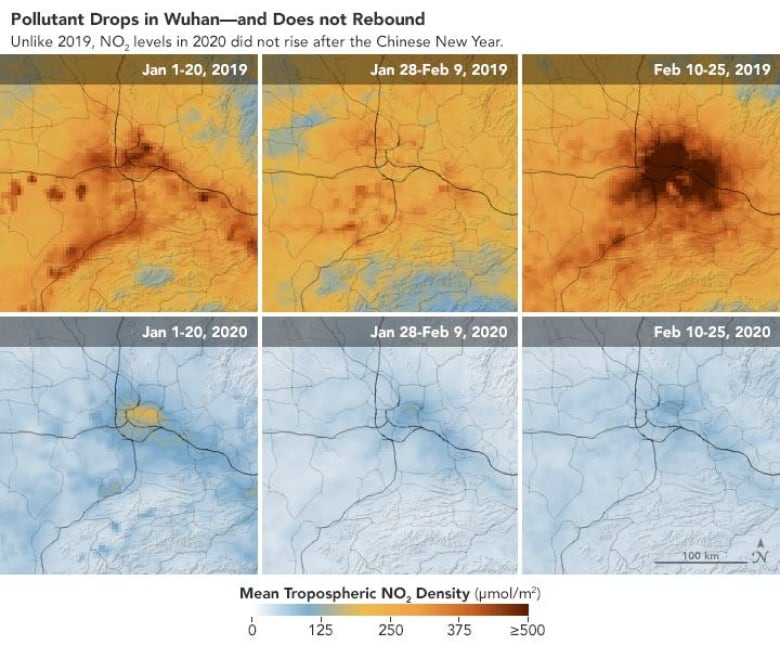
Satellite observations found that nitrogen dioxide (NO2) levels had dropped by 10 to 30 per cent between Jan. 1 and Feb. 25. NO2 emissions are produced by cars, trucks and power plants, among other human-related activities. While NO2 is also produced naturally, it accounts for just one per cent of total emissions.

NASA and European Space Agency pollution monitoring satellites detected significant decreases in nitrogen dioxide (NO2) over China. There is evidence that the change is at least partly related to the economic slowdown following the outbreak of coronavirus. (NASA/ESA)

“This is the first time I have seen such a dramatic drop-off over such a wide area for a specific event,” Fei Liu, an air quality researcher at NASA’s Goddard Space Flight Center, said in early March.

While some of the reduction was linked to Chinese New Year celebrations, when many people were on holiday away from work, what surprised scientists was the fact that, after the holiday, NO2 emissions did not rise. 

Satellite images show that concentrations of nitrogen dioxide (NO2) declined around Chinese New Year in Wuhan, China, but did not rebound once the holiday was over. (NASA/ESA)

But that wasn’t the only thing that had dropped. Particulate matter 2.5 (PM 2.5), a fine particle in the atmosphere linked to serious health issues, was also reduced.

This is particularly good news for those living in China. The country has some of the worst air pollution in the world, which is responsible for killing more than one million people annually. The United Nations estimates that globally, roughly four million people die each year because of air pollution.

Changes over northern Italy

Meanwhile, other observations by a satellite gathering information for the European Commission’s European Centre for Medium-Range Weather Forecasts showed a significant NO2 drop in northern Italy.

Because of its geographical location, Italy’s north — which includes the region of Lombardy, home to the country’s second-most populous city, Milan — is considered one of the worst cities for air pollution in Europe

The European Space Agency (ESA)  also used the Copernicus satellite to measure NO2 over Italy. It found that NO2 decreased by 10 per cent since the lockdown began in the region. 

“When you look at satellite data, if you look at the time series of nitrogen dioxide, you always see northern Italy as a kind of hotspot,” said Claus Zehner, a scientist with ESA who works with Copernicus data. “We have a lot of pollution, a lot of industry and also the location [matters].”

[embedded content]

But under a national lockdown, with most businesses closed and people relegated to being shut in, there were far fewer vehicles on the road, meaning less NO2 being pumped into the air.

Lessons to be learned?

With the concern over the climate crisis, some are wondering if this is a teachable moment.

“This is a big question that very many people are asking themselves these days: What can we learn from this pandemic or this crisis that the world is going through now?” said Kristin Aunan, a researcher at Norway’s Center for International Climate Research.

“Will we learn from it and take measures to see how we can avoid getting back to normal for things that we would like to avoid?”

While not everyone is able to work from home, she noted, it could make organizations consider allowing those who can to do so.

“Hopefully we will at least change your habits in some important ways that could lead to a longer-term reduction in emissions,” Aunan said.

Zehner echoed that sentiment.

“You could also do some theoretical measurements or predictions — if you say we will change all our cars to electric cars where we do not get any of these kinds of emissions. And then you could even calculate what would be the impact,” he said, likening it to a test case “to check what can be done if it would change our habits.”

As to what these lowered NO2 emissions might mean in terms of CO2, Zehner said we’ll have to wait and see.

“You should also see reduction of greenhouse gases over this timeframe. But it’s very hard to get how much,” he said. “This would have to be investigated in detail. And this will be done. There will be publications on this for sure. People are working on it already.”


Source link

Categories
Tech

'Wonderchicken' fossil shows what earliest modern birds looked like


A tiny fossil skull nicknamed “Wonderchicken” is giving scientists a rare glimpse at early ancestors of today’s birds. It may be the oldest known fossil from this group.

With a face like those of today’s chicken-like birds and a back portion like that of living duck-like birds, Wonderchicken is “down near the bottom of the modern-bird family tree,” said Daniel Field of Cambridge University.

He and others announced the find in a report released Wednesday by the journal Nature. They named the creature Asteriornis maastrichtensis, but let’s stick with Wonderchicken.

Found in Belgium, it is some 66.7 to 66.8 million years old. A previously reported Antarctic fossil find is about as old, but its precise age and place on the evolutionary tree are not clear. Field said the Belgian skull is slightly older.

It appeared as a block of broken rocks with some broken leg bones sticking out. After it was donated to a museum, Field tried CT scanning to get a better look at those bones. To his astonishment, the scanning revealed a well preserved skull inside the rock “staring out of the computer screen right at us.”

This illustration shows the world’s oldest modern bird, Asteriornis maastrichtensis, nicknamed the “Wonderchicken,” in its original environment. About 66.7 million years ago parts of Belgium were covered by a shallow sea, and conditions were similar to modern tropical beaches like The Bahamas. (Phillip Krzeminski via Associated Press)

The leg bones let researchers estimate the creature was the size of a very small duck, weighing only about 395 grams. Its legs were long and slender, and it was evidently a shore bird and it could probably fly, Field said.

Wonderchicken lived just before the asteroid impact that’s blamed for killing off many species, most notably the giant dinosaurs. That suggests the evolution of the family tree for modern-day-birds was in a very early stage when the asteroid struck, Field said.

Not a tree dweller

Close relatives of Wonderchicken survived the cataclysm, and the fossil itself shows some traits that have been proposed as beneficial for making it through, Field said. It was small, and its legs suggest it did not live in trees, an important factor since forests were thought to have been devastated by wildfires.

“It also probably paid to not be picky about what you are eating,” since there wasn’t much on the menu in the aftermath of the asteroid strike, Field said. Wonderchicken’s beak shows no signs of a specialized diet, he said.

Scientists unconnected to the research were enthusiastic.

Kevin Padian, a paleontologist at the University of California, Berkeley, said the fossil provides the best evidence yet of when and how the earliest ancestors of today’s birds evolved.

Genetic studies have suggested that those ancestors appeared tens of millions of years earlier than Wonderchicken, he said. But at this point the fossil record shows no support for that, and there’s no known fossil that is clearly from this lineage that predates Wonderchicken, he said.

Julia Clarke, a fossil-bird expert at the University of Texas at Austin, said the fossil “has a lot of information that can start to add to our picture of the earliest steps” in the proliferation of living birds species.

Fossils are snapshots, she said, and “right now our photo album has almost nothing in it” from this time period that relates to modern-day birds. “Any new picture is of key importance.”


Source link