Categories
Tech

Experts alarmed as recipes for homemade hand sanitizer proliferate online


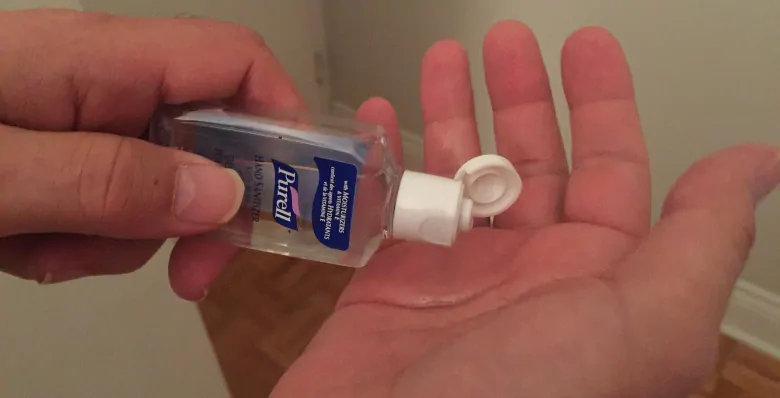
Recipes for homemade hand sanitizer concoctions have been multiplying online but experts are warning that many of the DIY solutions are ineffective — even harmful.

“You don’t want anyone making up their homemade hand sanitizers that might have a component that’s going to lead to some kind of toxic reaction on their hands,” said Dr. Alyson Kelvin, an assistant professor at Dalhousie University in Halifax and a member of the Canadian Centre for Vaccinology.

“We don’t need any more people in the hospitals right now.”

Shortages of hand sanitizer have prompted some Canadian distilleries to make their own. (CBC/Sophia Harris)

Commercial hand sanitizing liquid has been hard to find in recent weeks as news of the spread of the COVID-19 virus has prompted Canadians to empty store shelves.

Health Canada — which considers alcohol-based hand sanitizers to be natural health products — authorizes the products that can be sold in Canada and assigns each one an eight-digit Natural Product Number, displayed on the product’s label.

But faced with the shortage of hand sanitizing solutions and other equipment needed to fight the COVID-19 virus, such as masks, gowns and swabs, Health Canada decided earlier this month to temporarily allow for sale some products that don’t meet some requirements, such as licensing and bilingual labelling.

“The department is allowing certain products to be sold in Canada that may not fully meet all requirements under this interim measure,” the department said in a statement, pointing out that it is maintaining a list on its website of products given temporary approval.

Dr. Alyson Kelvin is an assistant professor at Dalhousie University’s Department of Microbiology and Immunology. (Craig Paisley/CBC)

To date, 14 hand sanitizers or disinfecting wipes have been given temporary authorization. Some of them are imported.

The list doesn’t currently include the many distilleries and breweries across the country that have announced plans to turn their skills to producing hand sanitizer.

Many Canadians are turning to social media for information about how to make their own — and some of that information is very misleading.

WATCH:  Canadians cautioned not to believe hype around prevention or cures for coronavirus

Health Canada warns it’s illegal to make false claims or sell unauthorized health products related to COVID-19. 2:33

One YouTube video that touts a concoction of witch hazel, tea tree oil and aloe vera has been viewed 1.8 million times. Another YouTube video, viewed 747,000 times in the past two weeks, recommends isopropyl rubbing alcohol with concentrations as low as 70 per cent — a level that, when mixed with the other ingredients, wouldn’t be enough to kill the virus.

Posts on sites like Facebook and Reddit have advised using things like vodka and tea tree oil to make your own hand sanitizer.

Many homemade remedies don’t work

The World Health Organization’s website has legitimate instructions for making hand sanitizer that recommend using ethanol with a concentration of 96 per cent, or isopropyl alcohol with a 99.8 per cent concentration.

Experts say the best way to kill the COVID 19 virus on your hands is to wash them properly with soap and water. If that’s not an option, an effective hand sanitizer should have an alcohol concentration of at least 60 per cent.

Kelvin said one of the people who saw recipes for homemade sanitizer on the internet was her own daughter.

“My 10 year old daughter saw online that she could make it herself. It’s a little bit alarming that even children are seeing this.”

Kelvin said hand-washing is the best approach because dirt or grease on your hands can interfere with hand sanitizers. She said it takes at least 20 seconds for properly made hand sanitizers to de-activate the virus.

While manufacturers can standardize the quality of their products and test individual lots, that’s harder to do with homemade solutions, she said.

“There’s no guarantee when you make it that it’s actually 60 per cent.”

Vodka isn’t strong enough

Kelvin said she hasn’t seen any studies on tea tree oil or witch hazel being able to render viruses like COVID-19 inactive. And vodka isn’t strong enough, she said.

“That’s probably not at 60 per cent, or our livers wouldn’t be doing very well.”

Even the recipes that call for highly concentrated alcohol could cause problems, Kelvin said.

“Most of the recipes are alcohol-based and that could create skin problems or be toxic to your own hands, so you have to watch out for that when looking at homemade recipes.”

Ada McVean, a science communicator with McGill University’s Office for Science and Society, said there are a lot of recipes out there.

“My great grandmother was actually texting me the other day, asking me to look at her formulation for homemade hand sanitizer,” said McVean. “And when I ran the math on what percentage her formulation was coming out at, it was incredibly too low.”

Another potential hazard: the 99 per cent alcohol needed to make sanitizer can be very flammable, while some other ingredients could cause allergic reactions.

“If you have never used tea tree oil or lavender essential oils, or any other oils or perfumes, or whatever they’re having you add to cover up the smell, there’s a huge risk of allergic reaction,” said McVean.

“As well, if you’re just using alcohol and not adding anything like aloe vera … you could dry out your skin to the point that it starts cracking, even on the microscopic level,” she said, adding that the novel coronavirus could hide in those cracks.

That’s why, in the end, hand-washing is better than hand sanitizer, McVean said.

Elizabeth Thompson can be reached at elizabeth.thompson@cbc.ca

CBC’s COVID-Check unit is here to help you sift through the noise and get to the truth. If there is something you want us to check out and verify, contact us at covidcheck@cbc.ca


Source link

Categories
Tech

Consumers rush to equip homes with technology during COVID-19 pandemic


As more businesses close their offices and send staff to work from home, technology companies are struggling to keep with demand for equipment.

“It has been bonkers,” says Jeremy Unger, managing partner at Rogue Focus Inc., a boutique agency in Edmonton that specializes in IT support and technology design for business.

An employee at an Edmonton computer store carries a customer’s new purchase Tuesday. (Rick Bremness/CBC)

“Webcams, laptops. People who didn’t have a great home computer are buying desktops as much as they can right now,” Unger said.

“Generally, they need access to business files, they need access to their business phones and they need access to each other.”

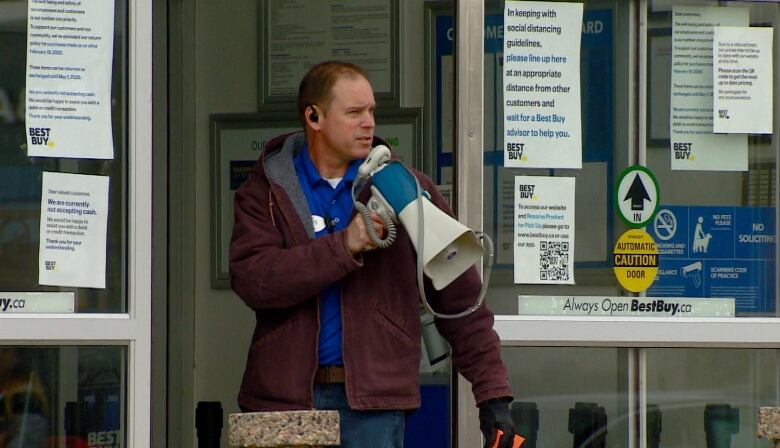
Customers lined up outside the Best Buy store in south Edmonton were waiting more than 30 minutes, as an employee announced numbers through a loudspeaker.

An employee at an Edmonton Best Buy store calls out numbers to customers who are waiting in line outside. (Rick Bremness/CBC)

“They have a limited number of people who are allowed in the store,” said customer Dylan Kernaghan, who was waiting in line. “They are making you draw a number and wait your turn. They’re not accepting cash, as well.”

Karen Speirs, senior manager of external communications at Best Buy, said the chain has seen customer demand jump for items that customers need to work from home.

Dylan Kernaghan waits outside the Best Buy Thursday to buy a video game to play while isolated in his home. (Rick Bremness/CBC)

Other computer stores are also experiencing a higher than usual demand. Mackenzie Ponech, manager of Memory Express, a south-side computer supply store, compared the rush to Black Friday.

Unger believes that school closures have also heightened the demand.

A customer wearing a mask takes a number to get into Best Buy. (Rick Bremness/CBC)

“With all of the schools moving toward Google Classroom, you may have two or three or four kids at home that all need to do homework at the same time, and maybe households need to stock up on a few extra workstations,” he said.  

According to Unger, there could be a supply gap in a few months if manufacturers in southeast Asia are not able to keep up with the demand.

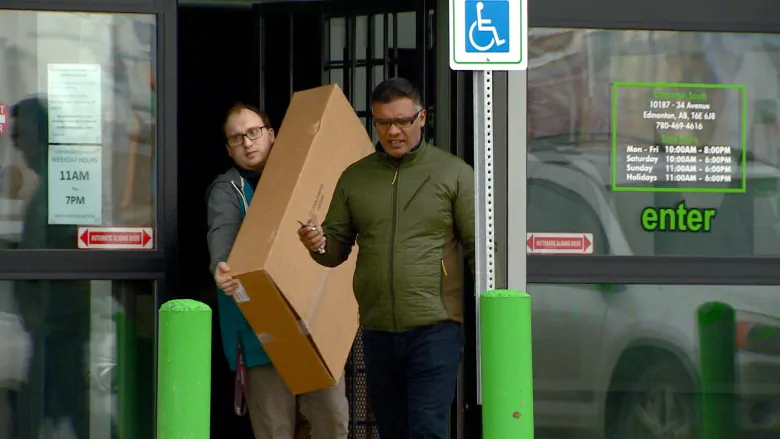
An Edmonton shopper leaves a Best Buy carrying several laptop computers. (Rick Bremness/CBC)


Source link

Categories
Tech

The riskiest surfaces for coronavirus and how to clean them


The recent news may have you worried about catching the novel coronavirus by touching the wrong thing.

Playgrounds have been closed across Canada to prevent transmission among children touching the same swings and jungle gyms, which typically aren’t sanitized. And more than a dozen Canada Post employees are in self-isolation after one tested positive for COVID-19 because a union local raised concerns about front-line postal workers transmitting the virus to the public as demand for parcel delivery skyrockets. Traces of the virus that causes COVID-19 were also recently discovered on a cruise ship 17 days after infected passengers left.

Here’s what you need to know about what materials and surfaces are worse than others, how to clean them, how long the virus lasts and how to protect yourself.

How can viruses be transmitted via surfaces?

COVID-19 is caused by the novel coronavirus SARS-CoV-2. Respiratory viruses like it are generally transmitted by droplets sprayed out when an infected person sneezes, coughs or sometimes just when they talk.

Those droplets can either land directly on surfaces or be transmitted to surfaces like doorknobs if touched by an infected person, and some people infected with COVID-19 show no symptoms. Others can theoretically become infected if they touch the contaminated object or surface and then touch their mouth, eyes or nose with their contaminated hands.

The technical name for those objects and surfaces is fomites, and this kind of disease transmission is called fomite transmission.

A children’s playground is closed with caution tape amid the coronavirus disease (COVID-19) outbreak in Seattle, Wash., on March 24, 2020. Playgrounds across Canada have also been closed as officials say the surfaces are not disinfected and could lead to a risk of transmission of the new coronavirus. (Brian Snyder/Reuters)

How long can the virus that causes COVID-19 survive on surfaces?

A recent study by U.S. National Institute of Allergy and Infectious Diseases found that how long the virus can survive depends on the surface. The study found that viable virus could be detected on:

However, the amount of viable virus fell much more quickly than that, and generally you need to be exposed to a certain “dose” before you can become infected. That said, sometimes only small amounts of a virus are needed to infect a host.

Also, the study didn’t look at how temperature and humidity affect survival time, which has been studied for other viruses. Another factor that makes a difference to survival time is how much virus was deposited on the surface in the first place.

You may have read about a study this week that found traces of the virus on surfaces on a cruise ship 17 days after infected passengers left. However, the researchers note those traces were just genetic material, not live virus, and noted that doesn’t mean the virus was transmitted via those surfaces.

This undated transmission electron microscope image shows SARS-CoV-2, also known as novel coronavirus, the virus that causes COVID-19, isolated from a patient in the U.S. In general, coronaviruses survive longer on surfaces than cold viruses, but not as long as flu viruses. (NIAID-RML via Reuters)

How hardy are coronaviruses on surfaces compared to other viruses?

In general, coronaviruses survive longer on surfaces than cold viruses, but not as long as flu viruses, studies show. However, respiratory viruses generally only remain infectious for hours or days on surfaces — not nearly as long as stomach bugs, which can remain infectious for months on surfaces.

How easily are viruses like the novel coronavirus transmitted via surfaces and objects?

We don’t know specifically for the novel coronavirus that causes COVID-19, but studies with other viruses suggest the scale at which it could potentially happen. One study found that three to 1,800 “plaque-forming units” of virus was recovered from the fingers of volunteers who handled faucets or doorknobs contaminated with cold viruses.

Another study that used a virus that does not infect humans found that 65 per cent of the virus could be transferred to uncontaminated hands and 34 per cent could be transferred to the mouth. 

What surfaces are riskiest and which ones are safer?

In general surfaces are riskier if they are:

  • Smooth, such as metal or plastic (although copper-containing metals are antimicrobial and can kill viruses more quickly). Viruses generally don’t survive as long on porous surfaces like paper or clothing.

  • Touched a lot by a lot of people, such as doorknobs, faucets and phones. Studies have detected coronaviruses on phones, doorknobs, computer mice, toilet handles, latex gloves and sponges in hospital and apartments.

Also, indoor surfaces are riskier than outdoor, because the UV rays in sunlight can kill viruses.

Coronaviruses have been detected on doorknobs, and such high-touch surfaces need to be frequently cleaned, first with soap and water and then disinfectant. (Photo: Holly McKay)

What can I do to protect myself against this type of transmission?

The Public Health Agency of Canada, U.S. Centers for Disease Control and Prevention and World Health Organization recommend that you:

  • Wash your hands often with soap and water for at least 20 seconds, especially after using the washroom or blowing your nose, coughing or sneezing; before preparing food; or after you have been in a public place. You can use hand sanitizer with at least 60 per cent alcohol if soap and water aren’t available.

  • Avoid touching your eyes, nose and mouth with unwashed hands.

  • Clean and disinfect frequently touched surfaces daily. The surfaces that the Public Health Agency of Canada recommends cleaning most often are: toys, toilets, phones, electronics, door handles, bedside tables and television remotes. The U.S. Centres for Disease Control and Prevention also recommends cleaning tables, light switches, countertops, desks, faucets and sinks.

In public places, you should avoid touching surfaces. If you have to touch something, you can use disinfectant wipes to wipe off surfaces that are touched frequently by other people, such as grocery cart handles, Ottawa epidemiologist Dr. Rama Nair recommends.

WATCH | How to wash your hands effectively:

Using “glo germ,” a product that shows up under black light, Andrew Chang takes a first-hand look at how germs are transmitted, and how to wash them off our hands effectively. 7:03

Is wearing gloves a good idea?

The CDC does recommend wearing disposable gloves while cleaning and disposing of them after cleaning.

But remember how coronaviruses were detected on latex gloves? That’s clear evidence that gloves become contaminated. Gloves could give you a false sense of security, could transmit the virus to you if they become contaminated and you touch your face while wearing them. They’re also difficult to remove without contaminating yourself, says medical microbiologist Dr. Jocelyn Srigley.

WATCH | Why gloves won’t do much to protect you from COVID-19:

Dr. Samir Gupta explains why most people are better off washing their hands with soap and water than wearing gloves for protection against COVID-19. 1:54

How can surfaces be cleaned of viruses?

Regular detergents or cleaning solutions can be used to clean items that have even been in contact with an infected person, says the Canadian Centre for Occupational Health and Safety.

The U.S. Centers for Disease Control and Prevention recommends:

  • Cleaning surfaces first with soap and water.

  • Disinfecting them next with EPA-registered household disinfectants including:


Source link

Categories
Tech

Experts alarmed as recipes for homemade hand sanitizer proliferate online


Recipes for homemade hand sanitizer concoctions have been multiplying online but experts are warning that many of the DIY solutions are ineffective — even harmful.

“You don’t want anyone making up their homemade hand sanitizers that might have a component that’s going to lead to some kind of toxic reaction on their hands,” said Dr. Alyson Kelvin, an assistant professor at Dalhousie University in Halifax and a member of the Canadian Centre for Vaccinology.

“We don’t need any more people in the hospitals right now.”

Shortages of hand sanitizer have prompted some Canadian distilleries to make their own. (CBC/Sophia Harris)

Commercial hand sanitizing liquid has been hard to find in recent weeks as news of the spread of the COVID-19 virus has prompted Canadians to empty store shelves.

Health Canada — which considers alcohol-based hand sanitizers to be natural health products — authorizes the products that can be sold in Canada and assigns each one an eight-digit Natural Product Number, displayed on the product’s label.

But faced with the shortage of hand sanitizing solutions and other equipment needed to fight the COVID-19 virus, such as masks, gowns and swabs, Health Canada decided earlier this month to temporarily allow for sale some products that don’t meet some requirements, such as licensing and bilingual labelling.

“The department is allowing certain products to be sold in Canada that may not fully meet all requirements under this interim measure,” the department said in a statement, pointing out that it is maintaining a list on its website of products given temporary approval.

Dr. Alyson Kelvin is an assistant professor at Dalhousie University’s Department of Microbiology and Immunology. (Craig Paisley/CBC)

To date, 14 hand sanitizers or disinfecting wipes have been given temporary authorization. Some of them are imported.

The list doesn’t currently include the many distilleries and breweries across the country that have announced plans to turn their skills to producing hand sanitizer.

Many Canadians are turning to social media for information about how to make their own — and some of that information is very misleading.

One YouTube video that touts a concoction of witch hazel, tea tree oil and aloe vera has been viewed 1.8 million times. Another YouTube video, viewed 747,000 times in the past two weeks, recommends isopropyl rubbing alcohol with concentrations as low as 70 per cent — a level that, when mixed with the other ingredients, wouldn’t be enough to kill the virus.

Posts on sites like Facebook and Reddit have advised using things like vodka and tea tree oil to make your own hand sanitizer.

Many homemade remedies don’t work

The World Health Organization’s website has legitimate instructions for making hand sanitizer that recommend using ethanol with a concentration of 96 per cent, or isopropyl alcohol with a 99.8 per cent concentration.

Experts say the best way to kill the COVID 19 virus on your hands is to wash them properly with soap and water. If that’s not an option, an effective hand sanitizer should have an alcohol concentration of at least 60 per cent.

Kelvin said one of the people who saw recipes for homemade sanitizer on the internet was her own daughter.

“My 10 year old daughter saw online that she could make it herself. It’s a little bit alarming that even children are seeing this.”

Kelvin said hand-washing is the best approach because dirt or grease on your hands can interfere with hand sanitizers. She said it takes at least 20 seconds for properly made hand sanitizers to de-activate the virus.

While manufacturers can standardize the quality of their products and test individual lots, that’s harder to do with homemade solutions, she said.

“There’s no guarantee when you make it that it’s actually 60 per cent.”

Vodka isn’t strong enough

Kelvin said she hasn’t seen any studies on tea tree oil or witch hazel being able to render viruses like COVID-19 inactive. And vodka isn’t strong enough, she said.

“That’s probably not at 60 per cent, or our livers wouldn’t be doing very well.”

Even the recipes that call for highly concentrated alcohol could cause problems, Kelvin said.

“Most of the recipes are alcohol-based and that could create skin problems or be toxic to your own hands, so you have to watch out for that when looking at homemade recipes.”

Ada McVean, a science communicator with McGill University’s Office for Science and Society, said there are a lot of recipes out there.

“My great grandmother was actually texting me the other day, asking me to look at her formulation for homemade hand sanitizer,” said McVean. “And when I ran the math on what percentage her formulation was coming out at, it was incredibly too low.”

Another potential hazard: the 99 per cent alcohol needed to make sanitizer can be very flammable, while some other ingredients could cause allergic reactions.

“If you have never used tea tree oil or lavender essential oils, or any other oils or perfumes, or whatever they’re having you add to cover up the smell, there’s a huge risk of allergic reaction,” said McVean.

“As well, if you’re just using alcohol and not adding anything like aloe vera … you could dry out your skin to the point that it starts cracking, even on the microscopic level,” she said, adding that the novel coronavirus could hide in those cracks.

That’s why, in the end, hand-washing is better than hand sanitizer, McVean said.

Elizabeth Thompson can be reached at elizabeth.thompson@cbc.ca

CBC’s COVID-Check unit is here to help you sift through the noise and get to the truth. If there is something you want us to check out and verify, contact us at covidcheck@cbc.ca


Source link

Categories
Tech

No, the new coronavirus wasn't created in a lab, scientists say


One of the most persistent and widespread pieces of disinformation during the COVID-19 pandemic has been the conspiracy theory that the novel coronavirus that causes the disease was created in a lab — and was let loose either by accident or on purpose by some nefarious actor.

The theory not only lives on social media and internet message boards pushing conspiracy theories but has been publicly floated by politicians.

On Sunday, Iran’s Supreme Leader, Ayatollah Ali Khamenei, raised the idea that SARS-CoV-2, the virus that causes COVID-19, was created by the U.S. government.

According to Al Jazeera, Khamenei said he didn’t know how real the theory was, but that he didn’t trust a recent U.S. offer of help for people sick with coronavirus in Iran — positing that the virus had actually been made to target Iranians.

A new paper from an international team of scientists recently published in the research journal Nature Medicine found that the coronavirus that causes COVID-19 was not, in fact, genetically engineered.

The paper, entitled “The proximal origin of SARS-CoV-2,” was published on March 17, and was produced by a five-person team that included scientists at Columbia University, the University of Edinburgh, Scripps Research Institute in California and the University of Sydney.

It compared the genetic data of the new virus to other coronaviruses and found that the way it binds to human cells suggests it evolved naturally. The research found that the new virus is very good at binding to the cellular receptor ACE2, which is usually involved in regulating blood pressure.

“Nature still can do a better job at designing a virus than any person could,” said Robert Garry, a professor of microbiology and immunology at Tulane University in New Orleans and the paper’s senior author. 

Prominent figures, states boost conspiracy theory

Despite such scientific evidence, conspiracy theories have proved irresistible for some politicians, often serving to help push foreign-policy agendas. Iran’s Supreme Leader is only the latest high-profile example.

Iran’s Supreme Leader, Ayatollah Ali Khamenei, recently ventured that the U.S. government had created the new coronavirus to hurt Iran. (Office of The Iranian Supreme Leader/The Associated Press)

In January, rumours falsely claimed that the virus was stolen from the National Microbiology Lab in Winnipeg by two Chinese scientists, a husband-and-wife team. The rumours appeared to be exaggerations of a CBC story from last July, about two researchers who were escorted out of the lab amid an RCMP investigation. Public Health Canada said there was no link between the researchers and the new coronavirus outbreak.

Nature still can do a better job at designing a virus than any person could.– Robert Garry, Tulane University

In February, the New York Times reported that U.S. Republican Sen. Tom Cotton boosted the rumour that China had created the virus in a high-security lab in Wuhan, the epicentre of the COVID-19 outbreak.

Cotton appeared on Fox News and said that while he had no evidence the virus had started in a Wuhan lab, he questioned how truthful the Chinese government was being. He later changed his mind, according to the Times. 

That same month, U.S. officials said Russia was behind a disinformation campaign on social media that included efforts to push a conspiracy theory that the virus was created in the United States. 

In March, China appeared to turn the tables when a spokesperson for the ministry of foreign affairs claimed the U.S. government was hiding what it knew about the origins of the virus. In this scenario, the virus was supposedly brought to Wuhan by the U.S. Army last October.

What researchers found

Because researchers in China sequenced the genome of the SARS-CoV-2 virus and made it publicly available, Garry and his co-authors were able to use that data for their work.

They were able to compare SARS-CoV-2 to other coronaviruses and look for signs of manipulation.

He said that if it had been manipulated, “one of the major things is … that you would expect it would have a closer relationship to some known viruses.” Garry explained that while there are some similar coronaviruses, the one that is closest genetically to SARS-CoV-2 wasn’t discovered until after this outbreak started. 

“[Scientists] went back in their tissue banks and things, and started looking for these coronaviruses, and they found one in a bat that’s fairly close, but [it has] some major differences in some important parts of the genome,” he said.

The genetic barcode of the 2019 novel coronavirus and a control are displayed at Ontario Public Health Laboratories in January. (Craig Chivers/CDC)

Another thing the team looked for was evidence of what Garry called “cloning artifacts.”

If you are engineering a virus, “you very often have to cut things up into pieces and then splice them back together. I suppose if you were, you know, a very clever mad scientist like you might see in a comic book somewhere, you can maybe figure out how to do it and not be detected, but it’s not that easy,” he said. 

“You can usually see where something has been cobbled together, and there just aren’t any signs of that in this virus,” he said. 

Where the virus came from

Garry said the SARS-CoV2 virus is similar to a bat virus, which makes bats the mostly likely source of the current virus, though that has yet to be confirmed.

WATCH | Professor Robert Garry explains the origins of the novel coronavirus

[embedded content]

He and his collaborators looked at two scenarios in which the virus jumped from animals to people.

In the first scenario, the virus circulates and evolves in animal hosts before jumping to humans. This could also mean that the virus passed from a bat to another species, like a pangolin, before being transmitted to humans.

In the second scenario, a version of the virus circulates in animals and then is transmitted to people, where it evolves to become a virus that can cause illness in humans.

The reason this matters is because if the virus evolved in people to cause illness, that means that if the virus again transfers from animals to people in the future, it will be less likely to cause outbreaks of sickness without the same mutations.

Garry said one thing researchers are considering is that an early version of the virus could have been circulating for years or even decades.   

SARS-CoV-2 “is pretty new, but it’s very likely that there was an immediate progenitor to that virus, maybe just missing a few of the key genetic changes,” he said, and that once those changes evolved, that’s when people began to get sick.

CBC’s COVID-Check unit is here to help you sift through the noise and get to the truth. If there is something you want us to check out and verify, contact us at covidcheck@cbc.ca.


Source link

Categories
Tech

Scientists urge Canada's COVID-19 testing be ramped up to 'war-time mode'


A distorted picture of Canada’s COVID-19 epidemic is emerging as a result of gaps in the ability to test for the infections. 

With testing being rationed across the country, it’s impossible to know how to read the signs. 

For example, a sudden spike in case numbers could be a sign of a disease flare-up. Or it could also be a sudden surge in test results.

A low total number of confirmed cases could mean Canada is getting the disease under control. Or it could be a sign that we’re just not testing enough people.

Politicians and public health leaders keep promising to increase testing capacity, but they’re up against some difficult realities.

There currently aren’t enough test kits to go around, which means a reported spike in case numbers could be either a surge in cases or a surge in results. (Ivanoh Demers/CBC/Radio-Canada)

There are not enough supplies, not enough machines and potentially not enough trained staff ﹘ all choke points that are causing critical delays in testing patients and controlling the disease.

“Everything is a choke point. If it wasn’t yesterday, it will be today or tomorrow.” said Dr. Allison McGeer, an infectious disease researcher at the Lunenfeld-Tanenbaum Research Institute in Toronto.

‘Priority of priorities’

Health care workers are at the front of the line for COVID-19 tests in many parts of the country. But being a priority for testing doesn’t guarantee a quick result.

One Ontario doctor, who didn’t want her name used, said she has been waiting eight days for test results. Two colleagues tested at the same time are also waiting for results, she said.

All three doctors have recovered from their symptoms, but can’t go back to work until they get the testing all-clear.

While there are numerous clinics open around the country, people who are tested often have to wait days for results. (Evan Mitsui/CBC)

“We need faster testing to shorten the gap between presentation and contact tracing so we can get on top of this thing to curb transmission and get health care workers back to their jobs,” she said.

On Tuesday, Prime Minister Justin Trudeau echoed this sentiment, saying, “We’re hearing that some doctors and nurses are waiting more than a week to get test results. Obviously that skews the numbers of how big a problem this is.”

In a phone call with the prime minister, Quebec Premier Francois Legault said help with testing was at the top of the list of requests.

“I repeated to Mr. Trudeau that the priority of priorities is medical equipment to be able to do the screening tests,” said Legault at a media briefing Tuesday. “We have to be certain that we have sufficient equipment in the next few weeks and months to be able to continue doing more screening tests.”

The swab shortage

One of the weakest links in the testing chain is the simple nasopharyngeal swab. 

The swabs are inserted into a patient’s nose and then sealed into a tube with a transport growth medium that keeps the virus alive until it can get to the lab.

Around the world, countries are desperately looking for the swabs. Even Iceland is running low.

As a result of the shortage, Public Health Ontario has approved the use of swabs normally used to test for other pathogens, including chlamydia.

How did the global pandemic response to COVID-19 risk being derailed by a swab on a stick? 

Most hospitals keep a short-term supply, a form of “just-in-time delivery” common to the broader marketplace, where supplies are delivered as they are needed. 

It works in normal, non-pandemic situations, but now Canada is competing with the rest of the world to buy everything from swabs to masks to testing kits — including the U.S., where many of these products are made.

Another weak link in the testing chain are the chemicals needed to put the patient’s sample through a PCR machine to isolate bits of the virus and determine if the patient is infected. 

“The supply chain for the clinical labs for actual tests is getting to be very constrained, to the point where we’re probably literally days away from running out of key components,” said Jim Woodgett, director of research at the Lunenfeld-Tanenbaum Research Institute.

RIght now, most provincial labs are running at full capacity, with each PCR machine able to do about 96 tests every three to four hours. That’s not fast enough. 

Growing backlog

In Ontario the backlog of tests is growing every day. The CBC’s Mike Crawley reported on Tuesday that Ontario testing centres are sending about 3,000 tests per day to the labs. Yet those labs are only able to produce about 2,000 test results per day.

Right now, Ontario has more than 10,000 people waiting for results.

“We all would want more tests,” said Dr. Theresa Tam, Canada’s chief medical officer, at a media briefing on Tuesday. “One has to recognize there’s some flexibility that has to be provided depending on the circumstances, but we all want to up our capacity.”

Canada’s chief public health officer, Dr. Theresa Tam, has acknowledged that more tests are needed. (Justin Tang/The Canadian Press)

One thing Tam and other leaders could do is start to ease the red tape so creative solutions can be put into action, said Woodgett, who is working with scientists at four of Toronto’s hospital research labs to develop a way to increase testing capacity.

The team is racing to develop a clinical trial protocol for alternative testing systems using research-grade materials that will meet an acceptable clinical standard.

“They’re not components that are part of the usual clinical testing supply chain, because we know that’s being exhausted,” said Woodgett. “So what we’re doing is testing and collaborating with the clinical labs to ensure they meet the right quality control.”

It might also be possible to allow university labs to conduct tests on the patient samples, even though they’re not accredited to do that now. It could increase capacity and take some of the burden off the provincial labs. 

Woodgett compared it to the way a field hospital can safely treat patients in an emergency.

“In the same way a military hospital in a battlefield doesn’t have the same standards as a conventional hospital, we have to relax standards to some degree to allow us to respond as if we’re almost in a war-time mode, but as safely as possible.”

The risks of broader testing

Already, lists are being drawn up of potential researchers who know how to use the equipment but would need to be trained for work in a clinical setting.

The idea isn’t favoured by Christine Nielsen, chief executive officer of the Canadian Society for Medical Laboratory Science (CSMLS), which represents professionals who work in provincial testing labs. 

Health care workers are working the front lines and risk getting infected with COVID-19 themselves. (Ivanoh Demers/Radio-Canada)

Nielsen said her members don’t want to work beside people who aren’t officially qualified.

CSMLS members “offer a level of professionalism and support that has been trained in them for three years. You can’t just bring somebody in and show them what to do in two days,” she said.

“The risk is false positives, false negatives, inappropriate infection control processes. A huge range of risk.”

Woodgett is calling on political and health leaders to provide encouragement and start figuring out ways to manage such hurdles.

“There are a lot of people who feel very uncomfortable because this is not their normal way of operating. But I would say this is not a normal circumstance we find ourselves in,” said Woodgett.

“I want [those leaders] to be thinking about where we’re going to be in a week’s time. If they need time to dismantle some of those roadblocks, now is the time to start.”

Tara Moriarty, an associate professor in the University of Toronto’s faculty of medicine, started a petition calling on federal, provincial and territorial leaders to temporarily relax regulations to increase testing capacity. 

She said it’s part of the strategy other countries have used to contain the epidemic.

“As researchers, we observed that in countries such as Germany and Korea there were early, widespread efforts to develop innovative technological responses to COVID-19 that were crucial for supporting and sustaining the capacity of diagnostics labs to identify and trace the contacts of people infected with COVID-19.”


Source link