Public health measures shutting down workplaces and schools to fight the COVID-19 pandemic have led to a noticeable reduction in air pollution in multiple Canadian cities known for their traffic congestion, according to satellite images shared with CBC News.
Toronto, Edmonton, Calgary and Vancouver have seen drops in vehicle traffic over the last few days as physical distancing measures introduced to slow the spread of the novel coronavirus have kept Canadians closer to home.
Images from Descartes Labs of the major cities and surrounding areas show their average levels of atmospheric nitrogen dioxide (NO2)— a pollutant created by the burning of fossil fuels, such as gasoline — has plummeted compared to a year ago. The New Mexico-based geospatial analysis group shared the data with some news organizations, including CBC and the New York Times.
The composite images come from the European Space Agency’s Sentinel 5P satellite and show averages over time.
“It seems pretty clear to us that things are slowing down in cities because of the outbreak,” Tim Wallace, the head of creative at Descartes Labs, told CBC News.
The bulk of NO2 emissions come from vehicles. The gas has a pungent odour and in high concentrations it can irritate the lungs and cause coughing, wheezing and difficulty breathing. Prolonged exposure has been linked to the development of asthma and other illnesses, according to the U.S. Environment Protection Agency.
Toronto
According to the traffic analysis firm Inrix, Toronto was the most congested city in Canada in 2019 and the 19th most congested in the world. Ontario’s residents were asked by their provincial and federal governments to stay home in March — the clear reduction in NO2 levels since then shows that they’ve been listening. Other cities, including Oshawa, Brampton and Hamilton, have also seen declines. (You can move the slider on the images below to see the year over year differences.)
Edmonton and Calgary
Edmonton and Calgary both saw similar emission declines within their urban cores and along Hwy 2, the main artery that connects the two cities.
Vancouver
British Columbia has been outpacing the rest of Canada in the adoption of electric vehicles and the province is considered by some to have a robust “green culture.” But even those on the West Coast might be breathing a bit easier lately as the city and its surrounding areas see less traffic.
Impact on greenhouse gas emissions?
Nitrogen dioxide should not be confused with greenhouse gases – but because it and carbon dioxide are both produced when fossil fuels are burned, there is a relationship between levels of NO2 and carbon dioxide emissions — the gas most associated with climate change.
“These are striking reminders of the impacts of the way that we are living now and our striking use of fossil fuels,” said Michael Brauer, a professor in the School of Population and Public Health at the University of British Columbia.
Ryan Katz-Rosene, president of the Environmental Studies Association of Canada, said that the world should see a decline in greenhouse gas emissions as result of this pandemic.
And while the immediate concern should be the health and well-being of citizens, Katz-Rosene, an assistant professor of political studies at the University of Ottawa, said policymakers should use this time to consider how post-pandemic stimulus and recovery money could be directed at creating jobs in clean tech, encouraging companies to use less carbon-intensive technology and building greener transportation networks.
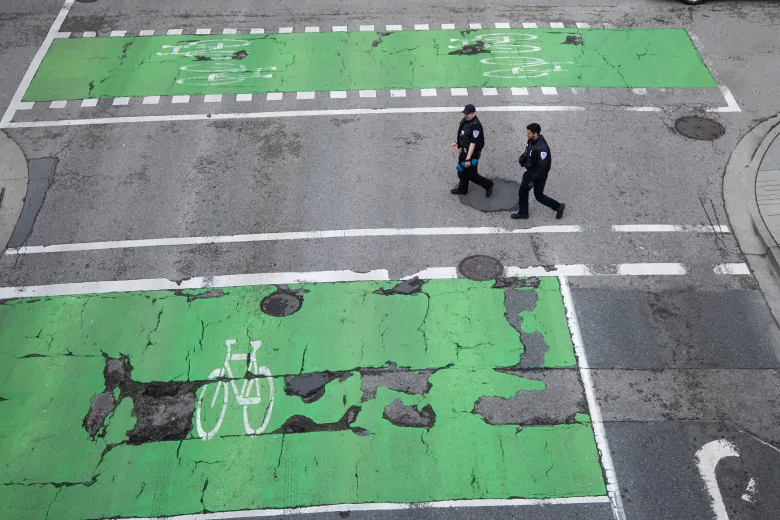
Two security guards walk through downtown Vancouver on Monday, March 23, 2020. (Ben Nelms/CBC)
“(We need to make) sure that we use the post-pandemic stimulus packages to work toward a just transition,” he said.
Take a look at the gold in the ring on your finger or a piece of jewelry. You are looking at something that came from a violent event that took place a long time ago in our galaxy before Earth was even born.
The precious metal can only be made during some of the most cataclysmic events in the universe, which is why it is so precious.
Now, scientists from Columbia University and the University of Florida believe they have found the source of Earth’s gold: the collision of two neutron stars that happened 100 million years before our solar system formed that took place roughly 1,000 light years away — which is close in cosmic terms.
Neutron stars are what you get when a massive star runs out of fuel and collapses, essentially melting together protons and electrons to form neutrons.
The scientists presented their findings, published in the journal Nature, at a recent meeting of the American Astronomical Society in Honolulu.
Clues contained in ancient meteorites
To calculate the source of Earth’s gold, the scientists examined meteorites, which are very old remnants of the pre-solar nebula, the cloud of gas, dust and debris that eventually gave rise to our solar system.
Radioactive isotopes in the meteorites act as timepieces that trace back to the early solar system when elements were first incorporated.
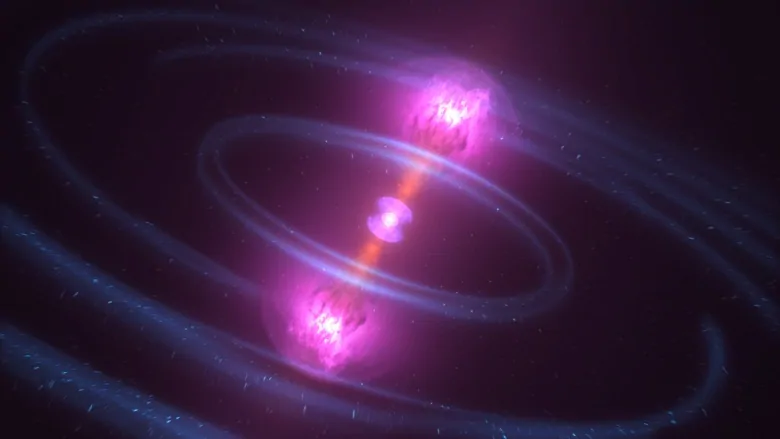
As neutron stars collide, some of the debris blasts away in particle jets moving at nearly the speed of light. (NASA’s Goddard Space Flight Center/CI Lab)
The scientists compared the quantity of these isotopes, which are elements that come in different masses due to the number of neutrons they contain, to computer models of the amount produced by neutron star mergers.
They also included data from LIGO, the gravitational-wave observatory that has recorded actual collisions of neutron stars.
This enabled the scientists to determine the time and distance of the collision, which turned out to be fairly close by. If such a collision happened today 1,000 light years from here, it would outshine all the stars in the sky.
Explosive dispersal of precious metals
The amount of energy released during these extreme events is so huge, with temperatures so extreme, they become cosmic blast furnaces forging heavy metals such as platinum and gold through nuclear fusion of lighter elements.
These new elements are then blasted outwards across space where they drift as shrapnel for millions or billions of years until they encounter a new star system being born.
They are captured by the gravity of the cloud of dust and gas that eventually condenses into a central star and a system of planets — and some leftover space rocks. The gold ends up spread around the planets like candy sprinkles on a cake.
Doomed neutron stars create blast of light and gravitational waves
[embedded content]
This is why gold is so rare. These neutron star collisions only happen every 100,000 years or so in our galaxy.
Not everyone agrees with this scenario because supernovae, giant stars that end their lives in powerful explosions, also produce gold, and they happen more frequently, every 50 years or so. So it’s possible that Earth’s gold is a blend of both.
Behold the cosmic bomb in Earth’s gold
So the next time you hold a piece of gold jewelry, look at the metal closely and think about the fact that it is older than life, older than Earth and the sun.
It was blown out of an unimaginably violent event, drifted among the stars of the Milky Way for 100 million years, then became part of the birth of our baby solar system.
Now we dig it out of the ground or pan for nuggets in rivers and form it into ornamental shapes that you can hold in the palm of your hand
That’s quite a journey.
It is something wondrous to think about during these troubled times.
Cybersecurity experts describe it as a perfect storm: employees working from home — away from their firm’s IT experts and sometimes without the protection of a corporate computer network — and hungry for information about a mysterious coronavirus.
With the COVID-19 crisis as the backdrop, fraudsters appear to be redoubling their efforts to steal information or money from unsuspecting users, sending fake emails and text messages as bait, in a scheme known as phishing.
In one scam, fraudsters pretend to be processing EI claims, preying on Canadians who’ve recently lost their jobs. Users are asked to enter their details, only for the information to be accessed by criminals.
Other schemes come disguised as messages from Shoppers Drug Mart, Public Health Agency of Canada or the World Health Organization. In all cases, the goal is to steal a user’s information or money, or infect their devices with malware.
“The tactics are still the same, it’s just the subject matter that’s changed,” said Joe Martin, with North Vancouver-based tech firm Compunet.
“People who do this for a living, they know that they’re going to get some clicks, as long as the coronavirus continues to be an issue.”
As number of online and telephone scams rises, Shoppers Drug Mart said on its website ‘if you receive an unsolicited call, we strongly encourage you to hang up, and call your local store back directly.’ (Michael Wilson/CBC)
According to analysis by virtual private network provider Atlas VPN, the number of active websites used for phishing has increased by 350 per cent between January and March, just as the COVID-19 crisis erupted.
What’s more, California-based Barracuda Networks said it had observed a 667 per cent spike in phishing emails from the end of February until late March.
The Canadian Anti-Fraud Centre (CACF) said Friday it had received 75 reports since March 5 related to coronavirus-related scams, adding Canadians had fallen victim in at least 13 instances. The real number of targets and victims is likely much higher, considering few users complain to authorities.
The U.K.’s Action Fraud network said coronavirus-related scams have cost Britons almost £970,000 (nearly $1.7 million Cdn). The FBI warned Americans to be wary of emails purporting to be from the Centers for Disease Control and Prevention, and to “be cautious of anyone selling products that claim to prevent, treat, diagnose, or cure COVID-19.”
There was a 400% increase in coronavirus-related scams in March, with victim losses totalling almost £970,000.<br><br>⚠️ Here are some examples of Coronavirus-related phishing messages we’ve had reported to us. <a href=”https://t.co/mmizvplLar”>pic.twitter.com/mmizvplLar</a>
The most high-profile scam in this country — highlighted last week by Prime Minister Justin Trudeau in his daily televised address — involves text messages ostensibly offering cash as part of the federal government’s Emergency Response Benefit. In reality, the con seeks to get users to click on a link leading them to a fraudulent scheme.
Prime Minister Justin Trudeau issued a warning about texts and other scams that try to lure Canadians using messages about COVID-19 support. CBC has intentionally blurred part of the URL in this message. (Submitted to CBC)
How to prevent phishing
Toronto-based cybersecurity consultant Ritesh Kotak said he had been repeatedly targeted in COVID-19-related scams, receiving “numerous” phishing messages since the start of the pandemic.
“My general advice is ‘think twice before you click,'” he said. Kotak also advises using a virtual private network at home for added protection.
Compunet, the B.C.-based firm, sent out an email to clients with the following guidance:
“Think before you click a link or download an attachment. If you’re unsure, don’t click or download.
Don’t respond to any requests for sensitive information, even if it’s supposedly to update payment information with an account.
Use well-known websites, such as the CDC or WHO, to stay up-to-date on coronavirus information.
Hover over the sender’s email address to verify whether or not it’s a legitimate domain from a familiar organization.
Remember that legitimate organizations won’t ask you to update account information or send personal data via email.”
‘Can I Be Phished?’
Cybersecurity firm Click Armor, based in Ottawa, even created an online self-assessment tool called “Can I Be Phished?” The platform presents a series of emails and asks users to flag the messages as either safe or suspicious.
The online assessment tool, ‘Can I Be Phished?’ features animations and emails, asking users to identify whether messages are fraudulent or not. (Click Armor)
“It comes down to people being aware of how they might be targeted and what their vulnerabilities are,” Scott Wright, Click Armor’s CEO said in an interview.
“We see a lot of attacks happening that try to exploit people’s anxieties” related to the pandemic itself and companies’ adjustment to it, Wright said.
He warned even consumers who believe they follow best practices can fall victim to scams.
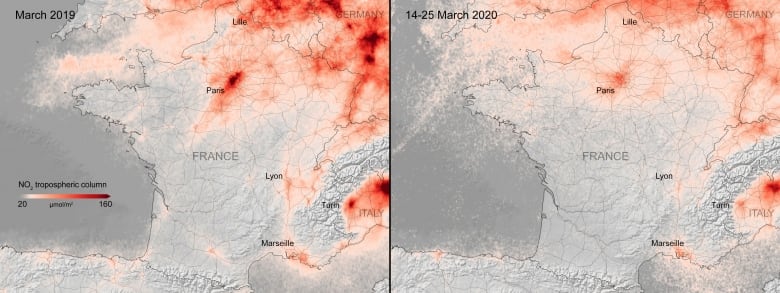
New <a href=”https://twitter.com/hashtag/NO2?src=hash&ref_src=twsrc%5Etfw”>#NO2</a> map available for <a href=”https://twitter.com/hashtag/Italy?src=hash&ref_src=twsrc%5Etfw”>#Italy</a>- based on data from <a href=”https://twitter.com/CopernicusEU?ref_src=twsrc%5Etfw”>@CopernicusEU</a> <a href=”https://twitter.com/hashtag/Sentinel5P?src=hash&ref_src=twsrc%5Etfw”>#Sentinel5P</a> and processed by <a href=”https://twitter.com/KNMI?ref_src=twsrc%5Etfw”>@KNMI</a>/<a href=”https://twitter.com/esa?ref_src=twsrc%5Etfw”>@esa</a>.<br>?️images show nitrogen dioxide concentrations from 14 to 25 March 2020, compared to the monthly average of concentrations from 2019. <br>Read more: <a href=”https://t.co/0gXGSaJAed”>https://t.co/0gXGSaJAed</a> <a href=”https://t.co/UCV6RN0C0U”>pic.twitter.com/UCV6RN0C0U</a>
Air pollution from nitrogen dioxide has fallen by an estimated 40 per cent in three European cities, according to new satellite data released by the European Space Agency (ESA), coinciding with a widespread lockdown to curb the spread of the coronavirus.
The space agency’s Copernicus Sentinel-5P satellite mission on Friday released three composite images showing nitrogen dioxide concentrations in the period March 14-25 over France, Spain and Italy, compared to the monthly average of concentrations from 2019.
“This is a first level estimate; some of these values have gone down by about 40 per cent of the normal value… so a very drastic decrease,” Josef Aschbacher, ESA Director of Earth Observation Programmes, told Reuters via a video call.
Researchers studying the impact of emissions from industry and transport on climate change and human health are scrambling to understand the possible implications of the coronavirus pandemic as economies slow, flights are disrupted and quarantines imposed.
(ESA/Handout via Reuters) (ESA/Handout via Reuters)
(ESA/Handout via Reuters) (ESA/Handout via Reuters)
“What you really see are the centres of this pollution. It is quite a good first level indicator of anthropogenic pollution coming from traffic and industry,” added Aschbacher.
Nitrogen dioxide, a noxious gas emitted by cars, power plants and factories, is blamed for some respiratory and heart conditions.
Almost every city-dwelling European is exposed to pollution levels that exceed healthy levels, according to a 2019 report from European Environment Agency (EEA).
Hello, people! This is our weekly newsletter on all things environmental, where we highlight trends and solutions that are moving us to a more sustainable world. (Sign up here to get it in your inbox every Thursday.)
This week:
COVID-19 shutdowns have affected human movement — and some animal behaviour
How horses can help protect the permafrost
Fixing the ozone hole has had another benefit, too
‘Lull’ in human movement due to COVID-19 is having unpredictable effect on wildlife
(Tang Chhin Sothy/Getty Images)
Photographs that went viral earlier in the pandemic seemed to suggest some environmental hope amid all the coronavirus woe: swans and dolphins seemingly appeared in the normally cloudy and crowded canals of Venice, which had gone quiet and clear during lockdown.
National Geographic later reported that the situation wasn’t quite so dramatic — the swans actually paddle around in the area regularly and the dolphins were filmed in Sardinia.
None of that diminishes the possibility, however, that changes in human behaviour during the pandemic might result in changes in animal behaviour, too.
Animals are “strongly influenced by the human footprint,” said John Fryxell, executive director of the Biodiversity Institute of Ontario and a professor in the college of biological science at the University of Guelph.
Fryxell also said that animals “respond to humans pretty quickly,” noting, for example, how deer and elk will change their behaviour when they know people are hunting in the area.
“During hunting season, deer tend to move less often, concentrate their movements in core parts of their home range, are more vigilant than usual and have less access to places with abundant forage, so [they] feed at lower rates.”
In some places, animal behaviour appears to have changed more immediately. The New York Times reported that some animals were going hungry in popular tourist spots in Thailand and Japan because visitors who feed them aren’t showing up. A video posted to social media showed macaques running around a plaza in Lopburi, Thailand.
“The fall in tourist numbers because of COVID-19 may have indeed brought about a shortage of food supply for them,” Asmita Sengupta, an ecologist in Bangalore, India, told the Times. This shows the “detrimental effects” of feeding the monkeys.
“Once they get used to being fed by humans, they become habituated to humans and even display hyper-aggression if not given food,” Sengupta said.
One particular change in human behaviour might give a fair number of animals a new — if temporary — lease on life. Because many of us are staying home right now, road mortality for wildlife could drop.
“If you remove the number of vehicles, there’s going to be [fewer] road deaths,” said James Pagé, the Canadian Wildlife Federation’s species at risk and biodiversity specialist.
The federation has been doing work with turtles, particularly in eastern Ontario and Ontario’s Muskoka region, and they find “the highest number of turtle mortalities are on the busiest roads.”
With fewer turtle road deaths, there’s the potential for a slight bump in the turtle population, he said.
Fryxell is quick to caution about making predictions on how the human response to the pandemic is influencing animals. But it is something that can be studied. “Maybe over the course of the summer we’ll see something that is meaningful,” Fryxell said, noting it could also vary from species to species.
Presumably, the pandemic crisis is a temporary state, and there is little to suggest any changes that might be observed in animal behaviour would become a permanent thing.
“We’re not looking at a kind of rewilding,” where nature is coming back, said Pagé. It’s more a “lull [in] human movement.”
Even so, the current state of affairs does offer a chance to think about the impact human behaviour has on animals. Said Pagé, “It gives us an opportunity to see what it might be like if we do reduce our movements.”
— Janet Davison
Reader feedback
Self-isolation makes environmental action more challenging, no doubt. What are you doing in this time of social distancing to stay green? Let us know!
Reducing carbon emissions is pretty much job No. 1 for anyone who’s serious about stopping the most harmful effects of climate change. But there are some sources of seeping carbon that defy human ingenuity — such as melting permafrost. This layer of the earth, which covers an estimated 24 per cent of the Northern Hemisphere, has stored carbon for millions of years, but it risks releasing a lot of it as temperatures rise in the Arctic. Experiments in Siberia, however, show that increasing the number of grazing herbivores — like reindeer, bison and horses — in the region could do wonders. Without these animals, the snow layer insulates the permafrost even when the temperature drops well below freezing. But when these creatures clomp around, they break up the snow layer and ensure the permafrost stays cold. A recent study suggested a concerted effort to let these animals graze the Arctic could protect 80 per cent of the planet’s permafrost until 2100.
(Shutterstock)
Hot and bothered: Provocative ideas from around the web
In light of the coronavirus pandemic, climate action has become a bit of an afterthought, but this essay argues that the way that the world has responded to COVID-19 can hold some lessons for the environment. As the writer puts it: “While the disease is playing out more quickly than the effects of global warming, the principle is the same … If you wait until you can see the impact, it is too late to stop it.”
And let’s not forget that many people are helping move the world to a low-carbon future. The Global Wind Energy Council recently announced that worldwide wind power capacity had grown by nearly 20 per cent from 2018 to 2019.
It turns out fixing the ozone hole has had another benefit, too
(NASA)
A new study published in the journal Nature suggests the banning of a harmful chemical has had an impact on the meandering southern jet stream.
The jet stream is a fast-moving river of air in our upper atmosphere that moves weather patterns around. There are two major ones: one in the Northern Hemisphere and one in the Southern Hemisphere.
Typically, the jet stream resides in the mid-latitudes in the Southern Hemisphere. However, scientists had noticed that it had been moving slowly towards the South Pole over time, which they attributed to ozone depletion in the upper atmosphere.
This, in turn, has had an impact on weather and climate — though it varies from region to region. It was possibly also having an effect on ocean circulation and salinity, which is important to marine life.
Why was ozone depleting? One word: Humans.
Ozone is nature’s sunscreen. It protects plants and animals from harmful ultraviolet radiation produced by the sun. Take it away, and this radiation can damage our DNA.
In the mid 1980s, scientists sounded the alarm over the depletion of the ozone layer (referred to as the “ozone hole”) over the South Pole. The cause was widespread use of chlorofluorocarbons (CFCs), found in things like air conditioners, fridges and aerosols. Under the Montreal Protocol of 1987, CFCs were gradually phased out and are now banned.
And the ozone hole healed. In 2019, the ozone hole was the smallest it’s been since 1982 (though weather patterns can still affect its size somewhat).
The authors of this new paper suggest that the shrinking of the ozone hole has, since 2000, caused a pause in the jet stream’s trip down south.
The result will be a change in weather patterns in the region, although how significant remains to be seen. The authors hope to see more studies on the phenomenon.
Whether or not the jet stream will remain at status quo or begin to head back to mid-latitudes is unknown — particularly due to a rise in CO2 emissions and its consequences.
— Nicole Mortillaro
Stay in touch!
Are there issues you’d like us to cover? Questions you want answered? Do you just want to share a kind word? We’d love to hear from you. Email us at whatonearth@cbc.ca.
Sign up hereto get What on Earth? in your inbox every Thursday.
The U.S. Environmental Protection Agency on Thursday abruptly waived enforcement on a range of legally mandated public-health and environmental protections, saying industries could have trouble complying with them during the coronavirus pandemic.
The oil and gas industry were among the industries that had sought an advance relaxation of environmental and public-health enforcement during the outbreak, citing potential staffing problems. The EPA’s decision was sweeping, forgoing fines or other civil penalties for companies that failed to monitor, report or meet some other requirements for releasing hazardous pollutants.
The move was the latest, and one of the broadest, regulation-easing moves by the EPA, which is seeking to roll back dozens of regulations as part of U.S. President Donald Trump’s purge of rules that the administration sees as unfriendly to business. Civil and criminal enforcement of polluters under the administration has fallen sharply.
Former Obama-era EPA chief Gina McCarthy, now president of the Natural Resources Defence Council, called the announcement “an open licence to pollute.”
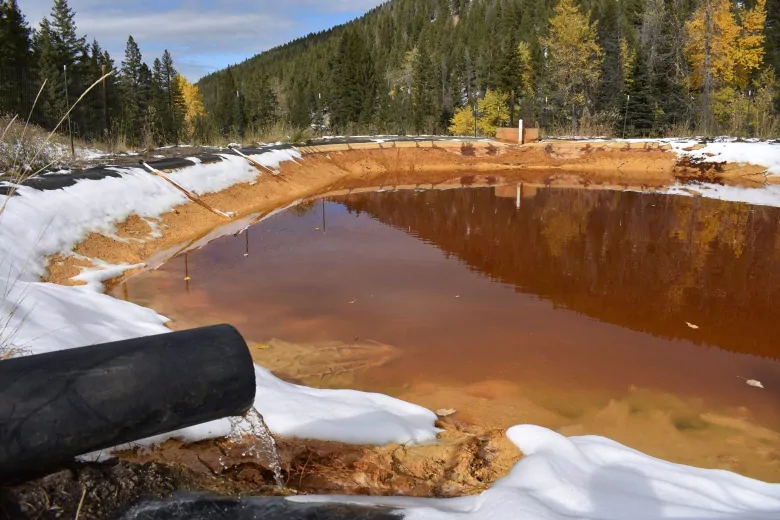
Water contaminated with arsenic, lead and zinc flows from a pipe out of the Lee Mountain mine and into a holding pond near Rimini, Mont. The EPA had already been seeking to roll back dozens of regulations as part of U.S. President Donald Trump’s purge of rules that the administration sees as unfriendly to business. (Matthew Brown/The Associated Press)
The administration was “taking advantage of an unprecedented public-health crisis to do favours for polluters that threaten public health,” McCarthy said, in part of what was a flurry of condemnation from environmental groups to the announcement.
In a statement, EPA administrator Andrew Wheeler said the open-ended waiver was temporary and retroactive to March 13.
“EPA is committed to protecting human health and the environment, but recognizes challenges resulting from efforts to protect workers and the public from COVID-19 may directly impact the ability of regulated facilities to meet all federal regulatory requirements,” Wheeler said. “This temporary policy is designed to provide enforcement discretion under the current, extraordinary conditions, while ensuring facility operations continue to protect human health and the environment.”
The EPA directive said industries would be expected to comply with regulations “where reasonably practicable.” Businesses that broke regulations would have to be able to show that they tried to reduce the harm, and show how any violations were caused by the coronavirus outbreak, the EPA said.
‘Abdication of the legal responsibilities of the EPA’
Collin O’Mara, president of the National Wildlife Federation, called the move “an assault on our public health and an absolute abdication of the legal responsibilities of the EPA.”
The EPA said the advance pass on enforcement did not apply to criminal violations by polluters.
While there were circumstances where a disaster like the pandemic might make compliance impossible, those instances called for narrow decisions by regulators on clemency, said Cynthia Giles, a former senior EPA enforcement official during the Obama administration.
Giles said she knew of no previous time in the EPA’s half-century history where it “relinquished its fundamental authority” as she said it did Thursday.