Categories
Sports

Montreal Alouettes hire former Green Bay Packers boss Mike Sherman as head coach


MONTREAL — Mike Sherman has simple goals for the Montreal Alouettes.

The Alouettes hired the former NFL coach Wednesday to fill their vacant head-coaching position. Sherman replaces general manager Kavis Reed, who assumed the position on an interim basis last year after firing Jacques Chapdelaine.

Sherman, 63, takes over a Montreal squad that posted a CFL-worst 3-15 record last year. The Alouettes become the third East Division team to have a former NFL head coach, joining Toronto (Marc Trestman) and Hamilton (June Jones).

“With me, you’re going to find what you see is what you get,” Sherman told reporters during a news conference. “It’s very simple and I have very simple objectives.

“I want this franchise to be in total alignment with this city.”

And to illustrate that point, Sherman recollected his days growing up in Boston and watching the Montreal Canadiens and Bruins square off.

“I didn’t watch a ton of hockey but whenever the Montreal Canadiens and Boston Bruins played we were tuned to that TV . . . and I remember those games,” he said. “Ken Dryden, Guy Lafleur, Bobby Orr, Phil Esposito and those championship battles.

“I always remember that and it affected me as a coach because you couldn’t tell if they were playing for the Stanley Cup or just the first game of the season. They always played at a high level against each other and that’s exactly how I want our team to play.”

Sherman has coached at the high school, NCAA and NFL levels over his career. He served as head coach/GM of the Green Bay Packers from 2000 to 2005 and has a career NFL coaching record of 59-43.

And Sherman said his wife, Karen, signed off on him accepting the Alouettes’ job because what the city of Montreal has to offer.

“I have to say this, if it wasn’t for Montreal, this city and what it offers to people that come here, that’s what really excited her about me taking this job,” he said. “If she had said, ’No,’ there would be somebody else standing her, for sure.”

In May 2015, Sherman became the head football coach at Nauset Regional High School but resigned two years later. And Sherman took a stab at speaking French, albeit a very brief one.

“Bonjour,” he said. “That’s as much as we’re going to get today.

“But it kind of rolls off your tongue. If I get a couple more to roll off like that, I think I’ll be OK.”

Sherman also praised owner Robert Wetenhall and team director Andrew Wetenhall for their interviewing process.

“I’ve been in a bunch of interviews in my career,” Sherman said. “When I interviewed with Bob and Andrew, it was one of the most precise, innovative, thoughtful interviews, I think, I’ve ever had as a football coach.

“When I left that room I was very much impressed by ownership.”

But the bottom line in pro football is winning, something Sherman said requires plenty of sacrific and dedication.

“Winning comes at a cost,” he said. “Winning consistently comes at a great cost.

“You’ve got to put a lot into it to win consistently. That is hard to do and we have to get our football team, the Montreal Alouettes, to play winning football, consistently winning football and we will get there.”


Source link

Categories
Sports

Deliverance from 27,000 feet: The journey to bring two climbers home from Mount Everest’s ‘death zone’


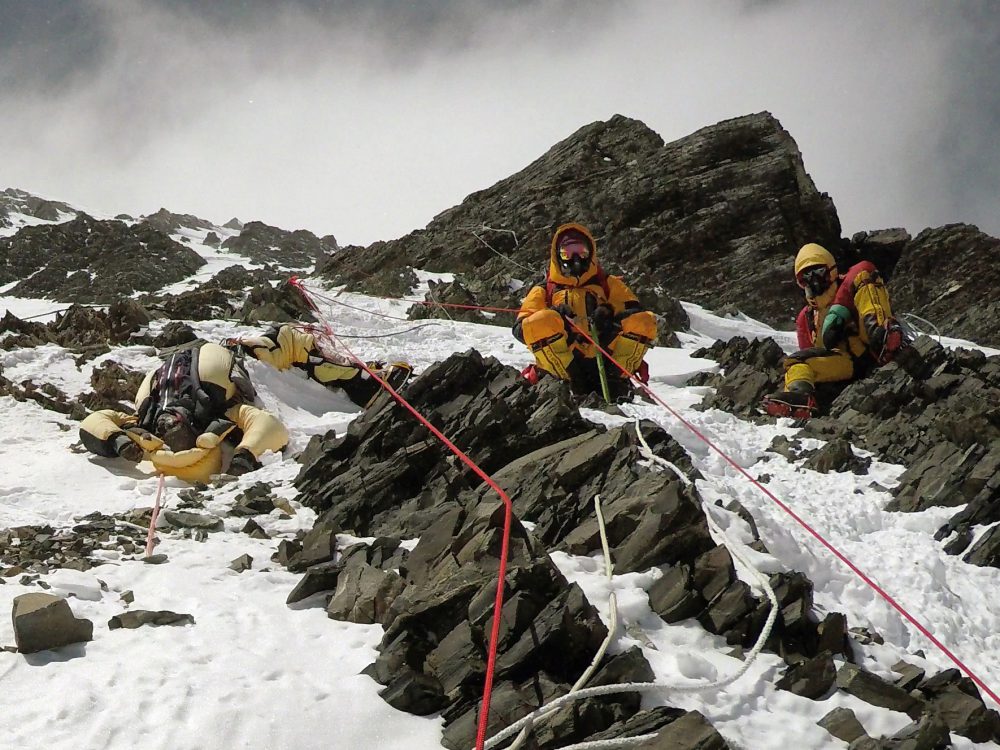
The body of Goutam Ghosh is brought down Mount Everest by two sherpas in May 2017.

Photograph by: Dawa Finjhok Sherpa / Seven Summit Treks / The New York Times

Five Sherpas surrounded the frozen corpse. They swung axes at the body’s edges, trying to pry it from its icy tomb. They knocked chunks of snow from the body, and the shattered pieces skittered down the mountain. When they finally freed a leg and lifted it, the entire stiff and contorted body shifted, down to its fingertips.

The sun was shining, but the air was dangerously cold and thin at 27,300 feet above sea level. A plume of snow clouded the ridge toward the summit of Mount Everest, so close above. When the Sherpas arrived — masks on their faces, oxygen tanks on their backs — the only movement on the steep face came from the dead man’s frayed jacket pockets.

More than a year of exposure to the world’s wickedest elements had blackened and shrivelled the man’s bare face and hands. His hydrant-yellow summit suit had dulled to the hue of a fallen leaf. The bottom of his boots pointed uphill. His frozen arms were bent at the elbows and splayed downhill over his head. It was as if the man sat down for a rest, fell backward and froze that way.

The Sherpas picked at the body and used gestures and muffled words to decide how best to move it off the mountain. The ghoulish face and bone-white teeth scared them, so they covered the head with the jacket’s hood.

There was no time to linger. That altitude is called the “death zone” for good reason. The Sherpas knew from experience how difficult it was to scale the world’s highest mountain. The only thing more daunting might be to haul a dead body back down.

The man’s name was Goutam Ghosh, and the last time anyone saw him alive was on the evening of May 21, 2016, when it was obvious that he would become another fatality statistic, soon frozen and as inanimate as the boulders around him.

Ghosh was a 50-year-old police officer from Kolkata, part of a doomed eight-person expedition — four climbers from the Indian state of West Bengal and four Sherpa guides from Nepal — that ran out of time and oxygen near the top of Everest. The four Bengali climbers were eventually abandoned by their guides and left to die. Three did; only one, a 42-year-old woman named Sunita Hazra, survived, as did the guides.

At the time of the tragedy, the climbing season for Everest was almost over. On their way to the summit over the next two nights, the last two dozen of the year’s climbers had come upon Ghosh’s rigid corpse on a steep section of rock and ice.

To get around him, climbers and their guides, sucking oxygen through masks and double-clipped to a rope for safety, stripped off their puffy mittens. They untethered the clips one at a time, stepped over and reached around Ghosh’s body, and clipped themselves to the rope above him.

The Ultimate Conquest

The four Indian climbers, from a vibrant climbing culture in West Bengal, saw the mountain as the ultimate conquest, a bucket-list item that would bring personal satisfaction and prestige.

Climbing Everest is an expensive endeavour. Some spend $100,000 to ensure the best guides, service and safety.

These four climbers measured monthly salaries in the hundreds of dollars. They borrowed money and sold off possessions simply for a chance.

Ghosh shared an apartment with eight members of his extended family. Paresh Nath, 58, was a one-handed tailor who barely scraped by with his wife and young son. Subhas Paul, 44, drove a small-goods truck and used his father’s pension to pay for his Everest attempt. Hazra was a nurse, married and raising a son.

About 5,000 people have reached the 29,029-foot summit of Everest at least once since Tenzing Norgay and Edmund Hillary first did it in 1953. Nearly 300 people have died on the mountain in that period, according to the Himalayan Database.

Nepal officials estimate that about 200 bodies remain scattered across Everest.

Most of the bodies are far out of sight. Some have been moved, dumped over cliffs or into crevasses at the behest of families bothered that their loved ones were someone else’s landmark or at the direction of Nepali officials who worry that the sight of dead bodies hinders the country’s tourist trade.

More and more, however, families and friends of those who die on Everest and the world’s other highest peaks want and expect the bodies to be brought home. Recovering the bodies can be more dangerous and far more costly than the expedition that killed the climber.

There are practical considerations, including whether to search for the bodies of those presumed missing or dead, if that is even feasible, and whether to recover the body or let it rest eternally where it is. There are emotional considerations, maybe cultural and religious ones, often in the name of closure. There are logistical concerns, including danger and cost, local customs and international laws. Sometimes, in some places, recovery of a body is not just wanted, it is needed, to prove a death so that benefits can be provided to a family in desperate need of financial support.

All these things came into play after the bodies of three men from India were scattered high on Everest in 2016. The dim hopes for rescue kindled into demands for recovery, led by the West Bengal government.

Within a few days, in the short window between the last of the season’s summit attempts and the start of the summer monsoon that racks the Himalayas and shuts down the climbing season until the following year, a recovery team of six hired Sherpas tried to find the deceased and carry them down. They had neither the manpower nor the time.

The first they found was Paul, the delivery driver and a part-time guitar instructor who lived with his family, including his wife and 10-year-old daughter, in the small town of Bankura. He was steps from the well-worn route below Camp 4, roughly 26,000 feet above sea level. It took four hours to chip and pry him from his icy grave and another 12 to drag him to Camp 2, where a helicopter carried the body to Base Camp.

Back on Everest, above where Paul’s body was extricated, two of the Sherpas moved up to Camp 4. At roughly 26,000 feet, higher than all but about 15 of Earth’s peaks, it sits at the edge of the oxygen-depleted death zone and is the last rest stop for climbers before their final push to the summit. The Sherpas searched the abandoned tents, some shredded to ribbons by wind, until they found the body of another of the missing Indian climbers. They knew it was Nath, the tailor, because he had only one hand, the other lost in a childhood firecracker accident.

Raging winds kept them from climbing any higher in search of Ghosh, and the men were called back. The summer monsoon was on the way, ending the climbing season. Ghosh and Nath, left dead in the death zone, would remain on Everest for at least a year, and maybe forever.

Ghosh’s wife, Chandana, kept the vermilion sindoor in the part of her hair, and the red and white bangles on her right wrist, to indicate that she was a married woman. She would not remove them until she was certain she was a widow. She left the calendar on the wall of the bedroom turned to May 2016. In her mind, that was when time stopped.

“I still believe he is alive,” she said in her home in February. “Unless I see him, and we cremate him, I will not change.”

In the steel town of Durgapur, 160 kilometres northwest of Kolkata, Nath’s wife, Sabita, tried to move on. She had no money to bring the body home. She and her husband never spoke about what to do if he died, but now she convinced herself that he would want to be left on the mountain.

Within Reach

On the afternoon of May 20, 2016, Ghosh, Nath, Paul and Hazra anxiously rested inside a tent at Camp 4. They wore oxygen masks and bright, bulky snowsuits filled with down.

Finally, after weeks at Base Camp and on the lower slopes of Everest, they were within reach of the summit. If all went well, they would be back at Camp 4 within 24 hours.

In the early evening, after dark and later than they had planned, they emerged from the tent, each with a guide.

The summit of Everest cannot be seen from Camp 4, but much of the route can. It leads up a series of ropes, used by every Everest climber, that are tied to anchors drilled into the rock and ice and set by Sherpas at the start of the season.

The route leads across a barren ice field, sliced with deep crevasses, and shoots up a steep and rocky slope until it reaches a small flat spot, a burr on the side of the mountain. The landing is known as the Balcony, and from there it is two hours or more along the exposed, knife-edged Southeast Ridge to the South Summit. From the South Summit, the top of Everest finally emerges in full view.

The round-trip journey from Camp 4 takes some people less than 12 hours, and experienced guides and climbers know that it should take no more than about 18 — 12 hours up, six hours back. Prolonged exposure is dangerous.

The West Bengal expedition stood at the Balcony well after dawn. There were four clients and only three guides because Nath’s guide appeared to stay behind at Camp 4, for reasons never understood.

The Base Camp manager for the Indian expedition received a radio call from Bishnu Gurung, the only one of the group’s guides with experience reaching the summit of Everest. He said he recommended to the clients that they turn back, but they refused.

Only Nath was persuaded to turn back to Camp 4.

Paul and Lakpa Sherpa reached the summit at 1:45 p.m., according to the camera later recovered from Paul’s body.

The others in their group — Ghosh, Hazra, Nath and their guides — were somewhere below.

The last photograph of Ghosh taken with his camera appeared to be at the South Summit at 1:57 p.m.

Hazra, the lone survivor, said that she reached the summit at about 3 p.m. There is no evidence that she got there.

Back in West Bengal, vague and inaccurate news reports spread quickly on May 21: The climbers had reached the summit.

By nightfall, however, updated reports from Everest arrived. The West Bengali climbers were lost on their way down.

The Red Tape

The first photographs arrived on Tuesday, May 16, a day after the 2017 season opened.

The photo showed a body in a faded yellow snowsuit bent like a horseshoe and half-buried in snow. There was no face visible, but the boots and the gear matched what Ghosh was wearing a year before.

Everyone agreed: It was Ghosh’s body.

Three men from the West Bengal government rushed to Kathmandu. They quickly struck a deal with Mingma Sherpa, owner of Seven Summit Treks, a major Himalayan expedition company based in Kathmandu. The sides agreed on a price that the government would pay for the two bodies to be recovered: $90,000, roughly the amount the government quietly set aside weeks earlier. The government announced it would pay for the retrievals.

Sabita Nath and Chandana Ghosh received calls from a government official asking them to sign a “no objection” certificate to allow for the attempted recoveries. They agreed.

Nepal’s Department of Tourism, which oversees the country’s mountaineering trade, placed only one major provision on the operation: It did not want the bodies coming down at the same time that hundreds of climbers were going up.

It was late May, the tail end of the Everest climbing season, when five hired Sherpas quietly left Camp 2 at 1 a.m.

They turned their oxygen on low at what they called the “crampon point,” an hour above Camp 2.

Sherpas typically use oxygen only in the death zone, at Camp 4 and above, but they wanted to move quickly.

The leader was Dawa Finjhok Sherpa, a 29-year-old guide who had been to the summit of Everest five times.

About 11 a.m., the retrieval Sherpas reached Camp 4, a ghost town of abandoned tents and gear so late in the season.

A few hours behind them, following the same route, six more Sherpas left Camp 2 and headed to Camp 4. Their mission was to recover Nath.

At 1:39 local time on a Wednesday afternoon, the recovery team searching for Ghosh got to his body.

The Sherpas connected Ghosh to a new rope, anchored in a rock about 30 feet uphill, and used ice axes to dig and pry the body from the snow. When the body moved, it moved as one piece, without torque, all the limbs, muscles and joints frozen solid. Dawa Finjhok Sherpa estimated the load weighed more than 300 pounds, double Ghosh’s weight when he was alive.

They lowered him by rigging a pulley-type system through the same anchors used for climbers attempting the summit.

At dawn, Ghosh’s body arrived at the crampon point. The Sherpas assigned to get his body had been working nearly 28 hours, but Ghosh’s journey was held up, awaiting Nath and the helicopter that would carry them off the mountain.

The body of Nath, still in the red-and-black snowsuit that he sewed for himself, reached the crampon point at about 2 p.m. Thursday, May 25. He was wrapped in a malleable, plastic stretcher.

The Ghosh team came up the short distance from Camp 2, and coaxed both men downhill in their makeshift sleds. In an hour, they got to the helicopter landing spot.

When the Sherpas called to Base Camp, they were told the helicopter would not come that day.

What the Sherpas did not know, and what the families of Ghosh and Nath did not know, was that they were also waiting for the body of another Indian climber, one who had died just days before.

Seven Summits wanted to minimize the cost by ferrying three bodies down at once.

Finally, on May 28, a helicopter curled around the valley and touched down.

In the final report, the doctors listed the cause of Ghosh’s death as “undetermined.” A similar examination for Nath ended with the same conclusion.

Last Respects

Nath’s body arrived in a hearse to the courtyard of his home, where a huge crowd awaited. The lid of the coffin was pried off, and the plastic wrap that encased his body was torn open at the head. A flag of the Durgapur Mountaineers Association was draped on top of him.

Sabita Nath sobbed, and held tight to her son, Adrishikar, now 10, who came face-to-face with the corpse of his father after a year of denying his death.

At the Ghosh house, Ghosh’s widow, Chandana, had changed clothes. Gone was the colorful sari, replaced by a white one with small, subtle flowers. She had no sindoor tilak, the vermilion smear along the hairline that signaled marriage, and no red bindi dot on her forehead.

The red and white bangles on her wrist were gone, too. While her husband’s body was cremated, she broke them. A year after her husband died on Everest, she was finally a widow.

The calendar on the bedroom wall still showed May 2016.

Original source article: Deliverance from 27,000 feet: The journey to bring two climbers home from Mount Everest’s ‘death zone’


Source link

Categories
Sports

Turkey wants to imprison New York Knicks centre Enes Kanter for tweeting insults of Erdogan


ANKARA, Turkey — Turkey’s state-run news agency says prosecutors are seeking more than four years in prison for NBA player Enes Kanter on charges of insulting President Recep Tayyip Erdogan.

Anadolu Agency says an indictment prepared by the Istanbul chief prosecutor’s office accuses the New York Knicks player of insulting the president in a series of tweets he posted in May and June 2016.

Kanter, who is in the United States, would be tried in absentia.

The player is a vocal supporter of Fethullah Gulen, the U.S.-based cleric blamed by Turkey for last year’s failed military coup.

Kanter was detained in Romania on May 20 because his Turkish passport was cancelled. He said he was able to return to the United States after American officials intervened.


Source link

Categories
Sports

Final cuts loom as Canada’s women’s hockey team enters Olympic home stretch


EDMONTON — Laura Schuler remembers how anxious she felt before her meeting with coach Shannon Miller to learn if she had made Canada’s first Olympic women’s hockey team.

“The set-up is similar to what they do now where you’re down to your final selections and the core of the team that is still remaining gets individually brought into a room one by one and you’re there with the head coach and two assistants,” Schuler said. “Obviously then your fate is determined.

“I remember being very nervous before walking in the room.”

Schuler received happy news on that day two decades ago as she and the Canadian team went onto win silver at the 1998 Games in Nagano, Japan. She also knows what it feels like to not make the cut as she was left off the 1994 world championship team.

The first former player to coach the Olympic team, the 47-year-old from Toronto is now the one making those decisions of joy and heartbreak ahead of February’s Winter Games in Pyeongchang, South Korea.

Twenty-eight women were summoned to try out for the team attempting to defend the gold won in an overtime thriller against the U.S. in 2014.

After a gruelling boot camp in June, the women congregated in Calgary in August to begin full-time preparation for Pyeongchang.

Schuler, assistants Dwayne Gylywoychuk of Winnipeg and Troy Ryan of Spryfield, N.S., and general manager Melody Davidson of Oyen, Alta., have been scrutinizing players in practices and games.

Forward Amy Potomak of Aldergrove, B.C. and defender Erin Ambrose of Keswick, Ont., were released Nov. 20.

Three more skaters will be cut to get to the roster of three goaltenders and 20 skaters, compared to the previous limit of three and 18 in 2014.

Goaltenders Shannon Szabados of Edmonton, Genevieve Lacasse of Kingston, Ont., and Ann-Renee Desbiens of Malbaie, Que., will be Canada’s three goalies in Pyeongchang. They’re competing for coveted starts.

Having experienced both acceptance and rejection, Schuler says there is no way to make what will be painful for some players less painful.

“No, absolutely not,” she said. “Obviously we had to let go of two players there and it was one of the hardest things we had to do as a staff and as a team because they become a part of your family.

“It’s a matter of finding what works into your puzzle. Getting all the pieces to come together, it’s a really challenging process and what lies ahead of us is really tough.

“It’s so close with our players. That’s just what’s going to be so hard. It’s so close. I’m talking paper thin.”

Hockey Canada has until Jan. 21 to submit its women’s roster to the Canadian Olympic Committee.

If history is an indicator, the Olympic team could be named as early as this week. Players in previous centralizations have gone home for their holiday break knowing their status.

“We have no idea when releases are going to be made,” two-time Olympic defender Meaghan Mikkelson said.

“It’s my third time around and it’s still stressful. It’s still hard. If you think you might be on the team, you want to know if you’re going to be on the power play or the penalty kill.

“You’re always thinking about one thing or another, but speaking from personal experience, I’ve just tried to never get complacent and just to try to stay in the moment because you can make it a lot harder on yourself than it needs to be.”

The Canadian women wrapped up their six-game pre-Olympic series against the U.S. with a 2-1 overtime win Sunday in Edmonton. Canada took the series 5-1.

The women have back-to-back games against male midget triple-A teams Tuesday and Wednesday. Since the 2006 Olympics, the women have made Alberta Midget Hockey League games part of their centralization schedule.

Rookie defender Micah Zandee-Hart of Saanichton, B.C., says she’s tried to concentrate on her performance and not think about the final cuts.

“There’s definitely ups and downs. I won’t lie to you,” the 20-year-old said.

“There have been times throughout this process that has been on my mind, but I think going into these last few games, it’s really important to play your best game and not really think about that happening, even though we know it is going to happen.”


Source link

Categories
Sports

Hot Buttered Post: Rogers agrees to keep the NHL on CBC through 2025-26


Your midday sports snack.

Toast points

• Sportsnet and CBC announced today that they have extended their Hockey Night in Canada sublicensing agreement to extend throughout the whole of Rogers’ 12-year deal for exclusive national NHL rights in Canada. Rogers will now continue to show regular-season and playoff games on CBC through the end of the 2025-26 season. When the Rogers-NHL deal was first announced, the CBC sublicensing deal was for only four years; it was later extended by one year.

• Easy joke alert: Anaheim won the Adam Henrique-Sami Vatanen trade. The Ducks got Henrique (plus Joseph Blandisi and a third-round pick) from the Devils for Vatanen three weeks ago, and last night the 27-year-old centre rewarded his new club by scoring the strangest, most creative of breakaway goals.

[embedded content]

The goal was Henrique’s fourth for Anaheim and eighth on the season. But it wasn’t enough to clinch a victory: former Ducks forward Stefan Noesen scored twice in the third period as New Jersey rallied from two goals down and won 5-3. Vatanen, meanwhile, got his first point as a Devil on a second-period assist.

• A fun tidbit from the Bulls’ 117-115 win over the 76ers last night: Nikola Mirotic and Bobby Portis became the first teammates to register double-doubles off the bench in the same game this season, per the Elias Sports Bureau. They’re also the first teammates to do so after punching each other in practice. Chicago is now 6-0 since Mirotic’s return from facial fractures he suffered in an Oct. 17 fight with Portis, a span over which the Bulls are plus-18.8 per 100 possessions when the two are on the court together.

• Texas Rangers pitcher Cole Hamels and his wife have donated a 32,000-square-foot mansion and 100 acres of land in southwest Missouri to Camp Barnabas, a camp charity for children with special needs and chronic illnesses. ESPN found the house on a real estate website where its value was listed at US$9.4 million. An attorney for the couple told the Springfield News-Leader that they never lived in the house, which is near where Heidi Hamels grew up, after Cole Hamels was traded from Philadelphia to the Rangers. They ended up making their off-season home in Texas.

• Convicted murderer Oscar Pistorius is appealing the recent prolongation of his prison sentence. South Africa’s Supreme Court of Appeal extended Pistorius’ sentence from six years to 13 years last month, calling the initial punishment he received for shooting his girlfriend, Reeva Steenkamp, to death through a washroom door in the early hours of Valentine’s Day 2013 “shockingly lenient.” Pistorius, a former Paralympic champion sprinter, has claimed he mistook Steenkamp for an intruder.

Nutritional analysis

Prolific sportswriter Joe Posnanski published a story on his personal blog yesterday picking up a reader suggestion to compare the abject futility of the current Cleveland Browns with that of the 1962 New York Mets, the worst team in modern baseball history. (Posnanski’s piece also shares a great anecdote about that Mets team, which is worth the price of admission alone.)

Posnanski’s reader, “Patrick,” thought it would be interesting to compare the Mets’ season, in which they won 40 of 160 games, with a period of time that covered the last 160 games the Browns had played. One hundred and sixty games works out nicely to 10 full NFL seasons.

The conclusion: the Browns, who are on track to have only the second 0-16 season in NFL history, have won 39 of their last 160 games, which stretches back to the last two games of the 2007 season.

A commenter on the Posnanski post threw out the spectre of the Detroit Lions’ stretch of futility between 2001 and 2010, which included the first 0-16 season in NFL history, the 2008 Lions. The Lions also won only 39 of 160 games in that 10-year period. Thinking of those terrible Lions teams and the comparison between baseball and football brought to mind the 2003 Detroit Tigers, who challenged the Mets’ record before winning five of their last six games to finish the 162-game season at 43-119.

Below is a chart showing the 160-game win progression of those four teams.

The Pythagorean win expectation for the Mets, according to Baseball-Reference.com, was actually 50-110. They were 10 games worse than their 1962 run differential expected them to be. The 2003 Tigers had a win expectation of 49.

Running the pythagorean win expectation for the two football teams shows they both would be expected to have won 49 games among the 160 based on their points scored and allowed.

Photos of the day

The NHL played its very first games 100 years ago today: the Montreal Canadiens beat the original Ottawa Senators 7-4 and the Toronto Arenas lost 10-9 to the shortlived Montreal Wanderers. The Canadiens’ and Senators’ inaugural meeting was feted with an outdoor game in Ottawa last weekend, and this afternoon the Toronto franchise — later known as the St. Patricks and, of course, the Maple Leafs — is celebrating its official centennial.

As Toronto tries to snap a three-game losing skid against the Hurricanes, flip through this gallery of old Leafs photos from our archives.

At nationalpost.com

• If you’d like some words to complement those photos, Lance Hornby has a thorough recounting of the Leafs’ first 10 decades in the NHL, from the players and figures who made their mark on a particular era to the games and events worth remembering today. The piece is also a sightline into the development of Toronto, for, as mayor John Tory says, “the Leafs are the team that’s most intrinsically woven into the fabric of the city.”

• Last year, Nick Faris profiled the greatest Leafs team of them all: 1933-34. Before Auston Matthews, Mats Sundin, Dave Keon or Syl Apps came along, Charlie Conacher prowled the wing for Toronto in front of King Clancy, Ace Bailey and George Hainsworth. Those Leafs outscored each of their opponents by more than a goal per game — and played witness to some of the zaniest, most remarkable moments in NHL history.

TV tonight

All times Eastern

2 p.m. NHL: Carolina at Toronto SN Ontario
7 p.m. NHL: Minnesota at Ottawa TSN5, RDS
7 p.m. NCAA Football: Boca Raton Bowl, Akron vs. Florida Atlantic TSN1
7 p.m. NBA: Sacramento at Philadelphia NBATV
7:30 p.m. NHL: Boston at Buffalo Sportsnet, TVAS
8 p.m. NHL: Winnipeg at Nashville TSN3
8 p.m. NBA: Cleveland at Milwaukee TSN4
10 p.m. NHL
— Montreal at Vancouver TSN2, SN Pacific, RDS
— Tampa Bay at Vegas SN One

Hot Buttered Post is served Monday through Thursday.


Source link

Categories
Sports

Jerry Richardson learns his punishment for claims he sexually harassed women: Raking in billions of dollars


Jerry Richardson, the owner of an NFL team, is crashing and burning amid sexual harassment allegations, including claims that he belittled women for years in various humiliating ways. But you know what? He has found an escape that looks more like a gentle ride under a golden parachute.

Richardson, the 81-year-old owner of the Carolina Panthers who has been accused of harassing female employees and racial discrimination, said he will sell the team after this season, distancing himself from the league and those women he reportedly groped and violated. As part of his penance, he will probably rake in billions of dollars.

That’ll teach him.

The Panthers are estimated to be worth at least US$2.3 billion, and Richardson, in a display of crooked justice, is set to collect that windfall.

Here’s what would make more sense: for Richardson to announce that the proceeds of the sale — or even just a couple hundred million? — would be donated to the women he harassed.

Harvey Weinstein, Russell Simmons, Charlie Rose, Matt Lauer, Mario Batali — the list goes on and on. All have been chased from the top of their professions for disgusting behaviour involving women they worked with. They are suddenly pariahs, their reputations destroyed. But they remain very rich men, and their families, for generations, will be able to live off the financial rewards they collected while perpetuating these offences.

What about their victims, some of whom were their employees? They might get payouts from legal settlements, but certainly not enough to fairly compensate them for years of abuse, mental anguish and missed career opportunities.

Richardson, who made his fortune in the fast-food industry, might be the richest of all the men accused in the #MeToo movement so far. Perhaps it’s appropriate, in a legal sense, that he is able to sell his company and walk off the stage. But it doesn’t seem morally fair that he should benefit so richly from it.

His career shows how abusing women hardly prevents some men from becoming fabulously wealthy and celebrated businessmen in male-dominated domains like Hollywood, restaurants and sports. Now he has been called out, as reported by Sports Illustrated, and he’ll collect his chips and walk away. (He has not publicly confirmed or denied the accusations.)

The Panthers have referred to Richardson’s situation as one of “workplace misconduct.” Not sexual harassment or sexual assault — workplace misconduct. Was he stealing office supplies, or leaving work early every day, or watching Cleveland Browns games in the office?

According to the Sports Illustrated article, which quoted anonymous sources, the accusations against Richardson included his grazing women’s breasts as he buckled their car seat belts; asking women if he could personally shave their legs; and, on Fridays, the Panthers’ weekly wear-jeans-to-work days, asking women to spin around so he could check out their backsides.

Knowing that, it’s difficult not to take offence at the “workplace misconduct” euphemism. When a professional sports team, with the league’s backing, is calling such reprehensible behaviour “workplace misconduct,” it’s no surprise that Richardson was able to thrive for so many years in his profession.

This is the NFL, the ultimate men’s club. Though it took longer than I expected, the league is feeling the heat of the #MeToo movement. Several NFL Network employees were cited last week in claims of sexual harassment and abuse by a former wardrobe stylist for the network. Now the NFL is investigating the Richardson case.

What do Richardson’s esteemed contemporaries make of all this? Here’s Jerry Jones, owner of the Dallas Cowboys:

“Jerry is one of the really, really, really outstanding men of football that I’ve ever met, and I really admire him,” Jones said on Sunday.

He went on to add that Richardson is “a big man with a big heart. But I’m really sad. I want all of those kind of men that we can have in the National Football League.”

Just how many more of “those kind of men” are in the National Football League?


Source link