Categories
Sports

Canadian swimmer Taylor Ruck wins 200m freestyle gold in record time at Commonwealth Games


GOLD COAST, Australia — Taylor Ruck has been surprising people for months. On Thursday she surprised herself.

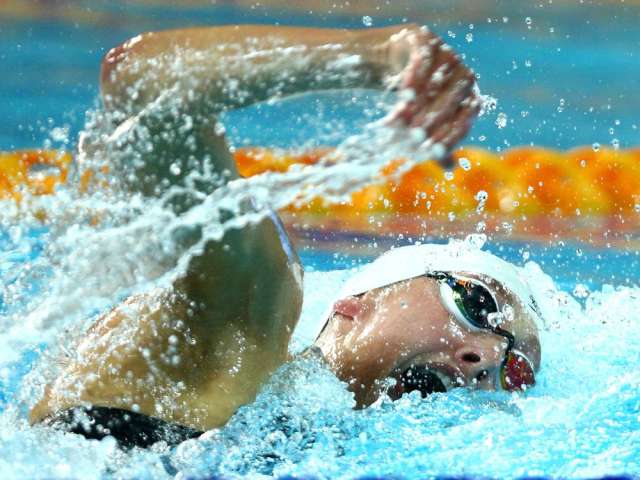
The 17-year-old phenom from Kelowna, B.C., won the 200-metre freestyle final in a Commonwealth Games and Canadian record time of one minute 54.81 seconds, erasing the mark of 1:55.57 set four years ago by defending champion Emma McKeon of Australia.

“Going into this race I think my expectations were just to try and get third which is what I was going in at (as the third-highest qualifier at 1:57.44),” said Ruck, who won two relay bronze medals in the Rio Olympics. “So anything better than that I was just going to be super happy.”

Ruck had to stave off a hard-charging Ariarne Titmus, a 17-year-old who won the 200, 400 and 800 freestyle at the Australian Commonwealth Games trials five weeks ago, in a heart-pounding final lap.

“An absolutely tremendous performance,” said Swimming Canada high performance director John Atkinson.

Ruck then teamed up with Toronto’s Penny Oleksiak and Kayla Sanchez and Alexia Zevnik of Montreal to earn silver in a 4×100 relay won by Australia in a world-record time of 3:30.05.

Ruck brought the Canadians home with a blistering 51.82-second anchor leg for a time of 3:33.92. The Canadian record is 3:32.89, set by Oleksiak, Ruck and company in a bronze medal performance in Rio.

Canada also picked up another silver in the pool, thanks to Sarah Mehain of Vernon, B.C., placing second in the women’s S7 (para) 50-metre butterfly. Tess Routliffe of Caledon, Ont., was third but did not get a bronze because there were only four competitors.

“It’s been a great day,” said Atkinson.

Ruck was second behind McKeon over the first 100 metres, but led after 150 metres and held off Titmus, who was fourth midway through the race, to touch the wall first.

“Great athletes know how to finish races and she finished it off well,” said Atkinson.

Ruck wasn’t so sure.

“I saw Ariarne coming up and I thought she won. So it was like ’Oh my gosh’ when I looked up at the board. I think I’m still in shock. I don’t think I’ve processed it yet.”

Getting her gold medal from Prince Charles wasn’t much of a help in terms of a reality check. “That was insane,” she said, adding: “He was really nice.”


Taylor Ruck competes in the women’s 200-metre freestyle final at the Commonwealth Games on April 5.

Michael Dodge /

Getty Images

Titmus was four one-hundredths of a second behind Ruck in the 200 in a personal best time of 1:54.85 while McKeon, the bronze medallist in Rio, was third in 1:56.26.

Ruck also had to knife through a wall of sound at the Optus Aquatic Centre, with the crowd of 10,000 doing its best to power the Aussies on home.

Oleksiak, who won the 100 freestyle in Rio but did not compete in the 200 there, was seventh in 1:59.55.

“I think the relay was amazing and Taylor’s 200 free was crazy,” said the four-time Olympic medallist, whose grandmother died on the eve of the meet. “Overall I think it was a really really good night for Canada and I’m just excited for the rest of the meet.”

Oleksiak finished second in her 100 butterfly semifinal to qualify for Friday’s final.

Ruck, who has verbally committed to attend Stanford University, has been serving notice recently that she is something very special.

She had set the Canadian record of 1:56.85 in the 200 freestyle in March in Atlanta with a sizzling swim in the final TYR Pro Swim Series stop in her final tune-up before the games. Ruck won three other events at the Atlanta meet including the 100 free where she beat world record-holder Sarah Sjostrom.

Ruck, who was born in Kelowna but moved to Scottsdale, Ariz., with her family when she was young, switched things up last year after failing in April to qualify for the world championships. She moved to Toronto in May to train with coach Ben Titley at the High Performance Centre-Ontario.

“Ben refocused her on going to the world junior championships,” said Atkinson.

Ruck responded by winning seven medals — six gold and one silver — at the 2017 FINA World Junior Championships last August in Indianapolis.

At the Swim England National Winter Championships in December, she tied the 200 freestyle Canadian record and trimmed her 100 free and 200 backstroke times, setting a Canadian national age group record (15-17) in the 200.

Ruck came to the games with four times in the top eight in the world (in the 100 and 200 backstroke and 100 and 200 freestyle).

Atkinson calls it a “breakout meet” for Ruck, a six-footer with an equally big smile. Unlike Rio where she competed only in the relays, she has three more individual events here plus relays.

“The work that she’s been doing in a lot of these swim meets over the last year is preparing her to come here, be busy, work on recovery strategies between heats, finals, semifinals,” said Atkinson. “And we want her to be swimming just as fast on Day 6 as she is on Day 1.”

There were five other finals Thursday, with England winning four and Australia one.

Ottawa’s Erika Seltenreich-Hodgson finished 0.28 seconds out of a medal, finishing fourth in the women’s 400 IM final won by England’s Aimee Willmott. Two-time defending champion Hannah Miley of Scotland was second and Australia’s Blair Evans third.

For Seltenreich-Hodgson, the disappointment of missing out on a medal was tempered by the fact she was coming back from a shoulder injury that has limited her preparations. The time of 4:38.51 was her best in four years.

Victoria’s Sarah Darcel led for more than half the race but was pegged back and finished fifth. Mary-Sophie Harvey Trois-Rivieres, Que., was eighth.

Victoria’s Jeremy Bagshaw was fifth in the men’s 400 freestyle won by Australian Mack Horton.

The six-day swimming event wraps up Tuesday.

Four years ago in Glasgow, Canadian swimmers won 11 medals (4-1-6) to finish behind England’s 28 (10-10-8) and Australia’s 57 (19-21-17).

Ryan Cochrane and Audrey Lacroix, who won three of those gold medals in Glasgow, have since retired. Katerine Savard, who won the other gold four years ago, pulled out of these Games due to illness.


Source link

Categories
Sports

Crazy About Video Games?


Frequently, when someone seems to have too much time on their hands, the advice that comes their way is that they should take up a hobby. Does that mean any hobby is good for you? When it comes to video games, the jury is still out. It is true that video games are a multi-billion dollar industry and that they appeal to a very wide market. It is also true that they have a bad reputation for violence, addictive qualities and laziness. Typically, those who love video games really love them and play them as often as possible. But is this hobby helping or hurting the rest of them?

Some people do not think there are arguments in defense of video games, but there are actually some legitimate ones. For example, video games have proven to increase a person’s hand-eye coordination when played regularly, which translates to their hand-eye coordination in the rest of life. On top of that, some video game creators are deeply concerned with including educational material in their video games. For instance, certain games that are based on a historical war will include facts and trivia for learning as well as gaming, and historical accuracy within the game itself. It is arguable that attributes such as these make gaming a worthwhile hobby.

On the other hand, there are plenty of arguments made against video games as well by people who find them to be a waste of time. When video games became mass produced in the 1990s, one of the first complaints about them was that kids playing them were being inactive. The nature of video games is to sit and stare at a screen, moving only your hands, which is widely regarded as bad for the body. Video games are now associated with weight gain and muscle deterioration. Some video games have also been highly criticized for being very violent video games, and have even been considered contributors to school shootings. Presently, video games are also considered by some to be a legitimate obsession that can require inpatient treatment for addiction, as there are people who game obsessively for days at a time.


Source link

Categories
Sports

Novak Djokovic’s return from elbow injury halted by lingering pain


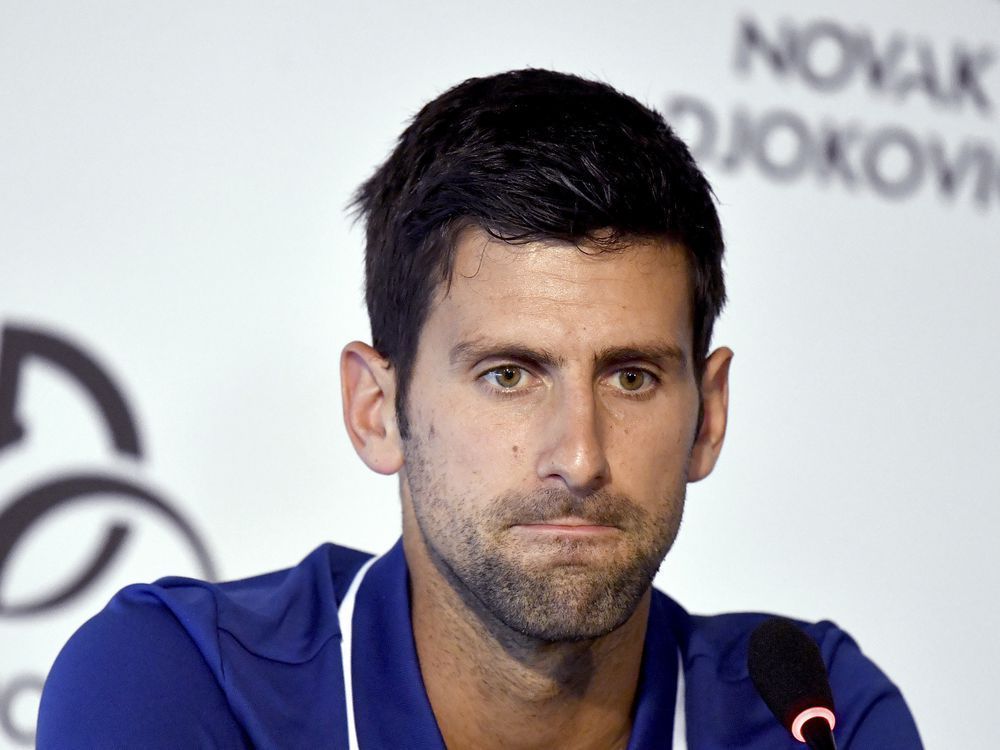
ABU DHABI, United Arab Emirates — The comeback plans for Novak Djokovic stalled on Friday when a recurrence of pain in his right elbow forced him to withdraw from an exhibition tournament in the United Arab Emirates.

Djokovic hasn’t played competitively since he retired in the Wimbledon quarterfinals because of the elbow injury. He was scheduled on Friday to play Roberto Bautista Agut of Spain in the exhibition semifinals, his first match in nearly five months.

“I am terribly disappointed that I am forced to withdraw,” Djokovic said in a statement on his website.

“Unfortunately, in the past few days I started to feel pain in the elbow and after several tests, my medical team has advised me not to risk anything, to withdraw from the tournament and to immediately continue with the therapies.

“This might affect the start of the season and the tournament plan, but the decision will be made in the following days.”

Djokovic is entered in the Qatar Open starting on Monday in Doha, where he’s the defending two-time champion. That’s his lead-in tournament for the Australian Open, which starts in just over two weeks.

Exhibition tournament organizers have arranged a substitute match between Andy Murray, another former No. 1 who has been out since Wimbledon with a hip injury, and Bautista Agut.

Murray has been in Abu Dhabi only to train for the tour.

Bautista Agut will take on the winner of the other semifinal between Dominic Thiem of Austria and Kevin Anderson of South Africa.


Source link

Categories
Sports

From a 28-3 Super Bowl choke to two Toronto championships, sports were kind of nuts in 2017


Perhaps we should have known that 2017 would be a weird sports year when, even before it started, Kevin Durant signed with the Golden State Warriors. A free-agent superstar taking a huge discount to sign with a rival? Who does that?

From there, the hits kept coming. An absurd Super Bowl, Sergio Garcia winning a major, the Oilers making the playoffs, the Maple Leafs making the playoffs, and then two other Toronto teams winning actual championships. And yet the most unexpected stuff might have happened off the field, where the NFL showed major chinks in its armour, and athletes, usually bland and reserved, threw themselves into politics like never before.

Here, then the Year in Sports 2017: Did That Just Happen?

28-3

I was pretty much done my Super Bowl column by the time Lady Gaga had finished her halftime performance.

It’s always risky to start writing when an event is far from over, but the Atlanta Falcons were up by 18 points. Matt Ryan was unstoppable, Tom Brady looked confused, and the only question left to settle was Atlanta’s margin of victory. So I wrote how this was the first time in all their Super Bowls that Bill Belichick’s Patriots had been blown off the field. The piece ended by noting that “on this night, the team everyone loves to hate gave them a reason to be happy.”

Sometime in the third quarter, I started writing a New England comeback version, just in case. Plus, I had time to kill. By the time the game ended in a 34-28 win for the Patriots, after all the ridiculous Atlanta mistakes and remarkable New England plays, I was merely grateful that the Falcons didn’t survive in the end. I had a column in which the Patriots lost, and I had one in which they staged a historic comeback. I had no version in which they staged a heroic comeback — and then lost. Kids, always start work on the backup column early.

The Masters

This whole Year in Review will not be about columns I wrote, but this item will, sort of. It was Wednesday of Masters week, and I had just filed a piece on Dustin Johnson, who came to Augusta with three wins already and whose opponents were saying there was him and there was everyone else. Then Johnson slipped on a staircase at his rental home and hurt his back. Awkward.

Johnson ultimately withdrew, but the tournament didn’t lack for drama. On Sunday, Sergio Garcia packed a microcosm of his career into his final round. He grabbed the lead, then coughed it up and then seized it back with a birdie on 14 and a spectacular eagle on 15. Then, very Sergio-like, he missed short putts on 16 and 18, the latter of which was for the win. His majors curse lived.

But, a last surprise: in the playoff with Justin Rose, it was the Englishman who bogeyed and Garcia finally had his major victory. “It’s been such a long time coming,” said Garcia, 37. He’s got that right.

El Chapeau

It wasn’t that long ago that there was a good debate to be had over which Canadian was more likely to win the country’s first singles tennis major title, Milos Raonic or Eugenie Bouchard. All of a sudden, that mantle might have shifted to a kid very few sports fans had even heard of at this time last year.

Denis Shapovalov, gangly teen from the Toronto suburbs who was a junior star but had not played much on the top senior circuit, blew into the summer hard court season and beat three top-10 players, including an in-form Rafael freaking Nadal. He made it to the final in Montreal and through three rounds at the U.S. Open, earning comparisons to a young Nadal and a young Roger Federer (!), while people were still trying to figure out how to say his name. “It’s pretty intimidating on paper, “ he said, encouraging all to go with Shapo, the new nickname. Between that and the signature backwards hat, he won’t sneak up on anyone this season.

Blew Jays

Canada’s lone baseball team was expected to be on the fringes of the American League playoff race, but a 1-9 start and an 8-17 April extinguished most of those hopes. The Blue Jays rebounded with a strong May, but the awful start meant they couldn’t afford any more swoons, and they had just enough of them to curb any serious post-season aspirations. The playoff streak, after two decades outside of them, ended at two seasons.

With team management saying it does not intend to embark on a rebuild, the Jays face the difficult task of trying to turn a creaky lineup and some young pitching talent into a competitive roster again. Whatever happens to the Jays on the field in 2018, it is unlikely to start worse.

Canada’s back

In the spring of 2016, our country was in crisis. No Canadian teams made the Stanley Cup playoffs for the first time in more than 50 years. Oh, sure, a team led by Sidney Crosby, who is definitely Canadian, won the Cup, but was there something bigger happening? Was there something keeping Canadian teams from competing? Were we smothering teams with our love? Was it … us?

Turns out, nope. Five Canadian teams were back in the playoffs in 2017, including previous sad sacks in Edmonton and Toronto, now led by two of the best young players in the game. Ottawa went all the way to the conference final. And then Crosby and the Penguins won again. Remind us not to freak out next time Canada has a collective off year.

At least one thing was familiar

There was much change in the Canadian Football League in 2017. New commissioner Randy Ambrosie arrived and won praise for making quick decisions, including ending full contact practices and talking the Hamilton Tiger-Cats out of the bizarre hiring of (deservedly) scandal-plagued former Baylor coach Art Briles.

But the on-field stuff was more of the same: the East was a hot mess, the Calgary Stampeders were the class of the West and, once more, the Stampeders were upset in the Grey Cup, this time by the Toronto Argonauts in snowy Ottawa. The year ended with the Argos purchased by MLSE, which means the future of the franchise is as safe as it has ever been. Ambrosie is on some kind of hot streak.

Go on you Reds

Two weeks after that Argonauts championship, Toronto’s soccer team won another trophy for the city, with Toronto FC winning Canada’s first MLS Cup. The tense 2-0 win at BMO Field, in which Seattle goalkeeper Stefan Frei looked like he might force the game to extra time all by himself, was broken open by TFC’s Jozy Altidore in the 65th minute, off passes from the team’s other two offensive stars, Sebastian Giovinco and Victor Vazquez.

It capped a year in which TFC also won the Canadian club championship and the Supporters’ Shield as the best team in the regular season, for a first-ever MLS treble. “Plan the parade” has long been such a punchline in Toronto that it was weird when it became an actual thing to do.

Kaep-tain America

The kneel-during-anthem protests that Colin Kaepernick had started as a protest against racial injustice last season were all but over as a story this fall, with only a few players still kneeling and Kaepernick out of a job. Then Donald Trump went off on NFL players in a speech and the ensuing flap kicked off a debate about an athlete’s right to speak out that touched the NHL and NBA, with players and coaches in that league blasting the U.S. President at every turn.

The idea of keeping politics and sports in two separate silos died in 2017, a development that won’t please certain fans. It also doesn’t please the NFL, which saw TV ratings drop again, although how much of that can be attributed to anthem protests remains a matter of debate. NFL owners responded to the many problems of recent years by extending the contract of commissioner Roger Goodell and paying him many millions more annually than any of the league’s star players receive.

It was just one more piece of evidence that 2017 was kind of nuts.

Email: sstinson@postmedia.com | Twitter: @scott_stinson

Original source article: From a 28-3 Super Bowl choke to two Toronto championships, sports were kind of nuts in 2017


Source link

Categories
Sports

Sharks get the last bite in overtime against Flames


SAN JOSE, CALIF. — The Calgary Flames were the only National Hockey League team that did not play on Dec. 23, prior to their Christmas break.

And, to make things even more interesting, they resumed game action a day later than most teams — on Thursday — which gave the team plenty of time to stew about their last loss, a lacklustre 3-2 defeat to the Montreal Canadiens at home.

There were only two probable outcomes, of course. The Flames could have blamed the break for the rust for another belly-flop. Or, they were going to leave San Jose’s SAP Center, praising the break for the recovery time.

But what they didn’t anticipate was a stellar showing from Flames back-up netminder David Rittich which gave neither excuse validity, as the Flames lost 3-2 in a shootout to the Sharks.

The Flames dropped to 18-15-4 and 10-0-1 when leading after two periods.

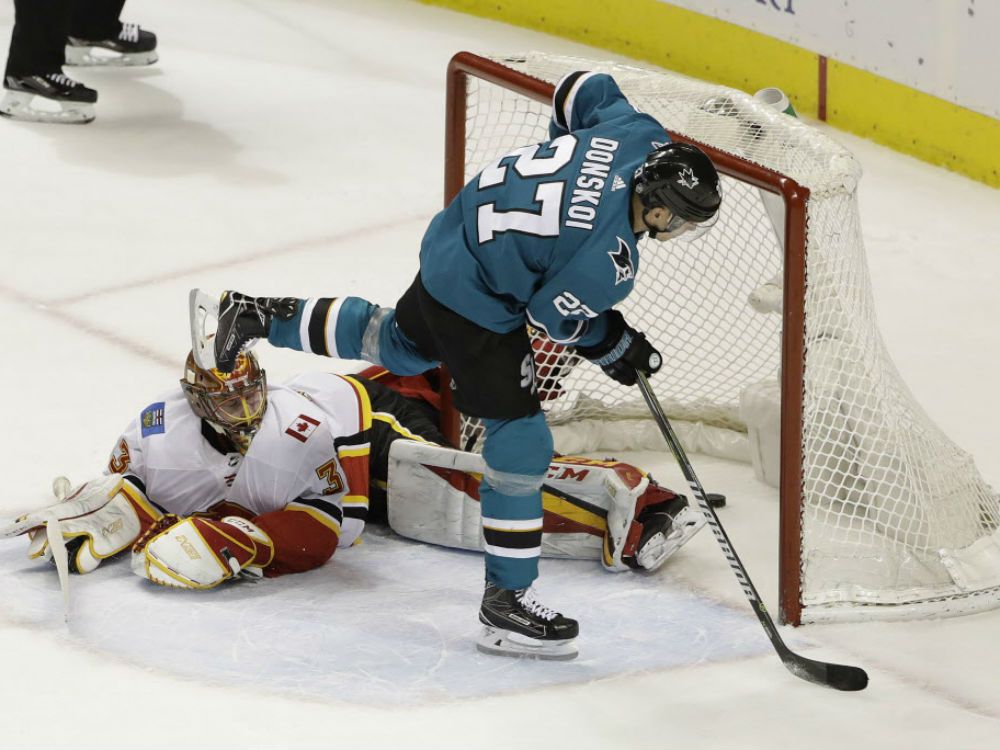
And, in the end, the 25-year-old native of Jihlava, Czech Republic, lost his first NHL game in his fourth start despite stopping 29 of 31 Sharks shots in regulation and another one important save on Marc-Edouard Vlasic with the clock winding down in overtime. He stopped Brent Burns in the shootout, but was evaded by Joe Pavelski and Joonas Donskoi.

Martin Jones made 32 saves in total, including a right-pad stop on T.J. Brodie in the extra frame and a doorstep save on Matthew Tkachuk. He also turned aside Sean Monahan and Mikael Backlund in the shootout.

After protecting a one-goal lead for 38 minutes and 15 seconds, a slight breakdown by the Flames in the third period led to the game-tying goal. Burns had been left alone at the point (never a good sign) and he let a shot rip, allowing Timo Meier to get a piece of it to send it past Rittich to knot the score 2-2 at the eight minute mark.

It was a tight third period, and Calgary nearly made it 3-1 early on when Matt Stajan and Troy Brouwer were on the doorstep of Jones. They managed to muscle a puck towards the goal-line but Vlasic batted it out for the Sharks goalie and created a scoring chance at the other end of the ice.

Rittich came up with a timely save, sticking out his right pad on Jannik Hansen.

It was exactly the kind of game Flames head coach Glen Gulutzan predicted at the morning skate.

“Their team wins battles,” Gulutzan had said, referring to a 3-2 loss at the Scotiabank Saddledome on Dec. 14. “They’re very good in one-on-one situations and that’s where our team is going to have to rise up today. We’re going to have to be above them and be ready for their start in this building. I look at their team and their individual battle level, that’s the part of our game that we have to elevate.”

And, from the first puck-drop, the Flames elevated.

Garnet Hathaway hit the scoresheet, thanks to Sam Bennett’s crashing and banging to pull Jones to his right. Hathaway slammed home the rebound on the former Calgary Hitmen netminder’s left side. It was a good start for the visitors — something preached by Gulutzan at their morning skate — who scored with just 4:22 elapsed in the opening frame.

The Sharks replied on the power-play to knot the score 1-1 with Stajan off for interference. Joe Pavelski went bar-down on Rittich after snapping up a magnificent no-look feed from Joe Thornton.

But with 4:15 remaining in the first period, the Flames regained the lead with a powerplay marker from Backlund. And unlike their last two powerplay goals — scratch that, their only two powerplay goals in the previous eight games — this one was a thing of beauty from their revamped first-unit of Backlund, Tkachuk, Monahan, Johnny Gaudreau and Mark Giordano.

With the loss, the Flames gained a point and are now 9-4-4 on the road and square off with the Anaheim Ducks on Friday (8 p.m. MT, Sportsnet West, Sportsnet 960 The Fan) in the second half of their sixth back-to-back series this season.

ICE CHIPS:

Jaromir Jagr skated in his 1,731st NHL game which equaled Ron Francis for third on the NHL’s all-time games-played list. The 45-year-old living legend had missed the previous two games with a groin injury, the same injury that has limited to only 19 games the season . . . D Travis Hamonic also returned from a groin injury . . . RW Michael Frolik left the game in the second period after he was struck in the face by a Burns shot. He did not return for the third . . . The teams will clash two more times, March 16 at Calgary and March 24 at San Jose.

kodland@postmedia.com

Twitter/Kristen_Odland


Source link

Categories
Sports

Forget Russia: At the world juniors and everywhere else, the U.S. has become Canada’s biggest hockey rival


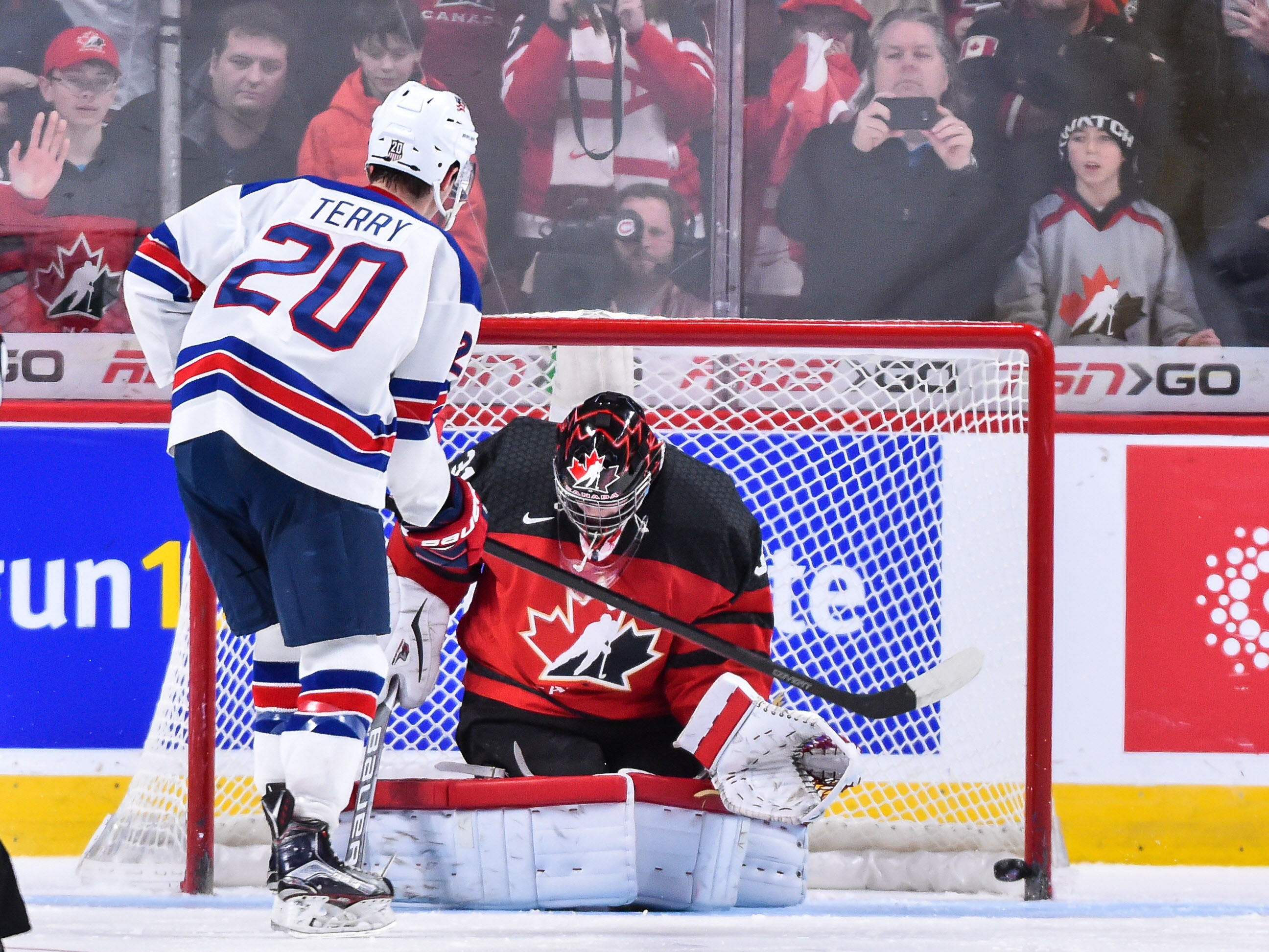
In this Jan. 5, 2017 file photo, U.S. forward Troy Terry scores on Carter Hart in the shootout of the world junior final.

Photograph by: Minas Panagiotakis

BUFFALO — Twelve months later, Dominique Ducharme still hasn’t been able to rewatch the gold medal game.

Well, that’s not entirely true.

“I watched part of it,” said the Team Canada head coach. “I just pause it and stop it when I get to the shootout.”

Most Canadians probably feel the same way. Depending on your country of origin, last year’s 5-4 overtime shootout win by U.S. against Canada in the world junior hockey championship final was either heartbreaking or heartwarming. But everyone can agree that it was unforgettable.

For the first three periods, the teams traded goals and chances in a fast-paced, hard-checking game that featured everything we love about junior hockey: highlight-reel goals, bonus-footage bloopers and more momentum swings than a fight featuring Rocky Balboa.

Canada jumped out to a 2-0 lead in the first period, only to have the U.S. tie things up with two straight goals in the second. Canada once again took a two-goal lead in the third period. But once again, the U.S. struck back with two goals. Overtime settled nothing, so a game that probably could have — and should have — gone on forever went to a deciding shootout, where American forward Troy Terry channelled T.J. Oshie (or Jonathan Toews) and scored twice for a dramatic win.

“I hate to be that guy, but I probably watched that in a lot of my classes,” said American captain Joey Anderson, a University of Minnesota Duluth forward and one of seven returning players from last year’s team. “I’d just throw it on YouTube and sit there and watch it on my computer. It’s pretty fun to look back on that. Hopefully we can do it again.”

[embedded content]

We will have to wait to see whether Canada and the U.S., who have played for gold in four previous tournaments, will meet again in this year’s final. Until then, Friday’s outdoor game at New Era Field — the home of the NFL’s Buffalo Bills — is a pretty good warm-up.

The stakes are obviously not quite as high this time around. And yet, with first place in Group A likely on the line, don’t expect anyone to take it easy.

“This is different,” said Team USA head coach Bob Motzko. “Usually it’s a regular season game (in the NHL for an outdoor game), but this is one that could have major implications in seeding. So this means something big. But if you look at the history of these games, they’re low-scoring. So you got to get ready to play hard and play heavy and not make a lot of mistakes in a game like that. I think the excitement will get over quickly, and then it’s survival.”

Then again, whether it’s played indoors or outdoors or with miniature figures underneath a bubbled tabletop, Canada versus the U.S. has become appointment viewing. Every game matters. Every game is memorable.

Like two siblings fighting over the last spoonful of turkey stuffing at Christmas dinner, it’s a clash that comes with a backstory. There might not be hatred between the two countries, but there is a history that has made it hockey’s biggest rivalry. Think back to Jonathan Toews going three-for-three in the semifinal shootout of the 2007 world juniors or Sidney Crosby’s golden goal at the 2010 Olympics or Marie-Philip Poulin scoring twice in an unbelievable comeback win in the 2014 Olympics.

By now, no other country even comes close.

The days when Russia was Canada’s main hockey rival appear to be stuck in the Cold War era. Sweden and Finland? With all due respect, they might as well be Team Europe. When it comes to bragging rights, it’s all about Canada versus the United States. Period.

“We know we’re rivals and that rivalry is right there and intense, so we know every time it’s going to be a tight game,” said Ducharme, who has seven returning players from last year’s team on his roster. “So we expect the same. Last year was a tight game, a shootout game, so we’re going to keep going at it again.”

Part of the reason Canada’s games against the U.S. have become so intense is familiarity. While Canada has played Russia in eight of the last 19 world junior finals, the Canadians usually have to go through the U.S. to get there.

The two countries have been lumped together in the same group in eight of the last 10 years, where they almost always play one other in the final game of the preliminary round on New Year’s Eve. But that’s not all. Whether it’s under-18, under-17 or a Five Nations tournament, Canada and the U.S. are well-acquainted dance partners. The players on either team have grown up playing against each other, but also with each other, either in major junior leagues in Canada or in the NCAA in the United States.

“Obviously, you’re always battling with Canada,” said American forward Max Jones, a forward with the London Knights. “They’re right over the border. But it’s a playful rivalry. We’re all hockey players and I play with a couple of guys on that team and am good buddies with some of them. But it’s completely different now. We’re obviously trying to win the game, so there’s no friends out there, but at the end of the day we’re still teammates. It’s going to be a competitive game.”

“It’s probably the biggest (rivalry) in hockey,” said Canadian defenceman Victor Mete, who was Jones’ teammate last year in London.

“I think it’s kind of every level,” said Mete. “The rivalry between the two is just crazy. Canada wants to beat USA, and USA wants to beat Canada, so every age group — U-17, U-18, U-20, Olympics — is pretty crazy.”

Mete, who was one of the final cuts from last year’s team, watched the 2017 gold medal final at Jones’ house. It was a bit awkward. As a team, they were all cheering for Knights goalie Tyler Parsons, who was playing for the U.S., to have a strong tournament. But as the game went on, national allegiances undoubtedly came out.

“It was kind of a team thing, because we had Parsons playing for Team USA, so we were kind of just watching the game,” said Mete. “It was crazy. They were cheering for the U.S. and we were cheering for Canada, so it was a little battle going on.”

“Obviously, Parsons was there, so we were cheering him on,” said Jones. “It kind of worked out against them (Canada). Parsons played well, but he was also the reason (the U.S.) won.

“Now we’re all a part of it.”

Five memorable Canada-U.S. games

Golden goal

Forget Paul Henderson and the Summit Series. For any Canadian born after 1972, Sidney Crosby’s overtime goal in the gold medal final of the 2010 Olympics was the most iconic moment in the country’s hockey history.

It’s tough to argue otherwise. After U.S. forward Zach Parise forced overtime by scoring a tying goal with 24 seconds remaining in the third period, the stage was set for a hero to emerge. Crosby, who was only 22 years old but already the best player in the world, was the obvious choice. Shouting to Jarome Iginla to pass him the puck — “Iggy!” — Crosby sifted a shot through the legs of Ryan Miller in what has become a “where were you when…” type of moment.

World Cup of fighting

To get a feel for the animosity between the two countries at the 1996 World Cup, Keith Tkachuk broke Claude Lemieux’s nose in an on-ice brawl — there were two other fights at the time — just 20 seconds into their preliminary round game.

As the tournament went on, things didn’t necessarily simmer down. Canada and the U.S. faced each other in a best-of-three championship final, with the U.S. losing the first game but fighting back with 5-2 wins in Games 2 and 3. A large part of the success was American goalie Mike Richter, who was named the tournament’s MVP.

Shootout spectacular

It wasn’t for gold. But the 2007 semi-final between Canada and the United States was the best game of the world junior tournament. And a now-hated gimmick was the reason.

Looking back at Canada’s 2-1 win, it’s hard to remember who else scored in the shootout. Heck, most hockey fans probably couldn’t tell you what happened to get to the shootout. All anyone remembers is that Jonathan Toews went 3-for-3 on American goalie Jeff Frazee and that all three goals were incredible.

One for the ages

When it comes to women’s hockey, it’s Canada and the United States and not much else. The two countries almost always face each other in championship games. And each and every time, it’s something to behold.

The 2014 Olympics was no different. With four minutes left and the U.S. leading 2-0, the gold seemed to be theirs. But Canada mounted an improbable comeback on goals from Brianne Jenner and Marie-Philip Poulin. In overtime, Poulin earned the nickname “the women’s Sidney Crosby” by scoring the 3-2 winner to give Canada its fourth straight Olympic gold medal.

End of an era

A year after Jordan Eberle was the hero against Russia, the Canadian forward nearly did the same in the 2010 world junior final against the U.S. With Canada trailing 5-3 in the third period, Eberle scored twice in the final three minutes to force overtime.

Unfortunately for Canada, which had defeated the U.S. in overtime during the preliminary round, American defenceman John Carlson beat goalie Martin Jones to snap Canada’s chase of six straight gold medals.

Email: mtraikos@postmedia.com | Twitter: @michael_traikos

Original source article: Forget Russia: At the world juniors and everywhere else, the U.S. has become Canada’s biggest hockey rival


Source link