Categories
Economic

Sears Canada chairman steps down so he can bid to buy retailer


The executive chairman of Sears Canada has stepped down in order to head up a bid to buy the company.

According to an employee memo obtained by CBC News, Brandon Stranzl will step away from his day-to-day operations at the company to instead focus on putting together a bid to buy the company and keep it going once it emerges from its current restructuring.

“In light of the approaching bid deadline and the focus required to assemble all necessary components of a bid, the board thought it was best for Brandon to focus exclusively on putting the bid together and step away from the day-to-day operations,” said the memo, signed by Graham Savage, chair of the board of director’s special committee while it restructures.

In June, Sears Canada announced it would be restructuring under the Companies’ Creditors Arrangement Act and close almost 60 stores and lay off almost 3,000 employees in the process.

As part of those CCAA proceedings, there’s an upcoming deadline of Aug. 31 for parties interested in buying any or all of the company’s assets to step forward. 

Stranzl had been focusing his efforts on finding a turnaround plan for the company after that process ends, and “the intention is to formulate these plans into a bid that can be submitted,” the memo reads. “The goal of any such proposal is to facilitate a path for Sears Canada to emerge from CCAA and so that all of us can continue with the company’s reinvention plans.”

$500,000 fund set up for severance

Sears has faced backlash from customers, employees and pensioners over the handling of its abrupt decision to begin insolvency proceedings.

This week, the company agreed to create a so-called hardship fund for employees who were denied severance payments when they lost their jobs with the retailer.

The $500,000 fund will come out of money that had been set aside to pay bonuses under a key employee retention plan.

A lawyer who represents current and former employees says the creation has the support of both the company and a court-appointed monitor in its restructuring.

Susan Ursel says it’s designed to “assist people in situations of precarious hardship.”

The hardship fund requires approval by the court overseeing Sears restructuring at a hearing set for Friday.


Source link

Categories
Economic

What Canadian business hopes to get from NAFTA talks


Canadian businesses are hoping U.S. negotiators will be receptive to maintaining, if not improving, the current flow of goods and workers across the border as the 23-year-old North American Free Trade Agreement is renegotiated.

Economist Trevor Tombe of the University of Calgary says ensuring the flow of skilled workers is a “pretty realistic prospect” in the NAFTA talks and is important to the economies of both the U.S. and Canada.

“We have a very deeply connected supply chain, and that means that employees flowing from one facility on one side of the border to another is very important to make sure that things run smoothly,” he told CBC News. 

Canada wants any new agreement to include easier cross-border movement of in-demand workers, such as those in the high-tech sector.

The Canadian Federation of Independent Business says members have complained that they would have to increase their prices if tariffs go up under a renegotiated NAFTA. (Ryan Remiorz/Canadian Press)

Tombe says there might be an opportunity to reach a deal on that front because of Trump’s legislation to admit immigrants based on their skills and entrepreneurial initiative.

“We are not a low-wage country relative to the U.S., so there is very little fear that we would be undercutting the labour services that Americans would be providing,” Tombe says.

Economist Jayson Myers, former CEO of Canadian Manufacturers and Exporters says the U.S. relies on a range of Canadian technology to support areas like infrastructure, and there is a risk the U.S. will want to change the rules of origin and content requirements, affecting tariffs and the bottom line.

Worries about price increases for customers

Joe Udzbinac is chief operating officer of Tessonics, a Windsor, Ont.,-based developer of ultrasonic testing equipment, useful for such things as determining the strength of steel. Some of its major customers, Detroit’s automakers, are just on the other side of the border with the U.S.

He said the current trade agreement is working well for the company’s finances and the worst case scenario is having to pay new duties on some of the components, forcing Tessonics to increase prices.

“Definitely we have some concerns about it, there’s no question,” he told CBC News.

Crossing border ‘cumbersome’

Udzbinac said the majority of the current frustration in doing business with the U.S. comes from making service calls and coming up with all the documentation to prove his employees have work visas and have, in fact, sold the equipment in the U.S. within the timeframe of the warranty period.

NAFTA Freeland 20170814

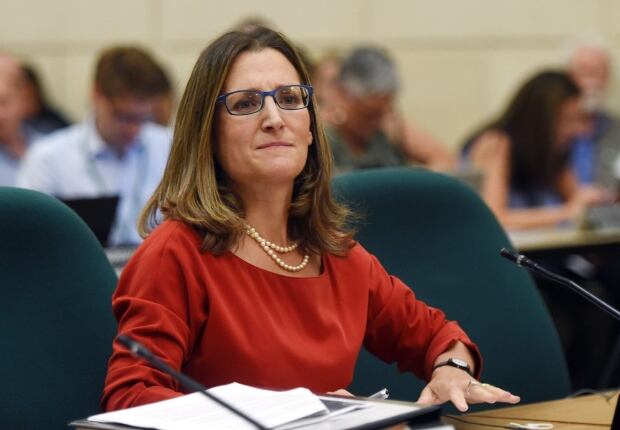
Foreign Affairs Minister Chrystia Freeland told the international trade committee on Monday that her government is ‘fully committed’ to defending supply management during NAFTA talks. (Sean Kilpatrick/Canadian Press)

“There’s always some anxiety with that process, depending on which customs officer you’re going to get and depending on what questions and documentation there are.”

Udzbinac said exporting equipment to the U.S. is “cumbersome” and he would like to see fewer crossing requirements, ideally something along the lines of those in the European Union.

Dairy uncharted territory

The dairy sector was excluded from the original NAFTA deal in 1994, but Canada’s supply management system for dairy has long been a point of contention.

The U.S. may push Canada to allow greater access to its markets for American dairy products in the NAFTA talks. But David Wiens, a dairy farmer from Grunfeld, Man., and vice-president of the Dairy Farmers of Canada, believes there is a lot of inaccuracy in the perception of unfairness on Canada’s part.

“The way in which supply management works, it’s a domestic policy,” he said, for producing milk for the Canadian marketplace

However, the U.S. dairy industry is not happy that Canadian producers get to profit from price controls, and then can sell skimmed-off diafiltered (higher protein) components for cheese-making at lower market prices, squeezing Americans out of a growing market.

Wiens is hoping dairy will remain out of NAFTA and that U.S. producers turn their focus on their domestic policies to control their problems with overproduction.

Small business uneasy with uncertainty

The Canadian Federation of Independent Business says there is “real concern” among its members that any changes to NAFTA could have significant effects on their ability to sell goods and services abroad. The CFIB says uncertainty in how the trading partners will have to do business makes it difficult for Canada’s small business owners to plan for the future.

The CFIB conducted a survey of its members recently and asked whether “the potential renegotiation of NAFTA” would alter or change their export-import plans in any way.

Twenty-eight per cent of those who trade with the U.S. and/or Mexico said yes.

Members were also asked, “What influences your decision to increase the amount that your business exports to countries outside of Canada?” Thirty-six per cent said they were motivated by “favourable free trade agreements.”

The findings illustrate that small business owners may already be looking to other markets for their imports or exports to deal with the ongoing uncertainty with NAFTA, the CFIB said.

In releasing its response to the start of the talks, the CFIB quoted a farming business owner in B.C. as saying, “We’re hoping that NAFTA remains relatively the same.”

The survey of 4,399 CFIB members was conducted online between May 15 and June 26. Results are considered accurate within plus or minus 1.48 percentage points, 19 times out of 20.

The first round of negotiations in Washington for a new three-way pact between Canada, the U.S, and Mexico is scheduled to continue from Wednesday until Sunday.

The Trump administration formally notified the U.S. Congress in May that it intended to initiate the talks.


Source link
Categories
Economic

Fiat-Chrysler and BMW team up with Intel to develop self-driving system


To encourage thoughtful and respectful conversations, first and last names will appear with each submission to CBC/Radio-Canada’s online communities (except in children and youth-oriented communities). Pseudonyms will no longer be permitted.

By submitting a comment, you accept that CBC has the right to reproduce and publish that comment in whole or in part, in any manner CBC chooses. Please note that CBC does not endorse the opinions expressed in comments. Comments on this story are moderated according to our Submission Guidelines. Comments are welcome while open. We reserve the right to close comments at any time.

Submission Policy

Note: The CBC does not necessarily endorse any of the views posted. By submitting your comments, you acknowledge that CBC has the right to reproduce, broadcast and publicize those comments or any part thereof in any manner whatsoever. Please note that comments are moderated and published according to our submission guidelines.


Source link

Categories
Economic

CIBC to swallow PC Financial's banking business, rebrand as Simplii


President’s Choice is getting out of the daily banking business and more than two million current PC Financial customers are moving to CIBC, which will rebrand the bank as Simplii.

The two companies announced the end of their almost 20-year collaboration on Wednesday, as Loblaw says it will retain its loyalty point program and MasterCard-branded credit card program, while all daily chequing, savings, lending and other banking services will move to CIBC, which has been running the back end of the bank’s operations behind the scenes since it launched.

The bank promises a seamless transition with no changes to account numbers or pre-existing automatic payment and savings plans while it absorbs more than 2 million PC customers between now and November.

“We are excited about the future and our ability to create new products to serve Canadians,” PC Financial spokesperson Lana Gogas said in a statement. “Today marks the start of an exciting new chapter for PC Financial, including continued strength in payments and loyalty through our PC Financial Mastercard products.”

What’s left of Loblaw’s banking division — the corporate title of which is President’s Choice Bank — is a registered Schedule I Bank under the Bank Act, which means it is legally allowed to conduct banking services such as taking deposits and offering loans. But as of November 1, it will no longer be doing so.

Although new products are in development, PC says it plans to focus on its popular loyalty program to “to further improve our customer experience.”

[embedded content]

“At the moment, our focus is on ensuring a smooth and seamless transition for our customers; tomorrow, our focus will be ensuring our future is as innovative as our past,” Gogas said.

RBC Capital Markets analyst Irene Nattel said in a note that the news is neutral for Loblaw, which will be putting more focus on its PC Plus program and MasterCard offerings.

“From Loblaw’s perspective, today’s announcement is yet another signal that the company is focusing its efforts/resources on programs that reinforce customer loyalty/traffic to its retail banners.”

While Loblaw has handled the branding of the PC Financial unit, CIBC was running the banking unit behind the scenes since the bank was created in 1997 primarily as an online high-interest savings account. Everyday banking services such as chequing accounts, lines of credit and mortgages came a little later.

PC Financial’s more than 2 million customers will be moved to a new brand entirely owned by CIBC. (Nicole Ireland/CBC)

CIBC says the hundreds of PC Financial kiosks and automated banking machines in Loblaw-owned stores across the country will be closed down between Nov. 1 and March 31. Financial terms of the deal were not disclosed, but the bank said it would take a $100-million charge in its next quarterly earnings related to the deal.

Currently, bank machines inside Loblaw stores are branded as PC but provided by CIBC. Those machines will be removed and replaced with new bank machines owned by PC, and CIBC customers will pay a fee to use them — the same way they would pay a fee to use an ATM to owned by anyone other than CIBC.

Bank alternatives

For years, PC Financial and Netherlands-based ING Direct were the two biggest online-based banks in Canada, gobbling up customers by promising no or low-fees for basic accounts, and higher rates for savings accounts than those on offer at the big banks at the time.

Then ING was bought out by Scotiabank in 2012 and rebranded as Tangerine. CIBC’s move to take over PC means the two largest players in the space have both been gobbled up by Canada’s big banks.

Mike Boluch, executive vice-president of direct banking at CIBC, said the bank plans to invest more in Simplii’s offerings over time.

“Our focus in the near term is to make this a seamless transition over for our clients. Over time, we’re going to invest in the offer. We at CIBC have a long history of being known for innovation.”

The new division will provide more options for the full range of client needs, from no-fee online banking to more advice-oriented customer service, Boluch said.

“We see a wide spectrum of client needs, and we see this as being an important part of that spectrum. We’re pretty confident there’s a place for both business models.”


Source link

Categories
Economic

Donald Trump disbands business and manufacturing councils as CEOs begin to jump ship


U.S. President Donald Trump announced he is disbanding two advisory panels full of business executives after a number of high-profile CEOs either quit the panels or criticized his response to last weekend’s tragic events in Charlottesville, Va. 

The president announced he would be ending the “Manufacturing Council & Strategy & Policy Forum” in a tweet on Wednesday afternoon.

The move comes after a second day of corporate defections away from him.

The CEO of industrial conglomerate 3M resigned from the president’s Manufacturing Jobs Initiative panel, saying it is no longer an effective forum for the company to advance its goals.

“Sustainability, diversity and inclusion are my personal values and also fundamental to the 3M vision,” Inge Thulin said. “The past few months have provided me with an opportunity to reflect upon my commitment to these values.”

That came after the CEOs of Merck, Under Armour and Intel did the same the previous day.

Earlier on Wednesday, Campbell Soup CEO Denise Campbell did the same, resigning from the manufacturing advisory panel while saying the company will “continue to support all efforts to spur economic growth and advocate for the values that have always made America great.”

More to come


Source link

Categories
Economic

Bank of Canada publishes its 2018 schedule for policy interest rate announcements and the release of the Monetary Policy Report


Available as: PDF

The Bank of Canada today published its 2018 schedule for policy interest rate announcements and the release of the quarterly Monetary Policy Report. It also reconfirmed the scheduled announcement dates for the remainder of this year.

The scheduled announcement dates from September 2017 through December 2017 are reconfirmed as follows:

  • Wednesday, September 6
  • Wednesday, October 25*
  • Wednesday, December 6

The scheduled announcement dates for 2018 are as follows:

  • Wednesday, January 17*
  • Wednesday, March 7
  • Wednesday, April 18*
  • Wednesday, May 30
  • Wednesday, July 11*
  • Wednesday, September 5
  • Wednesday, October 24*
  • Wednesday, December 5

*Monetary Policy Report published

All rate announcements will be made at 10:00 (ET), and the Monetary Policy Report will be published concurrently with the January, April, July and October rate announcements.


Source link