
CBC News is dedicating a special day of coverage to the Ebola crisis on Tuesday. On radio, television and online, we’ll explore the facts behind Ebola and answer questions. Be part of the conversation Tuesday by using #ebolafacts on social media or by joining our live chat on CBCNews.ca starting at 8 p.m. ET.
Canada’s health minister and top public health officer are set to take questions about the country’s Ebola preparedness.
Health Minister Rona Ambrose and Dr. Gregory Taylor, Canada’s chief public health officer, are scheduled to hold a news conference on Friday in Toronto on Canada’s response to the Ebola outbreak in West Africa.
Earlier on Friday, Ontario’s Health Ministry announced it is enhancing preparations to fight Ebola, such as adding staff and designating 10 hospitals as referral centres in the event the virus becomes an issue in the province.
Dr. Eric Hoskins, Ontario’s minister of health and long-term care, announced the new precautionary measures Friday at Toronto Western Hospital.
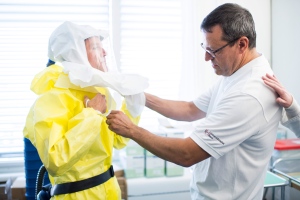
Across the world, health-care systems are developing safety protocols to help protect front-line workers treating patients with Ebola. Ontario’s new measures were announced Friday. (Ennio Leanza/EPA)
The 10 hospitals designated for referrals are:
- Children’s Hospital of Eastern Ontario in Ottawa.
- Hamilton Health Sciences.
- Health Sciences North in Sudbury.
- Kingston General Hospital.
- London Health Sciences Centre.
- The Ottawa Hospital.
- Hospital for Sick Children in Toronto.
- St. Michael’s Hospital in Toronto.
- Sunnybrook Hospital in Toronto.
- University Health Network’s Toronto Western Hospital.
The hospitals were chosen because they already have sophisticated infection control systems and procedures in place, officials said.
The World Health Organization says the current Ebola outbreak centred in West Africa, where more than 4,000 people have died, is the largest and most complex one since the virus was discovered in 1976. The U.S. has seen two health-care workers diagnosed with the virus after they contracted it from the first U.S. patient to be diagnosed with the disease.
The risk of transmission of Ebola virus disease is very low in Canada, said Dr. David Mowat, the province’s interim chief medical officer of health.
Preparedness measures
“There are no confirmed cases of Ebola or any other hemorrhagic virus diseases in Canada,” Mowat said. “In fact, there has never been a case of such a disease in Canada.”
As part of Ontario’s new preparedness measures, two nurses at each hospital will now exclusively care for any confirmed Ebola patient at all times under the supervision of qualified management staff.
For suspected Ebola patients, more protective equipment such as biohazard suits and N95 masks will be available.
As of Monday, the provincial lab will also be able to test for the Ebola virus, Hoskins said. Specimens will continue to be sent to the National Microbiology Laboratory in Winnipeg for confirmation.
The province is also outfitting ambulances to safely transport potential cases of Ebola to designated hospitals in an isolation bubble.
Hoskins also created a working group he’ll chair that will include front-line health workers to advise him.
Hoskins said he supported calls from health-care workers for stronger training, more protective equipment and enhanced procedures.
The moves come as fallout continues over two health-care workers who contracted Ebola from the first patient to be diagnosed with the virus in the U.S.
Mowat said the SARS outbreak in 2003 led the province to strengthen its capacity to anticipate, prepare for and respond to health emergencies.
The Ontario government’s SARS commission, headed by then Justice Archie Campbell, recommended a precautionary approach that errs on the side of caution to ensure a safe work environment, Linda Haslam-Stroud, president of the Ontario Nurses’ Association, said in a statement on the Ebola preparedness announcement.
The third and final report on the 2003 outbreak of severe acute respiratory syndrome was released in December 2006.
“ONA is pleased to hear that occupational health and safety standards will guide the work of the government,” Haslam-Stroud said.


