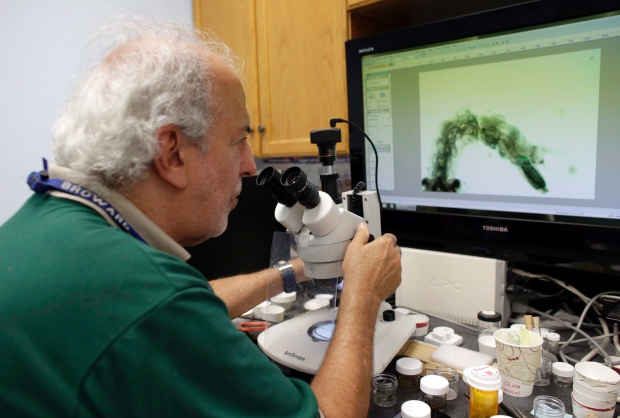
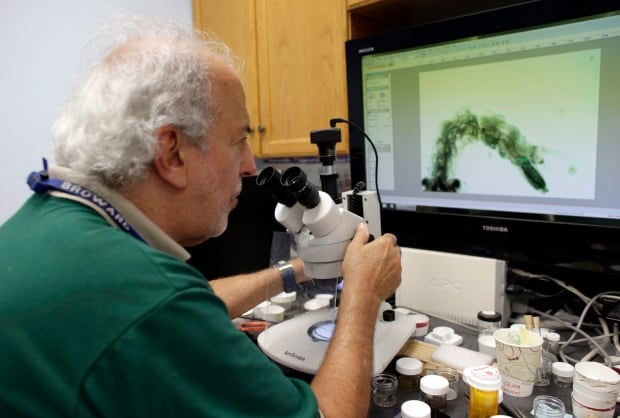
Evaristo Miqueli, a natural resources officer in Florida, looks through a microscope at Aedes aegypti mosquito larvae in June in Florida. Health officials in the state are distributing Zika prevention kits and repellent. (Lynne Sladky/Associated Press)
The U.S. Centers for Disease Control and Prevention is working with Florida health officials to investigate what could be the first Zika infection from a mosquito in the continental United States.
They say lab tests confirm a person in the Miami area is infected with the Zika virus, and there may not be any connection to someone travelling outside the country.
The CDC says none of the more than 1,300 Zika infections in the United States to date were from local mosquitoes. Fourteen were sexually transmitted and one involved laboratory exposure.
Mosquito control inspectors were at work in Miami-Dade County on Wednesday. Spokeswoman Gayle Love said they’ve been going door-to-door since health authorities alerted them late last week, spraying to kill mosquitoes and emptying any containers because the insects like to lay eggs in and around standing water.
Tuesday’s statement from the Florida Department of Health did not specify whether the Zika case was believed to have been transmitted via mosquito bite, sexual contact or other means.
Zika prevention kits and mosquito repellent — strongly recommended for women who are pregnant or planning to be pregnant — are being distributed in the area and can be picked up at the health department as well.
No additional information about the health investigation was immediately available Wednesday.
In most people, Zika causes only a mild and brief illness, at worst. But it can cause fetal death and severe brain defects in the children of women infected during pregnancy.
There is no vaccine. In outbreak areas, the main defence is to avoid mosquito bites. Zika also can be spread through unprotected sex with someone who is infected.
Health officials worldwide have advised pregnant women not to travel to areas where Zika is spreading.
They also recommend that women wait at least eight weeks after a Zika illness, or possible exposure to the virus, before trying to conceive. Men who had symptoms should wait at least six months before trying.
U.S. officials have predicted local outbreaks to begin as the weather warms, particularly in southern states such as Florida and Texas.
There are three steps in local transmission:
- Someone who is infected with Zika while travelling and has high enough level of the virus returns home to the U.S.
- The person then gets bitten by a local mosquito that is able to acquire and replicate the Zika virus.
- The local mosquito then bites and infects someone else.
Experts with the CDC have previously said if local spread of the virus occurs in the U.S., it is not likely to be as widespread as in Latin America and Caribbean.
They point to what happened when Aedes mosquitoes spread dengue and chikungunya, cousins of Zika virus. Locally transmitted outbreaks of dengue occurred in Florida, Hawaii and Texas. In 2014, there were 12 cases of locally acquired chikungunya reported in Florida, the CDC said.
In the continental U.S., greater use of air conditioning, window screens, mosquito control, and less densely populated areas than in Central and South America are all thought to lessen the likelihood of widespread outbreaks, CDC officials have said.