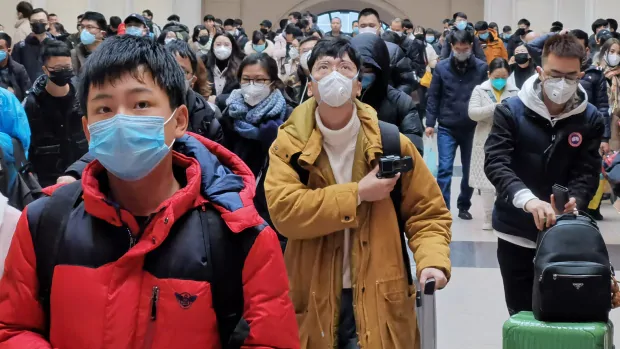
A World Health Organization (WHO) panel of experts on the new coronavirus said Thursday “it is a bit too early” to consider the outbreak an international emergency.
The 16 independent experts in disease control, virology, epidemiology and vaccine development were holding a second closed-door meeting at the UN agency’s headquarters in Geneva after not reaching a decision on Wednesday.
The new coronavirus that first appeared in the Chinese city of Wuhan has killed 18 people and infected more than 600, most in China. But cases have been detected as far away as the Thailand.
WHO defines a global emergency as an “extraordinary event” that constitutes a risk to other countries and requires a coordinated international response.
Chinese health authorities made a presentation by teleconference and have allowed a WHO team into the country who are due to report back to the panel.
The Canadian government urged travellers on Thursday to “exercise a high degree of caution in China due to the risk of arbitrary enforcement of local laws,” a notice that is one level below an official travel advisory. The government previously said in a travel health notice that the “overall risk to Canadian travellers and to Canada remains low.”
Meanwhile, the U.S. Centers for Disease Control and Prevention raised its travel alert for the coronavirus outbreak to a Level 3, recommending people avoid all non-essential travel to Wuhan.
Early this week, the agency said it expects to see more cases of the coronavirus in the U.S. after a man was found carrying the virus in Seattle on Wednesday. It has announced plans to expand screening to airports in Atlanta and Chicago.
Developing potential vaccines
In separate developments, three research teams are to start work on developing potential vaccines against the new coronavirus, a global coalition set up to fight diseases said on Thursday.
The Coalition for Epidemic Preparedness Innovations (CEPI), which is co-funding the emergency projects, said the plan was to have at least one potential vaccine in clinical trials by June.
The research will be conducted by the drug and vaccine developer, Moderna, working with the U.S. National Institute of Allergy and Infectious Diseases, the U.S. firm Inovio Pharma, and a team at the University of Queensland, Australia.
Each of the three projects will test a distinct scientific approach to developing a preventative vaccine against the China virus, known as nCoV-2019.
“Our aspiration with these technologies is to bring a new pathogen from gene sequence to clinical testing in 16 weeks,” said Richard Hatchett, CEPI’s chief executive.
“There are no guarantees of success, but we hope this work could provide a significant and important step forward in developing a vaccine for this disease.”