The lifetime chief of a First Nation in northern Ontario has gone to the Federal Court of Canada to stop the toppling of his decades-long rule.
The Ojibway Nation of Saugeen, about 400 kilometres north of Thunder Bay, filed for a judicial review with the Federal Court in Winnipeg on Feb. 1 to quash a move by community members to install new leadership under the band’s customary laws.
Chief Edward Machimity, who is in his 70s, has held his position since 1986 and became lifetime chief after the band adopted a custom leadership selection code in 1997.
The code called for a leadership review every 21 years. He has told CBC News that he would remain chief until his death.
Band members allege he shares little information and runs the majority of band services in the 242-member community for the benefit of his immediate family and friends.
Machimity has also been accused of using the band’s police to suppress dissent in Saugeen. His son-in-law is the band’s police chief.
The Federal Court filing was aimed to undercut a meeting held Sunday by dissident members of the Saugeen band, arguing it wasn’t “authorized” by the band’s custom leadership selection code.
New leadership chosen at meeting
Opposition band members had held a meeting on Dec. 9 in Savant Lake, Ont., about 20 km south of the Saugeen reserve, where they decided to replace the band leadership on Feb. 3. The December meeting was held on the day the 21-year review mark kicked in.
The band members selected four new band headmen (councillors) during the Feb. 3 meeting. They decided a new chief would be selected during a planned community meeting in June, said Darlene Necan, 59, a newly appointed headman and long-time advocate for leadership change.
The band members were served with Federal Court papers during the meeting, which also received a visit from three OPP officers and a band police constable.
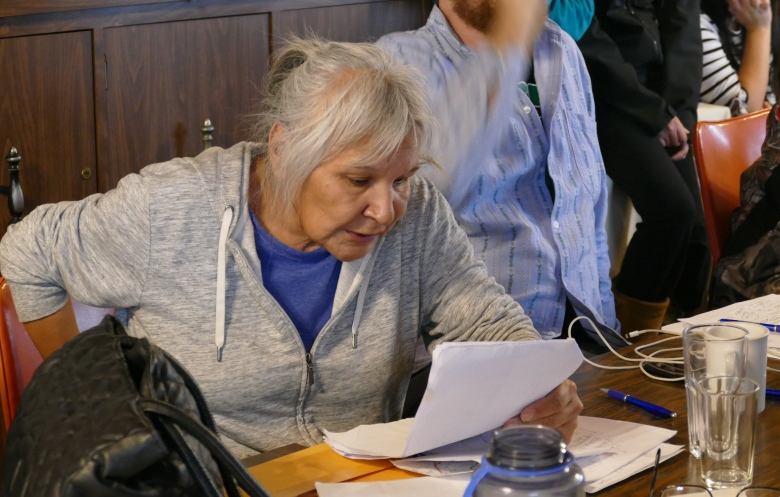
Darlene Necan was appointed as a headman by Ojibway Nation of Saugeen band members on Feb. 3. (Jorge Barrera/CBC)
The Federal Court application also sought an interim order recognizing Chief Machimity, headmen Eileen Keesic, John Sapay and Gladys Ombash as the “lawfully appointed” leadership of the band until the rendering of a final ruling, according to the filing.
Keesic is the chief’s daughter. Ombash has relinquished her position and given it to her daughter and band member Betty Necan, who is named in the court action. Betty Necan was confirmed as one of the four new headmen at the meeting Feb. 3.
“The respondents are purporting to remove the customary chief and headmen from ‘lifetime’ positions … without colour or right,” said the filing.
“The respondents have…failed to observe principles of natural justice and procedural fairness.”
The Federal Court referred the matter to case management where a judge would meet with the parties with the aim of mediating the dispute.
A woman who answered the phone at the Saugeen band office said Chief Machimity, Keesic and the band manager Violet Machimity, Chief Machimity’s wife, were unavailable for comment before hanging up.

The band police station at the entrance to the Ojibway Nation of Saugeen reserve in northern Ontario. (Jorge Barrera/CBC)
Lawyers Robert Watchman and Julia Ryckman, from the Winnipeg firm Pitblado LLP who are representing the band, did not return repeated requests for comment.
Saugeen’s band lawyer, Doug Keshen, said he couldn’t comment as he wasn’t representing the band in the legal proceedings.
Selected headman says he should have succeeded his father
Ottawa rarely intervenes in political disputes involving bands under a custom election code. There are 358 First Nations that operate under a custom code, according to the department of Indigenous Services.
The headmen selected by Saugeen community members at the Feb. 3 meeting retained a lawyer this week.

Ron Machimity, 60, was appointed as a headman by Ojibway Nation of Saugeen band members on Feb. 3. (Jorge Barrera/CBC)
Ron Machimity, 60, was one of the four selected as a new headman. His father, Gilbert Machimity, who died in April 2000, was one of the founding members of the band and an original headman.
Machimity said that under the First Nation’s custom rules he should have replaced his father on council.
He said that his father told him before he died not to fight Chief Machimity if he wasn’t appointed successor because it would make things worse and lead to the deterioration of their custom code.
“That is why I was keeping quiet,” he said. “He told me, ‘you will know the time to step up.’ And that is what I am doing today.”