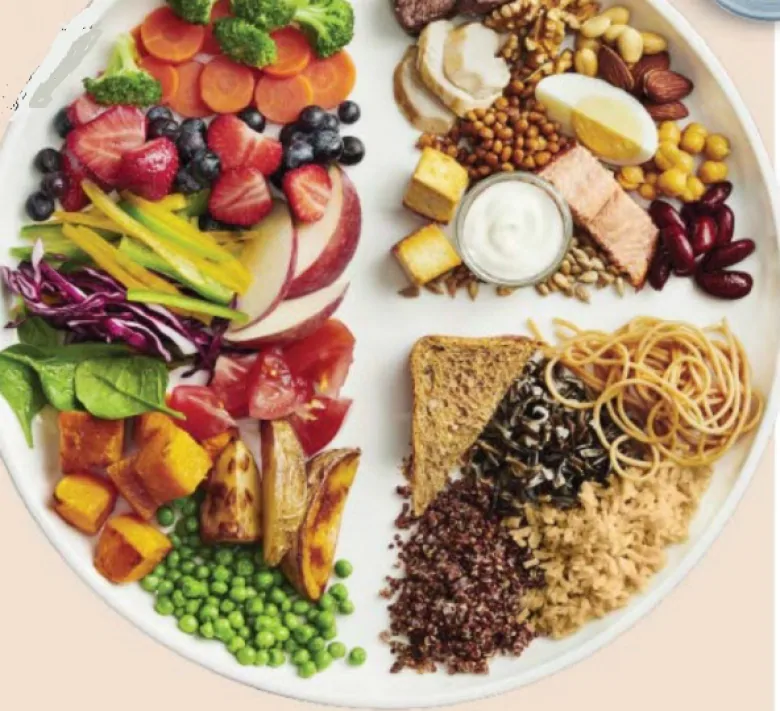
Instead of eating four food groups, Canadians are now encouraged to follow three guidelines on what to eat regularly, what to avoid and the importance of cooking and preparing meals at home.
Health Minister Ginette Petitpas Taylor unveiled Canada’s new food guide on Tuesday at a market in Montreal.
There’s no longer an emphasis on food groups and recommended servings. Instead, Health Canada recommends eating “plenty of vegetables and fruits, whole grain foods and protein foods. Choose protein foods that come from plants more often.” For instance, fruits and vegetables make up half the plate on the report’s front cover.
“It’s not about portion per se but perhaps about proportion,” Dr. Hasan Hutchinson, director general of Health Canada’s Office of Nutrition Policy and Promotion, Health Products and Food Branch, told reporters.
The proportion approach can be incorporated into family meals and snacks, he said.
Health Canada said the food guide is taught in schools and promoted by health professionals to support Canadians to eat well. It can also influence the foods served and sold at daycares and schools, recreation centres, workplaces and health-care facilities.
A two-page snapshot of the 62-page guide for health professionals and policy makers includes a glass of water as the recommended “drink of choice.”
The second of three guidelines covered foods and beverages that undermine healthy eating.
Health Canada recommends eating ‘plenty of vegetables and fruits, whole grain foods and protein foods.’ (Health Canada)
Beverages that contain a lot of sugar — including 100 per cent fruit juice — have been associated with a higher risk of tooth decay in children, the guide said. What’s more, consuming foods or beverages with added sugars has been linked to an increased risk of weight gain, excess weight and Type 2 diabetes.
The guide also notes there are health risks associated with alcohol consumption.
The guide was prepared using high-quality scientific reports on food and health, excluding industry-commissioned reports given the potential for conflicts of interest, according to Health Canada.
Hutchinson said when officials scanned the evidence, they were stuck by aspects of the food guides in Brazil, Sweden and Belgium. Fresh, unprocessed food is the cornerstone of the Brazilian food guide.
Guideline three focused on food skills. The snapshot advised:
- Be mindful of your eating habits.
- Cook more often.
- Enjoy your food.
- Eat meals with others.
- Use food labels.
- Limit foods high in sodium, sugars or saturated fat.
- Be aware of food marketing.
The full guide said food skills should be considered within the social, cultural, and historical context of Indigenous peoples.
“It’s quite different from the previous one because it talks about the context of eating,” said Jean-Claude Moubarac, a professor in the nutrition department at the University of Montreal who advised on Brazil’s food guide. “It goes way beyond just nutrients and food and really adopts this much more holistic approach, which is much more appropriate.”
Food loaded with sugar, salt and fat
Moubarac is pleased with most of the new Canadian food guide. He said it makes it clearer to consumers to seek out fresh and minimally processed foods and to avoid highly processed foods. The food industry has three years to introduce new nutrition labels to food products detailing information such as processed sugar content.
He said one limitation is that those new food labels will only be available in 2022.
“It makes me think: how will consumers be able to identify highly processed food loaded with sugar, salt and fat?”
Availability and accessibility concerns such as finances are another consideration in the guide.
Now that Canada’s new food guide is released, Moubarac said, policies and programs should be set up to make healthy foods more available and less expensive to address obstacles for healthy living for people who want to eat more fruits and vegetables. He also called for teaching children how to cook in school so they “fall in love with cooking real food.”
The new guide will include a mobile-friendly version that’s continually updated with resources, such as recipes.
Health Canada is also working on healthy eating patterns for health professionals and policy makers with details on the amounts and types of foods to serve at institutions for people in different age groups and life stages.
A tool kit for for Indigenous populations is planned for the spring.
The current guide was last revised in 2007.