
The first total solar eclipse to sweep the U.S. from coast to coast in nearly a century is underway.
Sky gazers across the land are watching in wonder through telescopes, cameras and protective glasses Monday as the moon blots out the sun and turns daylight into twilight.
CBC News is broadcasting a live special, hosted by Hannah Thibedeau, starting at 1 p.m. ET. Watch it on CBC News Network or live streamed on CBCNews.ca. CBCNews.ca is also bringing you on-the-ground coverage from sites across North America via our live blog. You can also follow along on Facebook and YouTube.
Totality — when the sun is completely obscured by the moon — will last just two minutes or so in each location along the narrow corridor stretching all the way across the U.S. heartland to Charleston, S.C.
Ezra Packham, from Jacksonville, Fla., looks through his solar glasses in preparation for the solar eclipse while he’s on the beach at Isle of Palms, S.C. (Mic Smith/Associated Press)
The shadow — a corridor just 96 to 113 kilometres wide — came ashore in Oregon and then began racing diagonally across the continent to South Carolina, with darkness lasting only about two to three minutes in any one spot.
It was expected to be the most observed and photographed eclipse in history.
In Canada, people were treated to a partial eclipse that was still pretty impressive. The best viewing sites were in Victoria, where the moon blocked 90 per cent of the sun, and Vancouver, where the the eclipse was 86 per cent.
Astronomers were giddy with excitement.
Jim Todd, a director at the Oregon Museum of Science and Industry, warmed up the crowd at an amphitheatre in Salem, Ore.
“The show has just begun, people. What a gorgeous day. Isn’t this great, people?” Todd told thousands at an amphitheatre in Salem as the moon seemed to take an ever-bigger bite out of the sun.
What to know about the solar eclipse | Ask Bob19:48
NASA solar physicist Alex Young said the last time Earthlings had a connection like this to the heavens was during man’s first flight to the moon, on Apollo 8 in 1968. The first, famous Earthrise photo came from that mission and, like this eclipse, showed us “we are part of something bigger.”
With a half hour to go before totality, NASA’s acting administrator, Robert Lightfoot, enjoyed the moon’s “first bites out of the sun” from a plane flying over the Oregon coast and declared it “just an incredible view.”

James Courtwright sets up his camera to take pictures of the solar eclipse in Depoe Bay, Ore. (Mike Blake/Reuters)
“I’m about to fight this man for a window seat,” Lightfoot said, referring to a fellow NASA official.
NASA’s planetary science director, Jim Green, a usually talkative sort, managed an “Oh, wow!” when totality arrived in Idaho Falls, Idaho, and shouted: “There’s Venus! There’s Venus.”
Hoping to learn more about the sun’s composition and activity, NASA and other scientists watched and analyzed from telescopes on the ground and in orbit, the International Space Station, airplanes and scores of high-altitude balloons beaming back live video.
“It’s really, really, really, really awesome,” said Cami Smith, 9, as she watched the fully eclipsed sun from a gravel lane near her grandfather’s home at Beverly Beach, Ore.
The temperature dropped and birds quieted down as the line of darkness crossed the continent.
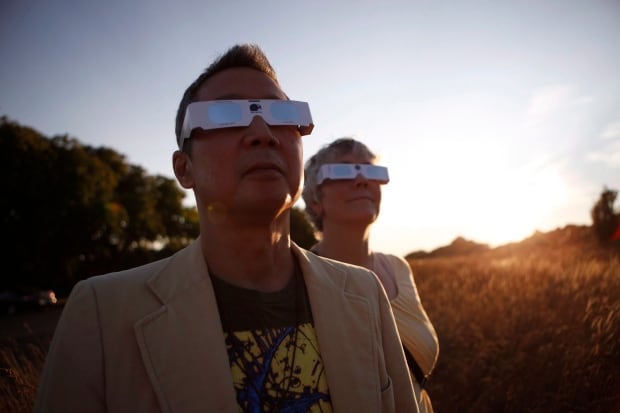
Clayton Uyeda and his wife Jo planned to enjoying the partial eclipse while travelling by ferry from Swartz Bay, near Victoria —where the eclipse was 90 per cent — to Tsawwassen ferry terminal on the mainland. (Chad Hipolito/Canadian Press)
David Avison showed up in Salem before dawn with his wife and relatives, after travelling by car and overnight train from their suburban Portland home. They couldn’t get reservations at a nearby resort, despite making plans six years ago.
“I’m telling people if you want to see the one in 2024, you’d better make your reservations now,” Avison said.
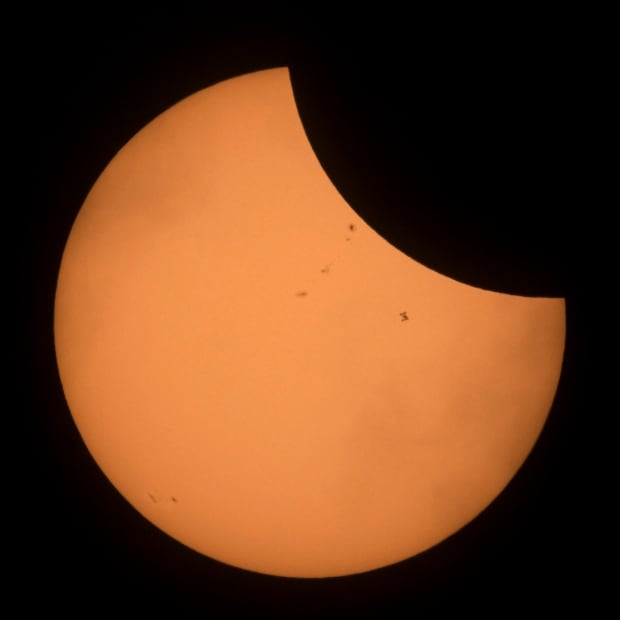
The International Space Station is seen in silhouette as it transits the sun during a partial solar eclipse Monday near Banner, Wyo.
With 200 million people within a day’s drive of Monday’s path of totality, towns and parks braced for monumental crowds. Clear skies beckoned along most of the route, to the relief of those who feared cloud cover would spoil this once-in-a-lifetime moment.
Cosmic spectacle
Astronomers consider a full solar eclipse the grandest of cosmic spectacles.
The Earth, moon and sun line up perfectly every one to three years, briefly turning day into night for a sliver of the planet. But these sights normally are in no man’s land, like the vast Pacific or Earth’s poles. This is the first eclipse of the social media era to pass through such a heavily populated area.
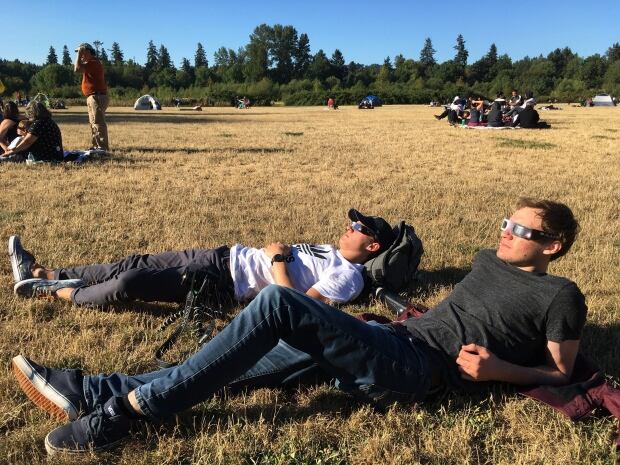
Jonathan Moric, left, and Finn Power, both of Vancouver get ready to watch the eclipse in a park in Salem, Ore. (Andrew Selsky/Associated Press)
The moon hasn’t thrown this much shade at the U.S. since 1918. That was the country’s last coast-to-coast total eclipse. In fact, the U.S. mainland hasn’t seen a total solar eclipse since 1979 — and even then, only five states in the Northwest experienced total darkness.
In Boise, Idaho, people clapped and whooped, and the street lights came on briefly in the middle of the day, while in Nashville, Tenn., people craned the necks at the sun and knocked back longneck beers at Nudie’s Honky Tonk bar.
Scientists had said Monday’s total eclipse would cast a shadow that would race through 14 states, entering near Lincoln City, Oregon, at 1:16 p.m. ET, moving diagonally across the heartland over Casper, Wy., Carbondale, Ill., and Nashville, and then exiting near Charleston at 2:47 p.m. ET.
Les and Mary Anderson marked their 13th eclipse with hundreds of amateur astronomers who have descended on Casper.
The couple from San Diego is attending Astroncon, organized by the Astronomical League.
Watching the #eclipse “first bite” pic.twitter.com/ka4IVBcMgw
The Andersons met on a photography field trip at Yosemite National Park and went to Mexico for an eclipse in 1991, the year before they got married.
In Casper, they joined a friend they met during an eclipse in Aruba in 1998.
Mike O’Leary was ready Monday with a camera outfitted with a homemade eclipse filter. He says seeing an eclipse is “like nothing else you will ever see or do.”

Madison the dog watches the solar eclipse in Nashville, Tenn. (Harrison McClary/Reuters)
Animal reaction
Eclipse viewers, many of them slathered with sunscreen, streamed into the noisy Nashville Zoo hours early to see both the eclipse and animals’ weird reactions to it.
Zoo spokesman Jim Bartoo says people were camping out at the zoo entrance at 6 a.m., three hours before the gates opened and 7½ hours before totality.
Paulette Simmons of Nashville said she came to the zoo she decided because she wanted to see how the animals reacted.
When’s the next one?
If you missed Monday’s eclipse, you’ll have to wait seven years to see another one in the continental U.S. and Canada, on April 8, 2024.
New Brunswick and Newfoundland will boast the best eclipse views in Canada. Those in Labrador, as well as other parts of Atlantic Canada, will be treated to a partial eclipse.
The line of totality will cross from Texas, up through the Midwest, almost directly over Indianapolis, Cleveland and Buffalo, N.Y., up over New England and out over Maine, New Brunswick and Newfoundland.
The very next total solar eclipse will be in 2019, but you’ll have to be below the equator for a glimpse — in the South Pacific, Chile or Argentina. It’s pretty much the same in 2020.