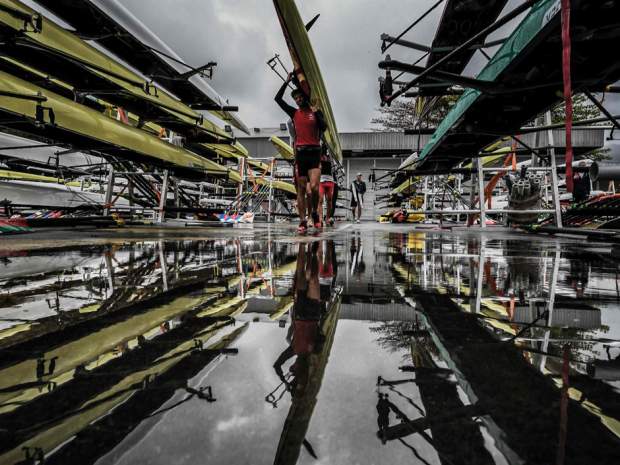
RIO DE JANEIRO — Thursday promises to be a big day for Canada at the Olympic rowing course on Lagoa Rodrigo de Freitas.
The women’s lightweight double of Lindsay Jennerich and Patricia Obee, the Maple Leaf’s best hope for a rowing medal, is set for their semifinal in the morning.
In the men’s four, the Canadian crew featuring Conlin McCabe and Will Crothers — both silver medal winners from the men’s eight in London — will race in their semifinal. And in the women’s single sculls, breakout star Carling Zeeman has a semifinal of her own.
Add it up and that’s three medal hopefuls for Canada on the same day, which should create just, er, boatloads of excitement. And maybe it will. But as it stands, the only racing being done at Lagoa these days is by FISA officials racing to tell the media another day of rowing has been cancelled.
“We have already made a plan C or D — I can’t remember which plan we’re on now,” said Matt Smith, the executive director of rowing’s governing body. “We would use a bit of Saturday afternoon just after the finals if we lose tomorrow (Thursday) and be able to finish Saturday with all of the races that are planned and promised to the rowers.”
And if they don’t? Smith advises there is a plan E in which some athletes would row twice in the same day and a Plan F where FISA would shorten the Lagoa course to 1,000 metres.
“The athletes want to get at it,” said Peter Cookson, the high-performance director of Rowing Canada. “They want to start racing. They also want the right conditions.”
But what if the right conditions never arrive?
On Wednesday, Olympic rowing was cancelled for the second time in five days, creating a scheduling headache for FISA and a potential nightmare if the weather doesn’t co-operate. Smith, the FISA boss, allowed he wasn’t confident the competition would resume on Thursday but said the forecast for Friday and Saturday, the final day of rowing, is more promising.
That would at least allow the Olympic regatta to finish, but it’s still possible they’ll have to row into Sunday.
The rowers have to be off the course by noon Sunday so Lagoa can be prepared for canoe/kayak.
“We remain optimistic that Friday and Saturday are going to be good days,” said Smith.
They’d better be.
“It’s unusual to be delayed as much as we have,” said Cookson. “We’re dealing with an open body of water that’s subject to some micro-climates that have a real impact on the water conditions. We have to live with it.”
Rowing started Saturday amid choppy conditions, with a number of rowers complaining about the rough water. Sunday’s racing was cancelled and on Wednesday it got worse, as the day’s racing was wiped out by a strong head wind and high waves.
“’The worst-case scenario is that there will not be any Olympic medals given out at this Games,” British rowing legend Sir Steven Redgrave told reporters. “So if you start at that doom and gloom view then anything better will be good.”
The Canadian team, meanwhile, is housed at a hotel in nearby Ipanema which means they’ve been spared the two-hour round trip between the athletes village and Lagoa. Cookson said Rowing Canada has made every attempt to normalize this abnormal situation, which sounds simple enough.

But when you’ve been peaking for this event for four years, any change in routine and preparation is a problem.
“These are all experienced athletes who’ve been doing this a long time,” said Cookson. “We don’t make a big deal of it. As an outdoor sport on water, we just have to accept that’s the way it is. I don’t think any of the athletes are stressed about it. They just know they have to wait their turn.”
ewilles@theprovince.com