Egyptian officials are investigating reports that smoke detectors went off on Egypt Air Flight 804 shortly before it crashed in the Mediterranean on Thursday.
French investigators are not drawing conclusions about the cause of the crash, but say there were indications of a fire on board the Airbus A320.
A spokesman for the French air accident investigation service says smoke was detected in multiple places on board the aircraft before it went down in the Mediterranean Sea.
Sebastien Barthe says the type of messages sent by the plane’s automatic detection system usually indicate the start of a fire. But he cautioned that anything beyond that is “pure conjecture” at this point.

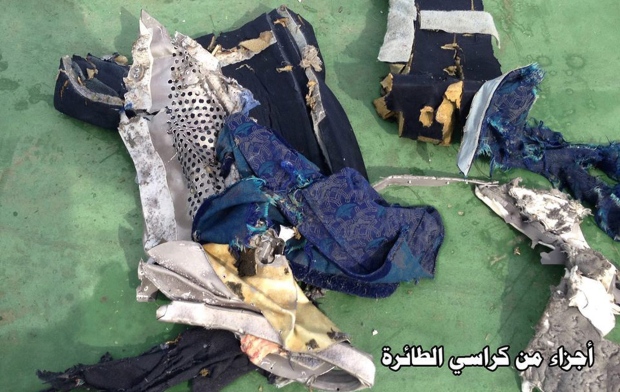
This picture posted Saturday on the official Facebook page of the Egyptian Armed Forces spokesman shows part of a plane chair from EgyptAir Flight 804. (Egyptian Armed Forces via Associated Press)
The respected industry website The Aviation Herald has published automatic alerts transmitted by the Airbus 320.
In short succession, they indicate the opening of a cockpit window, smoke in a lavatory and smoke underneath the flight deck in the electronics bay.
Further messages also suggest problems with the flight controls computer.
“Over a period of three minutes, the aircraft system shut down,” said the editor of Aviation Security International magazine, Philip Baum.

Relatives and friends of passengers of the EgyptAir plane comfort each other on Friday during prayers at Abou Bakr el-Sedek mosque in Cairo. (Mohamed Meteab/AFP/Getty Images)
“That’s starting to indicate that it probably wasn’t a hijacking. There probably wasn’t a struggle in the cockpit. It’s more likely a fire on board,” he said. “Now, whether that was a technical fire, a short circuit, or whether it was because a bomb went off on board, we don’t know.”
Egypt Air flight 804 was flying from Paris to Cairo with 66 people on board, including two Canadians, when the aircraft went missing.
Wreckage of the plane, as well as human remains and suitcases, were spotted floating in the Mediterranean Sea on Friday, according to Greek and Egyptian officials.
Search and recovery teams are still looking for the downed plane’s black boxes.
The devices will emit pings for only 28 more days and officials say that to get an accurate signal from those pings, a boat has to be virtually on top of the wreckage.

An unidentified woman waits outside the EgyptAir in-flight service building, at Cairo International Airport on Thursday, after hearing the plane had gone missing. (Mohamed Abd El Ghany/Reuters)
Finding pieces of the fuselage is a challenge with parts of the Mediterranean 3,000 metres deep.
The Greek defence minister, Panos Kammenos, said the plane swerved wildly shortly after leaving Greek airspace and entering Egyptian airspace and then disappeared from radar screens.
The Airbus A320 had been cruising normally in clear skies on a nighttime flight to Cairo early Thursday when it suddenly lurched left, then right, spun all the way around and plummeted 38,000 feet (11,582.4 metres) into the sea, never issuing a distress signal.
No militant group has claimed to have brought down the aircraft. That is a contrast to the downing of a Russian jet in October over Egypt’s Sinai Peninsula that killed all 224 on board. In that case, the Islamic State group’s branch in Sinai issued a claim of responsibility within hours.
On Friday, ISIS issued a statement on clashes with the Egyptian military in Sinai, but said nothing about the plane crash.