Categories
Alberta Ft Mac Health Politics

Environmental Policies to Blame for Blue Heron Deaths Says Athabasca Chipewyan First Nation Chief

environmental policies, blue heron deaths

Athabasca Chipewyan First Nation Chief Allen Adam is warning that every Canadian will pay a price for the current environmental policies in place after the recent blue heron deaths at the Syncrude site. Around 30 of the majestic birds died and this has upset environmentalists. The blue heron is not a protected species but it is a large and beautiful bird that delights those who see it. Chief Allan Adam told the media “We continue to pay the price. We see environmental issues come up in regards to wildlife and waterfowl that keep on occurring. Let’s do this right. If we want to continue to grow the oilsands and continue to prosper from what is here as a resource, then let’s do it the right way.” Chief Adam also expressed frustration at inaction by policy makers. The first bird that was discovered was reported to be covered in bitumen, and one of the blue herons was found alive but later euthanized by provincial officials.

Calls for better environmental policies are also coming from others after the blue heron deaths. Two investigators from the Albrta Energy Regulator have arrived at the Suncor Mildred Lake site and facility. In addition Syncrude has also appointed an investigator to examine what happened, why the birds died, and what can be done to prevent similar events in the future. Will Gibson, spokesperson for Syncrude, stated “There will be a very thorough investigation into what caused this. We are co-operating with the three agencies that are investigating this on site. We intend to find out what happened and address it.”

Categories
Alberta Ft Mac Health

Helipad on Hold While Northern Lights Regional Health Centre Goes Over Options for Design

Northern Lights Regional Health Centre, helipad

A new helipad at Northern Lights Regional Health Centre is on hold while officials go over the design options available. Alberta Health Services has announced the delay and the reasons behind it. The early designs were not ideal according to hospital officials, and different choices are being considered. NLRHC site director David Matear discussed the delay and said “Essentially, there may be other options that would better suit this project. From my perspective … it’s well worth taking the time and effort — and maybe that little bit more time now — to select the best option long term. If there is reinforcement required for the roof for a heliport … then there’s construction throughout the building that is required. Once that happens, then in those areas of construction — clearly they need to be sealed off.”

One point under consideration during the delay of the helipad at the Northern Lights Regional Health Centre is the elevator placement for patients being brought into the facility. Adding the helipad provides medevac services to land a helicopter right on the roof of the facility, bypassing the current method of landing at the local airport and then transporting the patient to the facility by ambulance. Until a final design is chosen there is no estimated completion date for the new helipad, but Alberta Health services released a news release with a scheduled completion date for the project at late 2016. Matear also explained that the helipad is sorely needed, commenting “Timely emergency medical transport is essential to those living and working in a region with a population and industry that is growing so rapidly.”

Categories
TV & Movies

Sincere Warmth, Unscripted Hilarity Abound as HFPA Gives Away $2M

Thumb_unmivojwz0v8xh6vjvtu9-4spjzbtqrqgktgpyfosqw

“Hi y’all!” cheerily replied Jamie Lee Curtis while taking the stage Thursday night at the Hollywood Foreign Press Association’s annual Grants Gala at the Beverly Wilshire Hotel in Beverly Hills, California. “Isn’t this fun? This is what all of show business should be.” The relaxed demeanor and infectious gaiety Curtis exuded set the tone for an evening refreshingly devoid of the usual pressures and tensions that plague star-studded events of this caliber. No awards were handed out and everyone left a winner.

“I love, as the [HFPA] loves, this confluence of art and commerce that I like to refer to as show-off business,” Curtis replied, while praising the HFPA for recognizing excellence in dramas as well as comedies and musicals during their annual Golden Globes ceremony. Yet what she loved, above all, was how the organization “puts their money where their mouth is” by giving over $2 million to non-profit entertainment-related organizations, foundations and scholarship programs. “If you wanna have a party, and you wanna give away $2 million, Lady Gaga’s coming to your f—king party,” Curtis declared to rousing applause.

If you ask anyone what the Hollywood Foreign Press Association does, they will mention the Golden Globes. But despite the fact that they have been giving away grants that number an estimated $24 million dollars over a period of 20 years, this remains the most closely guarded secret in Hollywood. No more, not after the celebrity studded dinner last night. Even the HFPA’s new president Lorenzo Soria acknowledged that more needed to be done to publicize the good works the organization does. And so celebs came out in numbers to do just that.

Nick Jonas opened the evening by serenading the audience with his rendition of Louis Armstrong’s immortal song, “What a Wonderful World.” When Lady Gaga finally appeared onstage, she immediately earned laughs by offering a disarmingly candid confession. “I’m a little embarrassed because when Jamie Lee Curtis said my name, I snarfed an olive into my nose,” Gaga admitted. “And there’s a teeny, tiny piece that’s still there.” But then her talk turned serious when she said she had attended the sort of performing arts studios that are supported by the HFPA. And “they’re WEIRD places,” she said to laughs and applause.

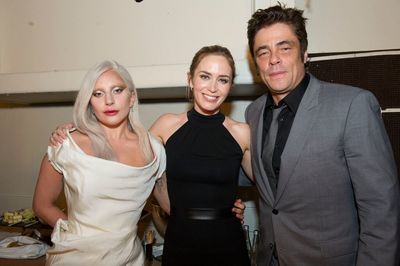
Unscripted moments like these resulted in many of the night’s most memorable moments. After flubbing a line while squinting at the teleprompter without glasses, Halle Berry shrugged and said, “I’m turning 49 tomorrow.” When Jane Fonda introduced “Sicario” stars Emily Blunt and Benicio del Toro, they initially failed to show up, leaving the actress stranded onstage. Luckily, she took this gaffe as an opportunity to improvise, musing on the “unreliable” glint in del Toro’s eyes.

Once Blunt and del Toro made it to the microphone, their eyesight proved to be exponentially worse than Berry’s, and their self-deprecating presentation transformed into an uproarious comedy sketch that ended up stealing the entire night. Blunt and del Toro milked the full potential of their impromptu routine, and eventually received sardonic handshakes from audience members, including a visibly amused Jon Hamm and Jake Gyllenhaal. Another hilarious duo was Joe Manganiello and Brie Larsen, the latter of whom appeared at Roger Ebert’s Film Festival (a.k.a. Ebertfest) two years ago for a screening of Destin Cretton’s powerful drama, “Short Term 12.”

Yet there were also moments of sincere emotion throughout the show, as celebrities spoke from the heart about the importance of these grants. America Ferrera said that she was honored to hand out grants that will help “make up for the unfortunate lack” of the arts in the Los Angeles Unified School District. “Without the arts programs in my own schools, I don’t know what outlet I would’ve found to express myself and find my career,” Ferrera said. Ice Cube also mentioned that he was a product of the Los Angeles Unified School District when he and his son O’Shea Jackson, Jr., presented a grant unrelated to their new movie, “Straight Outta Compton.”

Dan Smith, a professor of television at Mt. San Antonio College, told RogerEbert.com that the $5,000 grant from the HFPA will be crucial in enabling his students to attend universities, since 72 percent of the campus can’t afford the tuition. “We encourage our students to go wherever they can to further their education,” Smith said. “We have a student that got into NYU, which is a great film school. It’s $27,000 a year, and the student will need assistance to avoid ending up in debt. I hate to see students drop out when they’ve earned their spot at these colleges.”

Jake Gyllenhall reflected on the joy he felt after watching Charles Vidor’s classic 1952 musical, “Hans Christian Anderson” with his three-year-old daughter. This experience affirmed for him the vitality of film preservation, as it was one of his childhood favorites. He presented one of the biggest grants of the evening to Martin Scorsese’s Film Foundation, an organization dedicated to the restoration of cinema. Though Gyllenhaal also accidentally earned laughs by stating that the HFPA has helped restore “over 90 million films,” before correcting the tally to “over 90.” “That’s what they’re hoping to do,” he quipped.

HFPA president Soria spoke with RogerEbert.com on the red carpet about why film preservation plays a crucial role in the preservation of our own culture. “Just as it is important to preserve the pyramids or books from the 1600s, it is also important to preserve the movies and television shows that make up our culture,” Soria said. “A thousand years from now, we will be defined by the movies we were watching.”

A prime example of films currently reflecting the culture in which they were made is Peter Sollett’s “Freeheld,” due out October 2nd. It recounts the fact-based story of a lesbian couple, Laurel (Julianne Moore) and Stacie (Ellen Page), and their struggles to secure Laurel’s pension benefits after she is diagnosed with cancer. The result of the June 26th Supreme Court ruling that ultimately legalized same-sex marriage nationwide was a giant question mark during production.

“The feeling that we had on set with the actors was that either we were going to have a film that reminded everyone of how we arrived at marriage equality in this country and why we need to defend it, or it was going to be a film that told us why we needed to continue fighting for equal rights,” Sollett said. “Fortunately, as it turns out, it’s a film that reminds us how we got here and why we need to continue protecting equal rights for everyone. It’s thrilling to be on the cutting edge of something like that. Films aren’t always in that position.”

Ebertfest was the recipient of a $10,000 scholarship presented by Topher Grace and Dakota Johnson. It was to further international understanding through film. Grace told Chaz Ebert that his parents were introduced by film critic Bosley Crowther, and that as a result, he grew up in a home containing volumes of film criticism, so he was a proponent of Ebert’s writing.

Among the films that screened at this year’s installment of Ebertfest was Ramin Bahrani’s “99 Homes.” It opens on September 25th, and reflects issues of modern economic inequality in such a provocative way that it is guaranteed to trigger a vital debate among moviegoers. The film’s star, Andrew Garfield, was also among the presenters at the HFPA gala. He told me how he had met with people who found themselves in the exact same predicament as his character who goes against his own moral code in order to ensure the financial stability of his family. Garfield also made a point of mentioning that he found “Life Itself,” Steve James’s acclaimed documentary about Ebert, “so beautiful.”

Another presenter, Jason Isaacs, spoke about the tremendous impact films can have on audiences, singling out an example from his own career. He’s surprised by the number of people who have talked to him about his brilliant scene in Rodrigo García’s 2005 drama, “Nine Lives,” where he and Robin Wright play former lovers who coincidentally cross paths in a supermarket.

“Rodrigo is a magnificent writer, and the fact is, when you have access to writing like that, it acts itself,” Isaacs said. “It was a 15 or 16-minute unbroken piece, a single Stedicam shot. Films are often shot in such tiny increments that it’s really a director’s medium because they get control of the edit. Since this scene was done in one take, it really felt like we were a team. It was this extraordinarily human, emotional sculpture. Robin and I jumped on it and by the end, we had no idea what had just happened to us. It turned out to be some of the finest stuff that I’ve ever seen—forget that I was even in it.”

“You want to affect people with your work, and so many people have talked about their first love to me, and how you can be transported in a situation, forget about the circumstances of your life, and go off with someone you had just met or used to be with. That is the power of great writing. You are constantly in search of good writing, and maybe three or four times in my 30-year career have I come across writing like that. You treasure it.”

Speaking of moments to treasure, “Attack the Block” star John Boyega reminisced with me about the chance encounter that eventually put his career into light speed, jettisoning him to the top of the A-list after he was cast in “Star Wars: Episode VII—The Force Awakens.” The movie is set to galvanize the box office upon its December 18th release. “J.J. Abrams saw me and was like, ‘You’re Moses from ‘Attack the Block’! I loved you in the movie. We’re going to get you in something.’ That was four years ago. He wanted to put me in something, and it just happened to be ‘Star Wars,’” Boyega said. The actor also pointed out that there is a key correlation between “Attack the Block,” Joe Cornish’s 2011 cult favorite about teenage gang members battling aliens, and “Star Wars.” Both of them are “coming-of-age stories about characters who are asked to be greater than they are.”

What distinguished the HFPA gala, above all, was the spirit of generosity that invigorated the night’s proceedings, from the grant-giving at the podium to the countless priceless moments occurring backstage. There was an especially lovely sight that occurred at the tail end of the red carpet. Jamie Lee Curtis asked Jake Gyllenhaal to pose for the lens of a pint-sized aspiring photojournalist, who appeared to be not a great deal older than his own daughter. Naturally, he obliged. If only all of show business were like this.

Source:: http://www.rogerebert.com/festivals-and-awards/sincere-warmth-unscripted-hilarity-as-hfpa-gives-away-2m


Categories
TV & Movies

Ten Thousand Saints

Thumb_tenthousandsaints_2015_1

“10,000 Saints,” a coming-of-age film directed by Shari Springer Berman and Robert Pulcini (who adapted the script from Eleanor Henderson’s novel) features a lot of the clichés we recognize from the genre. There’s a love triangle. There’s a breaking-away from parental influences as the kids create a makeshift family. It takes place in 1988-89, with the backdrop of New York City at that chaotic moment in its history: the Tompkins Square Park riots with violent stand-offs with police, the war against the homeless, Yuppies vs. the Squatters in the East Village, the new threat of AIDS, plus the post-punk searching/yearning in the subculture of the ‘straight edge’ music movement. That’s a lot. But it’s an extremely effective context for this particular story, told with no nostalgia, lots of humor, and a cast of really watchable characters. They are “types,” for sure, but the types are given room to breathe. It’s a sensitive and interesting film.

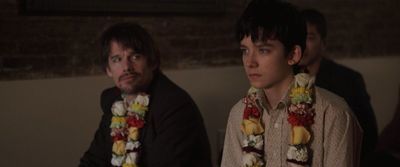
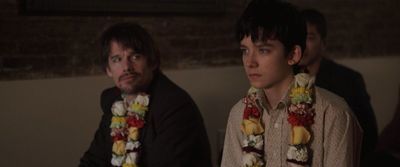
In the first scene, a young boy named Jude hangs out with his wild-child father, Les (Ethan Hawke) in the makeshift greenhouse in their Vermont backyard. Les is in the greenhouse, but also in the doghouse with his wife, and he opens up to his child son about it, all while lighting up a joint. The story he tells, of grown-up infidelity, is pretty heavy stuff to lay on your kid, but Les is clearly clueless. Then Les drops the bomb, so casually you might even miss it, that Jude was adopted. Jude looks shocked as his understanding of his young life shatters, and Les says in an encouraging way, “Aristotle was adopted! Lee Majors was adopted!” The scene is a prologue, but it’s efficient in setting up the atmosphere of the film. And Ethan Hawke single-handedly makes the whole thing land.

The 8-year-old boy in the greenhouse grows up to be a teenager (Asa Butterfield), with a long lock of hair dangling over his entire face, pissed at his father (who has since abandoned the family and moved to New York City), and hanging out with his best friend Teddy (Avan Jogia), getting stoned and wandering aimlessly through the icy landscape of their neighborhood, dreaming of New York. Everything changes on one New Year’s Eve, when Eliza (Hailee Steinfeld), the daughter of the woman Les is now dating in Manhattan, shows up for one night. Eliza arrives with the glamour of the city glimmering around her, and a little baggie of cocaine. Teddy and Jude hover beside her, entranced, slightly competitive for her attention. The night goes horribly wrong when Teddy freezes to death in the snow, but not before he loses his virginity to Eliza. She ends up pregnant, and her pregnancy launches everything that follows.

In the aftermath of Teddy’s death, Jude’s glass-blower hippie mother (Julianne Nicholson) sends him to New York to live with his dad. It’s a strange choice, because Les a.) lives in a one-room rent-controlled cold-water apartment on St. Mark’s Place, b.) spends most of his time hanging out with his posh ex-ballerina girlfriend (Emily Mortimer), Eliza’s mother, and c.) sells pot for a living. But it’s all part of the parental laissez-faire atmosphere in the film. The film is filled with abandoned children, adopted children, broken homes, vanished fathers. Les lays down some rules for Jude (“call if you’re going to be late, don’t stay out all night”), all as he lights up a bong and passes it across the table to his son. Jude starts to circulate in New York, looking up Eliza, and trying to find Teddy’s brother Johnny (Emile Hirsch) who currently lives in an abandoned building in the East Village. With these two, Jude finds his “tribe.”

Johnny is a tattoo artist (before that was a cool thing to do: Johnny mentions it being illegal in New York at that time) and a member of a band called Army of One. Army of One identify as “straight-edge”, a subculture of the post-punk period, when certain bands reacted against the overindulgence of their predecessors. “Straight edge” musicians lived clean lifestyles (many were former addicts), and made it a point to not hit on every woman in sight at their shows. They were “pure”, they were above sex/drugs/rock-n-roll.

Johnny is our entryway into that world. He’s devastated at the death of his younger brother and becomes invested in Eliza’s teenage pregnancy, taking a protective and almost fatherly attitude towards her. Johnny splits his time between band rehearsals and the Hare Krishna temple out in Brooklyn. Jude and Eliza trail along, going on mini-tours with Army of One, putting duct-tape X’s on their hands (a “straight-edge” signifier). Jude, of course, has a huge awkward crush on Eliza. Johnny’s “straight edge” mentality keeps him gentlemanly about whatever feelings he may have. Eliza is, in reality, an avatar. She’s viewed through the gazes of all of the men in her life, and she knows it. She’s 17, 18 years old, she’s pregnant, her mother is furious at her. Everyone focuses so much on her unborn baby that she gets lost in the shuffle.

This cast of characters, Jude, Eliza, Johnny, Les, Jude’s mother, Eliza’s mother, intersect, explode, retreat, argue, make mistakes, bang on each other’s doors, have extremely stilted “family” dinners where Les’ cavalier comments stop the room. Normal suburban concerns do not come into play, although there are vague stabs at it. Between the hippies in Vermont, and the squatters in New York, these people are somewhat off the grid of mainstream American life, and they like it that way.

The setting is one of the most important factors in the film. New York in the 1980s, pre-Giuliani, was closer to the New York seen in “Midnight Cowboy,” still filled with hustlers and hookers and peep shows (“live girls working their way through college” blared one neon sign at 40th and 8th) and graffiti covering everything. Garbage piles up on the streets. The homeless have created a tent city in Tompkins Square Park, and the imposition of a curfew (to control the homeless population) has resulted in riots and protests, growing in strength with every day. “10,000 Saints” portrays all of this believably, with only a couple of shots of stock footage (necessary since that neighborhood has changed so drastically). You get a visceral feel for that neighborhood in the film, its sense that unstoppable forces were moving in on them, running them out of town.

The script sometimes borders on the too-literary and symbolic (Jude’s name, first of all, and the Book of Jude quoted at Teddy’s funeral), but the acting is so solid, so fascinating to watch behaviorally, that it’s not an issue. Ethan Hawke’s performance will probably be compared to the one he gave in “Boyhood,” but except for the fact that the character is a guy not really ready for the responsibility of fatherhood, they are two completely different characters. Les is a beautiful creation from Hawke, a compound of slightly-seedy charisma, narcissistic self-involvement, a genuine desire to hang out with his son, and a pleading “I’m doing the best I can” energy during confrontations. It’s understandable why women like him, and why Jude’s mother has not cut all ties with him.

Asa Butterfield, Emile Hirsche and Hailee Steinfeld beautifully meld together in their makeshift family. These people are kids, but they’re trying to do right by one another. They have passions and obsessions outside of getting laid or getting high; they sit in the Hare Krishna temple and listen closely to the chants; they jump around slam-dancing at shows at CBGB’s; they talk and argue and try to work things out. Johnny says, with no vanity, “There’s nothing not to like about me.” Unbelievably, and beautifully, Emile Hirsch makes us see the truth in that line. That’s hard for an actor to deliver, especially in such a character which could come off as creepy or like he’s up to no good.

As young as they all are, you can see why their parents feel willing to let them go. They’re good people already. “10,000 Saints” respects kids like this. How a teenage pregnancy can be treated as a beautiful opportunity is one of the weird little miracles of the film: it makes sense. It’s difficult, but it makes sense. The world is a total mess and often very dangerous. New York was starting to erupt along social, political and economic lines, and the Ground Zero for that confrontation was Alphabet City. The kids are in the thick of it. Seeing where “10,000 Saints” chooses to go, and how it chooses to go there, is the main unexpected pleasure of the film. It’s not what you think.

Source:: http://www.rogerebert.com/reviews/ten-thousand-saints-2015


Categories
TV & Movies

Mistress America

Thumb_mistressamerica_2015_1

Noah Baumbach has been making movies for twenty years now, and they’ve nearly always been comedies of the sort that I call “radio with pictures”—not because of any inherent lack of filmmaking skill (he’s quite a good director) but because his characters are often so deluded or bitter or ignorant or self-aggrandizing or otherwise unpleasant that I find myself watching certain scenes through the cracks between my fingers. “Kicking and Screaming,” “Mr. Jealousy,” “The Squid and the Whale,” “Margot at the Wedding” and “Greenberg” were all picture-radio incarnate: astute at detailing the sorts of people you try to avoid at parties (or who try to avoid you, maybe?) and at times unnervingly willing to stick the knife into characters, and you, and twist it.

Baumbach’s collaborations since hooking up with onetime costar and now collaborator Greta Gerwig—whom he first worked with on “Greenberg”—have changed his tone. His movies are now slightly less scathing and a bit more accessible, but without for one moment sending the message that he’s suddenly become nice and sweet. They feel even more like mid-period Woody Allen films than they already did, although Baumbach, like a lot of dialogue-driven American filmmakers, owes so much to Allen that this might have been inevitable no matter who he worked with. His latest, “Mistress America,” gives Gerwig the sort of role that Diane Keaton would have knocked out of the park for Allen: Brooke, an almost-thirtysomething New Yorker who talks and talks without every actually seeming to listen, much less connect, with anyone else, and who wants to be influential and famous and successful but doesn’t seem to have any sort of realistic plan for achieving that, or any particular talents to bring to bear on her goal.

Brooke isn’t the main character of the film, though: that would be Tracy Fishcoe (Lola Kirke), a Columbia University student whose whose mother, Stevie (Kathryn Erbe) is about to get married to Brooke’s widowed dad. Tracy is an incoming freshman who doesn’t know anyone in New York; she’s never met Brooke, but her mom hopes Brooke will bond with her and become a companion or even a mentor to her, and encourages her daughter to make it happen.

Baumbach can be a marvelous, unsparing reporter on a certain slice of upper-middle-class to wealthy America, and he brings that skill to bear here in the scenes of Tracy feeling out of her element. The satirical details of college student delusions of grandeur are expertly observed by Baumbach and his co-writer Gerwig, particularly the competition to get into a literary society that taps its new members by hitting them in the face with pies and then hands them briefcases to carry around as emblems of their specialness. Brooke and her rather too competitive classmate Tony (Matthew Shear) and Tony’s dour girlfriend, Nicolette (Jasmine Cephas Jones) are sharply observed: like many Baumbach characters, they’re entitled and oblivious and fantasize about skipping to the head of the cultural line and maybe collecting that Nobel for literature before they hit the big three-o. At the same time, the movie has trace elements of sympathy for the lonely and alienated: the scene where Tracy eats alone in a booth at a restaurant from a takeout container while listening to Paul McCartney’s “No More Lonely Nights” on the PA system and pondering her cracked cell phone screen captures a particular kind of minor-key depression perfectly.

Once Brooke whirls into the movie, things take a turn for the madcap. She comes on like a classic Diane Keaton beautiful kook—imagine Annie Hall by way of the character in “Love and Death” who insists that subjectivity is objective—but there’s a specificity to her that’s uniquely maddening. She and Tracy match up in the a way that they probably both think is marvelous but that quickly shows its downside: they aren’t really talking to each other, but having adjacent monologues, with each waiting for a turn to chime in and talk about themselves. Gerwig and Baumbach’s dialogue here nails this social class’ brand of self-aggrandizing with a nearly surgical precision. Brooke describes herself as an “autodidact” and adds, “that word is one of the words I self-taught myself!” She works casual mentions of her dead mother into seemingly unrelated conversations (“That’s cool about the frozen yogurt machine…everyone I love dies”) and knocks her own skull with her knuckles for good luck and brags about her newfound appreciation for the social media, which she hopes to somehow parlay into making her dreams, whatever those are, come true.

Brooke is the kind of person that you think of as a “young spirit” if you yourself are young and don’t know any better. She calls herself a “curator,” which is the new word that people use to describe themselves when they don’t actually have any particular talent or skill, and talks about turning a rather cramped and awkward space into a combination restaurant and coffee shop and cultural space called “Mom’s,” blatantly Freudian title symbolism entirely intentional. She’s going to fund this venture by tracking down an ex-boyfriend named Dylan (Michael Chernus of “Orange is the New Black”) and the wife, Mimi Clare (Heather Lind), that she claims stole Dylan away from her, along with an idea that later proved very lucrative. Brooke says this is all about redress of grievance, but if you’ve watched her for more than five minutes you know she’s unreliable and that unflattering details will come out soon enough.

Baumbach has said that he had movies like “Something Wild” in mind while writing the script with Gerwig, and the film does have a touch of that formula, with Brooke as a variation of the “life force” character leading a more straitlaced narrator, Tracy, plus the increasingly unhappy Tony and Nicolette, on a whirlwind misadventure. There’s a parallel story about Tracy developing the ruthlessness that is unfortunately necessary to translate life into meaningful art. Of all the Columbia kids that we meet, only she seems to have the stuff to become a credible writer of realistic fiction, and some of the snippets we hear in voice-over of “Mistress America,” a short-story-in-progress about Brooke, do suggest talent, plus an acuity that would make Tracy’s subject deeply uncomfortable were she to read the finished piece. “Her beauty was that rare kind that made you want to look more like yourself and not like her,” says one of the more flattering lines, but at another moment she accurately describes the Brooke character as an exhausting, tragically limited person who uses others and bounces from one disastrously misconceived venture to another and doesn’t know herself and seems incapable of looking inward. Other people, Tracy writes, avoided her because “they could feel her failure coming.”

“Mistress America” is a very funny and observant movie, albeit squirm-inducing, with endlessly quotable dialogue. “X doesn’t roll like that,” Brooke tells a student that she’s tutoring in math, “because X can’t be pinned down.” The movie starts to crater as soon as Brooke and Tracy and company end up at the fantastically beautiful modernist house where Dylan and Mimi Clare live, and find Mimi Clare overseeing a reading group for pregnant women; there are some good bits involving a pot stash and a Chipwich and literary affectations, but the length of the sequence, coupled with its essentially static nature, makes the film feel too much like a low-budget talk-fest in which everyone resolves their issues through monologues and revelations. Up until that point, though, it’s a breezy and occasionally bracing movie, fun to watch if you’re a bit of a masochist, or if you’ve ever suffered through a weekend or even an hour with people like these, and wondered why you can’t hate them, and realized that it’s because you probably see a little bit of yourself in them and it scares you.

Source:: http://www.rogerebert.com/reviews/mistress-america-2015


Categories
Alberta Economic Ft Mac

Did Alberta Tax Increases Cost CNRL $405 Million in Second Quarter Losses?

CNRL, Alberta tax increases

CNRL is the second big oil company to blame an Alberta tax increase for hundreds of millions of dollars in losses during their second quarter of operations. The entire oil industry saw losses last year because of the drop in global oil prices, but some energy companies are seeing current losses that they link with Alberta tax increases as well. The corporate tax rate for Alberta jumped from 10% to 12%, and this caused CNRL to record a $405 million net loss during the second quarter. This is in comparison to a profit of $1.07 billion that was recorded just a year ago. CNRL has taken the position that the sudden increase in the tax rate for corporations played a huge part in the losses the company is experiencing.

When discussing the Alberta tax increases and the posted loss that CNRL has the chief financial officer for the company, Corey Bieber, stated “This charge effectively translates into lower future cash flows and therefore, lowers reinvestment in the business. Based upon third-party research, this lower future capital reinvestment likely equates to about 4,100 fewer person years of direct, indirect and induced employment, with follow-on impact of higher income taxes on future income streams. We expect to deliver annual oil production at the midpoint of guidance despite the forest fire impact on second quarter oil production,. We have been able to achieve significant cost savings through better effectiveness, efficiency and innovation. Both operating and capital costs were down significantly from the second quarter in 2014 to the second quarter of this year.”