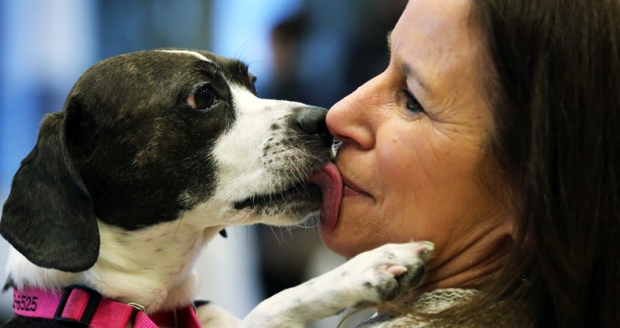

Hailey, a Boston terrier beagle, kisses her owner, Karen Profenna. Scientists have discovered gazing into the eyes of canine companions facilitates social connection. (John Moore/Getty)
A dog wins a place in its owner’s heart through mutual affectionate gazes, say scientists, who suspect a hormone reinforces the bond the same way parents connect with their babies.
Dogs were domesticated over centuries to select for their friendly temperament. Since then, we’ve shared a mutually beneficial relationship with our fireside companions.
Now, veterinary researchers in Japan have tested how our bond with canines gets strengthened.
Step one? Those irresistible puppy eyes.
First, the researchers put dogs into a room with 27 owners, and videotaped their their verbal communications, and how they touched and gazed at each other for 30 minutes.
They then measured levels of oxytocin, the “love hormone,” a marker for the surge of affection that appears when mothers care for their children and sexual pleasure.
Oxytocin levels measured in the urine of both the dogs and their owners increased during long gazes at each other, Takefumi Kikusu of the veterinary medicine department at Azabu University in Kanagawa, Japan, and his co-authors report in Thursday’s issue of the journal Science.
In the second part of the experiment, owners were told not to speak or touch their dogs as two strangers were also seated in the room. Researchers sprayed oxytocin or saline as a control into the dogs’ noses to see if they watched their owners more, and if oxytoxin levels in the owners also increased.
Female dogs did gaze into their owners’ eyes for longer, the human looked at their pets longer, and both showed an oxytoxin boost.
“There are a whole lot of ways to speculate about this,” said Stanley Coren, a professor emeritus at the University of British Columbia who studies and writes books about the bond between humans and canines.
Coren, who was not involved in the research, pointed to how oxytoxin shows up in a variety of expressions of affection.
“One possible guess is that the female, when they get that surge of affection, it’s almost like they’re caring for us. We’re just a big puppy. And we see them as a baby or a young child and that causes our oxytoxcin to rise and those longer gazes cause both the dog and the human to have more of the hormone. It’s sort of an increasing cycle.”
At a dog park in Toronto, Angelina Chan said her beagle, Danny, picks up on unspoken feelings.
“To me, she is just like family. It’s the same as if you’re looking into a sibling or a son or a daughter’s eyes,” Chan said.
“She is definitely my fur baby.”
Pathway to better therapy dogs
The study’s authors said sex differences in oxytocin nasal sprays have also been observed in studies on humans. It’s also possible the presence of strangers might be balancing out the gazes by vigilant male dogs.
A journal commentary published with the study said if the findings stand up to the test of time, they could be applied to strengthen the relationship between pooches and people.
“For example, the benefits of assistance dogs or individuals with autism or posttraumatic stress disorder – conditions for which oxytoxin is currently being used as an experimental treatment – may arise partly through these social pathways,” Evan MacLean and Brian Hare of Duke Canine Cognition Center in Durham, N.C., concluded.
In the meantime, the findings provide “more evidence that when your dog is staring at you, she may not just be after your sandwich.”
Source:: http://www.cbc.ca/news/health/puppy-love-hormone-boosts-fido-s-bond-to-owner-1.3035943?cmp=rss


