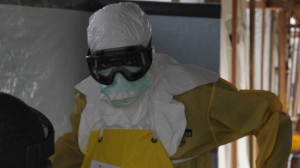

Some nurses are turning up for work at hospitals in Liberia today despite calls for a strike to demand better hazard pay amid an Ebola epidemic.
A strike could severely hamper Liberia’s ability to respond to the largest ever Ebola outbreak.
The disease is believed to have killed more than 4,000 people in West Africa. Liberia has the highest death toll.
Ebola has hit health-care workers especially hard, infecting about 400, nearly half of those in Liberia. Members of the National Health Workers Association of Liberia are demanding higher monthly hazard pay.
A strike by health-care workers would undermine the gains being made in the fight against Ebola in Liberia, said Liberian Deputy Health Minister Matthew Flomo on Sunday. (2Tango/Reuters)
Dr. Gobee Logan, a doctor at a government hospital, said some nurses were at work Monday.
The association boasts more than 10,000 members, though the Health Ministry says only about 1,000 of those are employed at sites receiving Ebola patients.
A meeting to resolve their grievances on Oct. 10 ended in a deadlock with the government refusing the meet their demands, said George Williams, secretary general of the National Health Workers Association.
On Sunday, Liberian Deputy Health Minister Matthew Flomo said the government was not aware of health workers planning to strike.
“What I do know is that the government has reached an agreement with health workers for their payment, which will be as of September, beginning Monday,” Flomo said.
But Williams denied the workers had reached any agreement with the government. He accused the administration of trying to divide the workers.
He, however, acknowledged that the strike would undermine the gains being made in the fight against Ebola in Liberia, but said they were confident the public would understand the reason behind their action.
“The problem is the government. The public should get angry with the government, not with us,” Williams said
“The public is aware that health workers are dying because they are not protected. Nobody is supposed to die while protecting lives, we have been calling on the government to give us protective gear but they are not doing so,” he said.
Liberia has the highest number of infections and deaths of the worst outbreak of the viral haemorrhagic fever that has killed 2,316 people in the West African nation.
Health-care systems in Liberia as well as in Sierra Leone and Guinea where the outbreak was first recorded in March, have been overwhelmed by the epidemic. The disease has also spread to Senegal, Nigeria, Spain and the United States.


