The following table of contents includes our complete coverage of the 2021 Toronto International Film Festival, as written by Brian Tallerico, Robert Daniels, Marya E. Gates, and Tomris Laffly.
The Midnight Madness program at the Toronto International Film Festival is always one of the most popular, premiering major films like David Gordon Green’s “Halloween” alongside independent genre flicks from around the world. While the electricity of actually being in the room as a new horror hit unfolds is impossible to replicate at home, two of the best films I saw in my virtual TIFF experience this year were from the Midnight Madness program, and there’s a third that I suspect will get a lot of attention when it inevitably drops on Shudder a few months from now.
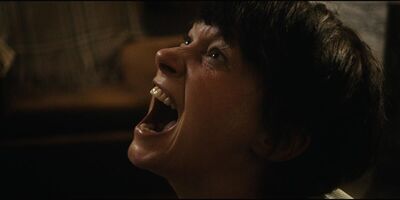
The best of the lot is Kate Dolan’s riveting “You Are Not My Mother,” as confident a feature debut as I’ve seen all year. The Irish writer/director weaves teen angst and mental illness into an updating of a classic Irish folk tale about changelings and doppelgangers. With fantastically committed performances and a deft management of tone, it’s one of the better genre films of 2021.
Hazel Doupe is phenomenal as Char, a reclusive young woman forced to deal with increasing bullying at school by a group of mean girls. As if that’s not bad enough, something is very wrong with Char’s mother Angela (Carolyn Bracken). The dialogue hints at a history of mental illness, and it feels like mom is about to dip into another severely depressive cycle when she just up and disappears. Just as quickly, she returns … but not quite. Something is wrong with mom.
The center of “You Are Not My Mother,” as Char comes to realize that Angela is living up to the title of the film they’re in, is perfectly calibrated, building tension with each passing scene. My concern was only that the final act couldn’t possibly pay off this tension (a common problem in debuts), but Dolan nails it, ending her film in a series of unforgettable scenes. Her tone management is remarkable, but the film doesn’t work without the complete commitment of Doupe, who is just terrific in portraying the spiral of a girl dealing with the mundane awfulness of being a teenager and something unimaginable at the same time.
A similar confidence elevates the intense atmosphere of Arsalan Amiri’s excellent “Zalava,” a film that also embeds cultural folklore with modern horror devices. It’s a story of the complexities of belief as much as it is a traditional tale of possession and Amiri’s visual sense, along with a surprising streak of dark humor, keep it humming from first frame to last. I’m also always a big admirer of when a horror director can make a mundane object terrifying and, believe it or not, chills will go down your spine with a close-up of an empty glass jar.
You see that jar may contain a demon. In a village named Zalava in the northwestern section of Iran, the people are terrified of an ancient demon that they have devoted their lives to keeping at bay. They perform ceremonies, including bloodletting, and call for the expertise of a shaman named Amardan (Pouria Rahimi Sam), who uses the jar to contain the demon. A visiting Gendarmerie sergeant named Masoud (an excellent Navid Pourfaraj) thinks it’s all nonsense. His belief is that Amardan is profiting off the fear of the villagers. He might be right. He might be wrong.
“Zalava” smartly plays with issues of dominating forces who don’t understand the history and culture of the places they dominate. It’s not accidental that Amiri sets his film in 1978, just before the Iranian Revolution, giving it a backdrop of distrust and rising tension. Amiri allows the question of whether or not Amardan is a shyster or a miracle worker to hang in the air, letting the uncertainty work its way both into Masoud’s remarkable stoicism and our understanding of this place and its people. And he shoots his film with striking confidence, getting a lot of mileage out of framing, forced POV, shadows, and, yes, close-ups of a terrifying glass jar.
A very different kind of Midnight Madness experience unfolds in “DASHCAM,” the latest from Rob Savage, the director of the very clever “Host,” now on Shudder. Like that film, Savage proves he knows how to manage a forced perspective of modern technology with this entire film unfolding from the vlog of an online personality who is as aggressively annoying as any character horror has seen in a very long time. Annie Hardy, a real YouTube personality, takes her real YouTube show Band Car to the world of horror, reportedly improvising this insane project across the countryside with Savage. The result is an abrasive experience, but I think it’s supposed to be. It’s about an awful woman who literally never stops vlogging as the world falls apart around her—so it’s kind of the most ‘20s movie yet.
On Band Car, Hardy drives around and improvises music, which is basically the set-up for “DASHCAM” too. Savage filters some funny comments from Hardy’s viewers on the left side of the screen with emojis popping up on the right as Hardy spews profanity and vitriol, some of it kind of anti-mask and MAGA (you’ve been trigger warned). Everything goes haywire when Hardy has to pick up a food delivery order and ends up with a passenger who clearly has something wrong with her.
A bit too much of “DASHCAM” consists of throwing the GoPro around the room and screaming, but Savage also finds times to slow down and provide his strongest imagery like a mask getting bloody from the other side or a woman slowly descending into camera from above. Hardy’s schtick is annoying, but I think that’s part of the point, and I admired both her and Savage’s commitment to the bit, even if I have no desire to ever see it again.
“You can’t teach American history without talking about Pauli Murray,” we’re told early on in “My Name is Pauli Murray.” You may agree by the end of this informative documentary. Directors Julie Cohen and Betsy West let their subject narrate an incredible life that influenced students, civil rights leaders and more than one future Supreme Court justice. Ruth Bader Ginsburg and Thurgood Marshall used Murray’s ideas and research in their most famous court cases. The filmmakers draw attention to how prescient and forward thinking those ideas were, pointing out how the ACLU used them as late as 2020 to ensure that LGBTQ+ rights were upheld. If this were a dramatic feature, I’m not sure my suspension of disbelief would be elastic enough to withstand the achievements presented here. Truth is indeed stranger, and more amazing, than fiction.
In a life spanning 74 years, Pauli Murray was a lawyer, a poet, an activist, a teacher, and an Episcopalian priest, the first Black woman to be ordained. Murray was also what we refer to as non-binary, proving that, as one person says in the documentary, this existed long before people spoke openly about it. However, we discover that Murray did try to express it, and at one point sought out exploratory surgery to see if undescended male genitalia were present. At times, and for safety during the Depression-era days of riding the rails, Murray’s appearance and dress was that of a teenage boy. Letters reveal someone who felt they were in the wrong body.
One thing that wasn’t discussed in those correspondences was preferred pronouns, presumably because the idea did not exist at the time. In biographies, Murray is referred to as “she” and “her,” and her own memoir, which we hear recordings of, is written in the first person. West and Cohen give time to a non-binary activist who acknowledges the use of feminine pronouns but decides to use “they” when they refer to Murray. When in doubt, I would normally ask a person’s preference, but such a case is not possible here. I will use “she” and “her” here, with no malice or disrespect intended.
In fact, there’s a section of “My Name is Pauli Murray” that’s all about identification and how the perceived wrong terminology can foster dissent. Murray taught students during the 1960s, bringing decades of firsthand civil rights struggle expertise to the classroom. Yet the students rejected her preference for using “Negro” instead of “Black,” going so far as to label their professor an Uncle Tom. We hear the reasoning behind the choice—“black” was never capitalized and was therefore considered demoralizing—but this was the “Black is Beautiful” era and, as one friend points out, these students were as fiery and outspoken as Murray was 30 years prior when Eleanor Roosevelt was getting pelted with typewritten letters chewing out FDR for his half-hearted anti-lynching statements.
Because of those letters, Mrs. Roosevelt and Murray formed a friendship spanning several decades. The First Lady became something of a motherly figure and cohort who also shared several life experiences: for example, the two were both orphaned and raised by older relatives. The Murray clan were a multi-ethnic group, some of whom could pass for White, and they all instilled the idea that a woman could do anything. Impressed by her friend’s strong will and fearlessness in confronting anyone regardless of their stature, Mrs. Roosevelt quite often suggested Murray as a valuable resource to people like JFK. “My Name is Pauli Murray” also blesses us with my all-time favorite Ebony magazine cover, the hilarious one where Roosevelt proclaims “Some of My Best Friends Are Negroes!”
To the world, Pauli Murray was a woman, and was treated as such. Sexism came from Blacks as well as Whites. “People talk about Jim Crow,” she wrote, “well, I’m dealing with Jane Crow.” This intersection of race and gender would become a constant talking point for Murray—again, far ahead of the times—and this included some clever uses of the 14th Amendment to force some semblance of equality in the law. After being denied acceptance in a PhD program, she enrolled in Howard University’s law school. “I don’t know why women would even consider the law,” a professor said. And during the first year, Murray “wasn’t even allowed to speak.” After graduating at the top of the class, Murray’s automatic acceptance into Harvard to continue studies was rescinded because it was for men only.
“My Name is Pauli Murray” isn’t just a list of achievements, each more impressive than the last. It’s also a bit of a love story between Murray and Irene “Renee” Barlow. The two met at the law firm they both worked at, gravitating toward one another because they were two of the few women in a jungle full of men. We hear snippets of a few letters between the two, and Murray mentions her as “my closest friend” on the tapes that were recorded during the writing of a second memoir, Song in a Weary Throat: An American Pilgrimage. When Yale recently created Pauli Murray College, it made the pioneer the first Black and LGBTQ+ person to have an institute named after them.
Before this film, I didn’t know very much about Pauli Murray. It does what all good documentaries do: it made me want to read up and be educated more on its subject. And what a great and inspiring subject Pauli Murray is.
Now playing in select theaters, and available on Amazon Prime on October 1.
Once she gets offstage, the real-life musical act St. Vincent loses her red-lipstick allure and becomes Annie Clark. No longer beholden to an audience that expects a larger-than-life entity, Annie relaxes into pedestrian activities and a less than exciting lifestyle that involves playing Scrabble. This presents a problem in the meta fiction of “The Nowhere Inn,” because Annie’s best friend Carrie is hoping to make a raw documentary about St. Vincent.
Consistently astute in how it handles its tonal shifts and point of view permutations, “The Nowhere Inn” is a mockumentary written by Carrie Brownstein and Clark. Both of them star as themselves, or rather scripted iterations of themselves. “The Nowhere Inn” is directed by Bill Benz, a former director and editor from the Brownstein’s “Portlandia” universe. Clark has appeared as actress on “Portlandia” (where she was curiously credited as Annie Clark) and directed a segment for the “XX” horror anthology feature.
Entrusted to direct the doc within “The Nowhere Inn,” Brownstein brings some ideas to enliven the material. Intensely lit concert footage captured during a St. Vincent tour is peppered in, particularly in the first act, to contrast Annie and her alter ego. But while Carrie adores Annie’s less glamorous personality—they are friends after all—she feels as though such uneventful normalcy would not entice the fans.
To amend the course from boring to slightly more bombastic, Carrie asks Annie to present herself closer to her alter ego, even when not performing. This begins a monstrous transmutation, with St. Vincent allowing the vices of stardom devour all of her relatable traits, empathy included. The more they work on this project, the more St. Vincent wants control over how she appears on camera.
It’s curious but fitting that on IMDb the co-writer is not listed as Annie Clark, but St. Vincent. The name choice seems to make official the film’s obsession with one’s curated image in the public; that it comes from the depths of the artist persona, not the depths of the person in non-plastic clothing playing Scrabble after a long day. It could also just be part of St. Vincent’s grand performance. Either way, it’s the guessing that induces interest.
Whatever the case, “The Nowhere Inn” (its title taken from a song the co-leads write together in the film) thematically concerns the public’s demand for celebrities to maintain their eccentricity. People like to think the rich and famous are different than us, on a realm of luxury unbothered with the day-to-day preoccupations of the rest of us. They fascinate us because they are unattainable. But the movie fails to factor in current modes of star-fan interaction. Through Carrie, we observe how Annie is treated when she behaves as St. Vincent, as if floating above everyone. Annie’s chaotic energy receives praise (and even romantic attention from Dakota Johnson), and she feeds off it.
By the same token, the creators attempt to manipulate reality, and ask us to pay mind to the line between embellishing and deceiving. Somewhere between whimsical and disturbing, Benz’s directorial choices seemingly mimic the ones of his on-screen proxy. The choices can be visually inventive, and make it impossible to decipher what is real: transitions crafted from physical film burning; the reframing of memories as if they were on a miniature screen; a sequence near the conclusion that plays out like a series of dreams within dreams.
Such aesthetic panache, however, can’t make up for how convoluted the story becomes as it creates more and more distance between both Carrie and Annie, and Annie’s artifice and sincerity as St. Vincent. The lack of emotional nuance makes other components repetitive: more dismissive reactions and more self-centered antics. Yes, the celebrated singer-songwriter is impenetrable and for that all the more desirable, but an hour into the film, the villainess disguise isn’t that intriguing.
Brownstein gets a subplot about her ill but very proud father, and yet we miss insight on her fictional directorial voice and why everyone is so impressed with her “finally” doing something artistic despite having a successful television show. With those issues on the backburner, the main conflict pertains to the two women’s dynamic: is it Carrie’s fault for asking for more of her subject in the first place, or is it Annie’s for abusing the request? By the time Carrie reaches a breaking point in which everything in her life seems to be performed, the film has already overplayed its hand building psychological labyrinths.
Plenty watchable and inspired from a visual standpoint, “The Nowhere Inn” is a less refined and less provocative relative of Joanna Hogg’s “The Souvenir,” Brady Corbet’s “Vox Lux,” or Robert Greene’s “Kate Plays Christine.” Benz’s film has a comparable ambition, but its returns are diminished in its own search of where someone’s lived experience and performance overlap.
Now playing in theaters and available on digital platforms.
There’s something mighty bizarre with Sion Sono’s “Prisoners of the Ghostland,” unrelated to when Nicolas Cage screams, “I’ll karate chop you! Hi-f**king-ya!” Yes, there are fleeting delights to be had from this movie, especially if one loves to be surprised by absurd production design. East literally meets West in this world, as samurai and Western iconography are layered on top of each other for a setting called Samurai Town, where gory duels across genre can break out on neon-lit streets that always wants its movie-set artifice and artistic abandon to be known. But while the world that contains Cage can sometimes be eye-popping, there’s a hole at the center of “Prisoners of the Ghostland.” No movie with Nicolas Cage, directed by the wonderfully weird Japanese director Sion Sono, should be this taxing, drawn out, and plainly boring.
Cage is the type of actor whose galactic performances directly feed from the stakes of the stories he’s in—think about the intense emotional journey of “Mandy,” with heavy metal guitars accompanying his unrelenting journey into hellish revenge, and the gold that movie gave us. In “Prisoners of the Ghostland,” Cage saunters around most of the movie with a suit that is geared to blow up different limbs and also his testicles. In theory that sounds like amazing and funny character motivation, but it gets lost in whatever this movie tries to pass off for plot. You come for ideas like Cage wearing a testicle trap, and then you get rambling exposition about some ghostland boundaries, history of a nuclear explosion, flashbacks to a bank robbery involving Cage’s character, and backstories for people whose emotions are played surface-level by their director.
Cage’s character (named Hero in the credits) is wearing the suit as a type of guarantee that he won’t run away, as he’s been forcefully enlisted by a powerful, malevolent figure named The Governor (Bill Moseley) to return his missing daughter Bernice (Sofia Boutella) from a place called the Ghostland. If Hero tries to take it off, it detonates at his neck; if he touches Bernice, his arm will. If he dares get excited around her, well, there’s two bulbs by his crotch. The star power of Cage’s performance, in Man with No Name mode, comes from select line-readings, a few yowling moments here, or a stolen goofy image there. It’s also a little exciting (in a few bursts of ultraviolence) to see Cage in a form that he has inched toward for so long—his own version of a samurai. Only Cage could have played this type of role, but his character itself is so uninteresting beyond being played by Nicolas Cage.
This is Sono’s long-anticipated English language debut, and he treats it like a victory lap with no attention to the game. The script was written by Aaron Henry and Reza Sixo Safai, but it was undeniably taken apart and tangled by the unpredictable instincts of Sono, who is not precious in the slightest with even bits of emotion or backstory that would give us something to care about. He’s especially slight when it comes to creating momentum for the story, even though it involves a rescue mission of sorts, a “Mad Max”-like apocalypse of sorts, and a flat subplot about a samurai named Yasujiro (Tak Sakaguchi) who later adds to the movie’s body count.
Sono is instead most concerned with getting every dollar out of his budget. It’s all about these massive sets and the dozens and dozens of cultish-looking background characters who chant weird things and sings songs, and it’s hard to get into the joke (whatever he might think it is) when it seems it’s all one rambling set-up. The crumbling ghostland of the movie is massive, complete with a towering clock that multiple people in rags play tug-of-war with to stop time from passing, as one of the movie’s many tangents. But it adds to the movie’s odd, mundane nature that it’s given a white and gray sheen—a far cry from the rich, heavy colors back in Samurai Town. Sôhei Tanikawa’s cinematography promises great color in the beginning with the slow motion shot of a gumball machine bursting open during an over-the-top shoot-out, and it feels like a con that we then get stuck with such a drab color palette that only remind us of the story’s bland stakes.
There’s the old Gene Siskel anecdote about whether a movie is more interesting than watching its actors have lunch. “Prisoners of the Ghostland” is more the case of, it would be more interesting to see its extras having lunch, preferably in their costumes. Imagine a group of people in samurai outfits, or shoulder pads with nails, or covered in toilet paper, talking amongst themselves about what they just did in a massive scene that Sono directed with the ease of a kid playing with action figures. Sometimes the movie is amusing because you can imagine its extras on the brink of laughing. But that charm wears off too, especially as “Prisoners of the Ghostland” proves to be a movie that’s far better at initially surprising you than holding your attention (it’s especially grating in a second viewing, I found out).
Perhaps the greatest value about “Prisoners of the Ghostland” is that it will expose numerous Cage-philes and movie fans to the filmmaking of Sion Sono, in part because it’s impossible to behold the extravagant excess of this movie and not want to know more about who made it with such abandon. Sono deserves the same kind of mainstream niche as a Quentin Tarantino or a Robert Rodriguez (I recommend Sono’s “Why Don’t You Play In Hell?”, or for the more ambitious, his almighty pervert epic “Love Exposure”), and having Cage endorse him like this is a rare moment of the world doing good. Cage and Sono are truly kindred nutcases: they are artists who do not question themselves, and while they have a sense of humor stranger than we can comprehend, they are too sincere for irony. But “Prisoners of the Ghostland” is truly just a beginning; a false start to what should, and still could be one of the greatest cinematic collaborations since sound met motion.
Now playing in theaters and available on digital platforms.
The profile doc is a tough form to navigate. They so often come off as little more than hagiography, hitting life highlights of public figures in a manner that does little to humanize them. The truth is that no documentarian is going to dedicate the time to make a profile doc without interest in the subject, but that interest can often lead to placing people on pedestals in a manner that just doesn’t lead to insightful filmmaking. Two of the best profile docs of the year premiered at TIFF and they work because of how carefully their talented filmmakers avoid the standard traps of the genre. A third film will work more for the fans, even if its subject surprisingly disagrees.
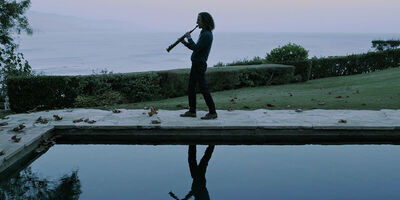
Penny Lane introduced her surprising “Listening to Kenny G” by asking, “Why should we care about other people’s taste in music?” More than a mere biography of one of the most famous and divisive jazz musicians of all time, the great Lane uses Kenny G to unpack how passionate we can get about musical taste. We get defensive when someone doesn’t like a musician who has changed our lives and we get aggressive when we feel someone like Kenny G is dismantling an art form we love (just ask Pat Matheny). At its best, Lane’s film directly asks why we put so much into our favorite (and least favorite) music, while also serving as something of image rehabilitation for Kenny himself, revealing him as someone incredibly dedicated to his craft, even if he is also radically unconcerned with some of the stronger criticisms lobbed at him.
Lane spends most of her film interviewing Kenny G himself, detailing his remarkable rise in the ‘80s and ‘90s to become one of the highest-selling musicians of all time. He’s likable, humorous, and revealing, but also feels like he’s very much in control of his image. He’s regularly repeating his mantras of constant practice—he reports to still do so three hours a day—and there’s a funny feeling watching his interviews that reflects his music in that “comfortable” way. It’s almost an “Easy Listening Interview,” which I don’t think is accidental on Lane’s part. It also makes Kenny G’s music feel more like a natural product of its creator instead of the carefully crafted money machine that some have accused it of being.
Lane counters the kindness to Mr. G. with jazz experts and critics who have spent a great deal of time detailing their reactions to the superstar. One calls Kenny G, “Part of the musical furniture of American culture,” and that’s on the nicer side. And yet even some of these people come around to recognizing the role that Kenny G has played in the world—one of the crazier bits involves how the artist’s “Going Home” has basically become the theme song of the end of the workday in China. A cool piece of trivia or proof that Kenny G is the tool of crushing regimes? You decide.
As Kenny G gets deeper into the kind of mash-ups that created his controversial collaboration with Louis Armstrong and allows his ego to emerge more fully (such as in a bit about how he could easily win an Oscar for Best Original Song if a filmmaker would just hire him), he started to lose me a bit. And I liked that. I like that even Lane seems a bit skeptical of Kenny at times by the end, but she still captures how much he means to people. After all, there needs to be some musical furniture out there.
A very different portrait of a man emerges in Liz Garbus’ National Geographic doc “Becoming Cousteau,” a film that sometimes feels less ambitious than her best work but that I found remarkably soothing and even comforting. There are men out there fighting to keep this world from falling apart, and “Becoming Cousteau” is a reminder of how people can use passion to make change. We could use more men like Jacques Cousteau.
The world-famous explorer is chronicled in a film that’s made up entirely of archival footage—always a choice that I admire. We don’t need to see talking heads. We hear from a few of them in archival audio and modern sound bites about the life of Cousteau, which is captured in ways that haven’t really been seen before. For one, I never appreciated the technological advancements and courage of Cousteau’s work. Deep-sea diving wasn’t what it is today when he started exploring the deep. The first person to try on an aqualung on a test day with Cousteau died. He was taking serious risks.
And he wasn’t just an explorer or a scientist, he was a filmmaker. Cousteau understood the power of the image, saying that he wanted to be the “John Ford or John Huston of the ocean.” I was having a very stressful, emotional day when I watched “Becoming Cousteau,” and I found it calming. Maybe it was the commitment of its subject and its filmmaker, but it was probably also something of what Cousteau saw in the deep: a gorgeous escape from the problems of the earth.
Jacques would eventually come around from just seeing the beauty of the oceans to realizing that conveying that beauty could help save them. He has an incredible line about how passion can impact change: “You’ll only protect what you love.” He taught people to love the planet. Anything that can remind us of that love in 2021 is valuable.
Finally, there’s Alison Klayman’s profile of Alanis Morisette in “Jagged,” a film that lacks the ambition of the best music docs by focusing almost solely on the remarkable ascendancy of its superstar during the production and release of Jagged Little Pill, one of the best-selling albums of all time. Hearing Morisette discuss her life in an open, likable manner has entertainment value—Klayman is clearly a gifted interviewer and gets great material from collaborators and colleagues like Taylor Hawkins and Shirley Manson too—but “Jagged” ultimately feels a little shallow for an album that really dug down to the bone.
Klayman’s approach is incredibly committed to Morisette’s work. She will regularly let live performances of songs from Jagged Little Pill play out, complete with lyrics put on the screen. The result is a reminder of the power of the album itself more than a profile of its creator (although, of course, the two are intertwined). Still, I wished for a bit more analysis and insight instead of replaying songs and discussing their production. And so I was stunned to read this week that Alanis herself has disowned the film as “salacious.” She does open up a bit about her horrifying experiences with sexual predators in the industry, but it’s not a word I would think anyone would associate with “Jagged.”
Alanis Morissette rules and it does feel like the critical industry has forgotten that too much. Her impact can be heard throughout music today (and I wish the film had worked that idea more too) and if “Jagged” serves as a reminder of a powerhouse moment in music culture than it has some value. I have to say that “All I Really Want” has been in my head all week.