Categories
Sports

This round goes to Canada: Women’s hockey Olympians beat U.S. five times in six tune-up games


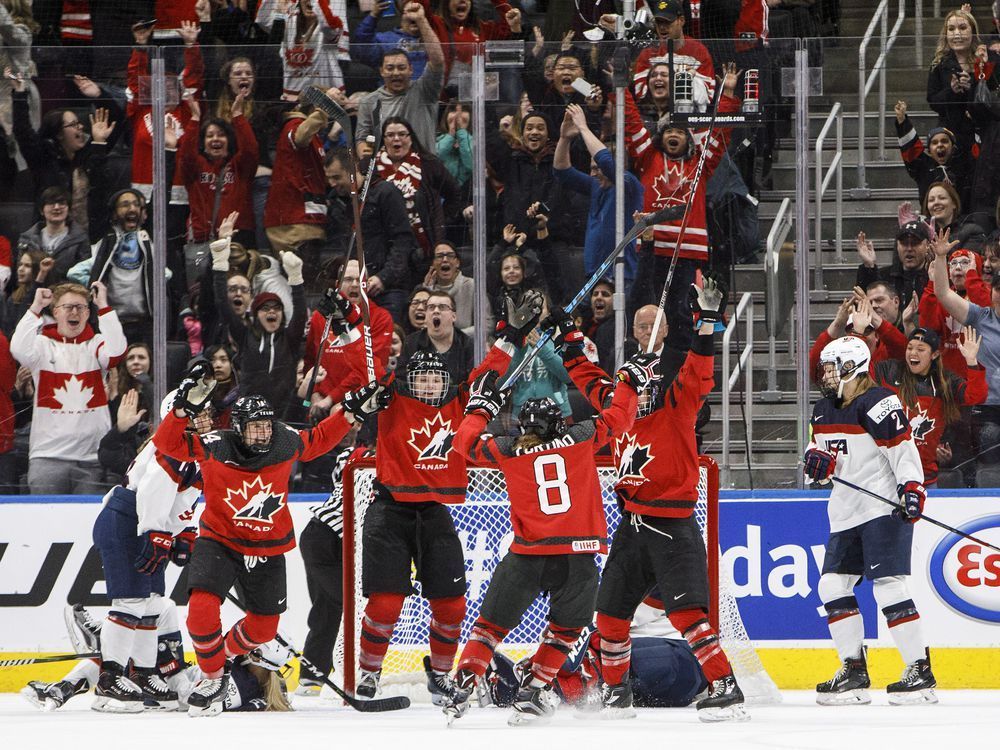
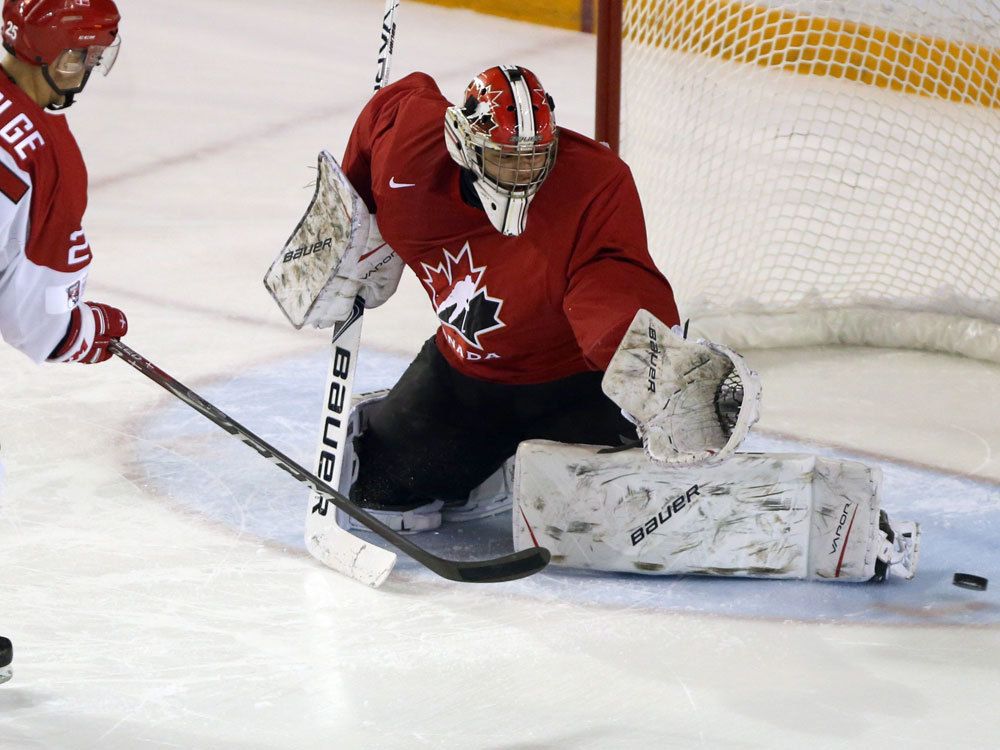
EDMONTON — In a career of many memorable games in Canada’s net, Shannon Szabados believes Sunday’s 2-1 overtime win over the United States will end up ranking high on her list.

The 31-year-old made 34 saves in her hometown for the national women’s hockey team. Jennifer Wakefield scored the winner with 27 seconds remaining in overtime.

Szabados was in Canada’s net for Olympic gold-medal victories over the U.S. in both 2010 and 2014. She held Canada in Sunday’s contest when her team was outshot 25-10 over the second and third periods.

“This is probably for sure in my top five,” Szabados said. “I feel like I’ve played in some pretty big games. This was pretty incredible.

“I think I had close to probably 300 people in the stands today, friends and family. Just being from Edmonton, born and raised, you couldn’t ask for anything better than this.”

Canada wrapped up their six-game exhibition series against the Americans with a 5-1 record. The archrivals won’t meet again until their pool game Feb. 15 at the Winter Olympics in Pyeongchang, South Korea.

But Canada opens defence of its gold Feb. 11 against Russia, who recently had six players banned by the International Olympic Committee for doping violations and had its sixth-place result in 2014 stripped.

Announced attendance at Rogers Place on Sunday was just short of a sellout at 17,468 and also just short of the record for a women’s hockey game, set in Ottawa at 18,023 in 2013.

Canadian captain Marie-Philip Poulin of Beauceville, Que., scored a power-play goal in the first period. Hilary Knight replied for the U.S., which has won four straight women’s world championships. Maddie Rooney had 24 saves in the loss.

Szabados also backstopped Canada to a 2-1 overtime win against the Americans on Dec. 3 in St. Paul, Minn. She controlled rebounds Sunday and smothered pucks when her teammates needed a breather.

How much results in the pre-Olympic series will matter at the Winter Games is debatable. Canada lost four in a row to the U.S. prior to arriving in Sochi, Russia, in 2014, but beat the Americans twice there en route to gold.

“These are great games for us to tune up against each other,” U.S. captain Meghan Duggan said. “Obviously it’s the best competition playing against them, we feel.

“Can’t live in the past, can’t live in the future, so tonight we were worried about this game. We weren’t looking ahead to February.”

Wakefield shovelled the puck into the U.S. net on a Canadian rush in overtime. The goal was reviewed and allowed to stand.

The forward from Pickering, Ont., was coughing and feeling less than robust post-game. The Canadian women had beaten the U.S. 3-1 two nights earlier in San Jose, Calif.

“I thought we played an alright game,” Wakefield said. “We have way more areas we need to improve on so it was nice to get the win even though we didn’t necessarily play our best.”

Knight scored late in the second for a 1-1 stalemate heading into the third. She beat Szabados glove side at 14:02 on a backhand feed from Kendall Coyne.

With Melodie Daoust providing traffic in front of Rooney, Poulin scored a power-play goal on a snap shot from the top of the face-off circle at 17:15 of the first period.

Including a pair of losses to the U.S. in November’s Four Nations Cup in Florida, Canada was 1-3 versus the Americans in October and November before winning four straight in December.

“I’m really happy with our process and where we’re at,” Canadian head coach Laura Schuler said. “Our girls have been so open to little tweaks and changes in our game plan to help us continue to get better.

“That’s been the difference in helping us be successful, but there’s still more work to do, for sure.”

With 26 players still centralized in Calgary, where the Canadian team is preparing for the Winter Games, three skaters have to be released to get down to a roster of three goalies and 20 skaters.

Since women’s hockey made its Olympic debut in 1998, Canada and the U.S. have met in the final four times (1998, 2002, 2010, 2014). Canada is 3-1 in those bouts and has won four gold medals in a row.


Source link

Categories
Sports

Canadian women’s gymnastics coach faces multiple charges of sexual assault, sexual exploitation


SARNIA, Ont. — Dave Brubaker, the women’s national team director of Gymnastics Canada, faces multiple sex-related charges.

Sarnia Police said in a statement that Brubaker was charged Friday with one count of invitation to sexual touching, three counts of sexual interference, three counts of sexual exploitation, and three counts of sexual assault.

The statement said Brubaker appeared in court on Friday and was released on bail with a February 2018 court date.

Police didn’t give any further details about the allegations and Gymnastics Canada said in a release that a publication ban has been imposed in the case.

The Bluewater Gymnastics Club, where Brubaker is the club director, did not immediately respond to an email seeking comment.

Brubaker was Canada’s head gymnastics coach at the 2016 Rio Olympics and was the women’s national team director at the 2017 world championships in Montreal in October, where Halifax native Ellie Black captured the women’s all-around silver medal.

Gymnastics Canada said in a statement that it was troubled by the allegations against Brubaker, who has been placed on administrative leave by the organization.


Source link

Categories
Sports

Canadian freestyle skier Cassie Sharpe nails first Dew Tour win in superpipe


You could say Cassie Sharpe anted up in a big way.

With M.O.P’s Ante Up cranked in her headphones, the 25-year-old freestyle skier claimed her first Dew Tour win on Friday in Breckenridge, Colorado.

She turned a technically difficult second run — right cork 900, left flare, right 360, switch 360, straight air truck driver, left cork 900, right flare — into 93.66 points and a superpipe victory at the invitation-only event.

“It feels pretty good, honestly,” said the Calgary native who grew up in Comox, B.C. “It’s just nice to be at a big event where it’s only invited athletes, and to be able to go against the best in the world and be able to persevere and be on top, it feels awesome,” she said.

She has already won on the World Cup tour this year as well, taking gold in New Zealand in September. But she fell back to ninth at Copper Mountain just last week and came into the Dew Tour ranked second overall in World Cup points behind Marie Martinod of France.

“It felt good to get another podium under my belt,” said Sharpe, who has been on the World Cup since since 2012. “I’m super happy, super proud to be riding the way that I am. The technicality in there of rotating both ways, flipping both ways and riding backwards in the halfpipe all adds up to a pretty technical run.”

Martinod finished second at 92.00 and American Maddie Bowman was third with 90.33 in the eight-woman final.

The original field of 21 included all the usual World Cup podium threats, attracted by prize money and the fact this event was also an Olympic qualifier.

“I had a lot of people asking me how I’m thinking, because it was an Olympic qualifier, how that weighed on my mind,” said Sharpe. “But honestly, when I’m at the top of the pipe, I’m not thinking about anything else. I’m not thinking about people looking at me, I’m not thinking of the cameras, I’m not thinking about the potential Olympic significance that it can have.

“I’m just trying to stay focused and in the moment of what I’m doing. Once I land a run and I take my headphones off and I can hear everyone, that’s when I have that moment of ‘whoa!’”

This win gives her confidence and a boost for the rest of the season, but she knows how wide open the Olympic competition will be in February. She finished fifth at a test event at PyeongChang last February.

“I think on any given day any of the eight women who make the final can be on top of the podium. It truly depends on the day. The top eight are all so close, we all leapfrog each other, but definitely when one of us is on, we’re on, and that’s it.”

Email: dbarnes@postmedia.com | Twitter: @sportsdanbarnes


Source link

Categories
Sports

Teary-eyed teens head home as Canada makes final world junior cuts


ST. CATHARINES, Ont. — Michael DiPietro was not expecting this.

Fighting back tears, the Vancouver Canucks goalie prospect looked blindsided moments after being told he was one of five final cuts — defencemen Mario Ferraro (San Jose) and Josh Muhura (Anaheim), and forwards Tanner Kaspick (St. Louis) and Nick Suzuki (Vegas) were the others — from Canada’s world hockey junior team.

“This is definitely something I’m not used to,” said DiPietro, who had led the Windsor Spitfires to a Memorial Cup championship this past spring. “You try to weather the storm. It’s not something that you expect coming to camp, but I respect their decision and I wish them all the best.

“I told them that they’re going to win gold and that they don’t look good with silver around their necks anyway.”

In some ways, the decision to cut DiPietro was in keeping with most of Canada’s decisions.

From not inviting a forward with NHL experience (Owen TIppett) to cutting a sixth-overall pick (Cody Glass), it’s clear that this team isn’t concerned with making the popular choices. Rather, Hockey Canada is trying to make the right choices.

“It’s not about what they are going to become in the NHL,” head coach Dominique Ducharme said. “Some guys are picked early and they got great potential, but where are they right now. It’s not where they are going to be in two years, three years, that’s the thing. At that age, especially 18 years old, a year makes a big difference.”

While there is just one top-10 draft pick and no draft-eligible players on Team Canada’s roster, what Canada lacks in big-name potential it more than makes up for in experience.

Of the 22 players, only three are younger than 19 and seven (forwards Dillon Dube, Michael McLeod and Taylor Raddysh, defencemen Jake Bean, Kale Clague, Dante Fabbro, and goalie Carter Hart) are returning from the team that lost to Team USA in last year’s championship final.

That should give Canada a more physical edge, especially for a team on the relatively small side, with nine of 22 players 6-feet or shorter.

“It’s not by design,” Ducharme said. “We really went with what we saw on the ice and what we felt was the 22 best players … experience, like I said before, you can’t buy. And having those guys that went different things — some of them were at the tournament last year and others went through other situations, like playoffs — whatever it is, it always helps.”

Canada, which plays two exhibition games next week, begins the tournament in Buffalo on Boxing Day, with a game against Finland.


Here is the 22-man roster:

Goalies: Carter Hart (Philadelphia), Colton Point (Dallas)

Defence: Jake Bean (Carolina), Kale Clague (Los Angeles), Dante Fabbro (Nashville), Cal Foote (Tampa Bay), Cale Makar (Colorado), Victor Mete (Montreal), Conor Timmins (Colorado)

Forwards: Drake Batherson (Ottawa), Maxime Comtois (Anaheim), Dillon Dube (Calgary), Alex Formenton (Ottawa), Jonah Gadjovich (Vancouver), Brett Howden (Tampa Bay), Boris Katchouk (Tampa Bay), Jordan Kyrou (St. Louis), Michael McLeod (New Jersey), Taylor Raddysh (Tampa Bay), Sam Steel (Anaheim), Tyler Steenbergen (Arizona), Robert Thomas (St. Louis)


TOP LINE BREWING

Team Canada merely picked its final roster on Friday, but forward line combinations — and chemistry — appear to be already forming.

Expect Sam Steel and Jordan Kyrou, who have been inseparable since they were put together during the summer camp, to start the tournament on the top line. The dynamic forwards combined for a goal and assist Friday in a 5-2 win against Denmark, but could have had plenty more based on the chances they generated.

“At first, it just happened, because we were trying things and then we saw this summer that they had chemistry,” Ducharme said. “We played them together here and we’ll see in the next few days what will happen.”

Steel, whom the Anaheim Ducks selected 30th overall in the 2016 draft, was named the WHL’s players of the year after scoring 50 goals and 131 points last season. Kyrou, a second-round pick of the St. Louis Blues last year, is leading the OHL in scoring with 39 assists and 58 points in 30 games.

According to Steel, it’s the duo’s unselfishness that makes them a perfect fit.

“We both love to score goals too, but I think we’re both the type of player where if the other guy is in a better position to score we’ll dish it off,” Steel said. “That’s the type of player I like playing with.”

DANTE DOIN’ JUST FINE

Dante Fabbro, who missed the first two games of the selection camp with a bone bruise, was in the lineup against the Danes. And though he hobbled off the ice midway through the third period, the Nashville Predators defence prospect said it was more of a precaution than something to be worried about.

“It was good,” he said of how he felt. “Later on in the game, I think I felt maybe more cardio-wise and where my contusion is. Other than that, I thought the guys did a good job helping me out there and getting me back in the swing of things.”

TIME TO BOND

With the roster now finalized, Ducharme said the focus is now on building a team.

It’s not something that will overnight. But, with the first game 10 days away, it’s essential that the 22 players quickly come together and start playing as one.

“It’s huge,” Ducharme said of bring the players together as one cohesive unit. “Not only friendships and building a group — that’s certainly part of it — but it’s chemistry on ice, the way we want to be playing, systems.”

mtraikos@postmedia.com


Source link

Categories
Sports

Formenton channeling inner Wendel Clark at Canada’s world junior camp


ST. CATHARINES, Ont. — It’s about finding a role. Any role.

On your junior team, you might be a top-line forward who gets all the goals or an offensive defenceman who quarterbacks the power play. But in a best-on-best tournament featuring literally the best players in the country, not everyone can be a star attraction.

Some have to take lesser assignments. Some might even have to switch positions.

Wendel Clark was a highly touted defenceman when he arrived to Team Canada’s selection camp in 1985. Two weeks later, he had become a checking-line forward.

“The last day of cuts, I thought I was getting cut and they said, ‘Would you be forward?’” Clark said. “I said, ‘I’ll carry the pucks as long as I get to go to Finland.’

“You’re playing for Team Canada. I just wanted to be one of the guys. Whatever it takes.”

Alex Formenton isn’t likely to move back to defence, however, since coming to Canada’s selection camp he has made the transition from a go-to goal-scorer to someone whose primary job is to get under the skin of opponents.

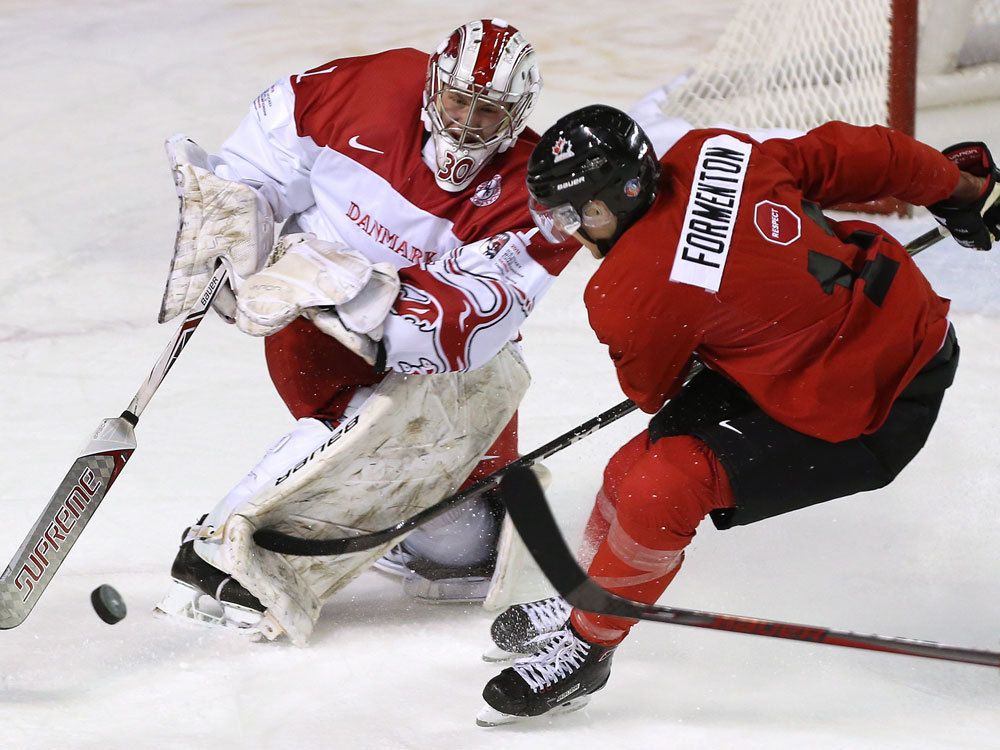
In Friday’s exhibition game against Denmark — a 5-2 win for Canada — that meant playing an energy role. He skated with pace, hit anything that moved and went hard to the net. He happened to score a garbage goal in the process.

And, after the game, he was more concerned with how many hits he delivered — a number he lost count of sometime during the first period.

“I have no idea,” laughed the Ottawa Senators prospect on his hit total. “Just finishing checks, that’s a way to get the puck back. Keep it simple. If you try to do too much, that’s when things start to not happen.”

Indeed, a lack of versatility is one of the reasons why 2017 sixth-overall NHL pick Cody Glass was cut from the team on Thursday and why Owen Tippett, selected four spots after Glass, was not even invited to the camp.

Canada has scorers — lots and lots of them. What Hockey Canada is looking for, as the roster is trimmed down to a final 22 bodies, are skilled players willing to get their hands dirty.

“I don’t see them just as checkers,” Team Canada head coach Dominique Ducharme said. “I think they play a complete game and checking is a part of their game. For sure, we need that on our team obviously. We need a team that is playing well on both sides. From there, it’s about balancing lines and finding the right combinations and chemistry.”

Formenton, who said he has “a little bit of Brad Marchand” in his game, has scored nine goals and 21 points in 20 games this season with the OHL’s London Knights. The 6-foot-2 winger’s strength, though, is his ability to get in on the forecheck and drive the opposition crazy.

It’s a role Formenton said he has always enjoyed, even when he was a foot shorter and playing for the Clark-coached Toronto Young Nationals as a kid. “I always had that grit to my game,” he said. “And just when I grew I stuck with it.”

“That’s him right there,” added Clark, who was at Friday’s game. “What you’re seeing today is him. You need that. You need those role guys who in junior maybe are a first-line guy, but in world juniors you’re picking the best and you need guys who are coming off the bench playing five, six, seven minutes and are great energy-line guys, who are finishing checks and changing the games and bringing positive energy as well.”

[embedded content]

Formenton, who played one game with the Senators this fall before being sent back to junior, said the brief experience of playing in the NHL gave him an indication of the type of player he needs to be in order to have success at the next level. Yes, he can score, but he also needs to continue to play with an edge.

The 18-year-old showed that in Friday’s game, especially on his goal. Sensing Canadian defenceman Cal Foote was taking a point shot, Formenton immediately rushed to the net and beat a defender for the easy rebound. It wasn’t pretty, but it was effective.

“I think my time up with the Sens has definitely helped me out a lot, learning from the NHL players that have had success there,” said Formenton, a Barrie, Ont., native drafted 47th overall in 2017. “You always want to be working hard and skating as fast as you can and creating as much energy.”

If you can score a goal in the process, all the better. But, like Clark before him, Formenton doesn’t care what he’s doing — as long as he’s doing it for Team Canada.

“Every team needs an energy player,” Formenton said. “To be that player would be really nice. Creating energy I think helps out a team a lot.”

mtraikos@postmedia.com


Source link

Categories
Sports

Dodgy ice, contract disputes and a lot of goals: What the newborn NHL looked like 100 years ago


OTTAWA — It was a night of sticky ice, last-minute player signings and a disappointingly small crowd.

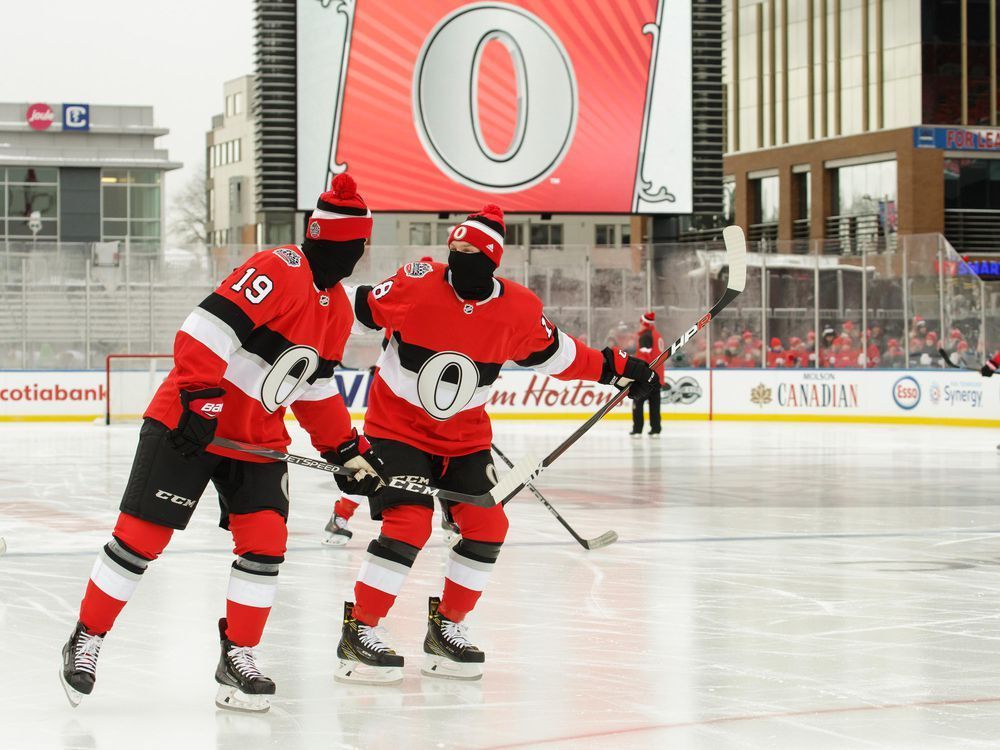
The glitches that marred the NHL’s debut seem like mere footnotes now, as the world’s premier hockey league celebrates its 100th anniversary with an outdoor game Saturday evening between the Montreal Canadiens and host Ottawa Senators.

Amid the humble beginnings, few could have foreseen the days of multimillion-dollar contracts, instant replays and franchises in Florida.

As a bloody war raged in Europe, the four-team NHL’s first games took place Wed., Dec. 19, 1917. The Canadiens took on an early incarnation of the Senators in Ottawa, while the Toronto Arenas played the Wanderers in Montreal.

The daily newspapers of the time, and their anonymous scribes, dutifully recorded the colour and chaos of the league’s emergence from the ashes of the National Hockey Association, alongside advertisements for gramophones, dyspepsia tablets and handkerchiefs.

Ottawa dominated the Canadiens in the final NHA season, winning six of seven matchups. But for their first NHL meeting, the Senators were missing top scorer Frank Nighbor, an enlisted airman whose military commitment kept him off the ice. The “Pembroke Peach” would go on to win several Stanley Cups with the Ottawa team.

One of his descendants, Derek Nighbor, plans to be at Ottawa’s TD Place Stadium for the NHL 100 Classic game with his brother and nephew, sporting their heritage Sens jerseys emblazoned with Frank’s No. 6.

“Our family’s pretty proud of the connection,” he said. “It’s not only the Nighbor name, but it’s Pembroke. Still today, with our Junior ‘A’ Lumber Kings, hockey is really central to life in the Ottawa Valley.”

The 1917 edition of the Senators had another headache on opening night: contract disputes meant several players were signed at the eleventh hour, and two — Jack Darragh and Hamby Shore — even missed the first part of the game.

Canadiens sharpshooter Joe Malone scored three times in the first period, and Montreal led 5-3 heading into the third.

Ottawa forced the play, but “it was useless, what looked like sure goals being missed by overskating the puck, missing passes and poor shooting,” the Ottawa Journal reported.

Montreal won 7-4. Ottawa might have fared better if it had begun the game at full strength, said the Journal, adding the fact the ice became “very sticky” near the end of the game “may have had a lot to do with their poor work here.”

The Daily Star confidently predicted the hometown Torontos, as the team was known, “should win in a walk” over the Wanderers, though the paper later acknowledged the Montreal roster was “not as weak” as player-coach Art Ross — future namesake of the league scoring trophy — “would have it believed.”

The Wanderers president invited soldiers who had been injured overseas to attend the Montreal Arena as honoured guests. Even so, the Montreal Gazette noted the turnout of 700 was “one of the smallest crowds” to see a season opener and “many of the well-known patrons of the game were missing.”

A Star story concluded the contest was certainly a first-of-the-season affair, as “the hockey was pretty rough in spots.”

“Torontos showed plenty of speed and dash on the attack, but were weak on the defence.”

The Arenas’ goaltending also failed to impress, with starter Sammy Hebert chased from the net in favour of Art Brooks.

“Sammy Hebert couldn’t stop a flock of balloons,” a fan told the Star.

One reporter considered the Wanderers lucky to outlast the Torontos, as Montreal faded in the late going, barely hanging on for a 10-9 victory.

No fewer than 20 minor penalties and two majors were handed out, said an account in the Ottawa Journal: “The game was not rough, but the players were irritable.”

Wanderers centre Harry Hyland — who scored five goals — suffered the only injury, when the puck bounced off his own goalie’s stick and “struck him a terrific smash fair in the eye, knocking him out.”

The Montreal arena burned down just weeks later and the Wanderers disbanded. In the playoffs, Toronto defeated the Canadiens for the league championship.

The season was notable for a major rule change in January 1918, allowing goalies to drop to the ice to stop the puck.

The league also tried to stay a stride ahead of sneaky fans by providing referees with special new whistles, preventing people in the crowd from stopping play by blowing the same type used by officials.

“They are really wonders in their way,” the Star noted. “When blown into from the centre their sound resembles something between the roaring of an infuriated bull and the summer night lullaby of the latter’s amphibious namesake, the bullfrog.”


Source link