Categories
Economic

China's Great Wall considers bid for Fiat Chrysler Jeep unit


Chinese SUV maker Great Wall Motors is considering making a bid to buy Fiat Chrysler’s Jeep unit, spokespeople for the company said Monday, in a possible ambitious new step onto the global stage for China’s fast-growing auto brands.

Great Wall has yet to formally declare its interest in Jeep, but a possible acquisition would be in line with chairman Wang Jianjun’s goal, announced in February, of becoming the top specialty SUV producer by 2020.

Great Wall “has this intention,” said the public relations director for its Haval SUV brand, Zhao Lijia, when asked about a report by Automotive News that the Chinese automaker wants to buy Jeep. An employee of the press office for the company headquarters, who would give only his surname, Zhang, said, “Yes, we are interested in Jeep.”

Zhao and Zhang said they had no other details when asked about a possible price. Zhao said it may take some time to assemble a formal bid.

Fiat Chrysler CEO Sergio Marchionne has said the company is for sale and cannot compete globally without a tie-up to a bigger partner due to the high costs of developing and marketing vehicles.

In a statement Monday, Fiat Chrysler Automobiles NV said it had not been approached by Great Wall.

Marchionne said in April that Jeep and Chrysler’s Ram truck brand are strong enough to stand alone. The company spun off its Ferrari brand in 2015 into a separate business.

Chinese companies in industries from autos to robots are spending billions of dollars to acquire brands and technology to strengthen their competitive position at home and speed their development.

Great Wall Motors Ltd., headquartered in Baoding, southwest of Beijing, is one of a series of independent Chinese automakers that have grown up alongside state-owned giants such as Shanghai Automotive Industries.

Expanding globally

If it goes ahead with a Jeep bid, Great Wall could become the second Chinese automaker, after Geely Holding Group, to expand onto the global stage by acquiring an established foreign brand.

Geely bought Sweden’s Volvo Cars from Ford Motor Co. in 2010 and has launched a third brand, Lynk & Co., as a partnership between Volvo and Geely’s Chinese brand.

In June, Geely bought a 49.9 per cent stake in Malaysian automaker Proton and a controlling interest in British sports car maker Lotus.

In 2011, a state-owned Chinese automaker, Dongfeng Motor Group, bought 14 per cent of France’s PSA Peugeot Citroen, Europe’s second-largest automaker.

Great Wall sold just under 1.1 million SUVs last year, behind Jeep’s 1.4 million. Its revenue of 98.6 billion yuan ($14.4 billion US) was a fraction of FCA’s global total of $118 billion US (111 billion euros), but its $1.5 billion US profit was almost equal to the Italian-U.S. automaker’s $1.8 billion US.

Great Wall also can draw on strong demand in China, the biggest auto market by units sold. Total SUV sales rose 16.8 per cent over a year earlier to 4.5 million in the six months ending in June.

Great Wall emerged from a collective founded in the 1980s to repair and customize vehicles. Wei, then 26, took control in 1990 and shifted into auto manufacturing. The company launched its first sedan in 1993 but narrowed its focus a decade ago to SUVs.

Wei said in February that the company’s “globalization strategy” included improving technology to meet U.S. safety standards. But he gave no indication when Haval might export to the United States or major European markets such as Germany.

Source link

Categories
Economic

Wholesale trade declines in June after 8 months of gains


To encourage thoughtful and respectful conversations, first and last names will appear with each submission to CBC/Radio-Canada’s online communities (except in children and youth-oriented communities). Pseudonyms will no longer be permitted.

By submitting a comment, you accept that CBC has the right to reproduce and publish that comment in whole or in part, in any manner CBC chooses. Please note that CBC does not endorse the opinions expressed in comments. Comments on this story are moderated according to our Submission Guidelines. Comments are welcome while open. We reserve the right to close comments at any time.

Submission Policy

Note: The CBC does not necessarily endorse any of the views posted. By submitting your comments, you acknowledge that CBC has the right to reproduce, broadcast and publicize those comments or any part thereof in any manner whatsoever. Please note that comments are moderated and published according to our submission guidelines.


Source link

Categories
Economic

Trump gets the headlines but NAFTA talks face a Mexican deadline: Don Pittis


President Donald Trump’s braying about NAFTA being the “worst trade deal maybe ever signed anywhere” might leave the impression that U.S. negotiators have all the cards in the current renegotiation.

But according to Canadian trade experts the real wild card is not the United States or the hostile views of its president.

Instead, an inflexible Mexican deadline has transformed the normal process for talks that began last week in Washington.

America First

And despite the “America First” rhetoric, the president’s recent falling out with the U.S. business sector may actually mean that failure to get a deal by that deadline would be a further serious blow to the Trump administration. 

Public posturing by politicians in advance of any talks is an accepted part of the process, says negotiating expert Chi Carmody, sort of like boasting before a prizefight, except that voters take the place of the boxing fans.

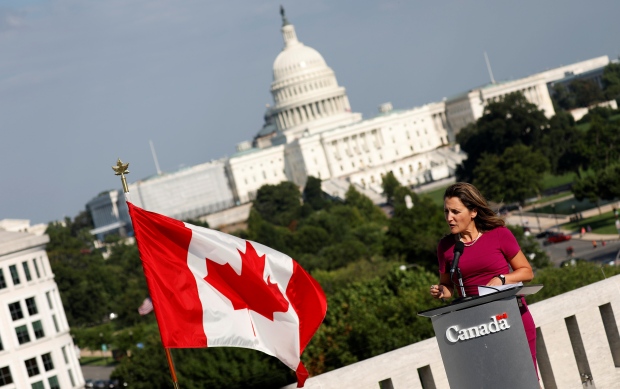
Canadian Foreign Minister Chrystia Freeland speaks in Washington at the Canadian embassy as NAFTA renegotiations were about to begin. (Aaron P. Bernstein/Reuters)

“The rhetoric is always important for those of us at home, but I think it does cast a shadow in the negotiations and may signal where it is that the parties may be just not prepared to go,” says Carmody, a Western University professor who is Canadian head of the Canada/U.S. Law Institute and has taught international business negotiations courses to lawyers.

He says the fact that Prime Minister Justin Trudeau has said in public that he would walk away from the talks rather than give up the dispute settlement mechanism, for instance, draws a line in the sand.

All the experts I talked to said that while there are still anti-free-trade voices coming from the U.S., including Trump appointee Peter Navarro, author of Death by China: Confronting the Dragon — A Global Call to Action, they are in a minority.

The most important players on all sides are anxious to get a deal.

NAFTA 2.0

That includes the U.S. Congress, which faces the lobbying efforts of farmers and business leaders who would be seriously damaged by failure to hammer out a NAFTA 2.0.

Andrea Bjorklund, an expert in international arbitration and commercial law, says there is plenty of room to find a deal that Canada, the U.S. and Mexico can live with. She says many of the issues on the table now were already worked out under the Trans-Pacific Partnership that Trump rejected early in his presidency.

“What you could say is that we already had a modern renegotiated NAFTA, and it was TPP,” says Bjorklund, who used to work for the U.S. State Department and is now a law professor at McGill University.

VIRGINIA-PROTESTS/

Relations between U.S. President Donald Trump and the business community have been corroded by his position on neo-Nazi violence that caused some business leaders to step down as presidential advisers. (Kevin Lamarque/Reuters)

But the process for reaching those mutual interests has been completely turned on its head this time, according to Meredith Lilly, the influential public policy analyst who was foreign affairs and international trade adviser to former prime minister Stephen Harper.

She says that’s because of the Mexican calendar.

“I think it’s something the Canadian side in particular may not fully appreciate,” says Lilly, who now holds the Simon Reisman Chair at Ottawa’s Carleton University. Reisman was Canada’s chief negotiator for the very first Canada-U.S. free trade agreement.

The issue is that starting next year, Mexico heads into what could be a divisive general election, and the current pro-business government faces a serious left-wing challenger. 

She says that while the new Mexican president won’t take office until December 2018, anti-American political posturing, including by the the party currently in power, will likely begin in the new year.

Coming out hard against Trump

“The closer they get to the electoral cycle, the more likely the Mexicans are going to come out hard against Donald Trump and his administration as part of an election tactic,” says Lilly. 

Due to Mexico’s term limits, President Enrique Pena Nieto, who has developed a strained modus vivendi with Trump, will not have the incumbent’s advantage.

“If the left-leaning populist candidate Lopez Obrador is elected there is some chance that NAFTA negotiations won’t resume at all,” says Lilly.

By tradition, negotiations where the parties want to come to a happy outcome begin with the easy things and work up. But because of the pressing Mexican deadline, says Lilly, things have turned around. Negotiators have opened with what are among the toughest trade issues, automobiles and rules of origin.

TRADE-NAFTA/

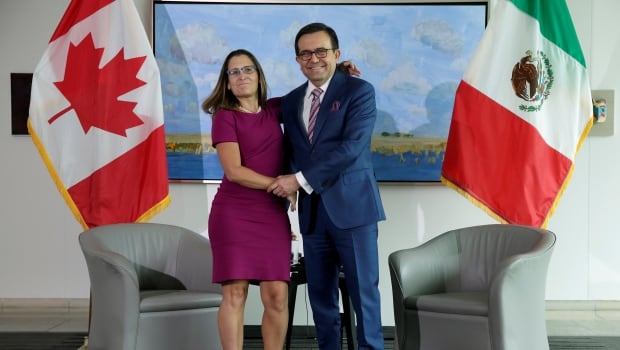
Freeland poses with Mexican Secretary of Economy Ildefonso Guajardo Villarreal before the first round of NAFTA talks. (Joshua Roberts/Reuters)

“Resolving the toughest issues is always going to wait until the end but the fact that they’re talking about them at the beginning signals to me that the Americans realize that they could be put in a [difficult] position because of the Mexican calendar,” says Lilly.

She says she objects to all the talk of walking away, and she says a lot of Canadians could be hurt if negotiations collapse.

But according to Carmody, pressure to close the deal by Christmas could be in Canada’s interest.

He says Canada did not ask for this renegotiation and without it, Canada still has NAFTA with Mexico, a deal with Europe, the TPP with Japan and membership in the World Trade Organization.

If Canada doesn’t get what it needs, the country could just say “Thank you very much. We tried it. ‘Bye,” says Carmody.

“I think that sort of situation would leave the Trump administration with a lot of egg on its face.”

Follow Don on Twitter @don_pittis

More analysis from Don Pittis


Source link

Categories
Economic

First round of NAFTA talks wrap in Washington


Canada, the United States and Mexico wrapped up their first round of talks Sunday to revamp the NAFTA trade pact, vowing to keep up a blistering pace of negotiations that some involved in the process said may be too fast to bridge deep differences.

In a joint statement issued at the end of five days of negotiations in Washington, the top trade officials from the three countries said Mexico would host the next round of talks from Sept. 1 to 5.

The talks will move to Canada later in September, then return to the United States in October, with additional rounds planned for later this year, U.S. Trade Representative Robert Lighthizer, Mexican Economy Minister Ildefonso Guajardo and Foreign Affairs Minister Chrystia Freeland said.

“While a great deal of effort and negotiation will be required in the coming months, Canada, Mexico and the United States are committed to an accelerated and comprehensive negotiation process that will upgrade our agreement,” the officials said.

One person directly involved in the talks described the schedule as exceedingly fast, given that past trade deals took years to negotiate.

At the day of the five days of talks, the countries’ top trade officials announced Mexico would host the next round of talks from Sept. 1 to 5. (Judi Bottoni/Associated Press)

The three countries are trying to complete a full modernization of the 23-year-old North American Free Trade Agreement by early 2018, before Mexico’s national election campaign starts.

U.S. President Donald Trump has threatened to scrap NAFTA without major changes to reduce U.S. goods trade deficits with its North American neighbours, describing it as a “disaster” that drained hundreds of thousands of American manufacturing jobs to low-wage Mexico.

The joint statement said the three countries made “detailed conceptual presentations” across the scope of NAFTA issues and began work to negotiate some of the agreement’s texts, although it did not provide details on the topics.

Negotiating teams “agreed to provide additional text, comments or alternate proposals during the next two weeks,” ahead of the Mexico round.

Not all cards on the table

The source involved in the talks, who was not authorized to speak to Reuters publicly, said there had been no drama as the three countries exchanged proposals.

Not all cards were put on the table, the source added, saying that during four four-hour sessions on rules of origin, the United States did not reveal its proposed targets for boosting North American and U.S. content for the automotive sector.

Lighthizer had made clear that strengthening rules of origin for autos — the biggest source of U.S. trade deficits — was one of his top priorities.

But the United States did reveal extensive texts governing cross-border data flows and e-commerce, said Kenneth Propp, the trade policy director for BSA-The Software Alliance, a group on the U.S. trade representative’s advisory committee.

NAFTA talks kick off

From left: U.S. trade representative Robert Lighthizer, Foreign Affairs Minister Chrystia Freeland, and Mexico’s secretary of economy, Ildefonso Guajardo Villarreal. (Aaron P. Bernstein/Reuters photos)

The NAFTA countries already had made broad agreements guaranteeing cross-border data flows and other digital trade as part of the now-defunct Trans-Pacific Partnership (TPP) agreement.

“Our sense is that there should be a lot of commonality as a starting point on this subject,” Propp said.

Trade experts have consistently said that the schedule is far too ambitious, given the amount of work and differences on key issues.

“It’s hard to imagine how they can do something very substantive and do it very quickly. It’s almost as if you can have one or the other,” said John Masswohl, director of government relations at the Canadian Cattlemen’s Association.

“You can have it quick, or you can have it meaningful.”


Source link

Categories
Economic

Broadway ticket-buying now easier for fans, not re-sellers


For longtime Bruce Springsteen fan Debbie Elster, there’s never been any doubt the competition to get tickets for his upcoming Broadway shows is going to be fierce.

But she’s feeling a little more hopeful, thanks to a new online verification system for ticket-buying that aims to keep more tickets in the hands of fans rather than re-sellers who seemingly snap them up and put them on the market, often for several times the face value.

Known as Verified Fan, the program from Ticketmaster requires people to register for a specific sale in advance, with information including their names, phone numbers and emails.

Identities verified

The registrations are reviewed, including past ticket purchase history and even social media accounts, with an eye toward determining whether they’re more likely to be event attendees.

Those accepted get unique codes that they can use when they go to buy tickets on the sale date.

The premise is that by vetting registrants, it’s more likely that actual fans would be the ones getting the first crack at hot tickets, instead of brokers and re-sellers.

“That makes me feel better,” said Elster, 66, a videographer who lives in Margate, Florida. “That makes me feel like I have a chance maybe, more of a chance than usual.”

Tickets for Springsteen’s show go on sale Aug. 30.

Tickets for Bruce Springsteen’s upcoming Broadway show, featuring songs from his career interspersed with readings from his memoir, will be sold using Verified Fan. (Matt Slocum/The Associated Press)

Getting more use

Verified Fan has been used for concert sales for artists such as Ed Sheeran and Harry Styles, and is now showing up for Broadway sales. Springsteen on Broadway, running from Oct. 3 to Nov. 26, is using the system, as is another show expected to be a hot prospect, Harry Potter and the Cursed Child, opening next spring.

The producers of the immensely popular Hamilton announced Tuesday that a new block of tickets for the show would go on sale through Verified Fan. That show has been the subject of a huge re-sale market, with tickets going for hundreds of dollars if not more than the face values.

Premium seats for Hamilton run as high as $849 US, with prices on the secondary ticket markets more than double that amount. While Hamilton has put aside a few digital lottery seats for $10, the average ticket last week went for $282.65.

Tickets and Technology

A theatre goer purchases a ticket to the Broadway show Hamilton in New York. The incredibly popular show announced this week that it would be the latest to offer up a new block of tickets for sale using Verified Fan. (Richard Drew/The Associated Press)

Making it fair

Those kinds of prices make Ayodele Williams, 44, of Philadelphia, outraged. She and her sister were in New York last week to see a performance of Hamilton, and they had tickets they consider themselves lucky to have snagged at face value last fall.

“It’s become so expensive and rigged,” Williams said. “If you have some kind of system or algorithm that allows you to buy all these tickets, you’re going to get them and then all you’re doing is re-selling. You’re not doing it for the love of the show really. You’re doing it for the love of the money.”

David Marcus, executive vice-president for Ticketmaster, said that was the point of the registration system: to give fans a better experience.

“It’s intended to make the initial distribution fairer,” he said, to fight against a system where brokers are the first ones out of the gate for tickets.

Re-sale has a role, he said, but it shouldn’t be the oversize one it’s playing.

He said so far the program has been working. Of the more than a million tickets distributed through Verified Fan since it began beta testing late last year, less than 5 per cent have gone onto the secondary re-sale market.


Source link

Categories
Economic

Eclipse eye safety and airline phone scams: CBC's Marketplace consumer cheat sheet


Miss something this week? Here’s the consumer news you need to know from CBC’s Marketplace. Get this in your inbox every Friday. Sign up here.

Protect your eyes during the eclipse

Planning on watching the eclipse Monday? Regular sunglasses won’t be enough to protect your eyes.

NASA suggests you make sure to have these specially-designed glasses. But watch out for fakes. One Vancouver woman who was giving away free glasses found out the hard way.

Back still sore? This could be why 

Lower back pain is experienced by most people at some point. (Evgeny Atamanenko/Shutterstock)

You might be taking a medication that some doctors are calling ineffective.

Patients are being prescribed anti-seizure and nerve pain medications for a common type of chronic low-back pain.

But a new review suggests there’s a lack of studies supporting the effectiveness of these off-label prescriptions.

That airline call is probably a scam

Alberta telephone scammers

RCMP in Alberta are warning of ongoing phone scams involving airlines. (Shutterstock/Gajus; Air Canada)

Heading off on a trip? The RCMP is warning people planning vacations to be extra careful about phone scams this summer.

Police say con artists are pretending to represent airlines like Air Canada and trying to get credit card information.

If you receive a suspicious call, Air Canada says you should hang up and call the airline’s official number.

The CIBC-PC Financial breakup

PC Financial ATM

President’s Choice Financial will no longer offer the kiosks and ATM machines after CIBC’s Simplii Financial begins service Nov. 1. (Nicole Ireland/CBC)

After 20 years together, CIBC and PC Financial are ending their banking collaboration. 

CIBC will swallow PC’s banking operations and will rebrand it as Simplii Financial. But it’s not the end for PC. It will keep its loyalty point program and branded MasterCard credit card. 

One financial expert says this isn’t necessarily a good or bad thing for consumers.

Fewer Canadians cutting cable

120722_kn04w_sports-television-manette_sn635-8col

About 100,000 Canadians cut their cable TV cord in the first half of this year, well below 2016’s mid-year pace. (Radio-Canada)

The pace of cord-cutting is slowing down for the first time in years.

A new report shows Canada’s biggest TV providers lost fewer cable customers in the first half of this year than the same time in 2016. But according to at least one expert, it’s not all good news.

Case in point: The number of cable subscribers is still declining thanks to streaming options and other services.

What else is going on?

That’s a lot of points: Pharmaprix, the name under which the Shoppers Drug Mart chain operates in Quebec, has agreed to pay more than two billion Optimum points to settle a lawsuit.

A lawyer is working to get certification for an $825-million class action lawsuit in Canada against Ford over transmission problems in some of its Focus and Fiesta models.

Ontario’s privacy commissioner is investigating after a man found the names, birth dates and health card numbers of 60 patients on the back of his wife’s prescription.

This week in recalls:

Watch what you eat. These raspberry mousse cakes were recalled due to norovirus and these chicken hot dogs may contain bone. Also, this toy hammer may crack and create a choking hazard, and this shampoo was recalled because it is contaminated and could cause infections in people with weak immune systems.

Real estate agents breaking the rules

[embedded content]

With bidding wars for houses cloaked in secrecy, how do you know your real estate deal wasn’t already rigged? Our hidden cameras catch some agents in the act. Watch it again on TV this weekend or online.


Source link