
U.S. President Barack Obama says the U.S. monitoring of Ebola must be “much more aggressive” and federal health teams must respond to future cases within 24 hours.
Obama says the second case of an infected nurse in Dallas highlights the need to ramp up efforts to confront the disease that has struck West Africa and has reached U.S. shores.
Obama spoke after meeting with top Cabinet officials involved in the Ebola response both here in the U.S. and in the West African region where the disease has been spreading at alarming rates.
Obama cancelled a political campaign trip to convene the session.
He said his administration is reviewing what happened in Dallas to ensure it doesn’t happen again.
Earlier, the White House strongly defended the government’s handling of the Ebola problem after it became clear that a second Texas health-care worker who tested positive for the virus had travelled aboard a commercial airliner.
White House spokesman Josh Earnest said the government is showing “the kind of tenacious, adaptive response that’s required,” and that Americans should continue having confidence in the Obama administration.
But criticism grew of the administration’s handling of the situation.
Democratic Representative Sheila Jackson Lee of Texas told MSNBC that the U.S. Centers for Disease Control and Prevention needs to be more responsive, and Ohio Republican Senator Rob Portman tweeted that the government must be more proactive in the fight to prevent Ebola from spreading in the United States.
Not clear how 2nd nurse contracted virus
The worker at Texas Health Presbyterian Hospital in Dallas had taken a Frontier Airlines flight from Cleveland, Ohio, to
Dallas-Fort Worth on Monday, officials said.
Though it was not clear how the nurse contracted the virus, the case represented just the latest instance in which the disease that has ravaged one of the poorest corners of the earth — West Africa — also managed to find weak spots in one of the world’s most advanced medical systems.
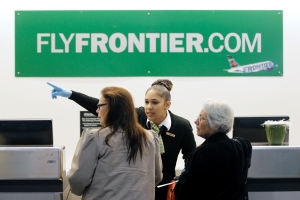
A Frontier Airlines employee directs passengers at Cleveland Hopkins International Airport. A health-care worker now infected with Ebola virus should not have flown on the commercial airline from Cleveland to the Dallas, the U.S. Centers for Disease Control and Prevention says. (Tony Dejak/Associated Press)
The second nurse was identified as 29-year-old Amber Joy Vinson. Medical records provided to The Associated Press by Ebola victim Thomas Eric Duncan’s family showed she inserted catheters, drew blood and dealt with Duncan’s body fluids.
Duncan, who was diagnosed with Ebola after coming to the U.S. from Liberia, died Oct. 8.
Kent State University in Ohio, where three of Vinson’s relatives work, confirmed she was the latest patient.
Even though the nurse did not report having a fever until Tuesday, the day after she returned home, she should not have boarded an airliner after learning that another nurse, Nina Pham, had been diagnosed with Ebola, government officials said Wednesday.
Unlikely other plane passengers at risk
Dr. Tom Frieden, director of the Centers for Disease Control and Prevention, said no one else involved in Duncan’s care will be allowed to travel “other than in a controlled environment.”
Infected Ebola patients are not considered contagious until they have symptoms. Frieden said it was unlikely that other passengers or airline crew members were at risk because the nurse did not have any vomiting or bleeding.
Even so, the CDC is alerting the 132 passengers aboard Frontier Airlines Flight 1143 from Cleveland to Dallas-Fort Worth on Monday “because of the proximity in time between the evening flight and first report of illness the following morning.” Officials are asking them to call the health agency so they can be monitored. The woman flew from Dallas to Cleveland on Oct. 10.
Kent State said it was asking the workers related to Vinson to stay off campus for 21 days “out of an abundance of caution.”
The nurse reported a fever Tuesday and was in isolation within 90 minutes, Dallas County Judge Clay Jenkins said.
“We are looking at every element of our personal protection equipment and infection control in the hospital,” said Dr. Daniel Varga, chief clinical officer for Texas Health Resources, which operates Texas Health Presbyterian Hospital Dallas.
On mobile? Follow our Ebola liveblog here


