
The United Nations Security Council was holding a special session Tuesday to discuss the Ebola crisis as the WHO warned that the death rate had risen to 70 per cent, and in two months there could be up to 10,000 new cases a week.
WHO assistant director-general Dr. Bruce Aylward gave the grim figures during a news conference in Geneva. Previously, WHO had estimated the death rate at around 50 per cent.
Aylward said the 70 per cent death rate was “a high mortality disease” in any circumstance and that the UN health agency was still focused on trying to get sick people isolated and provide treatment as early as possible.
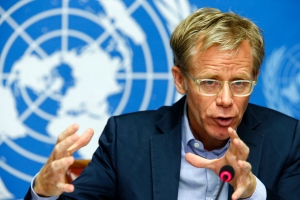
World Health Organization assistant director-general Bruce Aylward says strategies to combat Ebola such as handing out protective equipment to families and setting up basic clinics are a priority. (Pierre Albouy/Reuters)
He told reporters that if the world’s response to the Ebola crisis isn’t stepped up within 60 days, “a lot more people will die” and there will be a huge need to deal with the spiraling numbers of cases.
For the last four weeks, there’s been about 1,000 new cases per week — including suspected, confirmed and probable cases, he said, adding that the UN health agency is aiming to get 70 per cent of cases isolated within two months to reverse the outbreak.
By December 2014, Aylward said, 5,000 to 10,000 Ebola cases per week are anticipated in Guinea, Liberia and Sierra Leone, the agency tweeted.
Those numbers are based on modelling projections, said Dr. Margaret Harris, a spokeswoman for WHO in Freetown, Sierra Leone.
WHO raised its Ebola death toll tally Tuesday to 4,447 people, nearly all of them in West Africa, out of more than 8,900 believed to be infected. Aylward said calculating the death rate means tracking the outcomes of all possible patients — a complicated process since the numbers of cases are substantially under-reported and much patient data is missing.
Sierra Leone, Guinea and Liberia have been the hardest-hit nations in the current outbreak. Aylward said WHO was very concerned about the continued spread of Ebola in the three countries’ capital cities — Freetown, Conakry and Monrovia.
He said the agency was still focused on trying to treat Ebola patients, despite the huge demands on the broken health systems in West Africa.
“It would be horrifically unethical to say that we’re just going to isolate people,” he said, noting that new strategies like handing out protective equipment to families and setting up very basic clinics — without much treatment — was a priority.
Risks for health workers
In Berlin, a UN medical worker infected with Ebola in Liberia died despite “intensive medical procedures.” The St. Georg hospital in Leipzig said Tuesday that the 56-year-old man, whose name has not been released, died overnight of the infection.
In other news Tuesday, the international aid organization Doctors Without Borders said 16 of its staff members have been infected with the Ebola virus. Of these, nine have died.
Sharon Ekambaram, head of Doctors Without Borders in South Africa, told reporters in Johannesburg that medical workers have received inadequate assistance from the international community.
“Where is WHO Africa? Where is the African Union?” said Ekambaram, who worked in Sierra Leone from August to September. “We’ve all heard their promises in the media but have seen very little on the ground.”
Four of the organization’s medical workers who had just returned from Sierra Leone and Liberia said they were frustrated, said Jens Pederson, the aid organization’s humanitarian affairs adviser.
Pederson said it “is not rocket science” to manage Ebola, but basic infection control and protection, such as use of clean water, chlorine and soap to disinfect affected areas, are needed.
Meanwhile, Facebook CEO Mark Zuckerberg and his wife, Priscilla Chan, said they’re donating $25 million US to the CDC Foundation to help address the Ebola epidemic in Guinea, Liberia and Sierra Leone and elsewhere in the world where Ebola is a threat.
Last month, Microsoft co-founder Paul Allen announced a $9-million US donation to the effort.
Harris said they’re racing to bring in more people and beds but the limited air transport and shipping routes limit the ability to respond.
Source:: http://www.cbc.ca/news/health/un-security-council-tackles-ebola-crisis-1.2797782?cmp=rss


