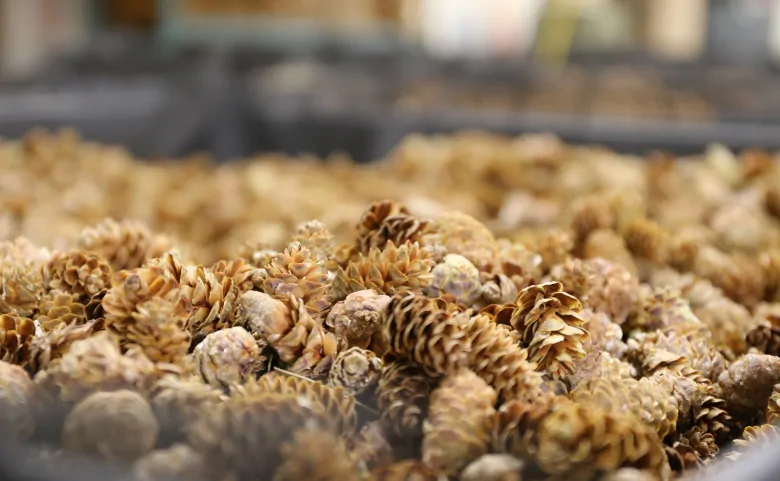
In a room 130 kilometres northeast of Edmonton sit bins of cones, thousands and thousands of cones, enough to produce 26 million tamarack, black spruce and white spruce trees.
“We are a part of the solution for the sustainability of forests and that’s really important to me,” Lee Charleson, manager of the Alberta Tree Improvement and Seed Centre in Smoky Lake, Alta.
Charleson is clear about what she thinks of trees, “[I] love them, they’re my favourite subject.”
Her staff tend to 640 acres of trees along with greenhouses, a concrete seed bunker and testing labs in the 40-year-old facility at the fore of reforestation in the province.
“What we’re actually looking for is their ability to grow well in height and diameter, in other words tree volume,” Charleson said.
The goal is to improve harvestable trees for timber and pulp production, while increasing resistance to insects, disease and climate change.
“When we start talking about climate change, the interest is also in how well they are adapted for drought hardiness or other properties for pest resistance, so there’s a number of new things we’re starting to explore.”
Dasvinder Kambo, applied tree physiologist, surveys the progress of the 400 trees in the black spruce seed orchard.
“Reading the language of nature is just very interesting to me,” Kambo said.
“Sometimes we plant them in trials around the geographic range that we’re curious about and other times we plant them in orchards with the objective that they grow, they’re healthy and ultimately they produce cones,” Kambo said.

Seed specialist Lindsay Robb works at the centre on a program helping to bring endangered Alberta species like whitebark pine and limber pine back from the brink.
“There’s just a lot of things against these guys, but they are considered a keystone species. They’re very important in their habitats, which is why we’re working to try and save them.”
Robb, who has been at the lab for eight years, believes the centre hidden away in the boreal forest is a hidden gem.
“Most people don’t actually know that we’re out here, they don’t really know what we do. I think people go out into the wilderness and they see trees and they think that they’ve always been there, but that’s truly not the case.”
You can see more from the Alberta Tree Improvement and Seed Centre on Our Edmonton Saturday at 10 a.m., Sunday at noon and 11 a.m. Monday on CBC TV.
