CBC News has learned former Ontario health minister Eric Hoskins will chair a federal government advisory council with a goal of creating a national pharmacare plan.
Hoskins announced his resignation as minister this afternoon without providing any details.
A federal government source has told CBC News the council’s mandate will be to “consult a wide range of stakeholders, provinces, territories, Indigenous groups and experts” and then provide the government with options on how to proceed with a national pharmacare program.
The advisory council has until 2019 to complete its job.
It’s expected the federal government will make the announcement during Tuesday’s budget.
“In leaving Queen’s Park, I am determined to continue building better healthcare for all Canadians,” said Hoskins in a statement. “That path and journey will become clearer in the days ahead.”
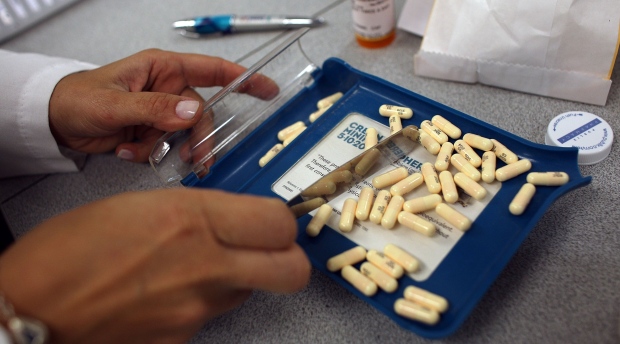
The parliamentary budget officer estimated that establishing a universal program for prescription medications would amount to about $4.2 billion in savings annually. (Joe Raedle/Getty Images)
Canadians currently pay among the highest prices for prescription drugs in the world. Canada is also the only country with universal health care that doesn’t include prescription drugs.
Pharmacare was part of the original plan for universal health coverage in 1964. While the Liberals endorsed pharmacare as a “long-term national objective” in their 1997 election campaign platform, the current government has said it will instead focus on trying to lower prescription drug costs.
Canadians are currently covered by a patchwork of public and private drug plans, while a minority pay completely out of pocket for their prescriptions.
Government-run plans cover about 40 to 45 per cent of Canadians, and are for the most part only available to seniors, Ontarians under 25, otherwise uninsured Quebecers, welfare recipients, Indigenous people and members of the RCMP and Canadian Forces.
When the committee asked the Parliamentary Budget Officer to research how much would be saved on prescriptions if Canadians were covered by these cheaper provincial drug plans, he concluded it would be $4.2 billion annually. That doesn’t include the cost to government of extending insurance coverage to everyone.
My statement: pic.twitter.com/PHF5btEjVN
Hoskins is a doctor and an officer of the Order of Canada. He was first elected as an MPP in 2009 in the Toronto riding of St. Paul’s. He ran for the Ontario Liberal Party leadership in 2013. Ontario Premier Kathleen Wynne appointed him economic development minister in her first cabinet, then made him her health minister after the 2014 election.
Hoskins is resigning as an MPP and won’t be running in the June provincial election.