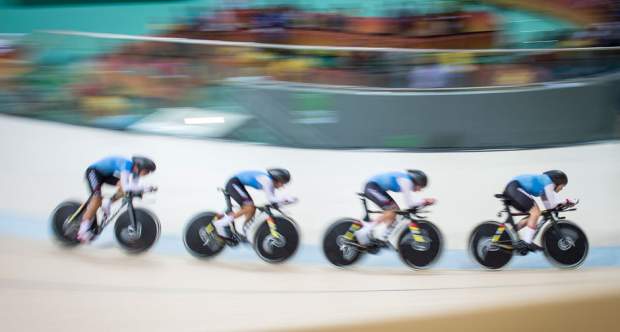
RIO DE JANEIRO — It was with about 600 metres or so left in their 4,000-metre race that Jasmin Glaesser, riding at the front of Canada’s cycling pack, spotted the New Zealand riders ahead of her.
And that meant one thing: medal.
In team pursuit, the duelling riders start on opposite sides of the track. In the bronze-medal race, Canada was facing New Zealand. They are racing the clock, ultimately, but if you get close enough around the velodrome’s insanely sloped track to see your opponents, that means you are definitely going faster than them. With the thighs screaming and the lungs burning, it is the ideal sight.
“I was able to see them, and to just know that we were riding to an Olympic medal, that’s a great feeling,” said Glaesser, after she and her teammates — Allison Beveridge, Kirsti Lay and Georgia Simmerling — secured the bronze with a ride of 4:16.629, breaking the Canadian record they had set earlier on Saturday in qualifying for the bronze-medal race. Canada was ahead of the Kiwis by six-10ths of a second at the 1,000-metre mark, and then they just kept pulling away — and chasing them down. At the end, they were almost four seconds faster than their opponents.
Great Britain won the team pursuit gold at a ridiculous 4:10.2, the third time in the competition they set a new world record, and more than three seconds faster than the world record time, held by Australia, coming into Rio 2016. The United States, which briefly held the world record in Saturday qualifying, took the silver at 4:12.4.
Glaesser, 24, who was on the bronze-medal-winning team in the same event at London 2012, said catching sight of New Zealand in the closing stretch helped with the finish.

“That’s that nice extra bit of motivation when it gets really tough,” she said.
“I think four years ago that medal was really a surprise to myself and to the program at the time, but it was a stepping stone for everything that has come since,” she said. “This program now is four years of hard work, of dedication by every single one of these girls, and to put it together on a day and when it matters, that’s an incredible feeling.”
It beats the feeling that sets in when you are three kilometres into a sprint, anyway.
“Oh my god, you go to very, very dark places on the track,” said Georgia Simmerling, 27. “It’s just pain. Just pain. It gets progressively worse, and then you go to a place where you just can’t feel anything.” She stopped there, seemingly thinking about the torture again for a moment. “Yeah,” she said. Like, what are you going do? It hurts like hell, but that’s what you have to do to be an Olympian. “Funny enough, the final ride hurt the least for me,” she said.
Simmerling had the most unusual journey of her teammates to the podium. An Olympian in alpine skiing in Vancouver in 2010, she switched to ski cross in 2011 and competed in that event in Sochi in 2014. But after breaking her wrist in a 2015 fall, she tried competitive cycling and only just made her World Cup debut last January. Now, the first Canadian to ever compete in three different sports in the Olympics, she is also a medallist.
“I really never thought this would be possible, and it’s just so amazing,” she said after the race. Considering the challenge that track cycling presents, it’s also oddly less punishing than some sports. “I mean, there’s no impact when you’re riding a bike,” Simmerling said. “It’s more, uh, what’s the word, nice on the joints, compared to skiing.”


She said she plans to go back to ski cross — upper body workouts start tomorrow, she said, apparently not kidding — and then back to cycling after that. Whatever works for you, kid.
Asked if she imagined an Olympic medal could come when she first got on a bike not that long ago, Simmerling didn’t even let the question finish,
“No,” she said. “No, not at all.”
“I was so shocked with our time today,” she said.
She also mentioned the team a lot after the race; the co-operation required in pursuit races, where each rider takes turns at the front of the pack, is a far sight from the solitary pursuit of ski racing.
“You need four riders,” Simmerling said. “Everyone plays a role in it, and puts their strengths on the line. There’s just something so powerful about that.”
And although she had already said quite a lot, Simmerling said she was “speechless” about getting onto a podium, after three Olympics and three disciplines.
“Just to be here with this team, it’s amazing,” she said. Then she added a line of compliment about her teammates, but it could stand for the whole Canadian Olympic effort so far, which has piled up 11 medals, all from women.

“These girls have taught me everything,” she said.
And the country is learning along with them.
sstinson@postmedia.com