The United Kingdom is deploying additional warships to the Strait of Hormuz, as world leaders urge de-escalation of tensions after a U.S. airstrike killed Iran’s military commander Qassem Soleimani and Iraqi militia leader Abu Mahdi al-Muhandis on Friday.
By ordering Friday’s airstrike on the commander of the Iranian Revolutionary Guard’s foreign legions, U.S. President Donald Trump has taken Washington and its allies, mainly Saudi Arabia and Israel, into uncharted territory in its confrontation with Iran and its proxy militias across the region.
Gholamali Abuhamzeh, a senior commander of Iran’s elite Revolutionary Guards, said Tehran would punish Americans “wherever they are in reach,” and raised the prospect of possible further attacks on ships in the Gulf, a key passage for oil tankers.
Defence minister Ben Wallace said in a statement that the Britain’s navy will accompany U.K.-flagged ships through the Strait of Hormuz to provide protection.
Wallace said he had ordered the warships HMS Montrose and HMS Defender to prepare to return to escort duties for all ships sailing under a British merchant flag.
“The government will take all necessary steps to protect our ships and citizens at this time,” he said.
Britain was forced to escort its ships through the world’s most important waterway for oil shipments for a time last year after Iranian commandos seized a British-flagged tanker in the Strait.
British forces had previously captured an Iranian oil tanker near Gibraltar that was accused of violating sanctions on Syria. The killing of Soleimani and al-Muhandis has raised fears that tankers could be targeted again.
Close U.S. ally Britain also urged all parties to show restraint, but said America was entitled to defend itself against an imminent threat.
Wallace said he had spoken to his U.S. counterpart Mark Esper, adding: “We urge all parties to engage to de-escalate the situation.
“Under international law the United States is entitled to defend itself against those posing an imminent threat to their citizens,” he added.
Germany seeks talks with Iran
Meanwhile, German Foreign Minister Heiko Maas has said he will seek direct talks with Iran to try to de-escalate tensions, a newspaper reported on Saturday.
“In the coming days, we will do all we can to counteract a further escalation of the situation — in the United Nations, the EU and in dialogue with our partners in the region, including in talks with Iran,” Maas told the Bild am Sonntag newspaper.
Maas told the paper he was in close contact with his British and French counterparts, with the European Union’s foreign affairs chief Josep Borrell and with U.S. Secretary of State Mike Pompeo.
On Saturday, Iraqi Prime Minister Adel Abdul Mahdi discussed the situation in Iraq and in the wider region with Saudi Crown Prince Mohammed bin Salman, his office said.

“Prime Minister Adel Abdul Mahdi received a phone call from the Kingdom of Saudi Arabia’s Crown Prince Mohammed bin Salman in which they discussed the difficult conditions facing Iraq and the region,” Abdul Mahdi’s office said in a statement.
“They exchanged points of view on the expected ramifications and the importance of mitigating their effects as well as avoiding total escalation.”
Mahdi on Saturday declared three days of national mourning for Soleimani, al-Muhandis, and others killed in the U.S. airstrike in Baghdad.
“Prime Minister and Commander in Chief Adel Abdul Mahdi orders the deceleration of national mourning for the souls of the martyrs for three days as of Saturday,” his office said in a statement.
U.S. Secretary of State Mike Pompeo on Saturday said he had spoken with Israeli Prime Minister Benjamin Netanyahu about the situation in Iran.
Netanyahu “and I just spoke and underscored the importance of countering Iran’s malign influence and threats to the region,” Pompeo said on Twitter.
.<a href=”https://twitter.com/IsraeliPM?ref_src=twsrc%5Etfw”>@IsraeliPM</a> <a href=”https://twitter.com/netanyahu?ref_src=twsrc%5Etfw”>@Netanyahu</a> and I just spoke and underscored the importance of countering Iran’s malign influence and threats to the region. I am always grateful for Israel’s steadfast support in defeating terrorism. The bond between Israel and the United States is unbreakable.
—@SecPompeo
The U.S. Embassy in Baghdad urged American citizens to leave Iraq following the strike at Baghdad airport that killed Soleimani. Dozens of American employees of foreign oil companies left the southern Iraqi city of Basra on Friday.
Global Affairs Canada is advising travellers of increased tensions in the Middle East, saying that the threat of attacks has increased. Canadians in the area are told to be extremely cautious.
The U.K. warned its nationals on Saturday to avoid all travel to Iraq, outside the autonomous Kurdistan region, and to avoid all but essential travel to Iran.
Thousands march in Baghdad
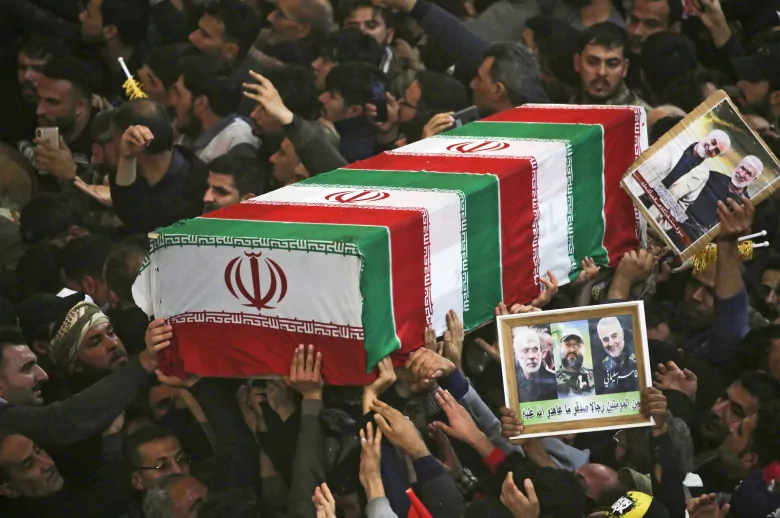
Amid talks of restraint, tens of thousands of people marched in Baghdad on Saturday to mourn Soleimani and al-Muhandis, killed in a U.S. airstrike that has raised the spectre of wider conflict in the Middle East.
Soleimani, a 62-year-old general, was Tehran’s pre-eminent military commander and — as head of the Quds Force, the foreign arm of the Revolutionary Guards — the architect of Iran’s spreading influence in the Middle East.
Muhandis was the deputy commander of Iraq’s Popular Mobilisation Forces (PMF) umbrella body of paramilitary groups.
An elaborate, PMF-organized procession carrying the bodies of Soleimani, Muhandis and other Iraqis killed in the U.S. strike took place in Baghdad’s heavily fortified Green Zone.

Mourners included many militiamen in uniform for whom Muhandis and Soleimani were heroes. They waved Iraqi and militia flags. They also carried portraits of both men and plastered them on walls and armoured personnel carriers in the procession, and chanted, “No No Israel” and “No No America.”
Mahdi and Iraqi militia commander Hadi al-Amiri, a close Iran ally and the top candidate to succeed Muhandis, attended.
Mourners later brought the bodies by car to the Shia holy city of Kerbala, south of Baghdad. The procession was to end in Najaf, another sacred Shia city where Muhandis and the other Iraqis will be laid to rest.
Soleimani’s body will be transferred on Saturday to the southwestern Iranian province of Khuzestan that borders Iraq. On Sunday it will be taken to the Shia holy city of Mashhad in Iran’s northeast and from there to Tehran and his hometown Kerman in the southeast for burial on Tuesday, state media said.
Many Iraqis also voiced fear of being engulfed in a major U.S.-Iranian conflict, and of militia reprisals against those involved in months of street protests against the Iranian-backed Baghdad government over alleged misrule and corruption.
‘Vital American targets’
In a separate development, several rockets fell Saturday on the Green Zone, its Jadriya neighourbood, and the Balad air base housing U.S. troops, the Iraqi military said, adding that there were no deaths. Police sources told Reuters five people were wounded when a mortar was launched inside Jadriya district.

Trump said on Friday that Soleimani had been plotting what he called imminent and sinister attacks on American diplomats and military personnel. Democratic critics of the Republican president said Trump’s order was reckless and that he had raised the risk of more violence in a dangerous region.
The U.S. strike followed a sharp increase in U.S.-Iranian hostilities in Iraq since last week when pro-Iranian militia attacked the U.S. Embassy in Baghdad following a deadly U.S. air raid on the Kataib Hezbollah militia, founded by Muhandis.
On Friday, Iranian Supreme Leader Ayatollah Ali Khamenei vowed harsh vengeance against the “criminals” who killed Soleimani and said his death would intensify the Islamic Republic’s resistance to the United States and Israel.
Abuhamzeh, the Revolutionary Guards commander in Kerman province, mentioned a series of possible targets for reprisals including the Gulf waterway through which a significant proportion of shipborne oil is exported to global markets.
“The Strait of Hormuz is a vital point for the West and a large number of American destroyers and warships cross there,” Abuhamzeh was quoted as saying on Friday evening by the semi-official news agency Tasnim.

“Vital American targets in the region have long since been identified by Iran … Some 35 U.S. targets in the region as well as Tel Aviv are within our reach,” he said, referring to Israel’s largest city.