Democrats accused the top Senate Republican Tuesday of rigging U.S. President Donald Trump’s impeachment trial with proposed rules that would prevent witnesses from testifying and bar evidence gathered by investigators.
Trump’s trial on abuse of power and obstruction of Congress charges begins in earnest in the Republican-controlled Senate on Tuesday in a rare use of the constitutional mechanism for ousting a president. The Democratic-led House of Representatives approved the charges last month on a party-line vote.
Senate Republican Majority Leader Mitch McConnell, who has vowed to co-ordinate the televised trial with the White House, proposed on Monday rules that would execute a potentially quick trial without new testimony or evidence.
He unveiled a resolution that would give House Democratic prosecutors and Trump lawyers 48 hours, evenly split, to present their arguments over four days. Opening arguments are expected to begin this week and could well run into each night.
Under the resolution, lawyers for Trump could move early in the proceedings to ask senators to dismiss all charges, a senior Republican leadership aide said, a motion that would likely fall short of the support needed to succeed.
Watch: How the impeachment trial may play out
“That is not a fair trial. In fact, it is no trial at all,” the seven House Democrats who will set out the case against Trump said in a statement on Tuesday.
“A White House-driven and rigged process, with a truncated schedule designed to go late into the night and further conceal the President’s misconduct, is not what the American people expect or deserve,” they wrote.
McConnell has repeatedly said the rules for the trial would mirror those the Senate used in the 1999 impeachment of then-President Bill Clinton, and Republican senators have not ruled out the possibility of further witness testimony and evidence.
Senate Democratic Minority Leader Chuck Schumer took great exception to the comparison during a morning news conference.
“The McConnell Rules are not even close to the Clinton Rules,” said Schumer, pointing to the compressed timeline for presenting evidence and the allowance of a dismissal motion at any point during the trial.
“McConnell wants a trial with no existing or new evidence,” he said.
Votes could take place as early as Tuesday afternoon on the rules, including deciding whether the Senate should at a later date consider subpoenas for witnesses, such as Trump’s former national security adviser John Bolton.
Schumer said he plans to offer amendments to subpoena White House records related to Ukraine policy in 2019. Democrats would need at least four Republicans to vote with them for any of their amendments to prevail.
‘Sham process’
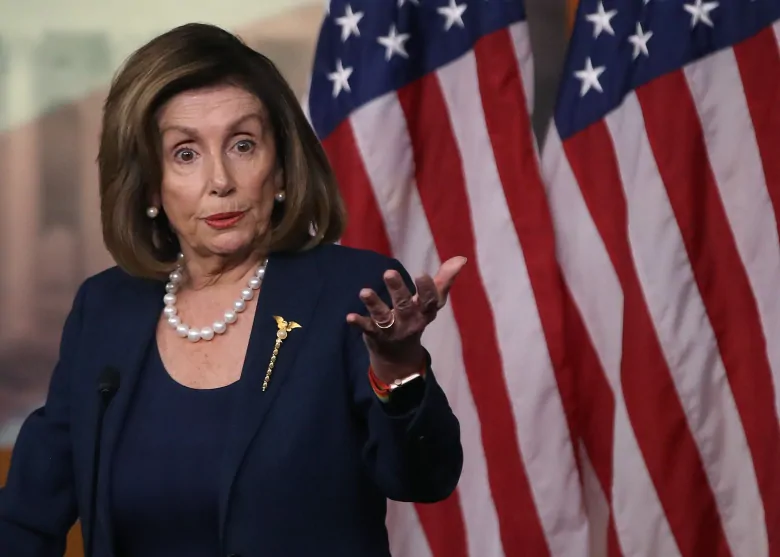
House Speaker Nancy Pelosi, in a statement, said the Republicans’ plan would force the trial into the “dark of night” and accused McConnell of choosing “a coverup for the president, rather than honour his oath to the Constitution.”
“Every Senator who supports this sham process must be held accountable to the American people,” added Pelosi, who formally kicked off the House impeachment investigation in September.
Republican Senator John Cornyn said on Twitter that the House’s investigation had been “tainted and half-baked” and that Democrats were to blame for any issues in the Senate trial.
The Senate proceedings began shortly after 1 p.m. ET and the trial is expected to continue six days a week, Monday through Saturday, until at least the end of January.
Democrats accuse Trump of pressuring a vulnerable ally to interfere in U.S. elections at the expense of American national security and say he needs to be removed from office because he is a danger to American democracy and national security.
At the heart of the impeachment trial is Trump’s request to Ukraine in July to investigate Joe Biden, a top Democratic contender to face Trump in the 2020 election, and his son Hunter. The younger Biden served on the board of a Ukrainian energy company for a period that included over two years while his father was U.S. vice-president.
Trump also sought the announcement of a probe based on a discredited theory involving the hacking of Democratic computers ahead of the 2016 election, which have been attributed by the U.S. intelligence community and a Republican-led Senate as being the work of Kremlin-connected Russian actors.
Democrats charge that Trump withheld nearly $400 million in aid to Ukraine that had been approved by the Pentagon and Congress, with the money only released as it became public knowledge that a whistleblower had lodged a complaint after Trump’s July 25 phone call with Ukraine’s president Volodymyr Zelensky.
Lawyer has conflict, Democrats say
Trump and his legal team, which includes White House counsel Pat Cipollone, say there was no pressure and that the Democrats’ case is based on hearsay. They say the president did nothing wrong and that Democrats are simply trying to stop him from being re-elected.
In a separate letter on Tuesday, the seven House Democratic “managers” prosecuting the case demanded that Cipollone disclose any first-hand knowledge he has of evidence he will present in the Senate’s impeachment trial, calling him a material witness.

The obstruction of Congress charge relates to Trump directing administration officials and agencies not to comply with House subpoenas for testimony and documents related to impeachment.
Trump has sought to rally his base with the impeachment issue, fundraising off it and at raucous election rallies painting himself as the victim of a witch hunt.
Trump is attending the annual gathering of world business leaders in Davos, Switzerland, on Tuesday to project an air of business as usual and tout the strength of the U.S. economy.
Asked whether Trump was planning to watch the trial, White House press secretary Stephanie Grisham said, “He has a full day here in Davos, but will be briefed by staff periodically.”
This is only the third impeachment trial in U.S. history. No president has ever been removed through impeachment, a mechanism the nation’s founders — worried about a monarch on American soil — devised to oust a president for “treason, bribery or other high crimes and misdemeanors.”
Bill Clinton, like Andrew Johnson in the 19th century, was acquitted in the Senate, while Richard Nixon resigned in 1974 before a full House vote on articles of impeachment could occur.
With a two-thirds majority needed in the 100-member Senate to remove Trump from office, he is almost certain to be acquitted by fellow Republicans in the chamber. But the impact of the trial on his re-election bid is far from clear.
“If the Senate permits President Trump to remain in office, he and future leaders would be emboldened to welcome, and even enlist, foreign interference in elections for years to come,” Democrats wrote in a pre-trial document over the weekend, making the case for his removal.
Watch: The battle over what testimony will be allowed in the Senate
Trump’s legal team, in their pre-trial brief on Monday, accused Democrats of using impeachment as a “partisan, election-year political tool” and said the Senate should move speedily to acquit him.
Trump, 73, has gone through a succession of controversies since taking office in January 2017.
Pelosi had previously resisted pressure from her party’s left flank to take the step after special counsel Robert Mueller spelled out instances in which Trump sought to impede the federal inquiry that documented 2016 Russian election interference to boost Trump’s candidacy.