The trial of a man with epilepsy who’s been charged with assaulting a police officer and resisting arrest was delayed Monday after he told court his lawyer had quit.
But his case may not go to trial at all.
Neil Ryley is accused of head butting an Edmonton police officer in June 2016 after his wife called 911 for help with her husband who can become violent during seizures.
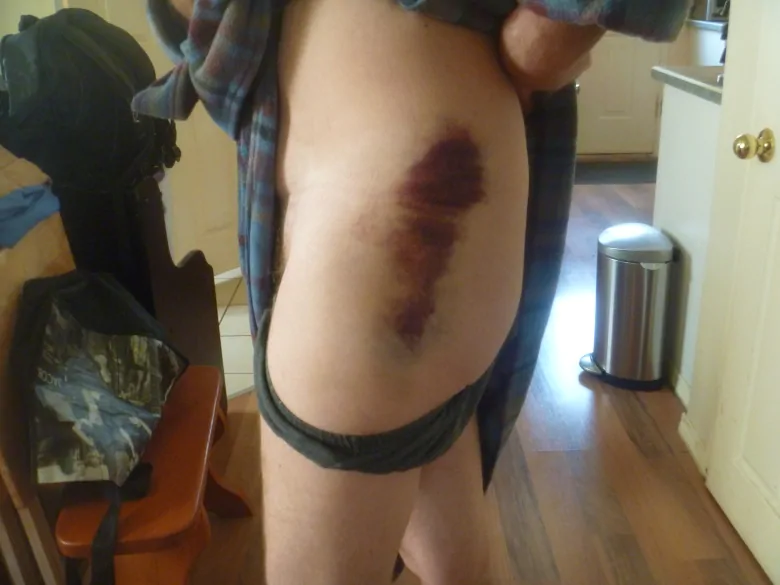
An officer’s nose was broken and Ryley suffered bruises to his hip, legs, arms, face and abdomen in an altercation that followed.
“They couldn’t control me. Because I couldn’t control myself,” Ryley said Monday outside the Edmonton courthouse. “No idea what I was doing.”
“I’m just out of my mind when I’m having seizures,” Ryley said. “It’s hard.”
Ryley’s trial was earlier adjourned in the fall of 2018 because he was in the hospital undergoing surgery.
Then in mid-December his lawyer quit, Ryley said Monday outside the Edmonton courthouse.
“He basically indicated to me he didn’t have much experience dealing with cases like this,” Ryley said. “He was more than willing to just give me my money back and tell me to seek other counsel. But this was three weeks before I had to be in court.”
Ryley said he didn’t have time to find a new lawyer, so he went to court Monday morning with the head of the Edmonton Epilepsy Association to act as his advocate.
Gary Sampley provided a letter to the Crown that led prosecutor Maxine Bond to tell the judge there may be “an air of reality” to the defence.
Justice Susan Bercov called the case novel and complicated, one that would require the assistance of a defence lawyer to be argued.
“In this defence you want to raise, unlike most cases, the burden will be on you to prove on a balance of probabilities the defence,” Bercov said. “So you’re going to have to bring forward evidence, some of it expert evidence.”
Ryley assured Bercov he planned to find a new lawyer quickly. An adjournment was granted and the case will go back to court Jan. 24 to set a new trial date.
But the trial may not go ahead at all, Bercov said.
The judge was told that Ryley’s neurologist Dr. Donald Gross recently published a peer-reviewed report about Ryley’s case.
Bercov said if that report is provided to the Crown she would be willing to re-evaluate the case.
The article, published online in Epilepsy and Behavior Reports, was located by CBC News even though Ryley’s name is not used.
The neurologist refers to Ryley’s aggressive and violent behaviour following epileptic seizures as “undirected and unintentional, but was exacerbated when attempts were made to restrain or control him.”
The doctor makes reference to Ryley assaulting a police officer, his subsequent arrest and the difficulty of dealing with ongoing episodes of violence following seizures.

Gross placed Ryley on a blood pressure medication, which controls his psychosis while he’s having seizures, and noted there have not been any episodes of aggression or violence in more than two years.
The head of the Edmonton Epilepsy Association hopes once the Crown reviews the published report by Gross, she may be willing to stay the charges against Ryley.
“Somebody who has a medical condition should not be further penalized by the law for something they are not responsible for,” Sampley said outside court.
Ryley told the judge, “I’d like to stay out of jail for this because this epilepsy is enough of a punishment for me.”