Global powers are warning that the world has become a more dangerous place after U.S. President Donald Trump ordered the targeted killing of Iran’s top general and are urging restraint on all sides.
Iran has vowed “harsh retaliation” for a U.S. airstrike near Baghdad’s airport that killed Gen. Qassim Soleimani, the head of Iran’s elite Quds Force and the architect of its interventions across the Middle East, as tensions soared in the wake of the targeted killing.
The killing of Soleimani marks a major escalation in the standoff between Washington and Iran, which has careened from one crisis to another since Trump withdrew from the 2015 nuclear deal and imposed crippling sanctions.
“We are waking up in a more dangerous world. Military escalation is always dangerous,” France’s deputy minister for foreign affairs, Amelie de Montchalin, said on RTL radio. “When such actions, such operations, take place, we see that escalation is underway.”
Montchalin indicated that urgent reconciliation efforts are being launched behind the scenes. French President Emmanuel Macron and his foreign minister were reaching out to “all the actors in the region,” she said.
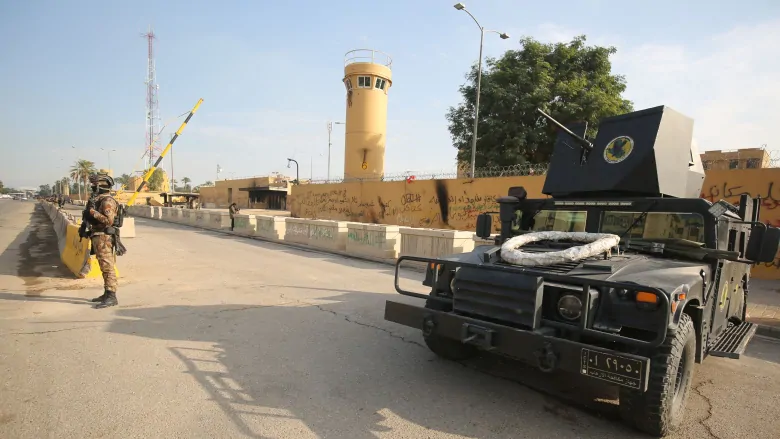
The United States urged its U.S. citizens to leave Iraq “immediately.” The State Department said the embassy in Baghdad, which was attacked by Iran-backed militiamen and other protesters earlier this week, is closed and all consular services have been suspended.
Around 5,200 U.S. troops are based in Iraq, where they mainly train Iraqi forces and help to combat Islamic State militants.
Iran’s Supreme Leader Ayatollah Ali Khamenei warned that a “harsh retaliation is waiting” for the U.S. after the airstrike, calling Soleimani the “international face of resistance.” Khamenei declared three days of public mourning for the general’s death.
Khamenei also appointed Soleimani’s deputy, Brig.-Gen. Esmail Ghaani, to replace him as head of the country’s Quds Forces, Iranian media reported.
The force’s program “will be unchanged from the time of his predecessor,” Khamenei said in a statement published by state media.
Iran summoned the Swiss charges d’affaires, who represents U.S. interests in Tehran, to protest the killing. Iran’s Foreign Minister Mohammad Javad Zarif called the strike “an act of state terrorism and violation of Iraq’s sovereignty.”
The killing, and any forceful retaliation by Iran, could ignite a conflict that engulfs the whole region, endangering U.S. troops in Iraq, Syria and beyond. Over the last two decades Soleimani had assembled a network of heavily armed allies stretching all the way to southern Lebanon, on Israel’s doorstep.
Oil prices surged on news of the killing and markets were mixed.
Russia criticizes killing, U.K. urges de-escalation
Russia’s Foreign Ministry condemned the killing of Soleimani and said it will increase tensions throughout the Middle East. An unnamed diplomat in the ministry told Russia’s state-run news agency TASS they consider the killing “an adventurist step.”
The head of the foreign affairs committee in Russia’s upper parliament house called the U.S. airstrike “a mistake” that could “boomerang on its organizers.” Konstantin Kosachev in a Facebook post Friday said the move destroyed the last hope to resolve the issues around the Iran nuclear deal.
And “Iran may accelerate making a nuclear weapon now, even if it didn’t plan on doing it before,” Kosachev said.
China, meanwhile, said it is “highly concerned” and called for all sides, especially the U.S., to exercise “calm and restraint.”
China is a close Iranian ally and has been among the most active countries in defying U.S. attempts to isolate Iran and cripple its economy. Last month, its navy joined with those of Iran and Russia in first-ever joint drills in the Indian Ocean.
China is also a staunch opponent of the U.S. presence in Iraq.
Foreign Ministry spokesman Geng Shuang said Friday that China is calling for peace and stability in the Middle East as well as respect for Iraq’s independence and territorial integrity.
The spokesman added that “China has always opposed the use of force in international relations” and warned against the further escalation of tensions.
U.K. Foreign Minister Dominic Raab urged all parties to de-escalate after the airstrike. “We have always recognized the aggressive threat posed by the Iranian Quds force led by Qasem Soleimani. Following his death, we urge all parties to de-escalate. Further conflict is in none of our interests,” he said in an emailed statement to Reuters.
Soleimani’s death weakens Iranian capabilities, expert says
There was no immediate reaction from Israel, which views Iran as its greatest threat. Authorities closed the Mount Hermon ski resort near the borders with Lebanon and Syria as a precaution but didn’t announce any other security measures. Prime Minister Benjamin Netanyahu’s office said he was cutting short a trip to Greece to return home and follow “ongoing developments.”
For Iran, the killing represents the loss of a cultural icon who represented national pride and resilience while facing U.S. sanctions. While careful to avoid involving himself in politics, Soleimani’s profile rose sharply as the U.S. and Israel blamed him for Iranian proxy attacks abroad.
Yoel Guzansky, an expert on Iran at the Institute for National Strategic Studies, a prestigious Tel Aviv think tank, said the killing restored U.S. deterrence powers in the Middle East.
“I think the Iranians are shocked now, the Russians, the Chinese, no one would believe Trump would do that,” he said, adding that Iran, in the short run, was likely to retaliate against the U.S. or its allies, and possibly against Israel. But he said in the long run, the loss of Soleimani — who had also been on Israel’s radar for some time — would weaken Iran’s capabilities across the region.

As the head of the Quds, or Jersualem, Force of Iran’s paramilitary Revolutionary Guard, Soleimani led all of its expeditionary forces and frequently shuttled between Iraq, Lebanon and Syria. Quds Force members have deployed into Syria’s long war to support President Bashar Assad, as well as into Iraq in the wake of the 2003 U.S. invasion that toppled dictator Saddam Hussein, a longtime foe of Tehran.
While Iran’s conventional military has suffered under 40 years of U.S. sanctions, the Guard has built up a ballistic missile program. It also can strike asymmetrically in the region through forces like Lebanon’s Hezbollah and Yemen’s Houthi rebels.
In the Gaza Strip, the ruling Hamas militant group offered its “sincerest condolences” to Iran, saying Soleimani had “played a major and critical role in supporting Palestinian resistance at all levels.”
The Syrian government, which has received key support from Iran throughout the civil war, also condemned the strike, saying it could lead to a “dangerous escalation” in the region. Hassan Nasrallah, the head of the Iran-backed Lebanese militant group Hezbollah, released a statement mourning those killed in the U.S. strike, saying their blood was not wasted.
Unclear what legal authority U.S. relied on to carry out attack
The U.S. Defence Department said it killed Soleimani because he “was actively developing plans to attack American diplomats and service members in Iraq and throughout the region.” It also accused Soleimani of approving the orchestrated violent protests at the U.S. Embassy in Baghdad earlier this week.
The airport strike also killed Abu Mahdi al-Muhandis, deputy commander of Iran-backed militias in Iraq known as the Popular Mobilization Forces. A PMF official said the strike killed a total of eight people, including Soleimani’s son-in-law, whom he did not identify.
Trump was vacationing on his estate in Palm Beach, Fla., but sent out a tweet of an American flag.
It’s unclear what legal authority the U.S. relied on to carry out the attack. U.S. presidents claim broad authority to act without the approval of the Congress when U.S. personnel or interests are facing an imminent threat. The Pentagon did not provide evidence to back up its assertion that Soleimani was planning new attacks against Americans.
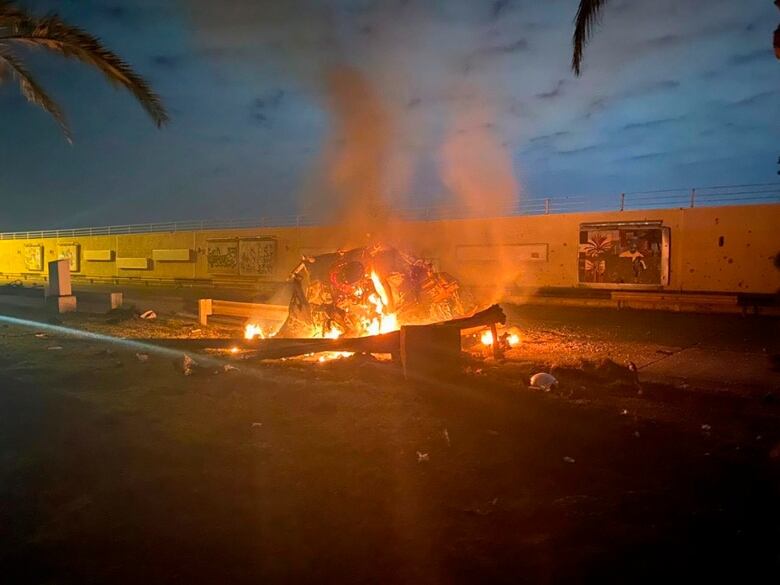
The killing promised to strain relations with Iraq’s government, which is closely allied with both Washington and Tehran. Prime Minister Adel Abdul-Mahdi condemned the strike as an “aggression against Iraq” and a “blatant attack on the nation’s dignity.”
He also called for an emergency session of parliament to take “necessary and appropriate measures to protect Iraq’s dignity, security and sovereignty” on Saturday, when funerals will be held in Baghdad for al-Muhandis, the militia commander, and the other slain Iraqis.
Iraq has been gripped by massive anti-government protests since October, partly against Iran’s influence over the country. But at least one protester, who asked not to be named for security concerns, said they “do not celebrate” the killing of Soleimani.
“America and Iran should solve their problems outside Iraq,” he said. “We do not want them to solve it inside Iraq, because this will not serve our cause.”