Discarded needles and other park debris could be no match for a new robot, if Sturgeon Composite High School students succeed in building their latest project.
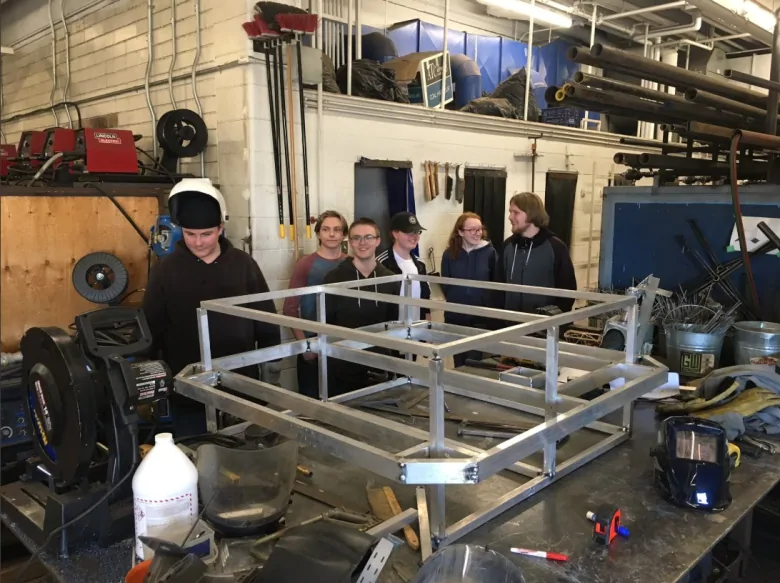
For months, a team of students from the rural school in northern Alberta, about 20 kilometres north of Edmonton, has been building a NASA Mars rover-inspired robot named Spirit Rover.
When it’s done, the autonomous machine should be able to scan the ground and systematically search for and dispose of hazardous objects like needles, condoms and broken bottles.
The extracurricular project began after a group of computing science students told veteran math teacher Kevin Hubick they wanted to build a large robot together.
After reading a news story about a young girl who was accidentally pricked with a discarded needle in a park, Hubick realized the students could potentially design a tool to prevent that from happening.
According to the City of Edmonton, the risk of getting sick after touching a used needle is very low. But having municipal employees pick up dangerous debris takes time and money, Hubick said Wednesday in an interview with CBC’s Radio Active.
“Robots are perfect for that. They don’t get tired. We can program them and as long as we’re very specific, they don’t make mistakes,” he said.
Hubick’s small group of three or four students has grown to include many more students and multiple teachers. A mechanical engineer has mentored the team and Edmonton-based Plastics Plus Ltd. has donated material.
A $5,000 award from the Association of Professional Engineers and Geoscientists of Alberta (APEGA) gave the team a huge financial boost last summer.
APEGA outreach coordinator Natalie Hervieux said Hubick’s application submitted to their Innovation in Education Awards was exciting because it blended engineering concepts with a real-world application.
“They’ll be able to create something that has an actual impact on the community,” she said.
Since the grant may not cover every expense, the team tries to make use of materials already on hand, like the robotic arm that was sitting in a discard pile at the school.
Harnessing and powering the arm has been one of the team’s biggest challenges so far. The computer and software it came with didn’t work, so students have been trying to reverse-engineer the arm and resolve numerous problems with encoders which measure how far the arm joints turn.
Brody has the first rover working!!! <a href=”https://t.co/jtjd1muXUH”>pic.twitter.com/jtjd1muXUH</a>
—@KevinHubick
Each hurdle, Hubick said, is a wonderful learning opportunity for his students, teaching them not only technical skills but the importance of perseverance, resilience, problem-solving and teamwork.
“All those big things that you don’t normally get in a textbook,” he said.
Despite all the struggles, students keep showing up, working on the robot every day at lunch, late on Thursday evenings and even on some weekend days.
Grade 12 student Shea Mullins said he finds the work fulfilling because he loves learning new skills while combining his interests in coding and design.
“I get a lot of joy out of it because I’m making something with my hands,” he said.
The team started working on the robot in June and are on track to finish it by the end of the school year.