It has been just over a month since House Speaker Nancy Pelosi announced Democratic Party-led committees were proceeding under the framework of an impeachment inquiry, focusing on Trump administration dealings with Ukraine.
The July 25 call between Donald Trump and Ukraine President Volodomyr Zelenksy and the events surrounding it are threatening to damage Trump’s presidency in a way allegations of Russian interference on his behalf did not.
Through a whistleblower complaint and known testimony in closed sessions in front of House committees so far, a narrative has emerged of an “irregular channel,” as one diplomat described it, of dealings with Ukraine led by Trump’s personal lawyer, Rudy Giuliani.
It has been alleged that Trump pressured Zelensky to investigate 2020 presidential candidate Joe Biden and his son, Hunter, who served on the board of Ukraine energy company Burisma, for corruption. As well, Trump wanted a probe into whether Ukraine, through cyber activities, had helped Hillary Clinton during the 2016 presidential election.
The larger question is whether nearly $400 million in Ukraine aid was withheld for months until the Zelensky administration committed to doing Trump’s bidding. A recap of testimony highlights so far:
Praise for Biden, warning about Guiliani
Kurt Volker, who resigned as special representative for Ukraine the day after the whistleblower’s complaint became public, revealed on Oct. 3 that he helped draft a statement for Zelensky committing Ukraine to investigate the Bidens.
Volker also said he told Zelensky while at a July 2 conference in Toronto that Giuliani had a negative perception of Ukraine’s corruption-fighting efforts and that it was likely influencing Trump’s views.
Volker characterized Biden as a “man of integrity” and said Trump once described Ukraine as full of “terrible people,” and that the country had “tried to take me down” in the 2016 election.
‘Concerted campaign’ to remove ambassador alleged
U.S. ambassador to Ukraine Marie Yovanovitch was removed from her post over two months before the July 25 call, during which Trump described her as “bad news,” and Zelensky agreed with that assessment “100 per cent.”
Yovanovitch said in her Oct. 11 opening statement that another official told her of a “concerted campaign” within the administration to remove her.
Other officials who’ve testified have praised her professionalism, with some lamenting the shoddy treatment they say she received from the administration.
Ukraine policy diverted to Giuliani
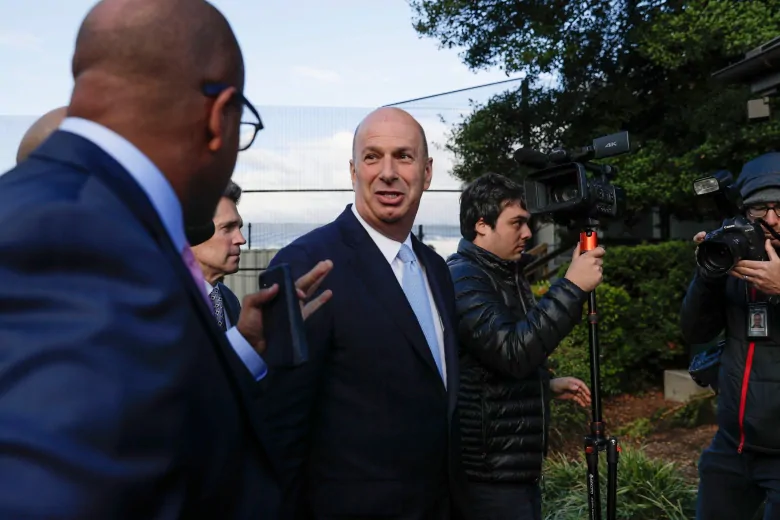
Gordon Sondland, Trump’s chosen ambassador to the European Union said on Oct. 17 it was apparent soon after Zelensky was elected in May that the president wanted Giuliani to be a point person on Ukraine policy.
Sondland’s lawyer told the Wall Street Journal in an Oct. 26 report that his client believed Trump’s pressure campaign amounted to a quid pro quo — Ukraine was to announce the twin probes Trump wanted in exchange for Zelensky getting a White House invitation.
Giuliani a ‘hand grenade’
Fiona Hill, former senior director for European and Russian Affairs on Trump’s national security council recounted a July 10 meeting in which Sondland raised the matter of investigations, which she and others took as a reference to a probe into the Bidens, a person familiar with her testimony, who spoke on condition of anonymity, told Reuters.
Multiple U.S. media reports indicated that Hill in her Oct. 14 appearance relayed that then-national security adviser John Bolton was appalled when learning of Giuliani’s efforts, referring to him as a “hand grenade who is going to blow everybody up.”
‘I think it’s crazy’
Bill Taylor, with some reluctance, became chargé d’affaires as essentially a replacement for Yovanovitch, who he spoke to before taking the role. Taylor levelled the most extensive publicly known allegations of a consistent pressure campaign on the Ukrainians to enable Trump’s investigations.
He described an unconventional group featuring Giuliani, Sondland and Energy Secretary Rick Perry become involved in Ukraine policy, with more traditional diplomats on the file being kept out of the loop of key calls and readouts.
“I think it’s crazy to withhold security assistance for help with a political campaign,” he texted other officials on Sept. 9, raising the possibility aid to Ukraine was being held until Zelensky agreed to investigate the Bidens.
Outside development
Two Eastern European associates of Giuliani, Lev Parnas and Igor Fruman, were formally accused on Oct. 9 of using a shell company to launder a contribution of more than $300,000 US to a Trump political action committee. Foreign donations are prohibited under U.S. law.
An indictment also alleges the duo were agitating for Yovanovitch’s ouster.
“Individuals who have been named in the press as contacts of Mr. Giuliani may well have believed that their personal financial ambitions were stymied by our anti-corruption policy in Ukraine,” Yovanovitch said in her statement to the House committees.
Volker testified he attended a July 19 breakfast meeting on Ukraine with Giuliani in which Parnas was present.
What’s next
A number of State Department and national security officials not recognizable to most Americans, such as Tim Cummings, scheduled for Oct. 31, will be heard from.
The National Security Council official may have had first-hand knowledge of the July 25 call given that he described it in less-than-stellar terms to Taylor. Cummings also described, according to Taylor, having a “sinking feeling” that a quid pro quo was being demanded by the U.S.
There are some high-profile names who say they won’t comply with subpoenas to appear: Giuliani, Perry and Mick Mulvaney, who serves as both Trump’s chief of staff and the head of the Office of Management and Budget. According to Taylor’s testimony, an OMB staffer on July 18 said that a hold on Ukraine aid had been directed by Trump and was to be overseen by Mulvaney.
Democrats have few good options to compel their appearances, as they found out with investigations concerning Trump officials and Russia. Seeking a remedy in court would take months and bleed into the 2020 election race.
In an ideal world, the Democrats would want to have forwarded their successful votes on articles of impeachment for a Senate trial to proceed in January, given that the Democrat primary race begins in earnest with voting in the Iowa caucuses on Feb. 3.

Bolton, who left the White House last month, has reportedly not ruled out testifying. That possibility would likely enrage Trump.
Ex-congressman Pete Sessions, who allegedly received cash from Parnas and Fruman to help lobby the administration to dump Yovanovitch, is said to be complying with document requests and could also appear.
Democrats have indicated public hearings will take place in a matter of weeks. It is, after all, in their best interests to try and build a groundswell of public opinion among Americans in favour of impeachment.
Nov. 21 deadline
Val Demings, part of the House intelligence and judiciary committees, said investigators should be able to wrap up their inquiry by December.
But there’s a big caveat — the government only has funding to remain fully open through Nov. 21.
“The concern is that if we vote on impeachment before December, Trump will refuse to sign the funding bills and shut down the government,” a Democratic congressional aide told Reuters.