The Democratic-controlled House of Representatives is set to take its first vote Thursday on the resolution that affirms the investigation into President Donald Trump and outlines the process for public hearings and possibly drafting articles of impeachment.
In a floor speech before Thursday’s vote, House Speaker Nancy Pelosi said, “This is not any cause for any glee or comfort.”
Standing next to a large U.S. flag in the well of the House, the top Democrat in the chamber said the impeachment inquiry was necessary to defend the Constitution and prevent an abuse of power by Trump.
“The times have found each and every one of us in this room,” Pelosi said. She urged lawmakers to vote in favour of the impeachment rules “to protect the Constitution of the United States. What is at stake in all of this is nothing less than our democracy.”
Republicans have said that the Democratic-run process has been secretive and tilted against them.
Democrats say their plan follows how impeachment efforts against then presidents Richard Nixon and Bill Clinton were run. The public impeachment hearings for Nixon took place after months of investigative work, and years in the case of Clinton’s impeachment.
The investigation is focused on Trump’s efforts to push Ukraine to investigate Democratic political rival Joe Biden by withholding military aid and an Oval Office meeting craved by the country’s new president.
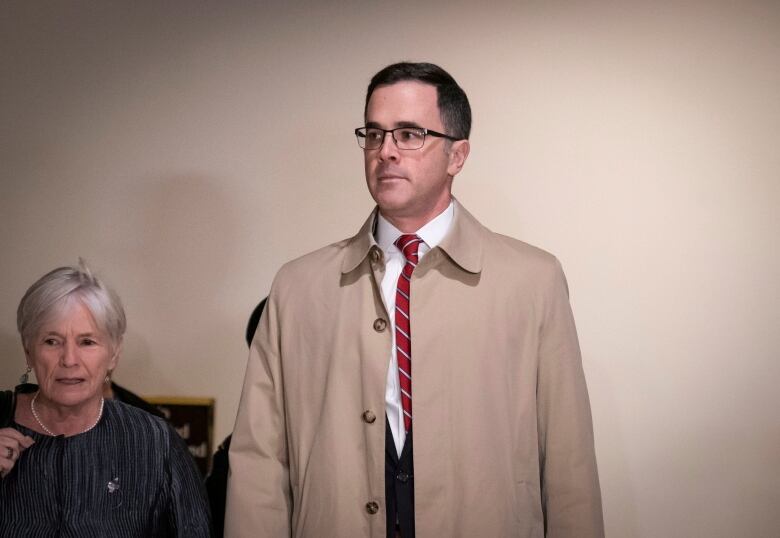
As rules regarding process are hammered out, testimony continues. Trump’s former top adviser for Russian and European affairs arrived on Capitol Hill in Washington on Thursday to testify to House impeachment investigators, a day after leaving his job at the White House.
Tim Morrison, the first White House political appointee to testify, didn’t respond to reporters’ questions as he entered.
Morrison, who served on the National Security Council, stepped down Wednesday, and a senior administration official said he “decided to pursue other opportunities.”
He has been in the spotlight since August, when a government whistleblower said multiple U.S. officials had said Trump was “using the power of his office to solicit interference from a foreign country in the 2020 U.S. election.”
Investigators want to hear about ‘sinking feeling’
Morrison will be asked to explain that “sinking feeling” he got when Trump demanded that Ukraine’s president investigate former vice-president Joe Biden and his son Hunter, who sat on the board of Ukraine energy company Burisma. That characterization of Morrison’s state of mind was given by U.S. diplomat Bill Taylor, who testified earlier this month.
Trump also pushed the ally to investigate a discredited theory that Ukraine interfered in the U.S. election through cyber activities that have been found by both congressional teams and special counsel Robert Mueller to have emanated from Russia.
Morrison was brought on board by then national security adviser John Bolton, who is also being asked to testify at a future date. It has been alleged through testimony that Trump’s personal lawyer, Rudy Giuliani, had been conversing with Ukrainian leaders outside of traditional U.S. diplomatic circles, with desired outcomes that would benefit Trump.
Here is a summary of the allegations against President Trump. We have a constitutional duty to investigate these potential abuses of power. This why I support the <a href=”https://twitter.com/hashtag/impeachmentinquiry?src=hash&ref_src=twsrc%5Etfw”>#impeachmentinquiry</a>. <a href=”https://t.co/NZ2TUtpBny”>pic.twitter.com/NZ2TUtpBny</a>
—@RepDarrenSoto
Morrison’s name appeared more than a dozen times in earlier testimony by Taylor, the acting U.S. ambassador in Ukraine, who told impeachment investigators that Trump was withholding military aid unless the new Ukrainian president, Volodymyr Zelensky, went public with a promise to investigate the Bidens.
Taylor said Morrison recounted a conversation that Gordon Sondland, America’s ambassador to the European Union, had with a top aide to Zelensky — Andriy Yermak. Taylor said Morrison told him security assistance would not materialize until Zelensky committed to investigate Burisma. A White House meeting for Zelensky was also held up.
“I was alarmed by what Mr. Morrison told me about the Sondland-Yermak conversation,” Taylor testified. “This was the first time I had heard that the security assistance — not just the White House meeting — was conditioned on the investigations.”

Taylor testified Morrison told him he had a “sinking feeling” after learning about a Sept. 7 conversation Sondland had with Trump.
Trump has tried to brand those testifying as unknowns, Democrats or so-called Never Trumpers. It will be harder to impugn Morrison, who has been bouncing around Washington in Republican positions for two decades, having worked for Congressmen Mark Kennedy and Jon Kyl, and as a senior staffer on the House’s armed services committee, including when it was led by Republicans.
It is likely to take weeks or more before the House votes on whether to actually impeach Trump. If the House impeaches Trump, the Senate would hold a trial to decide whether to remove him from office, presided over by the chief justice of the Supreme Court.
Another potential complication is the possibility of a government shutdown on Nov. 21 if further funding is not approved.
Republicans slam ‘sham process’
House Speaker Nancy Pelosi decided to have the impeachment resolution vote following weeks of Republican claims that the inquiry was invalid because the chamber had not voted to formally commence the work.
Republican leaders have called the rules “Speaker Pelosi’s sham process designed to discredit the Democratic process” in their daily impeachment email to lawmakers.
The rules lay out how the House’s intelligence committee — now leading the investigation by deposing diplomats and other officials behind closed doors — would transition to public hearings.
That panel would issue a report and release transcripts of the closed-door interviews it has been conducting with diplomats and other officials with connections to Trump’s interactions with Ukraine.

The judiciary committee would then decide whether to recommend that the House impeach Trump — which would mean he should be removed from office.
Republicans could only issue subpoenas for witnesses to appear if the entire panel approved them, in effect giving Democrats veto power over such requests by the GOP.
Lawyers for Trump could participate in the judiciary committee proceedings, but “specific requests” by Trump representatives could be denied by Democrats if the White House continues to refuse to provide documents or witnesses sought by Democratic investigators.
Both parties’ leaders were rounding up votes as Thursday’s roll call approached, with each side eager to come as close to unanimity as possible.