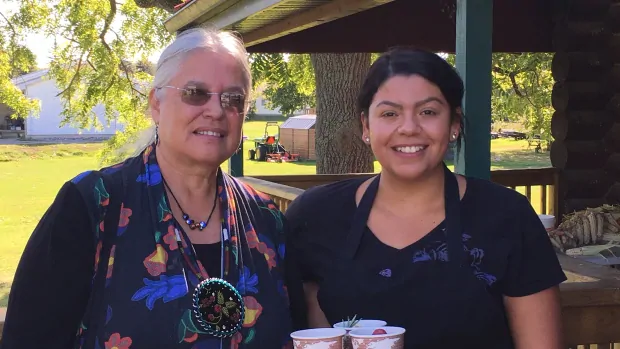
CBC Hamilton and CBC Kitchener-Waterloo headed to Six Nations of the Grand River last Friday and The Morning Edition’s host, Craig Norris, spoke with Chief Ava Hill about what the community of Six Nations is looking forward to in this upcoming election, her legacy as chief and more.
Read an excerpt of their conversation below (this conversation has been shortened and edited for clarity):
Craig Norris: Let’s get political for a second. We’re in the middle of an election campaign, a federal election campaign. What’s the most important issue in the campaign for your community?
Chief Ava Hill: The most important thing for me is to make this community healthy and safe. You know we want healthy people so health is the big issue. You know that as I said we’ve got diabetes. It’s been a problem in our community for years now. Cancer, I’m a champion for early screening. There is so much going on in the world with drug abuse. We’re trying to work with the younger people to get them on the right path.
We got to get these kids busy, we got to get them in school, we got to get them educated. We’ve got to get them in sports. Otherwise, they’re going to go on drugs. You know just plain and simple so let’s work together to make life better. I think the main thing is that we make life better for our people.
And another issue that’s important for our community is our land rights. You know, the government has been dragging it on for years. When we relocated here from the upper New York State we had six miles on either side of the Grand River mouth to source, 950,000 acres and we’re now on 45000 acres with the largest populated first nation in this country – there’s 27000 people and they can’t live here because we don’t have the land base.
CN: Is there any party you feel is speaking specifically to your concerns?
AH: You know I think they’re all trying to speak to our concerns I guess in their own way. Some speak more favourably than others. I’m not going to get right and say you know this is the party that you know that has done more for us because we never know.
Look who we have in Ontario, we got a Conservative government here now and we had a good relationship with the previous governments and we’ve had a good one with this one and we hope to have a good relationship with whoever the new government is and what we will do is listen to their platforms and listen to what they say and then hold their feet to the fire when whoever gets in.
CN: In 2015, I think it was 883 people voted here on Six Nations. Would you like to see more voter participation?
AH: I’m not encouraging people to vote one way or the other. I mean it’s up to them. You know, I haven’t even yet made up my own mind whether I will or not. I know that there are some ridings throughout the country where the First Nations vote or the indigenous vote can make a big difference. And I think people are doing that. Here traditionally, you know we still maintain the position that we have sovereignty and we’re a nation. You know we’ve heard the government talk about nation to nation relationship.
We are a nation, so why do [we] take part in another nations system? We wouldn’t want them taking part in our system and I think that’s part of it leading to the whole nation to nation relationship is having that respect for our nation and that’s I think where people come from is that we’re a sovereign nation why should we take part in their system.
CN: Some Haudenosaunee people say they’d made a conscious decision not to vote. Do you think that it would have more power and more sway with the government if the voter turnout was higher?
AH: It would depend on that on the ridings, you know how many people can swing a riding. It could be a hot contest in [Andrew] Scheer’s riding because he’s in Fort Qu’Appelle, there’s a lot of first nations in there and I know people are really watching that. Here, if everybody did vote we probably could because we’re so large because we’re in Brant county.
I think we make a bigger impact with doing our own advocacy, political work once they get in. That’s how I’ve always approached it and I’ve tried to establish relationships with the members of parliament whether you know cabinet ministers, opposition members everybody because particularly the federal government, has the fiduciary responsibility to provide services for our community and they have to live up to that.
CN: I want you to talk a bit about the Grand River Development Corporation. This is really interesting. At Our Sustenance there were a lot of people reading all about it. It’s very interesting tell us a bit about the genesis of this the birth of this and what exactly it is.
AH: Before I was the chief I was a councillor for nine years. I’ve been a chief for six years. I was the chair of the economic development committee. At that time we had an economic development department within our administration. We’ve done studies and listened to a lot of people about how business should be separated from politics so that it can be more successful and more attractive to potential partners. We engaged some of our people and went to the community and said What do you think? What do you want? How do you think?… because, as I said, although the government has the fiduciary responsibility to provide funding to us over the years, they chip away, chip away, chip away and cut back, cut back, cut back… so we’re not getting the resources that we need to sustain our community and provide services.
So,we started talking about how do we generate our own revenue. I’m still passionate about economic development and business. We set the rules to as to how it’s spent and sometimes our rules are more stringent than any other rules.
Just this past spring we were honoured is by Deloitte at a huge gala in Toronto as one of the best managed companies in the country.– Chief Ava Hill
We start saying we’ve got to start making our own money. The way to do that is to this development corporation which would be separate it from the business. Community agreed. We did a report. It was called ‘We Gather our Voices’ and it came back saying ‘yes we need to start making our own money and this is how we should do it.’ So, we went to a team that came up and we formed the development corporation. It’s made up of community members. It has three bodies.
I sit on the advisory council as an ex-officio. The elected council as a whole is the shareholder on behalf of the community. We have no other involvement. They make the money. We have a board of directors who work with the president CEO of the corporation, Matt Jamieson, and they go out and they seek those partnerships. They go out and they look for the money and then we have a board of trustees who decide how that money is going to be spent. It’s coming back into our community and then we have an advisory council which is like the overseer and also the link back to the community.
I think it’s working great. They’ve been in operation for three years. They have already given back over nine million dollars to our community. Just this past spring we were honoured is by Deloitte at a huge gala in Toronto as one of the best managed companies in the country.
CN: What do you see as your legacy as chief?
AH: I think just encouraging more young people. You know I’ve worked with many groups here. I’ve worked for the residential school survivors. I worked with our families who were involved in missing and murdered women. During my tenure we opened up a youth and elder centre but I really want to concentrate on the young, trying to show them that there’s a better life. They can dream and they can do what they want and I hope that I’ve been able to inspire some people to do that, particularly the young women and, you know, don’t be afraid. Just get out there and do that. If I can make my community a better place for everybody… always at the top of my mind is health and safety for everyone. Those young people are gonna be taking over. I just want to encourage them and hopefully I have.