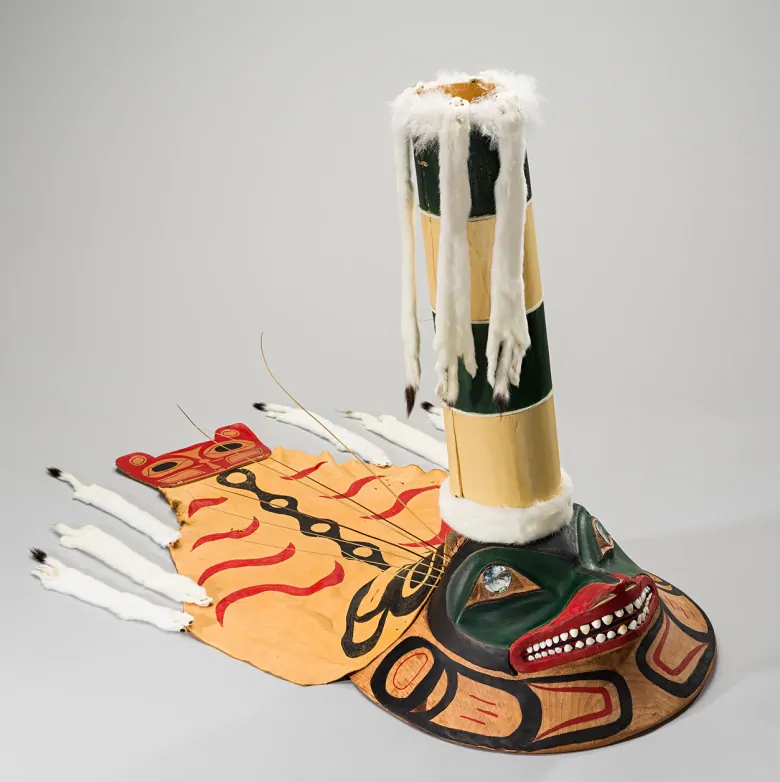
A ceremonial piece unveiled recently in Juneau, Alaska, demonstrates state-of-the-art replication technology.
A Tlingit clan crest hat, recreated by the Smithsonian Natural History Museum and members of the Tlingit Kiks.ádi clan of Sitka, Alaska, was welcomed back to the community as an almost-identical copy of the original in late September.
The Smithsonian says a team used a computer-controlled milling machine to replicate the sculpin red cedar hat, which has been in the Smithsonian’s collection for more than 135 years.
“It [the original] was collected in 1884 but it was broken,” said Eric Hollinger, tribal liaison with the Smithsonian.
“It’s worn; it has lots of parts that are missing from it now.”
Harold Jacobs, with the Central Council Tlingit and Haida Indian Tribes of Alaska, saw the hat at the Smithsonian in 2012 and broached the idea of creating a replica.
Over seven years, the Smithsonian worked with the Tlingit clan leaders to acquire the cedar and get guidance on how to attach the lost leather cape, ermine skins and down feather.
Hollinger says the carving knife marks can be seen in the digital files from the original and that came through in the milling work.
“Physically, the wood is shaped in exactly the same way as the original was because of the computer milling, but the attachments on it were interpreted by the clans because we can’t determine what was attached to it,” he said.
A Kiks.ádi ceremony put spirit into the new hat to culturally restore it.
Hollinger says the original hat will be going back to the museum because it’s too fragile to be used in traditional ceremonies.

Canoe restoration?
The Alaska State Museum in Juneau also had the Smithsonian’s team digitally scan cultural objects from clan leaders in southeast Alaska.
Andrew Washburn, registrar of the museum, says one artefact in particular is close to his heart.
“It is a canoe, built in Klukwan — perhaps almost as long as 100 years ago,” he said. “It’s a very traditional design.”
Washburn says the technology will give him a better idea of what the canoe looked like when it was first built and may allow his team to repair it in the future.
