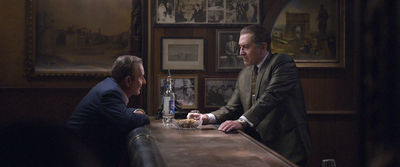
Robert DeNiro excels at playing closed-off, unreachable characters—hard men who might seem a bit dull if you met them for the first time, but have complicated inner lives that they rarely let anyone see, and who are mysteries to themselves. DeNiro was 75 when he played yet another of those characters in Martin Scorsese’s “The Irishman”, and the result feels like a summation of a rich subset of his long career. Adapted by screenwriter Steve Zaillian (“Schindler’s List”) from Charles Brandt’s biography “I Heard You Paint Houses,” and clocking in at three-and-a-half hours, the movie is an alternately sad, violent, and drily funny biography of Frank Sheeran, a World War II combat veteran who became a Mafia hitman and then a union leader, and who had a long, at times politically fraught friendship with Teamster leader Jimmy Hoffa (Al Pacino, acting opposite DeNiro for the first time since “Heat”).
You feel every one of DeNiro’s years in his haunting performance, as well as those of Pacino, Joe Pesci, and Harvey Keitel, who are “de-aged” for flashbacks via computer-generated imagery. You also feel them in the mostly younger supporting cast (including Bobby Cannavale, Kathrine Narrducci, Stephanie Kurtzurba, Gary Basaraba and Stephen Graham as other gang bosses, spouses, and union leaders) who age forward, courtesy of the same techniques. And you feel them in Scorsese’s direction, which is more measured and contemplative than his gangster movie norm (at times as meditative as his religious films), and which deftly shifts between eras, using dialogue and voice-over narration to make the time-jumps seamless.
The opening shot glides through a retirement home, locating Frank sitting alone in a wheelchair, face lined, eyes cloudy, hair white. He’s such a rock-like presence that, viewed from the back, he looks as if he could be dead. Then the camera circles around to reveal his face, and he starts to speak, and his statements become the film’s narration. We don’t know exactly who he’s telling this story to (although the concluding half-hour—a immersion into a now-old man’s life, fuller than we’re used to seeing in any American movie not directed by Clint Eastwood—gives us more of a framework. This is a film about the intersection of crime and politics, Mafia history and Washington history, touching on Castro’s rise in Cuba, the CIA’s attempts to overthrow him, John F. Kennedy’s assassiantion, and the mob wars of the 1960s and ‘70s. But it’s mostly about age, loss, sin, regret, and how you can feel like a passive object swept along by history even if you played a role in shaping it.
If Sheeran’s account of his life is to be trusted (and many crime historians warn that it isn’t), he was intimately involved in severa pivotal events of mid-20th century America. And yet we might still come away from “The Irishman“ seeing him as a passive figure, practically an ultraviolent Zelig or Forrest Gump. Frank seems mostly content to sit quietly in the background of Scorsese’s wiseguy murals, behind louder, more eccentric figures (especially Jimmy Hoffa, played with wit and gusto by Pacino, in full-on, hoarse-voiced, shouting-and-strutting mode). Measured and reactive for the most part, and good at talking his way out of tight spots by pretending not to understand the questions being asked of him, Frank comes into several defining tasks and jobs by being in the right place, or meeting the right people, at just the right time. As he describes his inexorable forward march through time and life, he characterizes things choices that he made of his own free will (including several truly ghastly murders) as if they were things that just happened to him.
This is not necessarily a seamless movie. Admirable as it is to see Scorsese committing to self-contained scenes that often unfurl like deadpan comedy sketches (Hoffa’s debate with Provenzano about assigning a precise numeric value to the word “late” is verbal banter worthy of Abbott and Costello) at three-and-a-half hours, some aspects feel undernourished. Recurring supporting players like Keitel (as Philadelphia crime boss Angelo Bruno), Cannavale (as Felix “Skinny Razor” DiTullio) and Ray Romano (as Teamster lawyer Bill Buffalino, whose daughter’s wedding provides a pretext for Frank to take a car trip that literalizes the idea of life as a journey) all register as visual and emotional presences, especially when you first meet them, but it’s not always easy to understand who they are as people, or what role they’re playing in this narrative besides sharing space with the leads. (Pesci, who hasn’t acted onscreen since DeNiro’s 2006 CIA history “The Good Shepherd,” makes a much stronger impression as Frank’s mentor Russell Bufalino, boss of the Northeastern Pennsylvania-based Bufalino crime family; he’s as quiet and controlled as his “GoodFellas” and “Casino” characters were obnoxious and volatile.)
The overwhelming maleness of the story also hurts it in the long run. As Russell’s wife Carrie, Narducci has some brilliant moments early on, mainly in car trip flashbacks, passive-aggressively hassling her husband to make Frank, the driver, pull over so that she can smoke; but she becomes a non presence after that. Kurtzuba (as Frank’s wife Mary) and Anna Paquin (as the grown-up version of his daughter Peggy, who saw a lot of things she shouldn’t have) are largely mute, at times nearly ghostly presences. There’s nothing innately unaccceptable about stories focusing mainly on men (or women, the current “Hustlers” being a strong counterexample). But at the same time, I don’t think it’s a coincidence that Scorsese’s two greatest Mafia pictures, “GoodFellas” and “Casino,” carve out substantial space for wives, girlfriends, mothers and daughters, and feature indelible lead performances by actresses (respectively, Lorraine Bracco in “GoodFellas” and Sharon Stone in “Casino”) that energize and transform the material, expoding the hero’s lives like the bombs that roast so many vintage cars in “The Irishman.”
That having been said, those who worried that Scorsese was dipping into the Sunday gravy one too many times will be reassured by the tonal originality of what’s been achieved here. More so than any other Scorsese crime picture—and this is saying a lot—“The Irishman” confirms him as one of the greatest living, though still largely unsung, comedy directors, and DeNiro as one of the great scene-stealing straight men in movies. His byplay with Pacino, Pesci, Keitel and all the rest is masterfully acted and edited (by Thelma Schoonmaker, who must be DeNiro to his Pacino, also seeing if they can get away with doing less), and the movie is low-key hilarious right up to the instant when blood gets splattered on walls, restaurant floors, and sidewalks. Much of it is a gangland “Who’s on first?” routine, or the “Joey Scala/Joey Clams” exchange between Keitel and DeNiro in “Mean Streets,” and Zaillian’s script is filled to bursting with quotable lines (I’m partial to Hoffa’s bit of non-wisdom, “Always charge a guy with a gun—with a knife, you run away.”) And every few minutes you get a marvelous bit of character-based comedy acting, such as Frank’s blank-faced look of concentration as he plots their wedding drive on a map with a red Sharpie marker, or a mad-eyed Hoffa glaring at a nemesis during a union awards banquet while slicing into a bloody steak.
But the net effect is more unsettling and melancholy-inducing than you might have anticipated. Frank’s storytelling aligns him with some of the most mesmerizing unrelable narrators in Scorsese’s voice-over-heavy directing career. It’s in the relationship between what the film shows us and what Frank tells us—as well as the relationship between the deadpan comedy that comprises probably 95% of the movie’s 209-minute running time and the intrigue and violence that fills out the rest—that Scorsese’s preoccupations seem to reside.
How much agency, how much moral choice, how much say, do we truly have in our lives? Is a sin still a sin if we don’t recognize the concept of sin, or lend credence the idea that certain deeds are innately right and others innately wrong? Does it even make sense to distinguish between murder and killing, between gangsterism and warfare that’s practiced by nations, or is that a construct designed by authority figures, intended to sanction acts approved by the state and condemn then when practiced outside its purview? What’s the difference between Frank executing two captured and unarmed prisoners in an Italian forest after forcing them to dig their own graves and Frank walking up to a designated enemy of his crime family on a street, often a man that he’s never met, and beating him within inch of his life or shooting him point-blank in the head? Is Frank a sociopath who is an great killer because he doesn’t feel emotions or have relationships in the way that most people do? (Because DeNiro italicizes so little of Frank, we often don’t know what Frank thinks of the things he does.) Is it possible that violence, even killing/murder, are just one more human activity, forbidden by the social compacts governing most societies, yet still compatible with genuine friendship, love, and loyalty? Are a killer’s tears at losing a friend or loved one counterfeit, a performance of grief? Is his smile on his wedding day a performance of love? And even if they are performances, what’s the substantive difference between performing feelings and experiencing them? Is it different from deciding to become a soldier or a mobster, and then being accepted as that thing, and feeling as if you are that thing?
Right up to the end, Scorsese and Zaillian don’t answer these or other questions. By the time we reach the movie’s detached and unfussy final image, we still aren’t sure quite what to make of Frank, or this sprawling tale. And I don’t believe we’re supposed to. The movie expects us to complete it on our own by thinking back on it later, and discussing it with others. Scorsese is probably the last big-budget filmmaker who mostly declines to tell the audience what to think, much less boldface and underline why he’s telling us a story about self-serving criminals and whether he personally condemns them. “The Irishman” doesn’t break with that tradition. Sitting with the movie might be primary reason for its existence. For all its borderline-vaudevillian verbal humor and occasional eruptionts ultraviolence (often done in a single take, and shot from far away) it feels like as much of a collection of thought prompts and images of contemplation as Scorsese’s somber religious epics “The Last Temptation of Christ,” “Kundun” and “Silence.” God only knows what it means, and God is as tight-lipped as Frank.