For the first time in its nearly 145-year history, the Supreme Court of Canada will hear two cases outside of Ottawa.
“It’s important for us to be accessible to all Canadians because the Supreme Court is your court. The decisions we make affect your life and that of your family and community,” Chief Justice Richard Wagner said in a video message posted online.
Indigenous representatives, who will meet with the justices later in the week, regard the visit as an opportunity to speak about how the legal system regards First Nations people and to introduce a culturally appropriate ritual to the court system.
The nine justices have a busy agenda, starting Monday morning with a question and answer session for journalists at the Manitoba law courts building, followed by meetings with students at nine different high schools.
The SCC will hear 2 appeals in <a href=”https://twitter.com/hashtag/Winnipeg?src=hash&ref_src=twsrc%5Etfw”>#Winnipeg</a>, <a href=”https://twitter.com/hashtag/Manitoba?src=hash&ref_src=twsrc%5Etfw”>#Manitoba</a> in September, Chief Justice Richard Wagner announced today. It’s part of the Court’s <a href=”https://twitter.com/hashtag/A2J?src=hash&ref_src=twsrc%5Etfw”>#A2J</a> <a href=”https://twitter.com/hashtag/accesstojustice?src=hash&ref_src=twsrc%5Etfw”>#accesstojustice</a> efforts & will be the 1st time the Court has ever sat outside Ottawa. <a href=”https://twitter.com/hashtag/SCCinWinnipeg?src=hash&ref_src=twsrc%5Etfw”>#SCCinWinnipeg</a> <a href=”https://t.co/FOVHdIpLvs”>pic.twitter.com/FOVHdIpLvs</a>
—@SCC_eng
The court will also hear two appeals this week.
One is a criminal case from Manitoba dealing with an accused person’s right to a trial in a reasonable time.
In the second, the court has to decide what school services British Columbia has to provide for its small French-speaking community.
“These are absolutely critical issues in our society that the Supreme Court deals with all the time, but the public, because they feel somewhat disassociated, aren’t fully aware of the role that they play,” said Mark Toews, past president of the Manitoba Bar Association.
One of the events will be a presentation of 40 sacred eagle feathers for use in Manitoba courtrooms, as well as meetings with Indigenous, Métis and French leaders.
People can swear or affirm affidavits using an eagle feather — rather than swearing on the Bible — or they can hold it while giving testimony. A joint sitting of the Court of Queen’s Bench and the Provincial Court of Manitoba will signal the acceptance of this Indigenous legal and cultural symbol in the justice system.
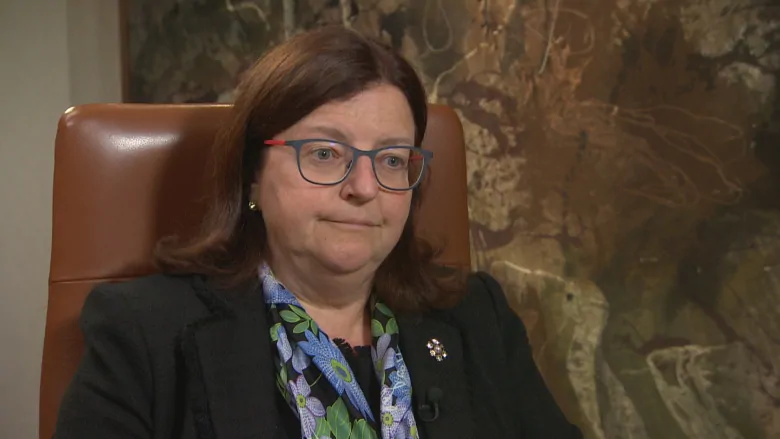
“That’s being done purposefully to recognize that our system needs to change and that our system needs to be more inclusive,” said Anita Southall, president of the Manitoba Law Society.
Southall also sees the value of Supreme Court justices interacting with those groups.
“It’s getting out and meeting with ordinary people and really hearing those views in a dynamic way. They do have to make decisions about societal change, policy issues, societal values and so to not engage and not be informed limits their ability to roll with that over time. Obviously in a measured way, obviously in accordance with the balancing of rights and the law,” she said.

There has been a lot of frustration and tension in Manitoba and Saskatchewan following lower court decisions after the deaths of Tina Fontaine and Colten Boushie.
In 2018, a jury acquitted Raymond Cormier, 56, of second-degree murder in the death of Fontaine, an Indigenous 15-year-old whose 72-pound body was pulled from the Red River in 2014, wrapped in a duvet cover that was weighed down by rocks.
Just weeks before that verdict, a rural Saskatchewan jury acquitted white farmer Gerald Stanley for the shooting death of Boushie, a 22-year-old Cree man.
Many Indigenous people feel they are treated differently by the courts and that there’s more than one level of justice in Canada, based on white privilege, said David Harper, a former grand chief of Manitoba’s northern First Nations.
“There’s three [levels of justice]. One is First Nations, one is not First Nations, and the other one is the government that holds all decisions, like who has the main decision-making power. So we need to balance that.”

Ceremonies and meetings this week may be a first step in achieving that, Toews said.
“There’s more that can be done to address the injustice that continues to exist for certain communities. At the same time, there can also be an increased appreciation for what the Supreme Court actually does do on behalf of these communities,” he said, ensuring the rule of law and that the Constitution is respected.
“It’ll enhance their understanding but it will also be beneficial for the Supreme Court to have these discussions and these conversations with them.”
There has never been an Indigenous Supreme Court justice.
“That’s only a matter of time. I think we can look forward to that happening in the not-too-distant future,” Toews said, adding he hopes this visit will spark the imagination of students who get a chance to meet the justices and experience the Supreme Court in person.
Only 10 women have been selected to serve Canada’s highest court, compared to 79 men.