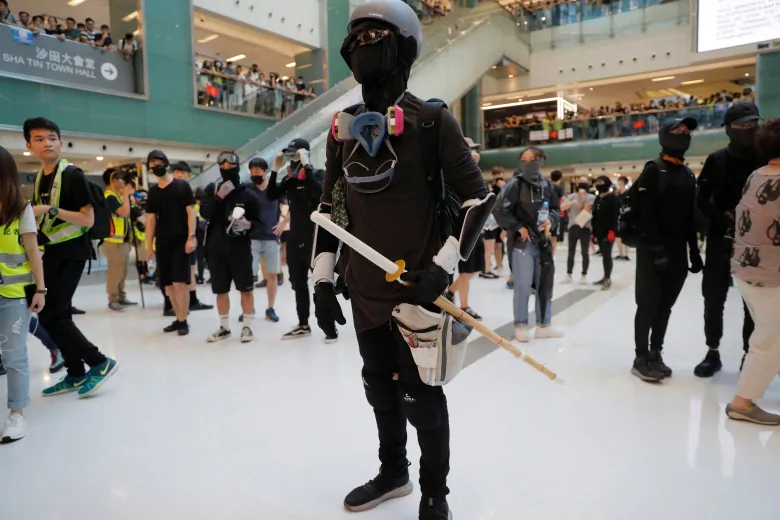
Protesters and police on Sunday clashed in Hong Kong for a second straight day, throwing the business and shopping belt into chaos and sparking fears of more ugly scenes leading up to China’s National Day next week.
Riot police repeatedly fired blue liquid, used to identify protesters, from a water cannon truck and multiple volleys of tear gas after demonstrators hurled Molotov cocktails at officers and targeted the government office complex.
It was a repeat of Saturday’s clashes and part of a familiar cycle since pro-democracy protests began in early June. The protests were sparked by a now-shelved extradition bill and have since snowballed into an anti-China movement.
“We know that in the face of the world’s largest totalitarian regime — to quote Captain America, ‘Whatever it takes,”‘ Justin Leung, a 21-year-old protester who covered his mouth with a black scarf, said of the methods deployed by radicals. “The consensus right now is that everyone’s methods are valid and we all do our part.”
Protesters are planning to march again on Tuesday despite a police ban, raising fears of more violent confrontations that could embarrass Chinese President Xi Jinping as his ruling Communist Party marks 70 years since taking power. Posters are calling for Oct. 1 to be marked as “A Day of Grief.”
Sunday’s gathering, a continuation of months-long protests for greater democracy in the semiautonomous Chinese territory, is part of global “anti-totalitarianism” rallies planned in over 60 cities worldwide to denounce “Chinese tyranny.”
In Sydney, more than a thousand people rallied in support of pro-democracy protests in Hong Kong, yelling “Fight for freedom” and “Stand with Hong Kong.”
Protests began in June
On Saturday, police fired tear gas and water cannons after protesters threw bricks and firebombs at government buildings following a massive rally in downtown Hong Kong. The clashes were part of a familiar cycle since protests began in June over a now-shelved extradition bill and have since snowballed into an anti-China movement.
Protesters are also planning to march on Tuesday despite a police ban, raising fears of more ugly scenes that could embarrass Chinese President Xi Jinping as his ruling Communist Party marks the 70th anniversary.
Many said they will wear black as a symbol of mourning in a direct challenge to the authority of the Communist Party, with posters calling for Oct. 1 to be marked as “A Day of Grief.”
Hong Kong’s government has already scaled down National Day celebrations in the city, cancelling an annual fireworks display and moving a reception indoors.
Despite security concerns, Hong Kong’s government said Sunday that Chief Executive Carrie Lam will lead a delegation of over 240 people to Beijing on Monday to participate in the festivities. She will be represented by Chief Secretary Matthew Cheung in her absence and return to the city on Tuesday evening.
Lam held her first community dialogue with the public on Thursday in a bid to defuse tensions but failed to persuade protesters, who vowed to press on until their demands are met, including direct elections for the city’s leader and police accountability.
China accuses world powers of stoking unrest
Earlier Sunday, hundreds of pro-Beijing supporters sang the Chinese national anthem and Happy Birthday in a counter show of solidarity for Chinese rule. Wearing red and carrying Chinese flags and posters, they chanted, “I am a citizen of China” at a waterfront cultural centre. They were later bused to the Victoria Peak hilltop for the same repertoire.
Organizer Innes Tang said the crowd, all Hong Kong citizens, responded to his invitation on social media to “promote positivity and patriotism” and urged protesters to replace violence with dialogue.
“We want to take this time for the people to express our love for our country China. We want to show the international community that there is another voice to Hong Kong” apart from the protests, he said.
Mobs of pro-Beijing supporters have appeared in malls and on the streets in recent weeks to counter pro-democracy protesters, leading to brawls between the rival camps.
Many people view the extradition bill, which would have sent criminal suspects to mainland China for trial, as a glaring example of the erosion of Hong Kong’s autonomy under the “one country, two systems” policy put in place when the former British colony returned to Chinese rule in 1997.
China has denied chipping away at Hong Kong’s freedoms and accused the U.S. and other foreign powers of fomenting the unrest to weaken its dominance.
In Beijing on Sunday, former Hong Kong leader Tung Chee-hwa was recognized for devoting himself to the implementation of the “one-country, two-systems” policy. Tung, the first leader after Hong Kong’s return to China, was among 42 people who received national medals and honours from Xi for their contributions to the country.