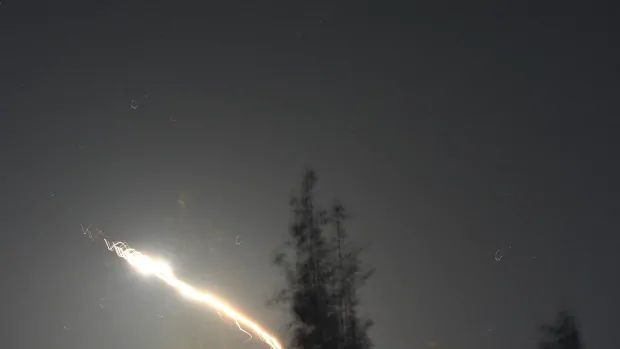
A fireball blazing across the sky was captured by doorbell and dash cameras in the Edmonton region late Saturday.
Many people took to social media, posting photos and videos of the mysterious bright object, speculating that it appeared to be a meteor. Wes Glassford wrote on Twitter that he was sitting up in Beaumont, hoping to photograph the northern lights when a meteor flew overhead, headed south. He quickly snapped a picture, and ended up with an image of a streak of light with squiggles on the end.
The bright streak was likely a bolide, or maybe even a super bolide, according to Mike Hankey, operations manager for the American Meteor Society.
Based on the images sent to the society so far, Hankey said it appears to be on the brighter end of the meteor spectrum that ranges from meteor, to fireball, to bolide and super bolide.
WATCH: A dash camera catches a fireball crossing the sky near the Cross Cancer Institute in Edmonton
[embedded content]
“A bigger object that is brighter than the full moon. It’s actually even brighter than that, almost as bright as the sun. So it explodes at the end of its flight, and oftentimes these events are associated with meteorites, which are rocks that survive from the fireball,” he said.
Hankey set up an event profile for reports that came out of northern Alberta late Saturday. By mid-morning Saturday, the society had received 69 reports, as well as two videos and pictures.
“This fireball would have been seen for 600 kilometres from either side of it, probably,” he said.
He said the more reports and visuals they are able to gather, the better it is for scientists who study meteor activity.
My Google Nest Cam also caught the meteor over Southeast Edmonton/Sherwood Park tonight. Taken at 10:23pm. <a href=”https://twitter.com/hashtag/yeg?src=hash&ref_src=twsrc%5Etfw”>#yeg</a> <a href=”https://twitter.com/hashtag/yegwx?src=hash&ref_src=twsrc%5Etfw”>#yegwx</a> <a href=”https://twitter.com/hashtag/yegmeteor?src=hash&ref_src=twsrc%5Etfw”>#yegmeteor</a> <a href=”https://twitter.com/hashtag/yegmeteorsighting?src=hash&ref_src=twsrc%5Etfw”>#yegmeteorsighting</a> <a href=”https://t.co/v7CTXq42pA”>pic.twitter.com/v7CTXq42pA</a>
—@yegventures
Though meteorites have been recovered in Alberta after past events, Hankey said it’s likely still too early to find fragments of last night’s bolide.
“In the first days or hours after the fireball, the reports and the data that we give is just an estimate,” he said.
He said he expects scientists are already combing through satellite images and other footage to get a better handle on the fireball’s path, in hopes of narrowing down the landing sites of meteorites. He said rocks are usually only recovered a few times per year.
The society has been dedicated to tracking meteors for over 100 years.