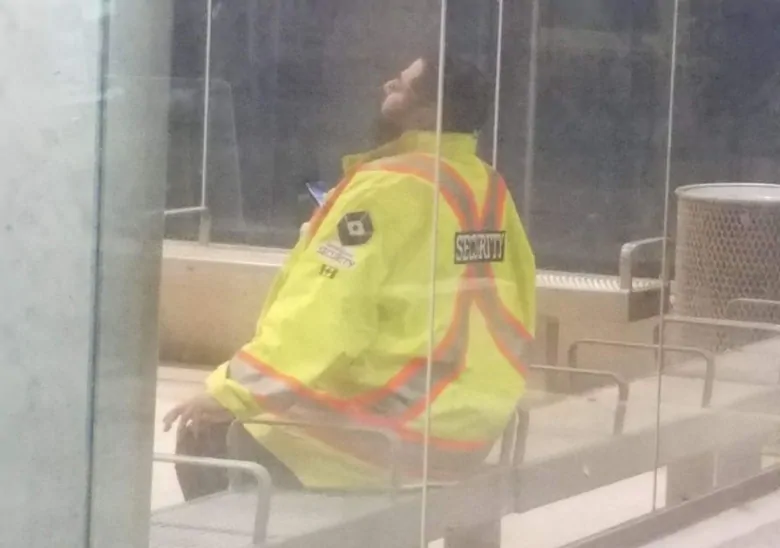
Edmonton’s transit union is flagging persistent problems with a private security company the city hired last November at a price tag of nearly $6 million a year.
Securiguard provides round-the-clock patrols at 25 transit stations in the city that have a track record of violent incidents.
The security presence is meant to deter crime and social disorder and make people feel more comfortable taking transit.
City council approved the “highly visible” security guards two months after a bus driver was stabbed more than a dozen times at the Mill Woods Transit Centre.
President of the Amalgamated Transit Union Local 569 Mark Tetterington said there have been problems reported with the security guards since they started.
The complaints come from a variety of sources including bus drivers, LRT conductors, peace officers and the public.

In one instance, a bus driver found a guard sleeping in a bathroom at Stadium station.
Another guard was seen panhandling at Bay/Enterprise station.
Edmonton Transit Service manager, Eddie Robar, admitted the city has had complaints about the guard’s conduct but told CBC News this week that he didn’t know how many or the exact nature of the complaints.
He said he’s aware that some Securiguard staff have been fired because of performance problems. He said the city works directly with the company to resolve those issues.
Peace officer, ETS Inspectors and the city’s corporate security office monitor the job, Robar said.
“Observe and report”
Wearing neon yellow vests with reflector strips and “Security” written in big letters on the back, the guards are highly visible.
Under the contract, the security guards can’t physically interfere in altercations or assaults.
It’s a job Robar describes as “observe and report.”
“They’re all trained to a level of what they’re allowed to interject with and what they aren’t, so they have a pretty strict procedure in which they’re either calling our control centre, they can call EPS directly in certain situations.”
Commuters at Churchill Square Tuesday were surprised at the job description.
Jessica Foy takes the LRT from Clareview to downtown every day.
“They stand around most of the time, they’re not doing a whole lot of anything, so I’m not sure what kind of security they’re providing,” Foy told CBC News.
Tiffany Redwood takes the LRT from Century Park to downtown on a regular basis.

Some of the complaints include situations where a security guard took 20 minutes before calling police or the control centre when a transit user was injured, Tetterington said.
Since November, the Securiguard patrollers have called the transit control centre just over 4,300 times, ETS Safety and Security reported. Calls related to loitering, mischief, smoking, medical emergencies and lost children.
‘Is it effective?’
The project is under review. Robar’s ETS team and the police are slated to report back to council in October to say whether the security has reduced crime.
“We’ll kind of pull out the empirical evidence of what’s been working well and what’s not,” Robar said. “Is it effective? And is it having the impact? “Has this been worth the investment for the public?”
Robar said the review will include looking at where the guards are placed — and consider relocating guards from centres with a low number of safety-related incidents.

From Nov.1, 2018 to July 30, 2019, the city recorded 311 mischief-related incidents.
In October 2018, police reported 2,072 transit-related incidents, 230 of which were under criminal investigation.
Police said they are working on compiling crime statistics for this year, to be included in the report presented to council in the fall.
City Coun. Mike Nickel takes the issue to heart, especially after a bus driver was stabbed more than a dozen times at the Mill Woods Transit Centre in his southeast Ward 11 last September.
“People in the administration aren’t watching or monitoring the productivity or the staff that’s on the ground,” Nickel said in a phone interview. “This is this is just a simple reminder wake up call — step up do your job.”
Nickel says the city needs to do better at monitoring and managing its contracts.
The ATU supports more security but believes the key is hiring more peace officers to take over.
“I don’t really care who does the job — it can be unionized, it can be non-unionized, it can be city worker, it could be non-city worker,” he said. “We pay people we need value out of these contracts.”