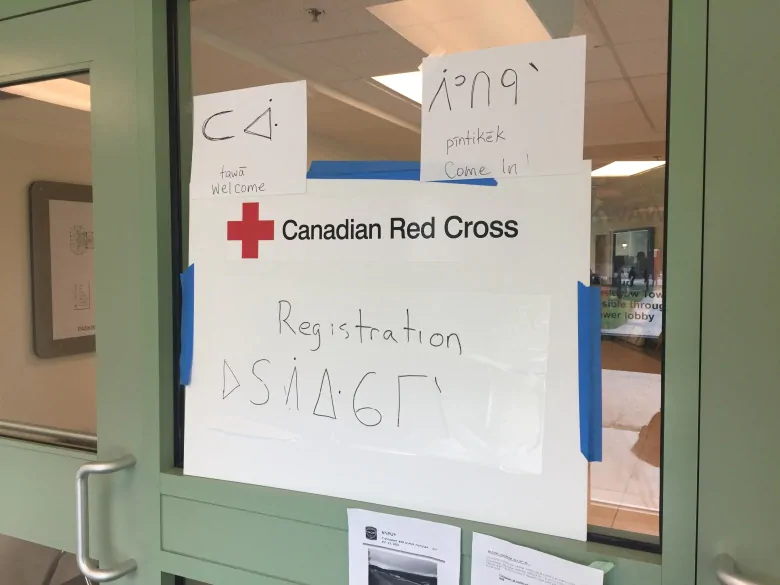
Mario Peters, 35, was sitting at home at Pikangikum First Nation in northern Ontario last week when someone came to the door telling him they were evacuating the community due to the threat of wildfires and he would have to grab some belongings and be ready to leave the same day.
His elderly mother was away visiting family in Thunder Bay, Ont., where many evacuees were sent.
Peters, however, was one of hundreds flown to Regina.
“We had no choice but to leave, the fire was just across the lake, that’s how close it was,” he said.
“[I’m] worried about our house because we didn’t know how the fire is doing over there.”
Pikangikum First Nation is a remote fly-in Ojibway community, located about 500 km northwest of Thunder Bay, and 750 km east of Regina, with a population of nearly 2400 members living on reserve. Last week wildfires began to approach portions of their 1808 hectare reserve that sits on Pikangikum Lake.
About 420 members of Pikangikum First Nation came to Regina. Many had never been out of Ontario.
For many of the evacuees, English is their second language, so several community members were asked to be liaisons between aid officials and the majority of those being housed in dorms at the University of Regina.
Peters said he is appreciative of the aid for evacuees but said he is ready to go home. He said that although they are provided with food and activities he would rather be in his own home.
The language barrier and the fact they are unfamiliar with the large city left him bored.
“You just visit one another,” he said.
Helping agencies
The Government of Saskatchewan has provided funding for their accommodations at the University of Regina campus while other agencies like the Red Cross, the province’s Ministry of Social Services and the Saskatchewan Health Authority have staff helping with any sort of supports Pikangikum members may need.
They have also been offered free access to all city swimming pools and access to transportation to shopping centres from the Salvation Army.
Some U of R student residents were also on hand to help out, like Michael Shorting, a second year social work student from Regina who is Ojibway.
“A lot of them have never been near a city before. So there is a lot of commenting that they have never been closely living together,” said Shorting.
“[It’s] just a huge culture shock for them as well to go from a remote community to an urban city.”
Regina Treaty/Status Indian Services (RTSIS) put out a call on social media to hunters in Saskatchewan for traditional meat.
Erica Beaudin, executive director of RTSIS, said that as a Treaty 4 member, it is only customary to welcome other Indigenous people to the land and they were instructed by the elders to give the best help they could.

Beaudin said they found with previous evacuations from remote communities that many people needed simple, more traditional diets.
“Many people who come from the north or isolated communities only eat food that they catch,” she said.
“Grocery stores come second. We wanted to provide that to them, plus we did this because we discovered in 2015 there was intense gastrointestinal issues that were coming up with older people and children.”
Some of the other Indigenous organizations that have been giving their time or supplies are the Yorkton Tribal Council, Prince Albert Grand Council, File Hills Qu’ Appelle Tribal Council and the Regina Friendship Centre.
Mini powwow
Not only has the University of Regina opened their campus to the evacuees, but the nearby First Nations University of Canada hosted a small powwow demonstration on Wednesday evening for the evacuees.
Pikangikum doesn’t host powwow celebrations because of its location.
“This powwow and these demonstrations are the first time many of the evacuees have actually seen a powwow or have seen this as a live event,” said Beaudin.

The event was funded by the Saskatchewan Health Authority, which made a formal commitment in 2009 to Truth and Reconciliation Calls to Action to provide culturally responsive care and services.
“It is really important to us to make sure that we are keeping those commitments and providing those services,” said Tania Lafontaine, director of First Nations and Métis Relations for the Saskatchewan Health Authority.
Peters said although he was wasn’t thrilled about leaving home and he is glad to be going home soon and plans to take a long nap in his own bed, he won’t forget the assistance he received while in Regina.
“[I ] just want to say thanks for the hospitality,” he said, adding he was appreciative of everyone’s hard work to keep them safe.