Earlier this month, a group of climbers found an undetonated explosive in Jasper National Park — but it was the work of the Department of National Defence that led to the safe destruction of the explosive.
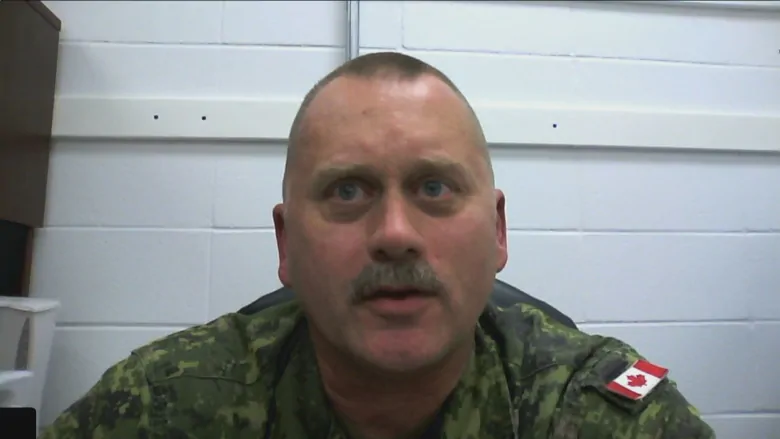
Ammunition technical officer Gordon Olson, from Garrison Wainwright, was among those who worked to safely deactivate and move the unexploded ordnance.
Olson shared his story with CBC News at 6 and The Homestretch on Thursday.
The following interviews have been combined and edited for brevity and clarity.
Q: Where was this bomb exactly?
A: The projectile was actually up on one of the glaciers by the Columbia Icefield on Mount Athabasca.
Q: When you say projectile, exactly what was it?
A: It was basically a bullet that was fired by the big gun.
Q: I understand this was a pretty remote area, so what did you have to do to get to it?
A: For the team to get to the location they had to helicopter into the base of the ice sheets and then with the assistance of the guides from Parks Canada they scaled the ice sheet to find the projectile.
Q: How difficult was that?
A: An ice sheet sounds really tough to climb, and the incline was rather difficult for people who are not used to climbing. However, for the Parks Canada guides it was not overly strenuous.
Q: And then what happened?
A: We determined the course of action on how to conduct a disposal of it. We placed the explosive charge beside it and then exited down the ice sheets and then the projectile was detonated.
Q: Oh, so they just blew it up?
A: Yes.
Q: And what happened when it was detonated?
A: It wasn’t an overly big bang. The actual amount of explosive used was quite minimal. And it created definitely a bit of a sound wave and a little bit of a smoke cloud.
Q: So what is a projectile from a big gun, as you mentioned. What does a bomb even look like from that era?
A: It had the appearance to be an old, 25-pound, armour-piercing projectile. It looks like a large chunk, a large round cylinder of steel mill. It’s got a pointed end and it was lodged into the actual side of the ice sheets.
Q: And what is that, the 25-pound, armour-piercing projectile?
A: It was created around the World War II era. Armour-piercing projectiles were designed for destroying tanks.
Q: Any idea how this device would’ve gotten up there?
A: It was possibly due to the fact that that area was used as a training area back in 1943-44, and it was probably fired at that glacier at one time.
Q: How common would it have been back then?
A: In the time frame that we’re talking about, fairly common. The location was very uncommon, we’ll say.

Q: And how common is it for you to respond to calls like this.
A: This is definitely a one-off situation for us.
Q: So you’ve never seen anything like this before?
A: I’ve never seen anything like this before but you do get other calls. We commonly get called in when people find items that they have cached away in their garages or houses or various other locations.
Q: What kind of advice would you give to someone who comes across something like this.
A: First of all, don’t pick it up or don’t touch it. You have no idea as to what the status is of the device. Take note of the location where you’re actually finding it, and at the end of everything, make sure you phone the RCMP or your local law enforcement, who will then be able to engage us properly.
Q: How do you train for something like this?
A: You have to become an ammunition technician with the Canadian Armed Forces.
Q: And how long does that take?
A: It’s a rather long training process, but we don’t randomly give people explosives to go to things like this.
Q: When you think about former bases — we had one here in Calgary, of course — what are the odds that there are other unexploded ordnance out there?
A: We’ve used a number of locations across Canada over the years to train on and to use as gunnery ranges. And the odds and the chances of something like this existing does exist out there.
Q: How do you detect these things and how do you know if they’re live not live. How do you approach those kind of things?
A: Most of the time when these things are detected, it’s with the good ol’ eyeball. Because these items will come to earth eventually with the freeze and thaw cycles that we have. As far as knowing whether it’s safe to move or touch or anything like that, those are things that we cover as part of our training.