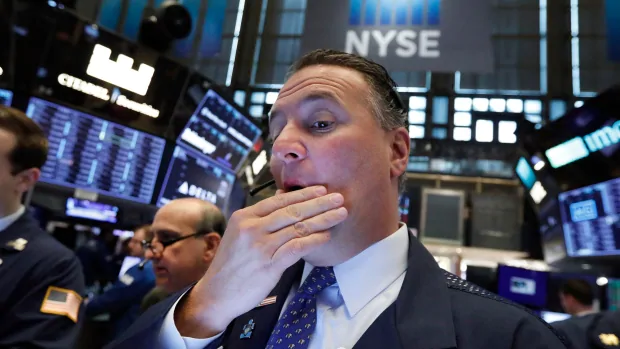
Wall Street’s main indexes fell more than two per cent on Monday after Beijing announced plans to retaliate with higher tariffs on U.S. goods, raising fears that another round of tit-for-tat measures could push the U.S. economy toward recession.
At the center of the selloff were shares of technology companies including chipmakers, manufacturing giants and retailers that are exposed to China.
The “FAANG” group of stocks — Facebook Inc, Amazon.com Inc, Apple Inc, Netflix Inc and Google parent Alphabet Inc — fell between 1.7 per cent and 5 per cent because of their exposure to the Chinese market.
China’s finance ministry said on Monday it planned to impose tariffs ranging from five to twenty-five per cent on 5,140 U.S. products on a target list worth about $60 billion starting June 1, striking back after U.S. raised duties last week.
“This just got messier and more expensive to the global economy and until we get break here, markets are going to be under pressure,” said Art Hogan, chief market strategist at National Securities in New York.
“Every increase in tariffs is a drag to the global economy and if it drags the economy down, it will drag earnings down, so stocks are going to react to that.”
S&P and Dow fall
The S&P 500 on Friday racked up its worst weekly decline since December, as Washington raised tariffs on Chinese goods worth $200 billion to 25 per cent from 10 per cent.
On Monday morning, it was down another 2.1 per cent or 65 points to 2,820. The Dow plunged 565 points or 2.2 per cent to 25,371 and the Nasdaq fell even further, by 236 points or 2.9 per cent.
U.S. equities hit record highs just two weeks ago on hopes of a trade deal and a positive first-quarter earnings season.
Toronto’s TSX index fell in tandem, down 165 points to 16,285. The fall in the TSX was checked by the uptick in oil prices.
Oil prices rise because of tanker attack
Two Saudi oil tankers and two other oil product vessels were attacked off the coast of the United Arab Emirates in what Saudi Arabia described it as an attempt to undermine the security of crude supplies amid tensions between the United States and Iran
The benchmark North American contract rose $1.32 US to $62.97 US a barrel as a result.
The trade tensions also affected the yield curve between three-month U.S. Treasury bills and 10-year notes, resulting in an inversion for the second time in less than a week on Monday.
An inversion in the yield curve is seen as a classic signal that a recession is coming. It also makes banks’ lending less profitable.
As the trade dispute extends, investors expect tariffs to increase corporate costs, lower profit margins and hinder the ability of companies to plan or make capital expenditures.
Tariff-sensitive Boeing Co declined and Caterpillar Inc had steep declines
Shares of Uber Technologies Inc fell 7.4 per cent, extending losses from Friday’s 7.6 per cent fall in its first day of trading as a public company.